Shoe names can sound like a private language: closed tab, open tab, wholecut, vamp. This glossary translates them into plain descriptions you can use in a shop or a listing.
This guide covers the main types of shoes, grouped by how they fasten and how formal they are, with notes on where the names come from when a museum, dictionary or trade body records it. Most styles are worn by everyone, so rather than splitting into types of shoes for women and types of shoes for men, we note where a style is traditionally associated with one or the other. Boots and heels have their own glossaries, linked below. If you are mainly dressing for the office, our Business Casual Shoes for Men and Women guide applies these terms to workplace dress codes.
Shoe styles at a glance
| Style | Key feature | Typically worn with |
|---|---|---|
| Oxford | Lace-up with closed lacing (tabs under the vamp) | Suits, formal wear |
| Derby (Blucher) | Lace-up with open lacing (tabs on top of the vamp) | Suits, chinos, smart casual |
| Brogue | Decorative punched holes along the seams | Tweed, chinos, smart casual |
| Monk strap | Buckled strap instead of laces | Suits, smart casual |
| Wholecut | Upper cut from one piece of leather | Formal suits |
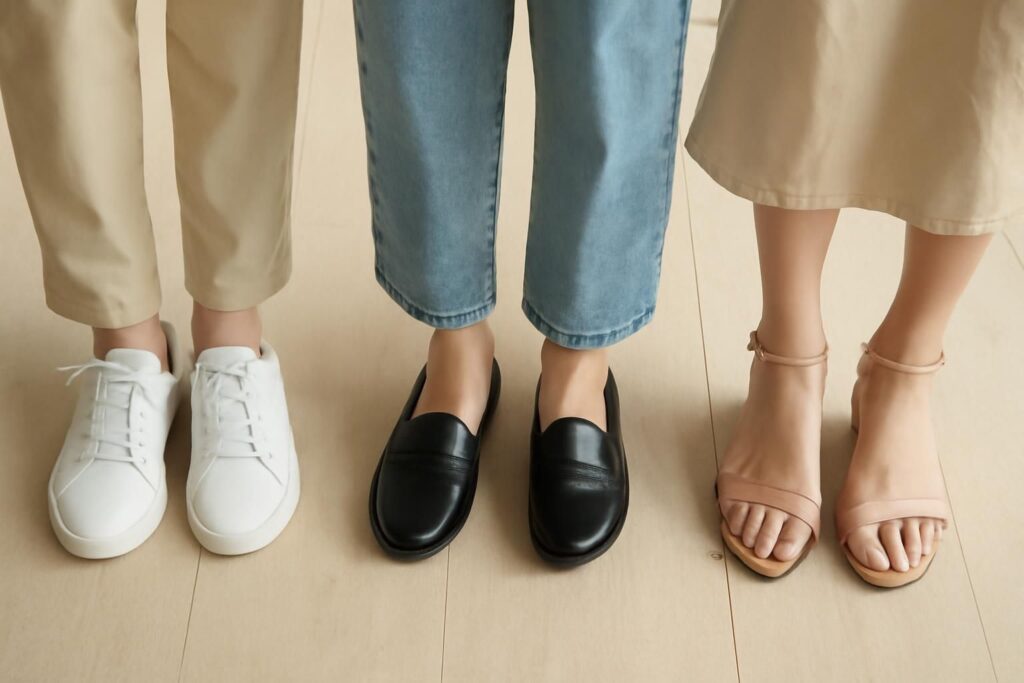
| Loafer | Slip-on with a moccasin-style vamp | Chinos, jeans, skirts, dresses |
| Sneaker | Rubber-soled casual shoe | Jeans, athleisure, dresses |
| Plimsoll | Simple canvas shoe on a thin rubber sole | Summer casual |
| Espadrille | Rope (jute or hemp) sole | Linen, summer dresses |
| Ballet flat | Low-cut, flexible flat | Cropped trousers, skirts |
| Mary Jane | Rounded toe, strap across the instep | Skirts, dresses, tights |
| Pump | Closed, low-cut slip-on, usually heeled | Workwear, formal wear |
| Mule | Backless shoe | Wide-leg trousers, dresses |
| Boat shoe | Leather moccasin with siped rubber sole and side laces | Shorts, chinos |
| Sandal | Open shoe held on by straps | Warm-weather outfits |
| Clog | Thick wooden or wood-look sole | Casual layers, workwear |
Lace-ups and formal shoes
Oxford
The Oxford is the most formal lace-up. The V&A explains that in the shoe trade it is a “closed tab shoe”: the eyelet tabs are stitched under the vamp, so the lacing sits neat and flush. The V&A also says the Oxford was “the predominant style in men’s footwear” in the 1920s and 1930s, usually made in plain black or brown leather for everyday wear. The origin of the name is not settled; stories about Oxford University students are widely repeated but unconfirmed. How to spot it: look where the laces sit. If the two lacing panels meet in a closed V with no flaps, it is an Oxford. How to wear it: a plain black Oxford is the dressiest everyday shoe. Debrett’s lists black “highly polished or patent lace-up shoes” for black tie and white tie. For the full comparison, read Oxford vs Derby Shoes.
Derby and Blucher
The V&A groups Derby, Blucher and Gibson styles as “open-tab” shoes: the eyelet tabs sit on top of the vamp, so the lacing panels can open wider. The Blucher name is traditionally linked to the Prussian field marshal Gebhard von Blücher, though this is a story rather than a documented fact. How to spot it: two flaps with eyelets stitched on top of the shoe’s front piece. How to wear it: derbies are slightly less formal than Oxfords, which makes them versatile with suits, chinos and smart casual outfits. Shop Mens Leather Derby Shoes on Amazon for a range of finishes.
Brogue
A brogue is defined by its decoration rather than its lacing, so you can have Oxford brogues and derby brogues. The Online Etymology Dictionary traces the word to a “rough, stout shoe” worn in rural Ireland and the Scottish Highlands in the 1580s, from Old Irish broce. SATRA says the punched holes were originally perforated right through the upper to let water drain out on boggy ground, and that brogues became fashionable in the 1920s. The V&A describes the pattern as circles and dots along the shoe’s seams and as a field pattern on the toecap. How to spot it: perforations along the seams, often with a decorative toecap; a “wingtip” has a W-shaped toecap. How to wear it: brogues are traditionally day and country shoes. SATRA notes that some commentators still consider them wrong for black-tie or white-tie events.
Monk strap
No museum or trade body definition was found for the monk strap, so here is the common description: a shoe that fastens with one or two buckled straps instead of laces. A “double monk” has two straps. How to spot it: a buckle on the outside of the foot and no laces. How to wear it: monk straps sit between derbies and loafers in formality and work with suits and smart casual. Our Monk Strap Shoes guide covers single and double styles.
Wholecut
A wholecut is commonly described as a shoe whose upper is cut from a single piece of leather, with only one seam at the back. How to spot it: no visible seams across the top of the foot. How to wear it: its clean look makes it one of the most formal shoes. See Men’s Dress Shoes for more formal options.
Putting the V&A’s closed/open distinction together with Debrett’s guidance, a common formality order from most to least formal is: plain black Oxford, then derby, then brogue, then loafer. This is common styling advice rather than a rule.
Slip-ons and flats
Loafer
The Online Etymology Dictionary dates “loafer” as a type of informal shoe to 1937. G.H. Bass says it introduced the Weejun in 1936, based on slip-ons worn by Norwegian farmers and fishermen, and calls it the original penny loafer; this is the company’s own claim. The story that students kept pennies in the strap slot is widely repeated but unconfirmed. The Met holds Gucci loafers dated around 1972. How to spot it: no laces, a low heel and a moccasin-style stitched vamp, sometimes with a strap (penny), tassels or a metal bar. How to wear it: loafers cross over easily between jeans, chinos, skirts and dresses. Our Loafers Outfit Ideas guide has outfit ideas, and you can browse Womens Leather Loafers on Amazon by colour.
Top-selling match on Amazon

- 𝗦𝗜𝗭𝗜𝗡𝗚: 𝗙𝗢𝗥 𝗧𝗛𝗘 𝗜𝗗𝗘𝗔𝗟 𝗙𝗜𝗧, 𝗪𝗘 𝗥𝗘𝗖𝗢𝗠𝗠𝗘𝗡𝗗 𝗢𝗥𝗗𝗘𝗥𝗜𝗡𝗚 𝗛𝗔𝗟𝗙 𝗔 𝗦𝗜𝗭𝗘 𝗗𝗢𝗪𝗡 𝗙𝗥𝗢𝗠 𝗬𝗢𝗨𝗥 𝗨𝗦𝗨𝗔𝗟 𝗦𝗜𝗭𝗘. The…
- 𝗚𝗲𝗻𝘂𝗶𝗻𝗲 𝗟𝗲𝗮𝘁𝗵𝗲𝗿 𝗨𝗽𝗽𝗲𝗿 & 𝗜𝗻𝘀𝗼𝗹𝗲: Premium womens shoes with a genuine leather upper and genuine…
Ballet flat
The ballet flat is commonly used to describe a low-cut, flexible shoe with a very thin heel, inspired by ballet slippers. How to spot it: a rounded or pointed toe, a soft sole and often a small bow. How to wear it: it pairs with cropped trousers, skirts and dresses.
Mary Jane
The Mary Jane is commonly used to describe a closed shoe with a rounded toe and a strap across the instep. The origin of the name is unclear, so we don’t repeat any of the popular stories. How to spot it: the instep strap, fastened with a buckle or button. It comes flat or heeled. How to wear it: Mary Janes look good with skirts, dresses and tights.
Mule
A mule is a backless shoe. According to the Online Etymology Dictionary, “mule” meant a loose slipper by the 1560s, from French mule. How to spot it: nothing behind the heel. How to wear it: flat mules work with jeans; heeled mules work with wide-leg trousers and dresses.
Pump
The pump is commonly used to describe a closed, low-cut shoe with no fastening, usually heeled; British shops often call it a court shoe. For heel shapes and heights, see our Types of Heels guide.
Boat shoe
The boat shoe is commonly described as a leather moccasin-style shoe with laces threaded around the sides and a rubber sole cut with fine grooves for grip. How to wear it: it is a warm-weather shoe for shorts and chinos.
Casual and summer shoes
Sneaker
The Online Etymology Dictionary dates “sneaker,” meaning a rubber-soled shoe, to 1894 in American English, so named because the shoe was quiet. SATRA says the word is often attributed to advertising agent Henry Nelson McKinney in 1917, though it hedges that story. The V&A records that Converse was founded in 1908, launched All Star basketball shoes in 1918 and improved them in 1923 at Chuck Taylor’s request. SATRA says teenagers in the 1950s began wearing trainers as fashion, especially after seeing James Dean in Rebel Without a Cause. How to spot it: a rubber sole and a fabric, leather or knit upper. How to wear it: sneakers go with jeans and athleisure, and plain leather pairs can dress up. See Dress Sneakers for Men and Sneakers With Dresses.
Plimsoll
SATRA calls the 1870s plimsoll a forerunner of the trainer, named “according to some sources” after the coloured band joining the upper to the sole. How to spot it: a plain canvas upper on a thin rubber sole. How to wear it: it is a simple summer shoe.
Espadrille
The Online Etymology Dictionary describes the espadrille as a shoe with a hemp-rope sole, originally worn in the Pyrenees, and dates the word to 1892, from Provençal and ultimately Latin spartum (esparto grass). How to spot it: a braided rope sole, flat or on a wedge, and a canvas upper. How to wear it: espadrilles suit linen and summer dresses. Search Womens Espadrille Flats on Amazon for options.
Top-selling match on Amazon

- Daisy Cut-Outs Design: Daisy cut-outs form the upper of the flats shoes. The cut-outs also ensure the shoes…
Sandal and clog
Sandals are commonly used to describe any open shoe held on by straps, from flat slides to strappy heels. Clogs are commonly described as shoes with a thick wooden or wood-look sole. Both are mainly casual.
Boots
Boots cover the ankle or higher and have their own vocabulary, from Chelsea and chukka to Wellington and western. See our Types of Boots glossary.
Shoe materials worth knowing
SATRA describes suede as leather finished by abrasion on the flesh side to create a velvet-like look. Under the FTC Leather Guides, a product should not be called simply “leather” unless it is leather in all substantial parts; bonded leather and imitation materials should be disclosed. Many shoes are also made from PU (polyurethane) leather or other leather-look materials, canvas and knit. SATRA says Seth Boyden brought patent leather to the US in 1818, with early makers applying as many as 15 coats of varnish.
Construction matters too. The Digital Public Library of America explains that a Goodyear welt gives an attaching point between upper and sole, which allows shoes to be resoled when worn down. Cemented (glued) soles are cheaper and lighter but usually harder to resole.
How to thrift these shoes
Well-made leather shoes often outlast their first owner, which makes secondhand shopping worth it. A few common checks help:
- Turn the shoe over and check the sole for holes and uneven wear.
- Look at the welt edge. A stitched welt may mean the shoe can be resoled by a cobbler.
- Flex the toe. Deep cracks across the creases are hard to repair.
- Check the heel counter (the back) to see if it has collapsed.
- Try them on later in the day. The AAOS notes feet can swell up to 8% during the day, and the AOFAS says not to rely on marked size, because it differs by brand.
- Clean and condition before wearing. Our How to Clean Leather Shoes and Keep Them Conditioned guide walks through it.
Types of shoes FAQ
What are the main types of shoes?
The core styles are Oxfords, derbies, brogues, loafers, sneakers, pumps, flats, mules, sandals and boots. Most other shoe names are variations on these.
What is the difference between an Oxford and a derby?
The V&A explains it by the lacing: an Oxford’s eyelet tabs are stitched under the vamp (closed), while a derby’s sit on top (open). Oxfords are usually considered more formal.
Is a brogue a type of Oxford?
A brogue describes decoration, not lacing, so a shoe can be both an Oxford and a brogue.
What types of shoes are business casual?
Emily Post says “leather shoes are probably the safest bet for business casual,” while clean, simple sneakers can work in more casual offices. Check your workplace’s own policy.
What shoe names are used for both men and women?
Almost all of them. Oxfords, derbies, loafers, sneakers, mules and boots are sold for everyone. Pumps and Mary Janes are more often sold as women’s styles.
How do you make leather shoes last longer?
Leather shoes last longest when you rotate pairs so each one rests a day between wears, letting moisture from your feet dry out. Cedar shoe trees help them keep their shape and absorb dampness, and regular cleaning and conditioning stops the leather cracking at the creases. Replace worn heel tips early, and on Goodyear-welted shoes, have a cobbler resole them before wear reaches the welt. Dry wet shoes at room temperature, never on a radiator.
Shop the look on Amazon
Everything you need to build a secondhand-style wardrobe, delivered. We may earn a commission on purchases.
Browse picks on Amazon →What Shoes to Wear With…
Dresses, maxi and midi dresses, linen pants, straight-leg and skinny jeans.
Shoe Pairing
- What Shoes to Wear With a Dress
- What Shoes to Wear With a Maxi Dress
- What Shoes to Wear With a Midi Dress
- What Shoes to Wear With Linen Pants
- What Shoes to Wear With Straight Leg Jeans
- What Shoes to Wear With Skinny Jeans
- Converse Outfit Ideas
Shoe Comparisons
Mules vs clogs, loafers vs moccasins, Chelsea vs chukka.
Comparisons
How to Style Your Shoes
Knee-high boots, ballet flats and platform sneakers.
Styling Guides
More Footwear Glossaries
Sandals, sneakers and socks.
Glossaries
More Shoe Comparisons
Flip-flops vs sandals, heels vs pumps, sneakers vs running shoes.