From across a room an Oxford and a derby look almost identical, but one small detail in how the laces are attached changes how formal the shoe is, how it fits and when you should wear it.
The Oxford vs derby question comes down to lacing. Both are lace-up dress shoes, both come in black, brown and every leather finish, and both can be plain or decorated with broguing. The difference is whether the flaps that hold the eyelets are stitched under the front of the shoe or on top of it. This guide explains that difference in plain terms, shows how to spot it in seconds, and covers formality, fit, colours, outfits and what to look for when buying secondhand. For the full range of styles, including monk straps, loafers and Chelsea boots, see our hub guide to Men’s Dress Shoes.
Closed vs open lacing: the one real difference
The Victoria and Albert Museum (V&A) puts it simply in its collection records. It describes the Oxford as a “closed tab shoe” in the trade: the eyelet tabs are stitched under the vamp, the piece of leather that covers the front of the foot. Derby, Blucher and Gibson styles are “open-tab” shoes: the eyelet tabs sit on top of the vamp.
In practice, that means:
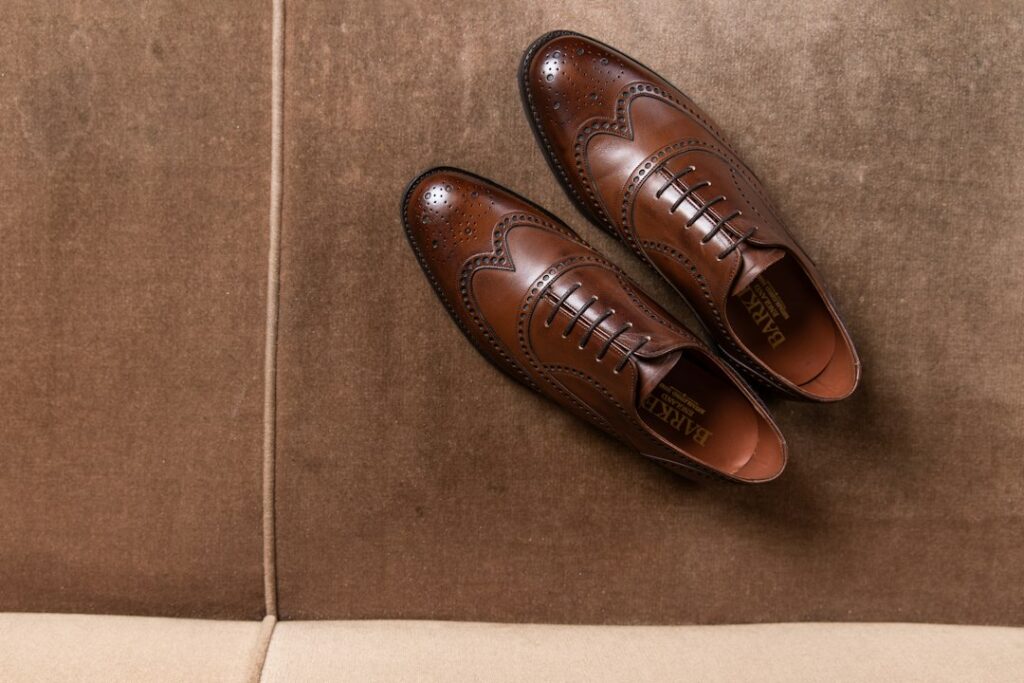
- Oxford (closed lacing): the two eyelet panels meet in a tight V at the base of the laces and look as if they are tucked into the shoe. When laced, the panels close neatly together with little or no gap.
- Derby (open lacing): the eyelet panels are flaps stitched on top of the vamp. You can see their edges, and they can open wide. When laced, there is often a visible gap between them, and the tongue shows underneath.
The quick test: look at the bottom of the lacing. If the panels disappear under the front of the shoe in a closed V, it is an Oxford. If they sit on top like two flaps that could lift away, it is a derby.
Oxford vs derby shoes at a glance
| Oxford | Derby | |
|---|---|---|
| Lacing | Closed: eyelet tabs stitched under the vamp | Open: eyelet tabs stitched on top of the vamp |
| Look | Sleek, close-fitting over the instep | Slightly chunkier, more relaxed |
| Formality | Higher; the default for black tie in plain black | One step down; still fine with suits |
| Fit adjustment | Limited; best for low to medium insteps | Generous; good for high insteps and wider feet |
| Typical outfits | Tuxedo, dark suits, business formal | Suits, blazers, chinos, flannel, dark denim |
| Related names | Often paired with a cap toe or wholecut upper | Blucher, Gibson (per the V&A grouping) |
A little history (and a few legends)
According to the V&A, the Oxford lace-up was “the predominant style in men’s footwear” in the 1920s and 1930s, and Oxfords were usually made “in plain black or brown leather for everyday wear.” The museum describes British men’s footwear of that era as conservative, with “strict rules dictating what shoe could be worn with which outfit.”
The names are harder to pin down. No reputable source confirms where “Oxford” came from. Two stories circulate: that Oxford University students cut down their boots into a lower shoe, or that the name links to Balmoral and Prince Albert. Both are best treated as legends. The derby’s alternative name, blucher, has a traditional story attached too: that the open-laced boot is connected to the Prussian field marshal Gebhard Leberecht von Blücher during the Napoleonic Wars. No museum source we could find confirms it, so it remains a story rather than a documented fact.
Which is more formal?
The Oxford. Its closed lacing gives a cleaner line, and plain black Oxfords sit at the top of the formality ladder. Debrett’s lists black “highly polished or patent lace-up shoes” for white tie and black tie, and Emily Post lists “black patent shoes and black dress socks” for black tie. A plain black patent or highly polished Oxford is the shoe that best fits that description.
A derby is not casual, though. In smooth black or dark brown calf, a plain-toe derby looks right with a business suit, and many people would not notice the difference at a glance. The common styling order, which is advice rather than a rule from any one authority, runs: plain black Oxford, then derby, then brogue, then loafer.
Decoration changes things too. Broguing, the punched perforations SATRA says were originally made to let water drain out on boggy ground, makes either shoe less formal. A full-brogue derby (often called a wingtip derby) is a country or weekend shoe; a plain cap-toe Oxford is a boardroom shoe.
Fit: why derbies suit high insteps
Fit is where the derby earns its place. Because the eyelet flaps on a derby are only attached at their base, they can spread apart to make room for a high instep or a thicker sock. On an Oxford the panels are sewn in under the vamp, so there is far less give. If you have a high instep and Oxford lacing gaps open wide or will not close, that is the shoe telling you a derby is the better choice, not that something is wrong with your foot.
General fit advice from foot-health bodies applies to both. The American Orthopaedic Foot & Ankle Society suggests getting measured at the end of the day when feet are largest, leaving about 3/8 to 1/2 inch beyond the longest toe, and not relying on the marked size, since it differs between brands. It also says: “Don’t plan on shoes stretching over time.” The American Academy of Orthopaedic Surgeons notes that the same model may come in different widths, indicated by letters or “wide.” If your feet hurt persistently, see a podiatrist.
Colours and outfit pairings
Colour conventions apply equally to both styles. Black is the formal choice, and the V&A notes that in 1920s–30s Britain “brown shoes with a dinner suit were frowned upon.” Brown and oxblood, in common styling advice, work with navy, grey and earth-tone suits for daytime and business. Debrett’s describes a British convention that black is a city colour and brown a country one, which is where the old phrase “no brown in town” comes from; treat it as tradition rather than a modern rule.
| Occasion | Best choice | Why |
|---|---|---|
| Black tie | Black patent or highly polished plain Oxford | Matches Debrett’s and Emily Post guidance |
| Formal wedding, funeral, interview | Black cap-toe Oxford | Conservative and clean |
| Everyday business suit | Oxford or plain derby in black or dark brown | Either works; derby if you want more comfort |
| Blazer and chinos | Brown derby or brogue derby | Matches the relaxed tailoring |
| Flannel or tweed trousers | Brown brogue derby, suede derby | Texture suits texture |
| Dark jeans | Suede or pebble-grain derby | An Oxford can look too sleek with denim |
If you want to compare options, Mens Black Cap Toe Oxford Shoes on Amazon and Mens Brown Leather Derby Shoes on Amazon bring up a range of styles and price points. For what to wear with them, our guides to Men’s Formal Wear and Business Casual for Men cover suits and office outfits.
Should your first pair be an Oxford or a derby?
It depends on your calendar more than on style.
- Choose an Oxford first if you attend formal events, work in a conservative office, or want one pair that covers weddings, funerals and interviews. Black cap-toe is the classic answer.
- Choose a derby first if you wear suits only occasionally, mostly dress business casual, have a high instep, or want a shoe that also works with chinos and dark jeans. Dark brown is the most flexible.
Over time most people end up with one of each. If business casual is your daily dress, our guide to Business Casual Shoes for Men and Women and our Dress Sneakers for Men guide cover the more relaxed end of the range.
Construction matters more than lacing
Whether you choose an Oxford or a derby, the way the sole is attached decides how long the shoe can last. A Goodyear welt adds a strip of leather that links the upper to the sole. The Digital Public Library of America’s exhibition on the Massachusetts shoe industry says the welt allows “shoes to be resoled when worn down,” so a pair could last “years, if not decades.” Blake stitching, which the Massachusetts Historical Society traces to Lyman Reed Blake’s 1858 sole-sewing machine, is lighter and also resoleable with the right equipment. Cemented (glued) shoes are lighter and cheaper but often cannot be resoled economically.
How to thrift Oxfords and derbies
Lace-up dress shoes turn up constantly in thrift stores, often barely worn. Here is what to check:
- Identify the lacing first. Use the closed-V test to confirm what you are holding; listings online often mix the names up.
- Soles and heels: look for holes, thin spots at the ball of the foot and lopsided heel wear. A worn sole on a welted shoe is fixable; on a glued one it may not be worth it.
- Uppers: fine creases polish out; deep cracks across the flex point usually do not.
- Insoles: check for heavy staining or a footbed deeply moulded to someone else’s foot.
- Labels: under the FTC Leather Guides, bonded or reconstituted leather should not be sold as plain “leather,” so read the label.
- Eyelet panels: on an Oxford, check that the stitching where the panels meet the vamp is intact; on a derby, check the flap edges for tears.
Our guides to Men’s Thrift Store Shopping and How to Clean Shoes from the Thrift Store cover where to look and how to freshen a pair once you bring it home. Cedar trees help a secondhand pair keep its shape; SATRA describes shoe trees as devices placed inside footwear “to try to preserve its shape and prevent creases from developing.” Search Cedar Shoe Trees Men on Amazon for options.
Frequently asked questions
What is the difference between Oxford and derby shoes?
Lacing. The V&A describes the Oxford as a closed-tab shoe, with eyelet tabs stitched under the vamp, and the derby as open-tab, with the tabs sitting on top of the vamp.
Is a blucher the same as a derby?
The V&A groups derby, blucher and Gibson styles together as open-tab shoes, and the names are often used interchangeably. Whatever the label, the open lacing is what defines the style.
Can you wear derby shoes with a suit?
Yes. A smooth black or dark brown plain derby works with most business suits. For black tie, convention favours a plain black Oxford in patent or highly polished leather.
Are Oxfords uncomfortable?
Not necessarily, but the closed lacing gives less room over the instep. If Oxfords pinch across the top of your foot or the laces will not close, a derby is often more comfortable.
Is a brogue an Oxford or a derby?
Either. Broguing is decoration, not a lacing system, so you can find Oxford brogues and derby brogues.
Shop the look on Amazon
Everything you need to build a secondhand-style wardrobe, delivered. We may earn a commission on purchases.