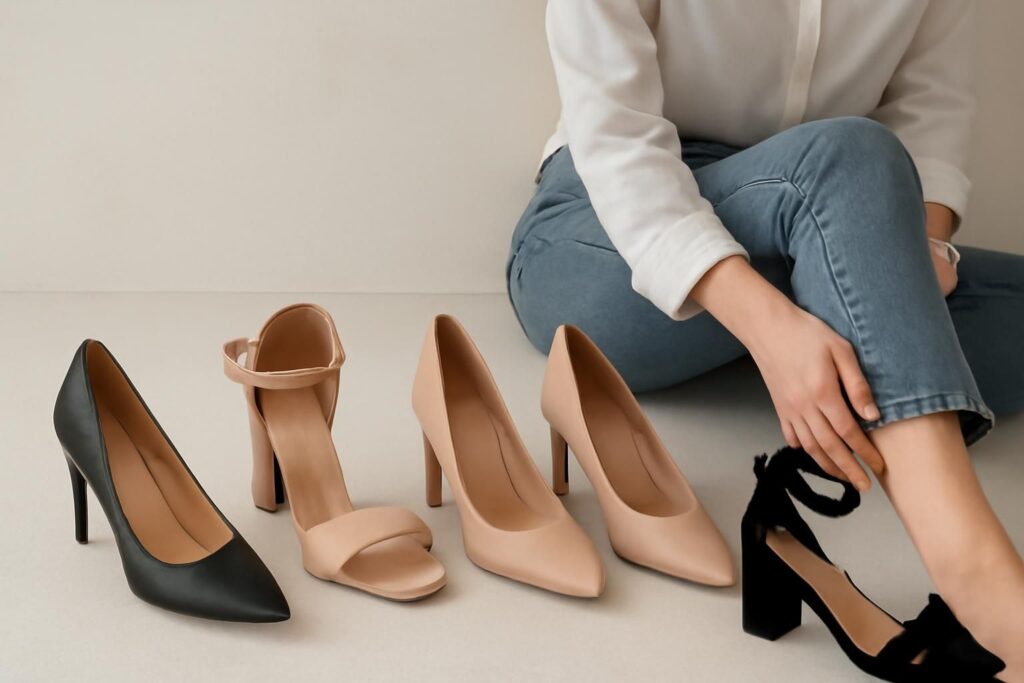
A heel is defined by two things: its shape and its height. Once you can name both, shoe listings stop being a guessing game.
This guide covers the main types of heels you will find in shops and on thrift racks, from the slender stiletto to the chunky block heel. It is split into two parts. First come the heel shapes, which describe the heel itself. Then come the shoe styles that are usually sold with a heel, such as pumps, slingbacks and mules, because listings often mix the two. There is a heel height guide, notes on comfort from foot-health organisations, and a checklist for buying heels secondhand. If comfort is your priority, our Comfortable Dress Shoes for Women guide covers lower and cushioned options in more depth.
Heel styles at a glance
| Style | Key feature | Typically worn with |
|---|---|---|
| Stiletto | Tall, very thin heel | Evening wear, cocktail dresses, tailoring |
| Kitten heel | Short, slim heel, often slightly curved | Office wear, cropped trousers, midi skirts |
| Block heel | Wide, square or rectangular heel | Work outfits, weddings, everyday dresses |
| Wedge | Solid heel running from toe area to back | Summer dresses, outdoor events |
| Platform | Thick sole under the front of the foot | Flared jeans, going-out outfits |
| Cone heel | Wide at the top, tapering to a point | Retro looks, smart casual |
| Spool heel | Wide top and base, narrow middle | Vintage-inspired outfits |
| Cuban heel | Low, thick heel with a slightly tapered back | Boots, western and 1960s styles |
| Stacked heel | Visible layers, often leather or wood-look | Loafers, boots, casual pumps |
| Flared heel | Widens toward the ground | Statement and 1970s-inspired shoes |
| Pump | Closed, low-cut, slip-on shoe with a heel | Workwear, formal events |
| Slingback | Strap around the back of the heel | Dresses, summer workwear |
| Mule | Backless shoe | Wide-leg trousers, casual dresses |
| Ankle-strap heel | Strap fastening around the ankle | Party dresses, wedding outfits |
Heel height guide
There is no official standard for heel heights, and brands label them differently, so treat these labels as rough shop terms rather than rules. Heel height is usually measured at the back of the shoe, from the floor to where the heel meets the upper.
- Low heel: commonly used to describe heels under about 2 inches. Kitten heels and many block heels sit here.
- Mid heel: commonly used for heels roughly between 2 and 3 inches.
- High heel: commonly used for heels above about 3 inches, including most stilettos.
A platform changes the picture, because a thick sole under the ball of the foot reduces the difference in height between heel and toe. A 5-inch heel with a 1-inch platform feels closer to a 4-inch heel on the foot.
For comfort, the American Academy of Orthopaedic Surgeons (AAOS) describes an ideal choice as “a shoe that has a square or wide toe box, with a heel that is lower than 2 inches high,” and says a square or round toe box lets the toes lie flat. The AAOS also notes that feet “may swell throughout the day (up to 8%),” so it suggests buying shoes toward the end of the day. The American Podiatric Medical Association takes a practical line for parties: keep sparkly high heels for the event itself, and wear comfortable shoes with good arch support and a padded sole when you are on your feet all day.
Heel shapes
Stiletto
The stiletto is a tall, very thin heel. The name comes from Italian stiletto, a short, slender dagger, and the Online Etymology Dictionary dates the phrase “stiletto heel” to 1953. The V&A says Roger Vivier “is credited with creating the stiletto heel”; he designed shoes for Dior from 1953 to 1963. According to the FIT Fashion History Timeline, stiletto heels were popular by the mid-1950s, helped by steel heels that could take more pressure than wooden ones. How to spot it: a heel that narrows to a tip roughly the size of a fingertip or smaller, usually 3 inches or taller. How to wear it: stilettos are the classic choice for evening wear and black-tie events. Browse Womens Stiletto Heels on Amazon for current options.
Top-selling match on Amazon

- Floral Design: Embrace the fashion with a three-dimensional floral detail, especially suited for…
- High Heel: The stiletto heel design not only adds height but also extends the leg lines, giving…
- Versatile Style: The floral appliqué can be removed, providing flexibility and endless styling…
Kitten heel
A kitten heel is a short, slim heel, usually curved slightly inward at the back. The V&A describes a pair of 1996 Jimmy Choo red patent slingbacks with “‘kitten’ heels” in its collection. How to spot it: a heel under about 2 inches that is as slender as a stiletto but much shorter. How to wear it: kitten heels are popular for office wear and with cropped trousers, because they add polish without much height.
Block heel
A block heel is commonly used to describe a wide heel with a square or rectangular cross-section. How to spot it: the heel looks like a solid block from the side and the back, and the base is broad. How to wear it: because the weight is spread over a larger area, block heels are a common pick for long days, outdoor weddings and grass. They come in every height. Search Womens Block Heel Pumps on Amazon to compare heights.
Top-selling match on Amazon

- Soft Upper: The upper is made of soft vegan leather with a smooth and supple texture, and the…
- Non-Slip Tpr Outsole: The 2.24-inch chunky heel, combined with a flexible TPR outsole, ensures stability…
- Retro Square Toe: The classic design with a delicate square toe adds a touch of elegance. Whether…
Wedge
A wedge heel is a solid heel that runs under the foot from the back to the ball, with no gap under the arch. According to the V&A, wedges and platforms “swept into fashion” in the late 1930s, popularised by Salvatore Ferragamo, though wedges had already appeared on rubber bathing shoes in the 1920s. How to spot it: a triangular profile from the side, often in cork, rope (as on espadrilles) or wood. How to wear it: wedges are a summer staple. Debrett’s suggests that “wedges are sensible if it may be soft underfoot (eg around churchyards, marquees or racecourses)” for daytime formal events.
Platform
A platform shoe has a thick sole under the front of the foot, and usually a tall heel at the back. As noted above, the V&A credits Ferragamo with popularising platforms alongside wedges in the late 1930s. How to spot it: a visibly thick front sole, from a modest half inch to several inches. How to wear it: platforms pair well with flared or wide-leg jeans, where the hem can cover part of the shoe. See our guide to What Shoes to Wear With Wide Leg Pants for more ideas.
Cone heel
The cone heel is commonly used to describe a heel that is wide where it meets the shoe and tapers to a small point, like an ice-cream cone. How to spot it: a rounded heel that narrows evenly toward the ground. How to wear it: it has a retro feel and works with smart casual outfits.
Spool heel
A spool heel is wide at the top and the base and narrow in the middle, like a cotton reel. It is sometimes called a Louis-style heel when it curves inward at the back. How to spot it: an hourglass profile from the side. How to wear it: it shows up on vintage and vintage-inspired shoes.
Cuban heel
A Cuban heel is commonly used to describe a low to medium, fairly thick heel with a straight front and a slightly tapered back. It is mostly found on boots. SATRA records that the Beatles commissioned a Cuban-heeled version of the Chelsea boot from Anello & Davide after October 1961. How to spot it: a sturdy heel about 1 to 2 inches high, often stacked. How to wear it: look for it on Chelsea and western boots; our Types of Boots glossary covers both.
Stacked heel
A stacked heel shows visible horizontal layers, traditionally from layers of leather and now often printed or moulded to look that way. How to spot it: look at the side of the heel for stripes. How to wear it: stacked heels are common on loafers, riding boots and casual pumps.
Flared heel
A flared heel is narrow where it meets the shoe and widens toward the ground. How to spot it: an upside-down cone shape. How to wear it: it often appears on 1970s-inspired and statement shoes.
Heeled shoe styles
Pump
The pump is commonly used to describe a closed, low-cut shoe with no fastening, usually with a heel; in the UK the same shoe is often called a court shoe. How to spot it: a smooth vamp, a closed toe and heel, and nothing to buckle or tie. How to wear it: pumps are a workwear and formal staple. Pointed-toe pumps look sharper; round-toe pumps feel softer. For office-friendly picks see Business Casual Shoes for Men and Women.
Slingback
A slingback has an open back with a strap that runs around the heel instead of a closed counter. The 1996 Jimmy Choo kitten heels in the V&A are slingbacks. How to spot it: a thin strap behind the heel, often with a small buckle. How to wear it: slingbacks are popular with dresses and summer workwear.
Mule
A mule is a backless shoe. The Online Etymology Dictionary dates “mule” in the sense of a loose slipper to the 1560s, from French mule, and links it to a Roman red high-soled shoe. How to spot it: no back or strap behind the heel. Mules come flat or heeled, with closed or open toes. How to wear it: heeled mules work with wide-leg trousers and casual dresses.
Ankle-strap and T-bar heels
These are commonly used to describe heels held on by a strap around the ankle, or by a T-shaped strap running up the vamp to join an ankle strap. How to spot it: a buckle or closure at the ankle. How to wear it: the strap keeps the shoe secure, so these are popular for dancing at weddings and parties.
Peep-toe and d’Orsay
A peep-toe has a small opening at the toe. A d’Orsay is commonly used to describe a pump cut away at one or both sides, exposing the arch. How to spot it: look for the toe opening or the side cut-out. How to wear it: both read as dressier than a closed pump and suit warm-weather events.
Heeled sandals
Heeled sandals cover any open shoe held on by straps, on any heel shape above. Strappy stiletto sandals are a classic evening choice; block-heel sandals are an easier day option. Browse Womens Block Heel Sandals on Amazon for a range, or see our Amazon Heels roundup.
How to thrift heels
Heels are among the easier shoes to buy secondhand because many pairs are worn only a handful of times. A few common checks help:
- Check the heel tip (the top lift). Worn or missing tips can usually be replaced by a cobbler cheaply, but a wobbly heel is a bigger repair.
- Press on the heel from the side to make sure it is firmly attached.
- Look inside at the insole. Heavy wear shows where the previous owner’s foot sat.
- Check the sole near the toe for splits and the upper for cracks, especially on patent leather.
- Try them on and stand up. The ball of your foot should sit in the widest part of the shoe, which the American Orthopaedic Foot & Ankle Society recommends.
- Don’t rely on the marked size. The AOFAS notes that size differs by brand, and it also advises not to plan on shoes stretching over time.
Our How to Clean Shoes from the Thrift Store guide covers cleaning and freshening secondhand pairs, and Thrift Store Shoes has more on where to look.
Types of heels FAQ
What are the main types of heels?
The heel shapes you will see most are the stiletto, kitten heel, block heel, wedge and platform. Cone, spool, Cuban, stacked and flared heels are less common variations.
Who invented the stiletto heel?
The V&A says Roger Vivier is credited with creating it. The Online Etymology Dictionary dates the phrase “stiletto heel” to 1953.
What is the most comfortable type of heel?
Comfort depends on your feet and the shoe’s fit. The AAOS points to a wide or square toe box and a heel under 2 inches as an ideal choice. Many people also find block heels and wedges steadier than stilettos because the weight is spread over a wider base.
What is a kitten heel?
A short, slim heel, usually under about 2 inches and slightly curved. The V&A uses the term for a 1996 pair of Jimmy Choo slingbacks.
How do I know what heel height I’m buying?
Check the product details for the heel measurement in inches or centimetres, and note any platform height separately. Labels such as “mid heel” vary between brands. For more shoe terms, see our Types of Shoes glossary.
How do you stop high heels from slipping off at the back?
Heels that slip at the back can usually be fixed with adhesive heel grips stuck inside the back of the shoe, which add padding and friction against the heel. A thin half insole or ball-of-foot cushion also helps by pushing the foot back and filling extra space. If the pair is a full size too big, inserts rarely solve it, and a slingback or ankle-strap style with an adjustable buckle is a more secure choice.
Shop the look on Amazon
Everything you need to build a secondhand-style wardrobe, delivered. We may earn a commission on purchases.