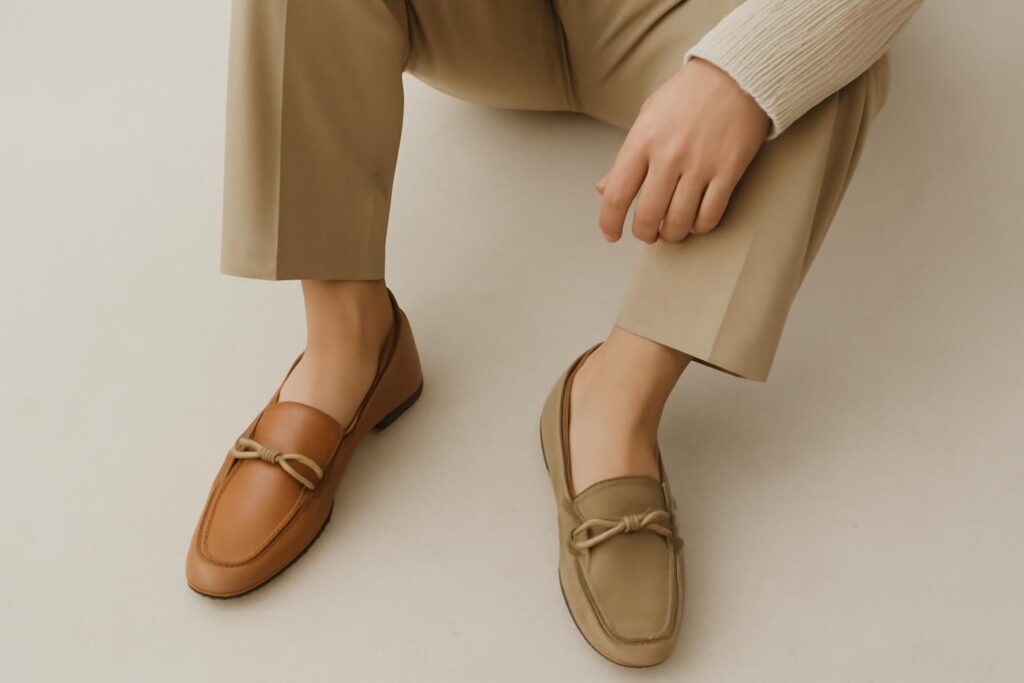
Both slip on, both often have that stitched seam around the toe, and both turn up in the same aisle, but the way the shoe is built underneath tells you which one you are holding.
The short answer to loafers vs moccasins: a true moccasin wraps one piece of soft leather under and around the foot and traditionally has a soft sole, while a loafer is a slip-on with a separate, stiffer sole and a heel, often borrowing the moccasin’s toe stitching. So a loafer can look like a moccasin from above, but turn it over and the difference is plain. For outfit ideas once you have chosen a pair, see our Loafers Outfit Ideas guide. This page covers construction, word history, the driving moccasin and penny loafer, and thrift checks.
Loafers vs moccasins at a glance
| Feature | Loafers | Moccasins |
|---|---|---|
| Construction | Upper attached to a separate sole | One piece of leather wraps under and around the foot |
| Sole | Stiffer, often leather or rubber | Traditionally soft, flexible |
| Heel | Distinct low heel | Flat or none |
| Toe stitching | Often present, borrowed from the moccasin | Traditional raised seam |
| Typical setting | Casual to business casual | Casual, indoors or light outdoor wear |
| Word recorded from | 1937 (as a shoe) | 1610s |
Where the words come from
The moccasin’s name comes from Indigenous languages of North America. According to the Online Etymology Dictionary, “moccasin” is recorded in English from the 1610s, “from an Algonquian language of Virginia, probably Powhatan makasin ‘shoe’,” from Central Atlantic Coast Algonquian mockasin. The dictionary notes related forms in other Algonquian languages, including Munsee Delaware and Ojibwa. That Indigenous origin is worth keeping in mind when the word is used as a generic fashion label.
“Loafer” is much more recent as a shoe name. The Online Etymology Dictionary records it as a type of informal shoe from 1937. G.H. Bass says it introduced its Weejun in 1936, based on slip-ons worn by Norwegian farmers and fishermen, and describes it in its own words as “we made a shoe and invented a word.” That is the brand’s account rather than an independent history.
Museums show how far the loafer has travelled. The Met holds Gucci loafers dated about 1972 (a gift in 1984); Gucci’s 1953 date for its horsebit loafer is the brand’s own claim. The V&A has displayed black leather loafers in a “Rude Boy UK 1960s” outfit and holds Patrick Cox “Wannabe” loafers from autumn/winter 1993–94.
How to tell them apart: four checks
- Turn the shoe over. A distinct sole stitched or glued to the upper, with a heel block, means loafer. A sole that is part of the same wrap of leather means moccasin.
- Bend it. Moccasins fold easily. Loafers resist.
- Look at the heel. Loafers have a defined low heel. Traditional moccasins sit flat.
- Check the inside. Moccasins often have little or no structure inside. Loafers usually have an insole and a firmer heel counter.
Driving moccasins vs loafers
“Driving moccasin” is commonly used to describe a soft, moccasin-style slip-on with rubber nubs or pads on the sole that wrap up the back of the heel. It sits between the two: softer and more flexible than a loafer, but with more grip than a traditional moccasin. Because the nubs wear down on pavement, many people keep driving moccasins for light use. A loafer, with its full sole and heel, is the sturdier everyday choice.
Penny loafer vs moccasin
A penny loafer is a loafer with a leather strap across the vamp that has a small cut-out. It typically carries moccasin-style stitching around the toe, which is where the confusion comes from. But it still has the loafer’s separate sole and heel. So a penny loafer is moccasin-inspired, not a moccasin. Shop Leather Penny Loafers on Amazon if you want the classic version.
Top-selling match on Amazon

- Excellent Craftsmanship: Stitching is simple, but durable, in a gold thread that is a nice detail, without…
- Easy On And Off: Laid-back slip-on design for quick and easy on and off. No pain, discomfort or…
- Dressy Or Casual: Nice slip-on shoe to dress up or down and goes well with most outfits. A new take on…
When to wear each
Loafers
- Business casual offices and smart casual dinners. See Business Casual Shoes for Men and Women.
- With chinos, tailored trousers, jeans or skirts. Our Chinos vs Khakis comparison covers the trouser side.
- When you want a slip-on that still looks polished.
Moccasins
- Relaxed weekends and indoors.
- Travel days when you want something soft that packs flat.
- With shorts, jeans and casual layers. Browse Suede Moccasins on Amazon for soft-soled styles.
Top-selling match on Amazon

- Size Tips: If you're wide feet or like more toe room, please order one size up.
- Handmade Moccasin Slippers: Made with pure hand-stitching techniques, each pair of slippers contains rich design…
- Soft And Comfortable Lining: The soft fax fur lining and microsuede upper of these slippers will warm your feet…
Can you swap them?
A loafer can go almost anywhere a moccasin can. The reverse is less true: a soft moccasin looks and feels casual, so it is a weaker choice for a business setting. For dressier lace-ups and buckled options, see Men’s Dress Shoes, Monk Strap Shoes and Oxford vs Derby Shoes.
Thrift tips for loafers and moccasins
- Check the sole and heel wear. Loafer soles and heels can be replaced by a cobbler if the upper is in good shape.
- Look at the toe stitching. Broken stitches on the raised seam can let the upper come apart.
- Inspect the inside. Moccasins are often worn without socks, so check and clean the lining. See How to Clean Leather Shoes and Keep Them Conditioned and How to Clean Suede Shoes (Without Ruining Them).
- Measure rather than trusting the size stamp. Older shoes can run differently from current sizing, so compare insole length with a pair that fits you.
- Condition dry leather. Light creasing is normal. Deep cracks across the vamp are hard to fix.
Another slip-on comparison worth a look: Mules vs Clogs.
Shop the look on Amazon
Everything you need to build a secondhand-style wardrobe, delivered. We may earn a commission on purchases.
FAQ
Is a loafer a type of moccasin?
Not in construction. A loafer often borrows moccasin stitching on top, but it has a separate sole and heel. A true moccasin wraps one piece of leather around the foot.
Can you wear moccasins outside?
Many people do, especially styles with a thin added outsole. Traditional soft-soled moccasins wear faster on rough ground.
Did Bass invent the loafer?
G.H. Bass says it introduced the Weejun in 1936 and “invented a word.” That is the brand’s claim. The Online Etymology Dictionary records “loafer” as a shoe from 1937.
What language does the word moccasin come from?
According to the Online Etymology Dictionary, it comes from an Algonquian language of Virginia, probably Powhatan.
Are moccasins more comfortable than loafers?
Moccasins usually feel softer than loafers, because one piece of flexible leather wraps under and around the foot with little internal structure, so they fold easily and suit indoors, travel and relaxed weekends. Loafers have a separate, stiffer sole, an insole and a firmer heel counter, which gives more support and durability on pavement. Driving moccasins sit between the two: soft like a moccasin, with rubber nubs for grip, but the nubs wear down on rough ground.
Do you wear socks with loafers and moccasins?
Loafers and moccasins are often worn without visible socks, and no-show socks are a common way to get that bare-ankle look while protecting the lining from sweat. Moccasins in particular are often worn sockless, so check and clean the lining on secondhand pairs. With business casual loafers and tailored trousers, thin dress socks that match the trousers or shoes look neat, especially in cooler weather.