A work boot is the one piece of clothing you will stand in for ten hours, and the label stitched inside its tongue tells you more about it than any product photo ever will.
Shopping for working boots for men gets confusing fast. Every listing promises toughness, comfort and protection, and the real differences hide in a row of letters on a label and a handful of construction details. This guide is the decoder. It covers what the safety toe options actually are, how to read the ASTM marking, what waterproofing and insulation mean in practice, how a work boot should fit, and how the best-known brands line up. It sits inside our wider workwear coverage, so for the jackets, chore coats and outer layers that go with your boots, start at our Shackets & Casual Coats hub. One ground rule before we start: if your job requires protective footwear, your employer’s requirements decide what you wear, not a buying guide.
Who decides what working boots for men need to have
Men's work boots: current Amazon prices
As an Amazon Associate we earn from qualifying purchases. Prices and availability are accurate as of November 2026 and may change. Specs are as stated in each Amazon listing.

- Steel Safety Toe: Metallic, asymmetrical-shaped toe cap that meets US safety standards including ASTM…
- Electrical Hazard Protection: Provides secondary underfoot protection against live electrical circuits…
- Timberland Pro Rubber: Heat-resistant, durable rubber compound offers enhanced slip, oil and abrasion…

- Anti-Fatigue Technology: A comfort system designed with shock-absorbing, geometrical technology that returns…
- Composite Safety Toe: Lightweight, non-metallic, asymmetrical-shaped toe cap that meets US safety…
- Waterproof Membrane: Delivers maximum waterproof protection and meets ASTM F1671-07 safety standard.

- Steel Safety Toe: Metallic, asymmetrical-shaped toe cap that meets US safety standards including ASTM…
- Waterproof Membrane: Delivers maximum waterproof protection and meets ASTM F1671-07 safety standard.
- Electrical Hazard Protection: Provides secondary underfoot protection against live electrical circuits…
It is worth getting this out of the way first, because it shapes everything else. In the United States, OSHA’s footwear rule (29 CFR 1910.136) puts the responsibility on the employer. The employer must make sure each affected employee wears protective footwear where there is a danger of foot injury from falling or rolling objects, from objects piercing the sole, or where the footwear is used as protection against an electrical hazard. More broadly, OSHA’s PPE rule requires employers to assess the workplace to determine which hazards are present.
In plain terms: the hazard assessment at your workplace sets the requirement. Some sites ask for a safety toe, some ask for puncture resistance as well, some specify an electrical hazard rating, and some have no footwear rule at all. Before you buy, find out exactly what your site, union or safety officer asks for, and buy a boot whose label shows those markings.
If you are buying for a weekend project, a farm, or general outdoor work with no formal requirement, you have more freedom, and comfort, weight and weather protection will drive the decision more than certification.
How to read a safety boot label: ASTM F2413-24
The current US standard for safety toe footwear is ASTM F2413-24, “Standard Specification for Performance Requirements for Protective (Safety) Toe Cap Footwear.” It replaced F2413-18 in 2024, and the CDC’s NIOSH PPE-Info database lists it as active. The test methods themselves live in a companion standard, ASTM F2412. To carry the ASTM marking, footwear has to be certified by independent third-party labs.
The standard covers several protections, and each one appears on the label as a code. The rule of thumb that matters most: a protection that is not marked on the label cannot be claimed. If a listing says “electrical hazard” but the label inside the boot does not show EH, go by the label.
The codes you will see
- "I/75" and "C/75". Impact and compression ratings for the toe cap, at the highest commonly used level.
- EH. Electrical hazard. The footwear acts as a secondary barrier that helps reduce shock risk under dry conditions. It is not primary protection, and it is not a substitute for the electrical safety measures your employer is responsible for.
- SD. Static dissipative. Limits static build-up while keeping enough resistance to limit current.
- PR. Puncture resistant, meaning a plate under the foot.
- Mt. Metatarsal protection for the top of the foot.
- Cd, CS and DI. Conductive, chain saw cut resistance and dielectric insulation, found on more specialised footwear.
Note that EH and SD do different jobs, and a boot will generally be marked for one approach or the other depending on its purpose. If your workplace specifies one, match it exactly rather than assuming one covers the other. When in doubt, ask whoever set the requirement.
Top-selling match on Amazon

- 【SAFETY】These steel toe boots meet ASTM F2413-24 and other international standards to ensure…
- 【NON SLIP】These steel toe work boots with rubber slip resistant outsole,rough grasp of the…
Steel, alloy or composite: choosing a safety toe
This is where most of the myths live. Steel, alloy and composite toes all have to pass the same F2413 impact and compression tests. In those tests, a clay cylinder placed under the toe cap has to stay at least half an inch tall after the impact or compression. The material does not change the rating: if a cap carries the marking, it has passed the same bar. The differences are in weight, cost, temperature and practicality.
Steel toes are the cheapest option. Steel conducts cold, so in winter the toe area can feel chillier, and it sets off metal detectors. Our Steel Toe Work Boots guide goes deeper on ratings and comfort.
Alloy toes, usually aluminium-based, are lighter than steel but cost more. Like steel, they conduct cold.
Composite toes are made from non-metal materials such as Kevlar, polycarbonate, fiberglass or carbon fiber. They conduct cold less, will not corrode, will not set off metal detectors and do not conduct electricity. That last point is about the cap material, not a rating for the whole boot; look for the EH marking on the label if electrical hazard protection is part of your requirement. Our Composite Toe Work Boots guide covers the trade-offs in detail.
If you have no safety toe requirement, a soft-toe work boot is lighter and more flexible, and it is a perfectly reasonable choice for yard work, warehouse jobs without falling-object hazards, or general wear.
Top-selling match on Amazon
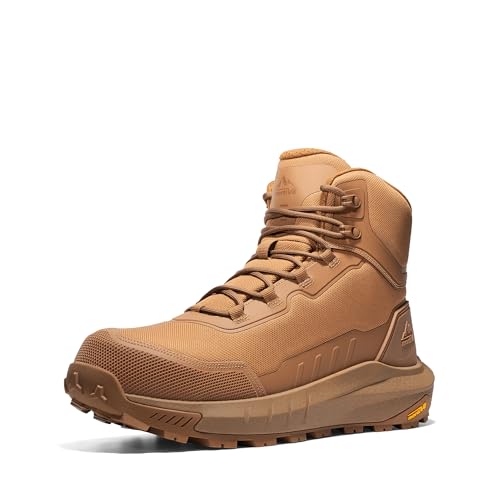
- Lightweight And Comfortable: Each boot only weighs approx. 22.5 oz (based on size 9), these men's industrial and…
- Protective And Safe: Meeting ASTM F2413-24 I/75 standards for impact resistance, these men's work boots…
- Durable And Supportive: These nano composite toe work boots for men are crafted with a wear-resistant nylon…
Waterproofing: membranes, leather and seams
A wet foot is a cold, blistered foot by the end of a shift, so waterproofing matters more than most people expect. There are two broad approaches.
The first is a waterproof membrane, a thin breathable liner sewn inside the boot, sometimes branded and sometimes proprietary. The membrane does the waterproofing, and the leather or synthetic outside handles abrasion. The second is waterproof treated leather combined with sealed seams, where the leather itself and the construction keep water out. Both can work well. What decides whether a boot stays dry over months is the build around them: a gusseted tongue (attached up the sides so water cannot come in through the lacing), sealed seams in the wet zone, and a sole attachment that does not let water wick in.
Be careful with wording. “Water-resistant” and “water-repellent” describe boots that shed splashes and light rain but will let water through eventually. That is fine for dry sites and not fine for standing in a trench. The trade-off for full waterproofing is breathability: a sealed boot traps sweat, so on hot, dry jobs a non-waterproof boot can feel noticeably more comfortable. Our Waterproof Work Boots guide explains membranes and seam construction in more depth.
Insulation: when you need it and how much
Insulation is listed in grams, which refers to the weight of insulation per square metre of material rather than the total in the boot. Higher numbers are warmer and bulkier. For reference, Timberland PRO’s Direct Attach 6″ Waterproof Insulated Steel-Toe Work Boot uses 200g insulation, a common level for cold-weather work boots where you are still moving around.
The question to ask is how much you move. Someone walking a site all day generates a lot of heat and can overheat in a heavily insulated boot. Someone standing still in a cold warehouse, or working outdoors in deep winter with little movement, needs more. Remember that steel and alloy toes conduct cold, which matters in a winter boot. For a full breakdown, see our Insulated Work Boots guide, and if you mostly need a cold-weather boot for life outside work, our Men’s Winter Boots guide is the better place to look.
Construction, soles and what high quality work boots have in common
High quality work boots tend to share a few traits regardless of brand. The first is how the sole is attached. Cemented soles are glued and are typically lighter and more flexible out of the box. Stitched constructions, including welted boots, are stiffer at first, heavier and can often be resoled by a cobbler. Direct-attach soles, where the sole is moulded onto the upper, form a strong bond and are common on boots built for wet conditions.
The second is the outsole. Look for a lug pattern that matches your ground: deep, widely spaced lugs shed mud and grip on dirt, while flatter, finer patterns tend to suit smooth floors. If your workplace requires slip resistance, check for a specific slip-resistance claim on the product page and match it to what your employer asks for. A defined heel helps on ladders; a wedge sole tends to suit flat concrete.
The third is the upper. Full-grain leather is the most durable and the slowest to break in. Nubuck and suede look good but scuff and need treatment. Synthetic and textile uppers are lighter and break in faster but generally wear sooner in abrasive work. Finally, look at the footbed: a removable insole is a big advantage because you can replace it with a better one, which is the cheapest comfort upgrade you can make to any boot.
Fit: getting the size right
A badly fitting work boot is miserable no matter how well it is built. These are the habits that make the difference.
Try boots on later in the day, when your feet have swollen slightly, and wear the socks you actually work in. Thick work socks can take up half a size. You want your heel to stay put when you walk, with only a little lift, and room to wiggle your toes. With a safety toe, pay close attention to the toe box: the cap does not stretch, so if your toes touch it in the shop, they will be sore after a shift. Crouch in them, because squatting is where a tight toe cap shows itself.
Width matters as much as length. Many work boot brands offer wide fits in their core models, and a wide foot crammed into a standard boot will never break in comfortably. Sizing guidance also varies by brand and model, so read the official size chart and the most recent reviewer feedback for the exact style you are buying. Leather boots soften with wear; safety toe caps and rigid soles do not.
Top-selling match on Amazon

- Specially designed for men over 200 lbs., tall and/or those with wide width feet
- All-day support & relief, every day
The best work boots for men: brands compared
These are the brands most shoppers will be choosing between. Features vary by SKU, so treat this as an introduction and check the label and product page of the exact model you buy.
Timberland PRO
Timberland PRO is the work line of Timberland, which is still owned by VF Corporation; VF bought Timberland in 2011 and now manages Timberland and Timberland PRO together within its Outdoor segment. The best-known models include the Boondock 6″ Waterproof Comp-Toe Work Boot (and the Boondock HD), the Pit Boss 6″ Steel Toe Work Boot, and the Direct Attach 6″ Waterproof Insulated Steel-Toe Work Boot, which is EH-rated and uses 200g insulation. Features like EH and PR vary from SKU to SKU, so do not assume a whole line carries the same markings. Our Timberland PRO Work Boots Review covers the range and sizing.
Timberland Pro Boondock 6 Inch Waterproof Composite Toe Work Boot on Amazon
Cat Footwear
Cat Footwear is made under license from Caterpillar Inc. by Wolverine World Wide. It has been the official footwear licensee of Caterpillar since 1994 and still appears in Wolverine’s filings. Cat boots tend to appeal to buyers who want a rugged look and a wide spread of steel and composite options. Our Caterpillar Work Boots Review goes through fit and durability.
Skechers Work
Skechers, founded in 1992 and headquartered in Manhattan Beach, California, was taken private by 3G Capital in a deal that closed in September 2025. Its Skechers Work range includes composite, alloy and steel safety toe styles, slip-resistant styles and electrical hazard styles. The appeal is comfort and a lighter, more sneaker-like feel; the trade-off is that lighter builds may not suit the most abrasive conditions. Our Skechers Work Boots Review has the details.
Skechers Work Composite Toe Boot Men on Amazon
Carhartt, Wolverine and the rest
Plenty of other names make well-regarded working boots for men. The evaluation is the same for all of them: read the label, check the construction, and size carefully. If you like the rugged workwear look, see our Carhartt Work Pants Review for pants to match.
Top-selling match on Amazon

- Waterproof leather upper
- Breathable lining that keeps moisture away and 200 grams of Thermolite insulation
How the safety toe and boot types compare
| Boot type | Toe type | Waterproofing | Insulation | Best for |
|---|---|---|---|---|
| Steel toe work boot | Steel cap; cheapest safety toe; conducts cold; sets off metal detectors | Varies by model; waterproof versions common | Uninsulated or insulated versions available | Sites requiring a safety toe where weight and metal detectors are not an issue |
| Alloy toe work boot | Aluminium-based cap; lighter than steel; costs more; conducts cold | Varies by model | Varies by model | Long days on your feet where a lighter safety toe helps |
| Composite toe work boot | Non-metal cap; conducts cold less; will not set off metal detectors or corrode | Varies by model | Varies by model; pairs well with cold work | Cold conditions, security-screened sites, buyers wanting a non-metal cap |
| Insulated waterproof work boot | Any of the above | Membrane or sealed leather, gusseted tongue | Listed in grams (e.g., 200g on the Timberland PRO Direct Attach) | Winter outdoor work with less movement |
| Soft toe work boot | No safety cap | Varies by model | Varies by model | Jobs with no protective toe requirement, farm and yard work |
The table makes one thing obvious: the toe material is only one decision out of several, and it is the one with the least room for preference if your employer specifies a rating. Since steel, alloy and composite all pass the same tests, choose between them based on weight, temperature and practical issues like metal detectors.
The decisions that change your day are waterproofing and insulation. A non-waterproof boot on a wet site will be the worst purchase you make; an insulated boot on a summer roofing job runs a close second. Be honest about the conditions you work in for most of the year rather than the worst day of the year, and consider a second pair if your seasons are extreme.
Finally, remember that a boot’s label is the source of truth for its ratings. Product pages, marketplace listings and boxes can be inaccurate or describe a different version of the same model. If a requirement matters, check the markings inside the boot when it arrives and return it if they do not match.
Caring for work boots so they last
Most work boots die early from neglect rather than wear. Knock off mud at the end of the day and let boots dry at room temperature, away from direct heat, which can crack leather and weaken adhesives. Pull out the insoles to speed up drying. If you can, rotate between two pairs so each gets a full day to dry out; it helps the boots and your feet.
Clean and condition leather periodically, and re-apply a waterproofing treatment to leather uppers when water stops beading. Check the sole for separation and the stitching for wear; catching a small problem early is often the difference between a cheap repair and a new pair.
When to replace a safety boot is not only a comfort question. Damage to the toe area, a cracked sole or a compromised upper may affect protection, and many employers have their own rules about replacing safety footwear after an impact or at intervals. Check with your employer and the manufacturer’s guidance rather than guessing.
Top-selling match on Amazon

- Waterproof & Stain-Resistant: The 2026 upgraded Mink Oil offers polish, conditioning, and protection. It nourishes…
- Natural & Durable: Made from pure, premium ingredients without silicone, the mink oil deeply penetrates…
- Widely Applicable: Perfect for various leather types, including tanned, full-grain, and smooth. Before…
What to wear with work boots
Socks first: a good wool or wool-blend work sock with cushioning under the heel and forefoot regulates temperature and moisture better than cotton, which holds sweat. Above the boot, a durable work pant with enough room at the hem to sit over the shaft is the classic pairing; double-front canvas pants and overalls are designed with this in mind. See our Double Knee Pants and Carhartt Overalls Review for those.
Work boots also cross over into everyday wear. A clean leather work boot with straight or relaxed jeans is a classic look, and our Work Jeans for Men guide covers jeans built to take that kind of abuse. Up top, sturdy shirts round it out; our Men’s Work Shirts guide explains fabrics and features.
The verdict
The best work boots for men are not the ones with the toughest-looking photos. They are the ones whose label matches your workplace requirement, whose waterproofing and insulation match the conditions you actually work in, and that fit your foot with the socks you wear. Start with the requirement from your employer, then pick the toe type that suits your day: steel if you want the most affordable option and do not mind the weight, alloy if you want something lighter, and composite if you work in the cold or around metal detectors.
From there, get the waterproofing right before you worry about brand. For most buyers, a waterproof boot with a removable insole, a gusseted tongue and a sole suited to their ground will be the right call. Timberland PRO’s Boondock and Pit Boss models are a sensible place to start comparing, Skechers Work is worth trying if comfort and weight are your priority, and Cat Footwear covers buyers who want a rugged look. Whatever you choose, check the markings inside the boot when it arrives.
Mens Wool Work Socks Cushioned Boot on Amazon
Shop the look on Amazon
Everything you need to build a secondhand-style wardrobe, delivered. We may earn a commission on purchases.
FAQ
What is the current safety standard for work boots in the US?
The current standard is ASTM F2413-24, which replaced F2413-18 in 2024. Test methods are in the companion standard ASTM F2412. Boots carrying the ASTM marking must be certified by independent third-party labs.
Is a composite toe as protective as a steel toe?
Steel, alloy and composite toes all have to pass the same F2413 impact and compression tests, so a rated composite toe has met the same requirement as a rated steel toe. The differences are weight, cost, how much cold they conduct and whether they set off metal detectors.
What does EH mean on a work boot?
EH stands for electrical hazard. An EH-rated boot acts as a secondary barrier that helps reduce shock risk under dry conditions. It is not primary protection and does not replace the electrical safety measures your employer is responsible for.
Who decides whether I need safety toe boots?
Your employer. OSHA’s footwear rule requires employers to ensure protective footwear is worn where there is a danger of foot injury or where footwear is used for electrical hazard protection, based on their own hazard assessment. Ask your employer or safety officer for the exact markings required.
Should work boots be a size bigger?
Not automatically. Fit with the socks you work in, check that your toes have room inside the safety cap and that your heel stays put, and follow the brand’s size guidance for that specific model. Consider a wide fit if standard widths pinch.
Are waterproof work boots too hot in summer?
They can be. Waterproofing traps sweat as well as keeping water out, so on hot, dry sites a non-waterproof boot may be more comfortable. If you work in both wet and dry conditions, two pairs is often the practical answer.
How long should work boots last?
It depends on the build, the conditions and how well you look after them. Drying boots properly, conditioning leather and replacing insoles all extend their life. For safety boots, also follow your employer’s and the manufacturer’s guidance on replacement after damage.