
Every chain is a row of linked metal, but the shape of those links decides how a necklace drapes, catches the light and holds up on a thrift-store tray.
Learning the main types of chains makes jewelry shopping much easier, whether you are scanning a glass case at a charity shop or filtering listings online. A chain is defined by how its links are shaped and joined: round or oval, flat or twisted, single or woven. Once you can name what you are looking at, you can compare like with like and judge whether a price is fair. This guide covers the common necklace and bracelet chain styles, how to spot each one, what the metal stamps on the clasp mean under US rules, and what to check before you buy secondhand. For pendants, collars and lengths, our Types of Necklaces hub covers the wider picture, and our guide to Types of Bracelets picks up the wrist side.
The word itself is old. According to the Online Etymology Dictionary, “chain” dates from around 1300 in the sense of a “connected series of links of metal or other material,” from Old French chaeine and Latin catena, and the sense of “a type of ornament worn about the neck” appears in the late 14th century.
Chain styles at a glance
| Style | Key feature | Typically worn with |
|---|---|---|
| Cable (anchor) | Simple uniform oval or round links | Small pendants, everyday layering |
| Rolo | Identical, often round links | Charms, casual layering |
| Curb | Links that lie flat and interlock | Worn alone or as a bracelet |
| Figaro | Short links followed by one long link | Worn alone, often in gold tones |
| Cuban link | A name commonly used for a heavy, rounded curb style | Worn alone as a statement |
| Rope | Two strands spiraled together | Worn alone or with a single pendant |
| Box | Looser, rectangular links | Pendants, slides, plain layering |
| Venetian | Tighter, always-square links | Fine pendants |
| Snake | Tight links with a round or square cross-section | Worn alone or with a slim pendant |
| Wheat (spiga) | Twisted links that look plaited | Pendants or worn alone |
| Byzantine | Each link joined to four others | Worn alone as a feature piece |
| Ball (bead) | Small metal balls on short wires | Dog tags, casual pendants |
| Singapore | A twisted chain that keeps a natural curve | Light pendants, layering |
| Franco | A V-shaped pattern on two sides | Worn alone or with a cross pendant |
| Paperclip | Long, flat, elongated links | Layering, charms |
| Herringbone | Flat, slanted links that lie like a ribbon | Worn alone close to the neck |
Simple link chains
These are the chains most people picture first. Each link is a separate ring passed through the next, so you can usually see daylight between links when you hold the chain up.
Cable chain
Wikipedia’s jewellery chain entry says a cable (or anchor) chain “copies the style of the chain that holds large anchors on ships” and calls it “one of the simplest and most universal chains.” To spot one, look for uniform oval or round links, each turned at a right angle to the next. It is the default chain on many pendants, which makes it easy to swap a charm from one cable chain to another.
Rolo chain
According to the same source, the links of a rolo chain are “usually identical and often round.” It looks a little chunkier than a cable chain of the same width because the round links are wider. Rolo chains are commonly used for charm necklaces and bracelets, since a jump ring can be hooked through almost any link.
Paperclip chain
“Paperclip” is a widely used retail name rather than a formally defined term, and it is commonly used to describe a chain of long, flat, elongated links that look like office paperclips. Many sellers market it for layering, and charms can be clipped straight onto the open links.
Curb, figaro and Cuban link chains
This family is built on links that are twisted so they lie flat, which gives a smooth, even surface when the chain rests on the collarbone or wrist.
Curb chain
Wikipedia describes curb links as ones that “interlock with each other when laid flat.” Hold one up and you will see the twist: each link turns so the whole chain lies like a flat ribbon of overlapping ovals. Curb chains come in everything from fine necklace widths to wide bracelet styles, and they are a common choice for ID bracelets.
Figaro chain
The same entry says the figaro is “not really a style but a popular variation of the Curb chain,” in which “a number of standard links (usually three) precede an elongated link.” Counting the pattern is the quickest way to identify one: short, short, short, long, then repeat. Some figaro chains use a different ratio, so a one-to-one or two-to-one pattern still counts.
Cuban link chain
“Cuban link” does not appear in the sources used for this guide, so treat it as a trade name. It is commonly used to describe a heavy curb-style chain with rounded, tightly interlocking links, often worn as a single statement necklace or bracelet. Because the name is informal, two sellers can use it for chains that look quite different, so judge the piece by its links rather than its label.
Twisted and woven chains
These chains are built so the links twist around a centre line or weave into a denser pattern. They tend to look more like one continuous strand than a row of separate rings.
Rope chain
According to Wikipedia, a rope chain “creates the effect of two twisting strands spiraled together.” Up close you will see small links arranged in a spiral, which catches light from many angles. Rope chains are often worn alone or with a single pendant.
Singapore chain
Wikipedia’s summary describes a Singapore chain as one that keeps “a natural curve” even when untwisted. It reads as a fine, twisted chain with a light, sparkly surface, and is often sold as a lightweight pendant chain.
Wheat (spiga) chain
A wheat or spiga chain is made of twisted, interlocking links, and Wikipedia says it has “the appearance of a plaited wire or stalk of wheat.” Look for a braided, four-sided look along its length.
Byzantine chain
In a Byzantine chain, per Wikipedia, “each link is connected to four other links, creating a woven appearance.” The result is a thick, textured chain that looks almost knitted, and it is commonly found in handmade and artisan jewelry.
Franco chain
According to a Wikipedia summary, a Franco chain has a V-shaped pattern on two sides. It is dense and square-feeling in the hand, and is commonly worn alone or with a cross or medallion pendant.
Box, snake and other smooth chains
These styles share a tidy, geometric look. They often feel smoother against the skin than open-link chains.
Box chain
A Wikipedia summary describes box-chain links as looser and rectangular. Each link forms a small open cube, so the chain looks like a row of tiny boxes. Box chains are a common choice for pendants because the even links let a bail slide along easily.
Venetian chain
The same summary says Venetian links are “always square” and tighter than box-chain links. Side by side, a Venetian chain looks denser and more uniform than a box chain of the same width.
Snake chain
Wikipedia calls a snake chain “a very tight-linked chain that has a round or square cross-section.” Instead of visible separate links, you see a smooth, scaled surface that bends like a tube. When thrifting, run it gently through your fingers and look for any flat spots or sharp bends along the length.
Herringbone chain
“Herringbone” is a common retail name with no single defining source. It is commonly used to describe flat, slanted links laid side by side so the chain lies like a shiny metal ribbon, echoing the herringbone weave pattern. Like the snake chain, check it for kinks or creases before buying.
Ball (bead) chain
Wikipedia describes ball chain as “small balls of metal joined by small lengths of wire.” It is the chain on many dog tags and keyrings, and it often closes with a small connector that the end ball snaps into rather than a traditional clasp.
Rope vs box chain, and other common comparisons
Shoppers often compare chains in pairs. These comparisons use the definitions above, not any durability ranking.
- Rope vs box chain: a rope chain is a spiral of small links that reads as a twisted strand, while a box chain is a straight row of open, rectangular links. Rope has more texture and sparkle; box has a cleaner, more geometric look and suits sliding pendants.
- Box vs Venetian: both are square-looking, but Venetian links are tighter and always square, and box links are looser and rectangular, according to Wikipedia’s summary.
- Curb vs figaro: a figaro is a variation of the curb, so the difference is pattern. A plain curb repeats one link size; a figaro adds an elongated link after a set of standard ones.
- Cable vs rolo: both are open-link chains. Rolo links are usually identical and often round, so they look fuller than the oval links of many cable chains.
Chain thickness and length
Chain thickness is commonly listed in millimetres of link width, and sellers use their own words for it, so “fine,” “medium” and “bold” mean different things from one shop to the next. Compare the listed width, not the adjective, and look at a photo with a ruler or coin for scale if one is available. A thicker chain is not automatically better made; the metal, the joins and the clasp matter more.
For length, GIA’s pearl buying guide notes that “traditional strands range from 14-16-inch chokers to 17-18-inch princess to longer matinee, opera, and rope lengths.” Those names are widely used for chains too, though inch ranges for the longer lengths vary by seller, so check the listed measurement. A soft tape or a piece of string laid where you want the necklace to sit gives you a number to shop with. If you plan to wear several chains together, our Layered Necklaces guide covers how to stack different lengths and link styles.
What metal stamps on a chain mean
The style of a chain says nothing about its metal, so look for a stamp, usually on the clasp or a small tag near it. In the US, the FTC Jewelry Guides set how gold and silver terms may be used:
- Karat: gold fineness is measured in 24ths, per 16 CFR § 23.3, so 14K means 14 parts in 24.
- Sterling: the FTC says “sterling” requires at least 925/1,000 silver (16 CFR § 23.5). That is why many sterling chains are stamped 925.
- Coin silver: “coin” or “coin silver” requires “at least 900/1,000ths pure silver,” and silver-coated items must not be called “silver” unless the term is qualified to show the item is only coated.
- Gold filled: the FTC wording is: “When such plating constitutes at least 1/20th of the weight of the metal in the entire article, the term ‘Gold Filled’ may be used.” Stamps such as 1/20 14K GF reflect that rule.
- Gold electroplate: gold or gold alloy “of not less than 10 karat fineness,” with “a minimum thickness throughout equivalent to 0.175 microns.” Heavy gold electroplate is at least 2.5 microns.
- Vermeil: “a base of sterling silver coated or plated on all significant surfaces with gold, or gold alloy of not less than 10 karat fineness,” with a minimum thickness equivalent to two and a half microns, per 16 CFR § 23.4.
A stamp is a claim by the maker, not a guarantee, and unmarked chains can be any metal. If a chain is plated, the stamp tells you about the coating, not the metal underneath. For nickel, the American Academy of Dermatology estimates that “more than 18 percent of people in North America are allergic to nickel,” so anyone with a known sensitivity should check what a chain and its clasp are made of before wearing it.
How to thrift chains
Secondhand chains turn up in jewelry cases, mixed bags and estate lots, and a few checks help you sort the keepers. Our Thrift Store Jewelry Finds guide covers where to look, and the Jewelry Box Thrift Store Haul post shows what a mixed lot can hold.
- Lay the chain flat and run it through your fingers to find kinks, flat spots or stiff links.
- Check every link near the clasp, where wear tends to show first.
- Open and close the clasp several times. Our Types of Jewelry Clasps guide explains each kind and what a weak one looks like.
- Look for a metal stamp on the clasp or end tag and read it against the FTC terms above.
- Check for worn plating, where a different colour shows through on high spots.
- Measure the length, since a missing section or a shortened chain is common on older pieces.
For cleaning, the Canadian Conservation Institute describes tarnish as a thin dark layer of mainly black silver sulfide and suggests silver polishing cloths for light tarnish. It warns against multi-purpose metal polishes, which are too abrasive, and ammonia-containing polishes. Our How to Clean Sterling Silver Jewelry and Remove Tarnish and How to Clean Jewelry at Home (by Metal and Stone) guides walk through the steps. If you need to repair or extend a find, a search such as Jewelry Making Pliers Kit on Amazon or Necklace Extender Chain on Amazon brings up the basic tools and parts, and Silver Polishing Cloth on Amazon covers light tarnish.
Top-selling match on Amazon
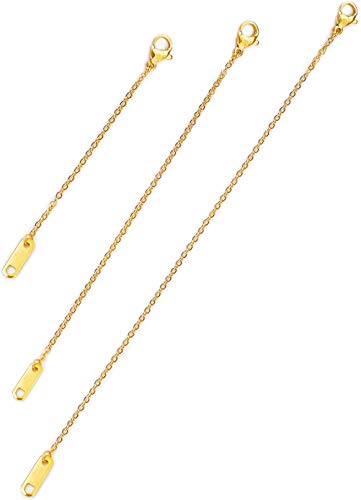
- ✨ Layers for Your Necklaces ✨ – Finally! Delicate yet durable necklace extenders crafted with…
- ✨ Quality Materials & Stylish Details ✨ – Made with quality stainless steel and plated with…
Top-selling match on Amazon

- Warm Tips: Anezus jump rings comes with a box of 1200 pieces silver and golden jump rings and…
- Variety Sizes: The jewelry making supplies contains a great selection of sizes jump ring for…
- Helpful Assembly Tools: The jump rings kit comes with bent nose pliers and a bonus jump ring opener. Just…
Chains often pair with earrings in a matching set, so if you are sorting a thrifted lot, our Types of Earring Backs guide helps you identify the fittings on the earrings too.
Shop the look on Amazon
Everything you need to build a secondhand-style wardrobe, delivered. We may earn a commission on purchases.
FAQ
What are the most common types of necklace chains?
Cable, rolo, curb, figaro, rope, box, snake and wheat chains are among the styles most often seen. The cable chain is described by Wikipedia as “one of the simplest and most universal chains,” which is why it turns up on so many pendants.
What is the difference between a rope chain and a box chain?
A rope chain looks like two strands spiraled together, while a box chain is a row of loose, rectangular links. Rope is textured and twisted; box is straight and geometric.
Is a Cuban link chain the same as a curb chain?
“Cuban link” is a trade name commonly used for a heavy, rounded curb-style chain. There is no single formal definition, so compare the actual links rather than relying on the label.
How do I know if a thrifted chain is real gold or silver?
Look for a stamp such as 14K, 925 or 1/20 14K GF and read it against the FTC terms. A stamp is the maker’s claim; for anything valuable, a jeweler can assess the metal.
How is chain thickness measured?
Sellers commonly list chain width in millimetres. Words such as “fine” or “chunky” vary between shops, so compare the measurement.
How do you untangle a knotted necklace chain?
Lay the chain flat on a smooth surface and loosen the knot slowly with two fine pins or needles rather than pulling the ends. A drop of baby oil or a little talc on the knot helps the links slide apart, and the chain can then be wiped clean with a soft cloth. Smooth chains such as snake and herringbone styles can crease if forced, so work gently and check for kinks afterwards.