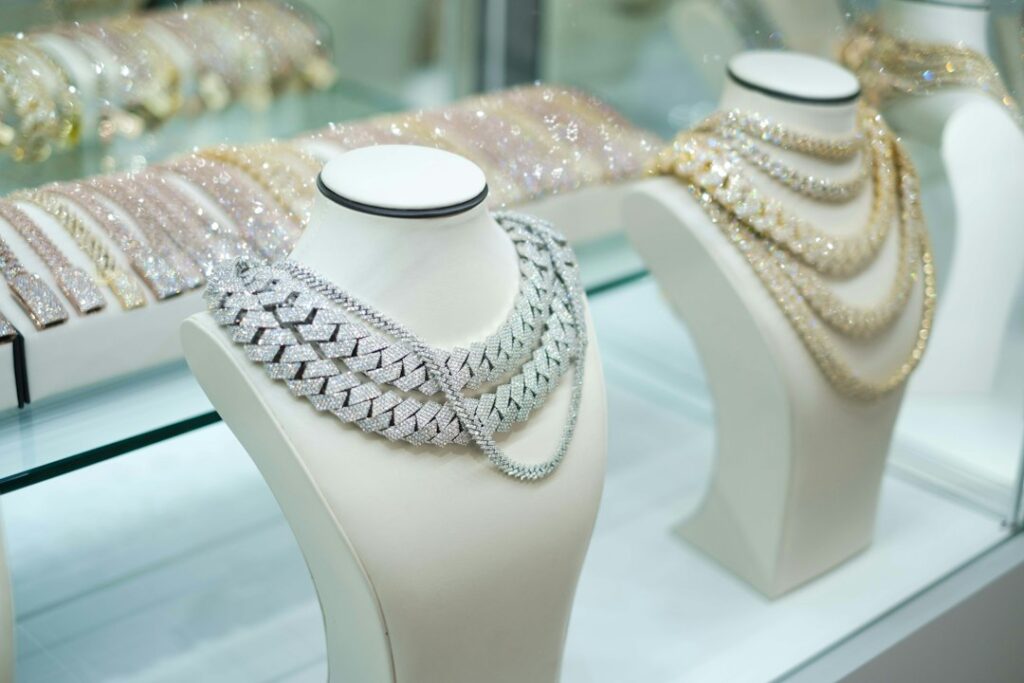
Necklace listings use three kinds of words at once: a length name, a chain name and a style name. Learn all three and a jewellery tray, at a shop or a thrift store, gets much easier to read.
The types of necklaces you see described online are usually sorted by length (choker, princess, matinee, opera, rope), by chain construction (cable, curb, rope, box, figaro and more) and by style (pendant, locket, statement, strand). Knowing those terms also makes stacking easier, which is the subject of our Layered Necklaces hub. This guide defines each term, notes where a source backs a number, and explains what the metal words on a tag mean under US rules.
Lengths and chain names are largely common trade usage. Where the Gemological Institute of America (GIA) or the Federal Trade Commission (FTC) give a definition, it is attributed below. Brands measure differently, so always check the length printed on the listing.
Necklace styles at a glance
| Style | Key feature | Typically worn with |
|---|---|---|
| Choker | Sits close around the neck | Open necklines, strapless tops |
| Princess | Falls just below the collarbone | Crewnecks, dresses |
| Matinee | Longer strand, mid-chest | Blouses, work dresses |
| Opera / rope | Very long, can be doubled | Evening dresses, knitwear |
| Pendant | Chain with a hanging charm or stone | Everyday outfits, layering |
| Locket | Pendant that opens | Simple tees and knits |
| Statement | Large, bold design | Plain dresses and tops |
| Bib / collar | Wide piece covering the upper chest | High or simple necklines |
Necklace lengths
GIA’s pearl buying guide puts it this way: “Traditional strands range from 14-16-inch chokers to 17-18-inch princess to longer matinee, opera, and rope lengths.” GIA gives inch ranges only for the choker and princess. The longer names are widely used in the trade, but any inch figures attached to them are common usage, not GIA numbers.
Choker
What it is: per GIA, a traditional choker strand is 14–16 inches. How to spot it: it sits snugly at the base of the neck or higher. How to wear it: with open necklines so it shows; velvet ribbon and pearl chokers are both common.
Princess
What it is: per GIA, a princess strand is 17–18 inches. How to spot it: it rests around the collarbone. How to wear it: one of the most versatile lengths, it sits neatly with crewnecks and most dress necklines.
Matinee
What it is: a longer strand that commonly falls around mid-chest. Lengths of roughly 20–24 inches are commonly cited, but this is trade usage, not a GIA figure. How to wear it: over blouses or work dresses.
Opera and rope
What they are: the longest traditional lengths. Opera lengths are commonly cited at around 28–36 inches and rope lengths at longer than that, again as trade usage rather than GIA numbers. How to wear them: long, or doubled into two shorter loops, often over knitwear like the styles in our Types of Sweaters guide.
Chain types
Chain names are common usage rather than standardised terms, and sellers sometimes vary them.
Cable
Uniform oval or round links joined one through the next. The most basic chain, often used for pendants.
Curb
Links that are twisted so they lie flat against each other. Common in both fine and heavier chains.
Rope
Small links woven so the chain looks like twisted rope. Not to be confused with a rope-length necklace.
Box
Square links that form a smooth, boxy line.
Figaro
A repeating pattern of several short flat links followed by one longer link.
Snake and herringbone
Both are smooth chains with tightly fitted links: a snake chain is round and flexible, a herringbone lies flat with a V-shaped pattern. Flat chains like herringbone are generally handled with care to avoid kinks.
Paperclip and Singapore
Paperclip chains use long, open rectangular links. Singapore chains twist flat links into a sparkly, rope-like strand.
Pendant vs choker, and other styles
A choker is a length; a pendant is a style. A pendant is any chain with a hanging element such as a charm, stone or initial, and it can come in any length. A choker sits close to the neck and may or may not have a pendant. Lockets are pendants that open to hold a photo. Statement and bib necklaces are larger pieces designed to be the focus of an outfit, usually worn with simple necklines.
What the metal labels mean
Under the FTC Guides (16 CFR Part 23), the terms on a tag have specific meanings:
- Karat gold: karat measures gold purity in 24ths, so 18K is 75% gold and 14K is about 58.3%. The FTC Guides say the word “Gold” should be immediately preceded by the correct karat.
- Gold plate, gold-filled and vermeil: per the FTC Guides, these must use gold alloy of at least 10 karat. Vermeil is sterling silver coated with gold at least 2.5 microns thick.
- Sterling: “Sterling Silver,” “Sterling,” “Ster.” or “solid silver” may be used only for items at least 92.5% silver.
Skin reactions are worth knowing about too. The American Academy of Dermatology says necklaces, rings and bracelets can trigger nickel allergy. If you react, look for clear metal labelling and ask the seller. For cleaning, see How to Clean Gold Jewelry Safely.
How to thrift necklaces
- Look for stamps near the clasp, such as 14K, 18K or 925, and use a loupe or phone magnifier to read them. A stamp is a clue, not proof; a jeweller can confirm.
- Test the clasp a few times; a weak spring ring is a common fault but is cheap to replace.
- Run the chain through your fingers to feel for kinks and stiff links.
- Lay the necklace flat and measure it end to end, clasp included, to find its length.
- Clean finds gently before wearing; our How to Clean Jewelry at Home (by Metal and Stone) guide covers common methods.
Our Thrift Store Jewelry Finds page shows what turns up on secondhand racks. For new pieces, searches such as 14K Gold Filled Pendant Necklace on Amazon, Sterling Silver Box Chain Necklace on Amazon or Pearl Choker Necklace on Amazon cover the main styles.
Top-selling match on Amazon

- Minimal Pearl Choker: This elegant station pearl choker boasts scattered starry simulated pearls on a slim…
- Size & Craftsmanship: This choker measures 14.5 inches with a 3‑inch adjustable extender; each simulated…
- Versatile Layerable Wear: Made for women and teen girls. Wear this white pearl choker solo for a sleek look or…
Top-selling match on Amazon
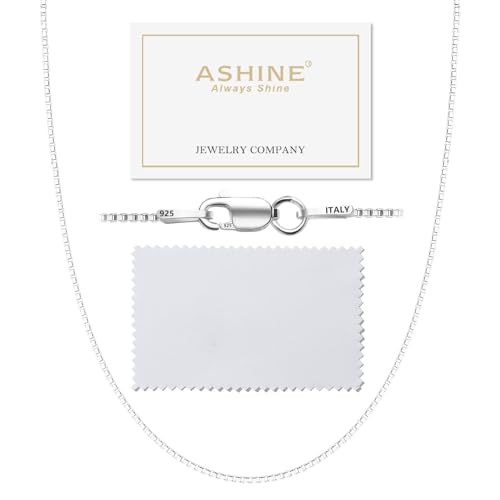
- Pendant Essential Box Chain: This necklace features a timeless square link structure that provides a sturdy base…
- Durable Interlocking Links: The geometric box links are tightly connected to offer flexibility and strength…
- High Polished Finish: The surface of the chain reflects light evenly to create a sleek and modern…
Shop the look on Amazon
Everything you need to build a secondhand-style wardrobe, delivered. We may earn a commission on purchases.
Browse picks on Amazon →Size charts: Necklace Length Chart
FAQ
What are the main necklace lengths?
Choker, princess, matinee, opera and rope. GIA gives 14–16 inches for chokers and 17–18 inches for princess strands; the longer lengths have commonly cited ranges that vary by seller.
What is the difference between a pendant and a choker?
A choker is a length that sits close to the neck. A pendant is a chain with a hanging charm or stone, and it can be any length.
What does 925 mean on a necklace?
It indicates 92.5% silver. Under the FTC Guides, “sterling” may be used only for items at least 92.5% silver.
Is gold vermeil real gold?
Under the FTC Guides, vermeil is sterling silver coated with gold alloy of at least 10 karat, at least 2.5 microns thick.
Which chain is best for a pendant?
Cable and box chains are common choices because their links are uniform, but this is styling preference rather than a rule. Check that the bail of the pendant fits over the chain and clasp.
Pair your necklace knowledge with our Types of Earrings glossary for a full jewellery vocabulary.
What is the difference between gold-filled and gold-plated necklaces?
Gold-filled necklaces carry a much thicker layer of gold alloy bonded to a base metal, while gold-plated pieces have only a thin surface coating. That difference is why gold-filled chains usually hold their colour far longer, and plated chains can wear through to the base metal with regular use. Under the FTC Guides, both terms require gold alloy of at least 10 karat. Check the stamp near the clasp and the listing wording to see which one you are buying.
How do you untangle a knotted necklace chain?
Untangle a necklace chain by laying it flat on a hard surface and loosening the knot gently with two pins or needles rather than pulling the ends. A drop of baby oil or a dusting of baby powder on the knot reduces friction and helps the links slide apart. Work slowly from the centre of the knot outward, then wipe off any oil with a soft cloth. Fine and flat chains such as herringbone kink easily, so avoid forcing them.
More Accessory Glossaries
Bracelets, watches, sunglasses, scarves and gloves.
Glossaries
Jewelry Findings Glossary
Chains, clasps and earring backs.
Glossaries
Western & Turquoise Jewelry
Squash blossoms and western jewelry.