The clasp is the smallest working part of a necklace or bracelet, and it is often the first thing to check when you pick up a secondhand piece.
Knowing the main types of jewelry clasps helps you judge a piece quickly, replace a broken fastening and pick one that is easy for you to work. The word is old: the Online Etymology Dictionary dates “clasp” to around 1300, as claspe, a “metal catch or hook used to hold things together.” This guide covers the common necklace clasp types, how to spot each one and what to check when thrifting. For chain styles and lengths, see our Types of Necklaces hub and the companion guide to Types of Chains.
Clasp types at a glance
| Clasp | Key feature | Typically worn with |
|---|---|---|
| Lobster | Spring-closed claw opened with a small lever | Necklaces, bracelets, keychains |
| Spring ring | Round ring with a sliding spring catch | Fine chains |
| Toggle | Bar passed through a ring | Bracelets, chunky necklaces |
| Box (tab insert) | Folded tab that clicks into a box | Multi-strand and beaded pieces |
| Magnetic | Two ends held by magnets | Light necklaces and bracelets |
| S-hook | S-shaped hook through a ring or link | Vintage and handmade pieces |
| Barrel (screw) | Two halves that screw together | Fine chains, beaded strands |
| Hook and eye | Open hook through a loop | Chokers and cord necklaces |
| Fold-over | Hinged cover that snaps shut | Watch-style and link bracelets |
Spring-loaded clasps
Lobster clasp
Wikipedia defines a lobster clasp as “a fastener that is held closed by a spring,” opened or closed with a small lever. It is named for its “pinching” mechanism and claw shape, and is also called a lobster hook, lobster claw or trigger clasp. The same source says it is used on “necklaces, bracelets, and keychains.” To spot one, look for an oval or teardrop claw with a small lever on one side. Press the lever and the gate swings in; let go and the spring closes it.
Spring ring clasp
“Spring ring” is a common trade name with no single defining source. It is commonly used to describe a small hollow ring with a tiny knob you pull back to open a gap, which springs shut when released. It is often found on fine, lightweight chains.
Lobster clasp vs spring ring
Both close with a spring, so the difference is shape and handling. A lobster clasp is a claw with a lever you press, and many people find the lever easier to grip. A spring ring is round and small, with a knob you slide, and it tends to sit neatly on fine chains. Neither is ranked above the other by the sources here; the better choice is the one you can open comfortably and that matches the weight of the chain.
Bar, box and hook clasps
Toggle clasp
A toggle is commonly described as a straight bar on one end that passes through a ring on the other, then turns sideways to hold. It is easy to work with one hand, which is why it is common on bracelets. Check that the bar is longer than the ring is wide.
Box clasp
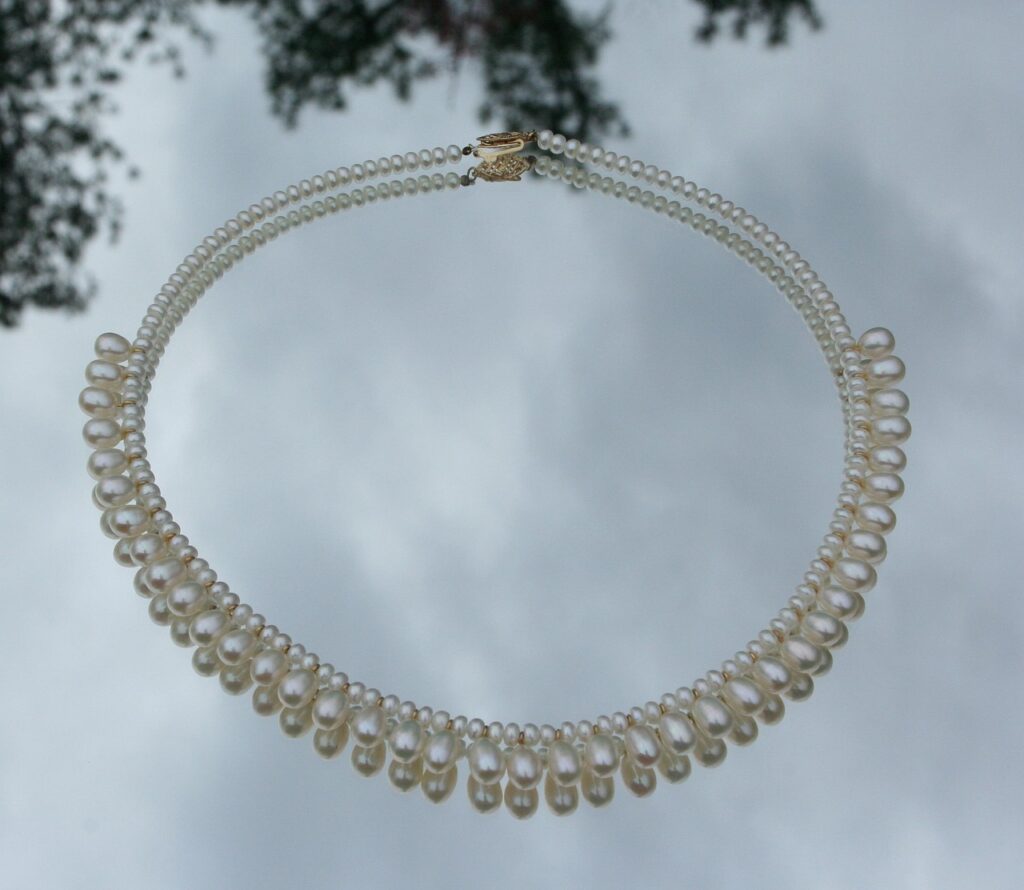
Also called a tab insert clasp, a box clasp is commonly described as a folded metal tab that slides into a small box and clicks into place. Many have an extra safety catch on the side. Box clasps are common on multi-strand pearl and bead necklaces.
S-hook
An S-hook is a simple S-shaped piece of wire or metal that hooks through a ring or the last link of a chain. It turns up often on vintage and handmade jewelry.
Hook and eye
This is commonly described as an open hook on one end that catches a loop or ring on the other. It is frequent on cord, leather and choker necklaces.
Screw, magnetic and fold-over clasps
Barrel (screw) clasp
A barrel clasp is commonly described as two small cylinders that screw together, so the closed clasp looks like a smooth bead. Check the threads for wear before buying secondhand.
Magnetic clasp
A magnetic clasp holds two ends together with magnets, and is often chosen by people who find small levers fiddly. Hold a thrifted one up and give it a gentle pull to see how firmly it closes.
Fold-over clasp
A fold-over clasp is commonly described as a hinged plate that folds down and snaps shut, often over a hook. It is common on link bracelets and watch-style bands; for watch straps, see our Types of Watches guide.
Metal stamps on clasps (FTC wording)
The clasp is where makers often stamp the metal. In the US, the FTC Jewelry Guides set the terms. Karat is measured in 24ths, and “sterling” requires at least 925/1,000 silver (16 CFR §§ 23.3, 23.5). On gold filled, the FTC wording is: “When such plating constitutes at least 1/20th of the weight of the metal in the entire article, the term ‘Gold Filled’ may be used.” Gold electroplate must be gold or gold alloy “of not less than 10 karat fineness” with “a minimum thickness throughout equivalent to 0.175 microns,” and vermeil is “a base of sterling silver coated or plated on all significant surfaces with gold, or gold alloy of not less than 10 karat fineness,” at a minimum two and a half microns (16 CFR § 23.4). A stamp is a claim, not a guarantee, and a replacement clasp may not match the metal of the chain. The American Academy of Dermatology estimates that “more than 18 percent of people in North America are allergic to nickel,” so check the clasp metal if you have a known sensitivity.
How to thrift pieces with good clasps
- Open and close the clasp several times and listen for a clean snap.
- On a lobster or spring ring, check that the gate closes fully with no gap.
- Look at the jump ring joining the clasp to the chain; a gap there can let the chain slip off.
- Read any stamp and compare it with the stamp on the chain.
- Look for worn plating or a different colour on the clasp, which can mean it was replaced.
A chain with a broken clasp can still be worth buying, since replacing a clasp is a small repair. A search such as Lobster Clasps Jewelry Findings on Amazon or Jewelry Pliers Set on Amazon brings up parts and tools, and Magnetic Clasp Converter Necklace on Amazon covers add-on magnetic converters. Our Thrift Store Jewelry Finds and How to Clean Jewelry at Home (by Metal and Stone) guides cover the rest of the routine, and the Types of Earring Backs guide does the same job for earrings. Matching bracelets are covered in Types of Bracelets.
Top-selling match on Amazon

- High-Quality Material: The needle nose plier set are made of drop forged carbon steel with nickel plating…
- Ergonomic And Comfortable Grip: Bi-material TPR handles offer a comfortable grip while using, soft and elastic…
- Self-Opening Shrapnel Design: The pliers set are equipped with double spring shrapnel to keep the pliers open…
Top-selling match on Amazon

- Please Note: If the pliers you received have some oil on the head that make it look like dirty…
- Assorted Sizes Jump Rings: These open jump rings are in sizes 4 mm, 5 mm, 6 mm, 7 mm, 8 mm, 10 mm. A nice…
- Helpful Jewelry Tools: The jewelry findings kit includes a jewelry pliers and a brass ring tool so you can…
Shop the look on Amazon
Everything you need to build a secondhand-style wardrobe, delivered. We may earn a commission on purchases.
FAQ
What is the most common necklace clasp?
Lobster clasps and spring rings are among the clasps seen most often. Wikipedia notes lobster clasps are used on necklaces, bracelets and keychains.
Which is easier to open, a lobster clasp or a spring ring?
Many people find a lobster clasp’s lever easier to grip than a spring ring’s small knob, but this is a matter of preference. Magnetic and toggle clasps are other options for one-handed use.
Can I replace a clasp on a thrifted chain?
Yes. A common method is to open the jump ring with two pairs of flat-nose pliers, swap the clasp and close the ring by twisting, not pulling. A jeweler can do it for valuable pieces.
What does the stamp on a clasp mean?
It is the maker’s metal marking, such as 925 for sterling or 14K for gold, read against the FTC Jewelry Guides.
How do you fasten a bracelet clasp by yourself?
The easiest bracelets to fasten alone have toggle or magnetic clasps, since a toggle bar passes through its ring with one hand and magnets pull the ends together. For a lobster clasp or spring ring, rest the wrist on a table and hold the loose end in place with a small piece of tape while working the clasp. Many people also find a lobster clasp’s lever easier to grip than a spring ring’s small knob.