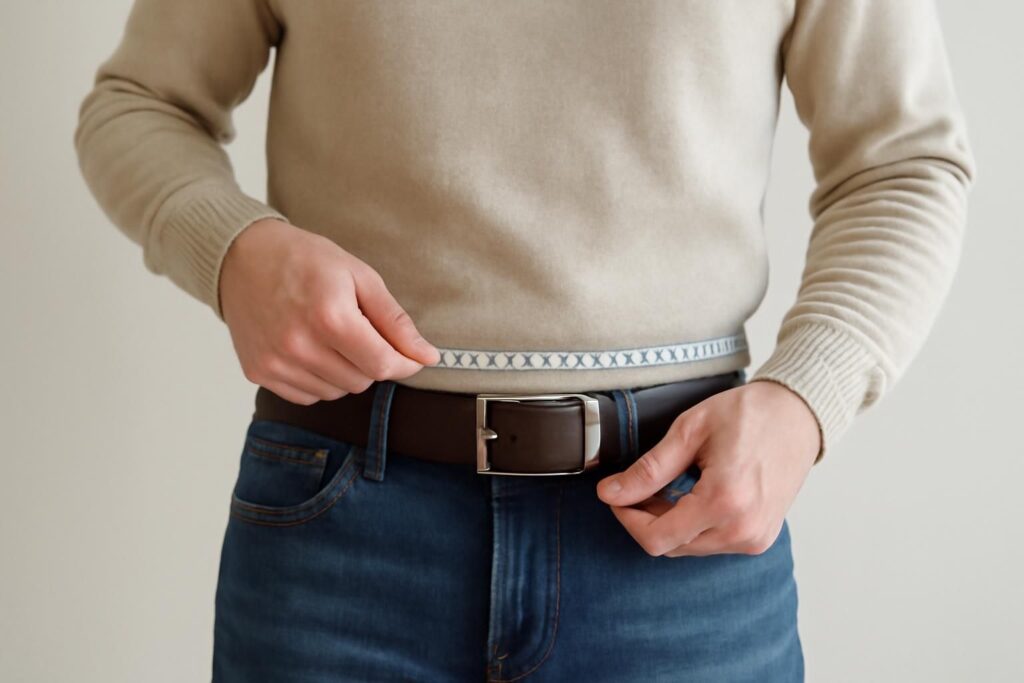
Belt sizes look simple, a single number on the tag, but that number is not the same as your trouser size. Here is how belt sizing usually works and three ways to find the right one.
This mens belt size chart and guide explains how belt sizes are commonly labelled, how to measure belt size from a belt you already own, and how to work from your waist measurement when you are starting from scratch. A quick word on sources up front: there is no single official standard for men’s belt sizing. What follows is a widely used sizing convention plus common measuring methods, and every brand is free to cut its belts differently. Always check the maker’s own chart before you buy. If you are choosing a belt to wear with denim, our Best Men’s Belts for Jeans guide covers styles, widths and buckles.
The common rule: belt size = waist size + 2
The most widely used belt sizing convention is that your belt size is about 2 inches larger than your trouser waist size. So if you wear 34-inch-waist trousers, a size 36 belt is the usual starting point. The extra length accounts for the belt sitting over the trousers and for the strap reaching a middle hole with some tail left over.
Belt sizes are usually given in inches and refer to the length of the strap from where the leather folds at the buckle to a central hole, not the full end-to-end length. That is why a size 36 belt measures longer than 36 inches overall.
Treat the rule as a starting point, not a guarantee. Trouser waist sizes themselves are inconsistent between brands: CBS News reported that a 2010 Esquire test by Abram Sauer measured “size 36” men’s trousers from several brands and found actual waists ranging from 39 to 41 inches. That was one reporter’s sample from 2010, not an industry-wide figure, but it shows why a label size may not match your real measurement. The methods below give you a more reliable number.
Men’s belt size chart (common convention)
The table applies the common waist-plus-two rule. It is a convention, not a brand chart. Brand sizing varies, so compare against the specific maker’s chart before ordering.
| Trouser waist size (in) | Typical belt size by the +2 convention (in) |
|---|---|
| 28 | 30 |
| 30 | 32 |
| 32 | 34 |
| 34 | 36 |
| 36 | 38 |
| 38 | 40 |
| 40 | 42 |
| 42 | 44 |
| 44 | 46 |
| 46 | 48 |
| 48 | 50 |
Some brands sell belts in letter sizes (S, M, L and so on) instead of inches. Each brand maps those letters to its own range of lengths, so there is no universal conversion between letter and inch sizes. Use the brand’s chart for those.
How to measure belt size: three methods
Pick the method that fits what you have on hand. The first is the most direct.
Method 1: measure a belt you already own
If you have a belt that fits well, it is the best guide to your size. A common method:
- Lay the belt flat on a table, buckle end on the left.
- Find the point where the leather folds around the buckle bar.
- Find the hole you use most often.
- Measure in inches from the fold to that hole.
- That length is your belt size. Round to the nearest inch.
Do not measure from the tip of the buckle or to the end of the strap, as that overstates your size. If the belt you are measuring has stretched or the favourite hole has worn larger, measure to the centre of the hole.
Method 2: measure your waist where the belt sits
If you do not have a well-fitting belt, a common method is to measure your waist where the belt will actually sit, over the trousers you plan to wear it with:
- Put on the trousers you intend to wear with the belt.
- Thread a soft tape measure through the belt loops, or wrap it around at belt-loop height.
- Keep the tape level all the way around.
- Hold it snug but not tight.
- Read the measurement in inches.
- Compare that number with the brand’s belt chart.
Where your trousers sit matters. A health-style waist measurement is taken just above the hip bones, according to the US National Heart, Lung, and Blood Institute, and that is not necessarily where jeans or chinos sit. For sizing, measure where the waistband actually rests. Our guide to How to Measure Your Waist for Clothing Sizes walks through the different waist measurements in more detail.
Method 3: use your trouser size
If you only know your trouser size, apply the waist-plus-two convention from the chart above. This is the quickest route but the least reliable, because trouser labels vary between brands. Our Men’s Pants Size Chart and Levi’s Size Chart for Men explain how trouser waist sizes are labelled, including the waist-by-inseam format.
Fit tips
These are common guidelines rather than rules, but they help you judge whether a belt fits:
- Aim for the middle hole. Many belts have five holes. A belt that fastens on the centre hole leaves room to adjust either way through the day or as your trousers change.
- Check the tail. After fastening, the strap end should reach the first belt loop past the buckle without wrapping far beyond it. A very long tail suggests the belt is too big; one that barely clears the buckle suggests it is too small.
- Match the width to the trousers. Dress belts are usually narrower and casual belts for jeans wider, and very wide belts may not fit through narrow trouser loops. Check the loop width on your trousers before buying.
- Consider the trouser rise. If you wear low-rise jeans with a belt sized for high-waisted trousers, the fit changes. Size the belt for the trousers you wear most.
- Between sizes, think about adjustability. Belts with a ratchet or track buckle and no holes, or belts you can trim at the buckle end, give finer adjustment. Read the product details to see whether a belt can be shortened.
One belt or two: dress and casual sizing
Many people own a dress belt for suits and chinos and a sturdier casual belt for jeans. The two do not always end up the same size, for a few practical reasons:
- Different trousers sit in different places. Tailored trousers often sit higher than jeans, so the measurement at belt-loop height can differ between them.
- Thicker leather takes up more room. A heavy casual strap wraps around the buckle bar differently from a thin dress strap, which can shift the fit by a hole.
- Layers change the measurement. A tucked-in shirt or sweater adds a little bulk at the waist.
If you wear both styles often, measure with each type of trouser on, using Method 2 above, or measure a well-fitting belt of each kind with Method 1. Writing the two numbers down saves guesswork the next time you shop.
Brand variation and buying online
Because there is no universal standard, the same number can mean slightly different lengths from one maker to another. Some brands measure to the centre hole, others list the overall length, and some use letter sizes. Before ordering online:
- Find the brand’s own size chart on the listing or the maker’s website.
- Check what the size number refers to (fold-to-centre-hole or overall length).
- Compare with the measurement of your best-fitting belt.
- Read the return policy in case the fit is off.
When browsing, searches like Mens Leather Belt For Jeans on Amazon or Mens Ratchet Belt Adjustable on Amazon bring up a wide range. Check each listing’s size chart rather than assuming the number matches another brand. For a broader roundup, see our Amazon Belts guide.
Top-selling match on Amazon

- Premium Full-Grain Leather: Crafted from the cowhide's top layer, this mens belts casual features 1.5"…
- Effortless Everyday Comfort: Oval holes ensure smooth, easy adjustments and resisting deformation for…
- Essential Wardrobe Staple: Designed to complement any outfit, this brown leather belt men is perfect for daily…
Thrift and vintage belts
Thrift stores are full of good leather belts, often with the size stamped on the inside of the strap. A few things to keep in mind:
- Ignore the stamp at first. Older belts may have been sized to a different convention, and a previous owner may have punched extra holes. Measure from the fold to the centre hole yourself.
- Look at the hole wear. The most-worn hole shows where the last owner fastened it. If that is near your measurement, the belt is likely a good fit.
- Check the leather. Look for cracking along the fold and around the holes. Light scuffs can often be cleaned and conditioned.
- Check the buckle. Make sure the prong moves freely and the buckle is firmly attached.
For smooth leather belts, a common care routine is the same as for leather shoes: wipe off dirt, clean with a leather cleaner or saddle soap, condition sparingly and let it dry at room temperature away from direct heat. Our guide to How to Clean Leather Shoes and Keep Them Conditioned covers that routine step by step, and a small kit like Leather Cleaner And Conditioner Kit on Amazon works for belts too. For other secondhand menswear, see our Men’s Thrift Store Shopping guide.
Top-selling match on Amazon
- Easy To Use Formula: Our multi-action formula conditions & protects in one simple step to maintain and…
- Multiple Uses: Use regularly on accessories such as leather, purses, shoes, boots, briefcases &…
- Uvx Protection: Weiman Leather Conditioner contains UVX-15 sunscreen which protects all types of…
Men’s belt size FAQ
What size belt should I get if I wear a 34 waist?
By the common waist-plus-two convention, a size 36 belt. Check the brand’s chart, since sizing varies.
How is belt size measured?
Belt size is commonly measured from the fold at the buckle to the hole you use most, usually the centre hole. It is not the overall length of the strap.
Should a belt fasten on the middle hole?
That is a common guideline, since it leaves room to adjust either way. It is a preference rather than a rule.
Is belt size the same as pant size?
Usually not. The common convention puts belt size about 2 inches above trouser waist size, and trouser labels themselves vary between brands.
What if I am between belt sizes?
Look for a belt that can be trimmed at the buckle end, or a ratchet-style belt with finer adjustment. Measuring your best-fitting belt is the most reliable way to choose.
How do you add a new hole to a leather belt?
A leather hole punch is the cleanest way to add a hole, because it removes a neat circle rather than tearing the strap like a nail or drill can. Fasten the belt where it feels right and mark the spot on the centre line, matching the spacing of the existing holes so the new one lines up. Choose a punch size close to the current holes, press firmly through on a hard surface, and smooth the edge. A cobbler or leather shop can do it if the leather is thick or embossed.
Shop the look on Amazon
Everything you need to build a secondhand-style wardrobe, delivered. We may earn a commission on purchases.