The curling teardrop on bandanas, silk ties and 1960s shirts has a longer road behind it than most patterns, running from Kashmir shawls to a weaving town in Scotland and back into everyday wardrobes.
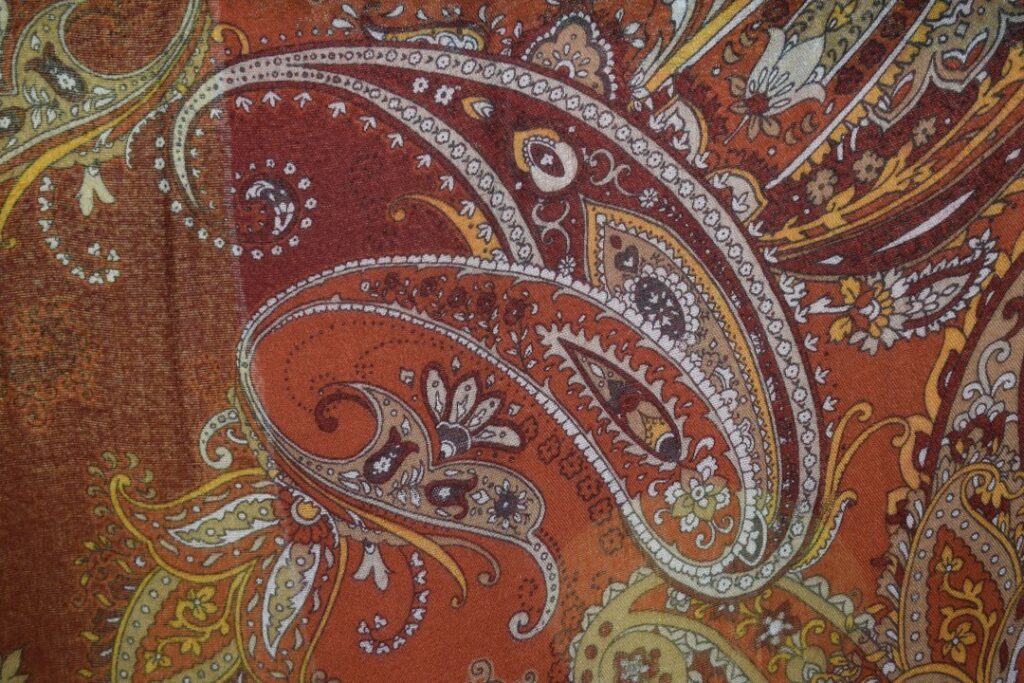
What is paisley? It is a pattern built from a curved teardrop motif, known as the boteh, usually repeated in rows or clusters and filled with smaller flowers, dots and lines. Most people meet it first on a bandana, and our How to Wear a Bandana guide covers the ways to tie one. This explainer looks at where the motif comes from, why it carries the name of a Scottish town, how to spot woven versus printed paisley, and how to wear and care for it when you find it secondhand.
Quick answer: Paisley is a repeating pattern of rounded teardrop shapes called boteh. The motif appears on woven pashmina shawls from Kashmir, and it takes its English name from Paisley, a town in southwest Scotland that became a major shawl-weaving centre in the early 1800s by reproducing Kashmir designs.
Where the boteh comes from
The motif at the heart of the paisley pattern is the boteh, a teardrop shape with its tip curled over. The Victoria and Albert Museum holds a 19th-century Kashmir shawl with boteh borders, acquired in Kashmir in 1881–82, and woven pashmina shawls of this kind are the best-known source of the shape. The Vintage Fashion Guild describes paisley as “a modified teardrop shape, with the point of the drop rounded over,” which is a neat way to recognise it on any garment.
The important point is that paisley was not invented in Scotland. The boteh belongs to Kashmir and the wider South and West Asian design tradition. Scotland’s contribution was the name and a great deal of machine-made imitation, which is where the story goes next.
How a Scottish town gave the pattern its name
According to Etymonline, “paisley” has been used for a type of clothing or material since 1834, named for Paisley, a town in southwest Scotland where the cloth was made. The town name itself is unrelated to textiles: Etymonline says it literally means “church,” from Latin basilica.
The V&A describes Paisley as becoming a major British shawl-making centre in the early 1800s, reproducing Kashmir patterns. The Jacquard loom, imported from France, was in general use there by 1845, and by the 1850s Paisley designers were drawing on French as well as Indian design. The museum notes that machine-woven Paisley shawls were much cheaper than hand-woven Indian ones, and that colours such as burgundy reflected European tastes. The Vintage Fashion Guild places Scottish imitation of Kashmir shawls slightly earlier, in the 18th century, so the sources differ a little on timing.
If you want to understand how a loom weaves a pattern this detailed, our What Is Jacquard? Woven Patterns Explained explainer covers the punched-card mechanism behind it.
Paisley through the decades
The motif kept moving after the shawl era. The Smithsonian Magazine notes that paisley on bandanas imitated Kashmir shawls, which is why the red and navy cotton kerchief still carries the shape. The Vintage Fashion Guild links a 1960s revival of paisley to interest in Indian culture at the time, and it remains part of the look of 60s Fashion and 70s Fashion in shirts, scarves and maxi dresses.
Woven paisley vs printed paisley
| Type | How to spot it | Pros | Cons |
|---|---|---|---|
| Woven (jacquard) paisley | Pattern is built from coloured threads; the back shows the design in reverse or with loose floats | Pattern cannot wear off; often heavier and richer | Floats on the back can snag; usually more expensive |
| Printed paisley | Pattern sits on the surface; the back is paler or plain | Lighter, cheaper, comes in every fabric from cotton to rayon | Print can fade with washing and sun |
| Embroidered paisley | Raised stitches you can feel | Texture and detail | Threads can catch and pull |
How to wear a paisley shirt and other pieces
Paisley is busy by nature, so common styling advice is to let it be the one pattern in an outfit and pull a single colour from it for everything else.
- Paisley shirt: wear it with plain dark denim or chinos and a solid jacket. A Paisley Shirt Men on Amazon in navy or burgundy is the easiest starting point. For dressier shirt shapes, see our Mens Dress Shirts guide.
- Bandana or scarf: a small dose at the neck or in the hair adds pattern without taking over. Our How to Tie a Scarf guide has the knots. Classic options include a Paisley Bandana Cotton on Amazon.
- Dresses and skirts: paisley maxi dresses and midi skirts pair well with a solid knit or a denim jacket.
- Mixing patterns: if you want two patterns, a common approach is to pair paisley with something much smaller in scale, such as a fine stripe or What Is Gingham? The Checked Cotton Explained, in a shared colour. Larger checks like Plaid vs Tartan or What Is Madras? The Lightweight Plaid Cotton compete more.
Top-selling match on Amazon

- 4 Pack of Paisley Bandanas in Coordinated Colors: Four 22 x 22 inch cotton paisley bandanas in…
- Dense, Soft 100% Cotton That Absorbs: Woven from tightly packed, high-density premium cotton…
Top-selling match on Amazon

- 【UNIQUE STYLE】Unique paisley design and jacquard woven craft add elegance to DiBanGu mens red…
- 【MATERIAL and CRAFT】2000 stitches jacquard woven craft, high-density fabric makes mens red and…
How to care for paisley
Care depends on the fabric, not the pattern, so the care label comes first. Under the FTC Care Labeling Rule, the label must say whether an item should be washed by hand or machine and give a water temperature if regular hot water would harm it.
- Silk paisley ties and scarves: silk is a protein fibre, and the Smithsonian Museum Conservation Institute warns that protein fibres “can be damaged by protein enzymes or alkali,” and that chlorine bleach “will dissolve silk or wool.” Avoid bio detergents and chlorine bleach. Our How to Wash Silk Without Ruining It guide has the step-by-step.
- Wool or cashmere shawls: the same MCI cautions apply. Handle them gently while wet, because MCI notes these fibres “stretch more easily, tear more readily in water.”
- Cotton bandanas and shirts: usually machine-washable; a common method is cold water and turning prints inside out to slow fading.
- Dry-clean-only pieces: take them to a professional cleaner.
Thrifting paisley: what to check
- The fibre label. Silk, wool, cotton and rayon all carry paisley; each needs different care.
- The back of the fabric. A reversed or float-covered back points to a woven pattern; a pale back points to a print.
- Fading and sun damage. Check folds and shoulders on printed pieces.
- Moth holes on wool and cashmere shawls, especially along the fringe.
- Snags on woven paisley where loose threads have caught.
Vintage shawls labelled as Paisley may be 19th-century textiles of real historical interest, so if one turns up, a museum collection such as the V&A’s is a useful reference for comparing details. For more fabric basics, browse our Types of Fabric hub, or shop a Paisley Silk Scarf Women on Amazon if you want a ready-made accent.
Shop the look on Amazon
Everything you need to build a secondhand-style wardrobe, delivered. We may earn a commission on purchases.
FAQ
What is the paisley pattern called in its place of origin?
The teardrop motif is known as the boteh. It appears on woven pashmina shawls from Kashmir, which the V&A holds in its collection.
Is paisley Scottish or Indian?
The motif comes from Kashmir and the wider South and West Asian tradition. Paisley, Scotland, gave it its English name and produced cheaper machine-woven imitations from the early 1800s, according to the V&A.
Why is paisley on bandanas?
The Smithsonian Magazine notes that paisley on bandanas imitated Kashmir shawls, carrying the motif onto an everyday cotton kerchief.
Is a paisley shirt formal or casual?
It depends on the fabric and cut. A silk paisley tie or pocket square works with tailoring, while a cotton paisley shirt reads casual. Treat it as a statement piece and keep the rest of the outfit plain.
How can I tell if paisley is woven or printed?
Turn it over. Woven paisley shows the design on the back, often in reverse or with floats, while a printed one is usually lighter or blank on the back.