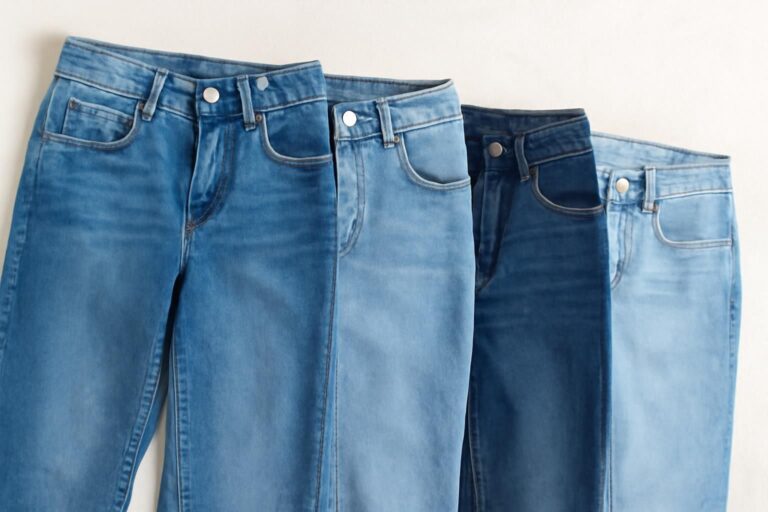
A waist measurement is one of the simplest numbers to take and one of the easiest to get muddled, because “waist” means different things on a size chart, on a pair of jeans and in a doctor’s office.
This guide explains how to measure waist size for clothing, step by step, and clears up the confusion between the natural waist, the spot where your pants actually sit, and the waist measurement used in health settings. It also covers measuring a pair of pants instead of your body, which is often the more useful number for jeans. Waist and inseam work as a pair on most pants, so if you also need your leg length, start with our How to Measure Inseam (for Pants and Jeans) guide.
A note on tone: a waist measurement is neutral data. It tells a size chart how much room a garment needs, nothing more. There is no right number, and the goal here is simply clothes that fit the way you want.
Three different “waists” and why it matters
Before picking up the tape, it helps to know which waist you are measuring. Three different measurements often get called “the waist”, and they can differ by several inches on the same person.
1. The natural waist (for size charts)
The natural waist is usually the narrowest part of the torso, often a little above the belly button. Many brand size charts for dresses, tops and some trousers use this point. According to the Levi’s size guide, shoppers should measure around the smallest part of the waist. If a brand’s chart says “natural waist” or “waist” without explanation, this is usually the spot it means.
2. Where your pants sit (for jeans and trousers)
Most modern jeans and many trousers do not sit at the natural waist. Mid-rise and low-rise styles sit lower, closer to the hips. The circumference where the waistband actually rests is often what matters for comfort, and it can be larger than the natural waist. This is why many people find that the most useful number for pants comes from measuring a pair that fits (covered below) rather than measuring the body.
3. The health waist (not a clothing size)
The US National Heart, Lung, and Blood Institute (NHLBI) describes a waist measurement used in health settings: “Stand and place a tape measure around your middle, just above your hipbones. Measure your waist just after you breathe out.” That measurement is taken for health screening, at a specific point above the hip bones. It is not the same as a brand’s natural waist, and it does not define trouser waist sizes. If a doctor or nurse takes this measurement, it serves a different purpose from a clothing size chart, and the two numbers should not be swapped for one another.
For shopping, the rest of this guide focuses on the first two: the natural waist and the waist where your pants sit.
What you need
- A soft, flexible tape measure. A cloth or fibreglass sewing tape wraps around the body. A metal tape does not bend well enough. A Soft Tape Measure Body Measuring on Amazon is inexpensive and useful for every size chart.
- A mirror to check that the tape is level all the way around.
- Thin clothing or none. Measure over underwear or a thin layer, not over jeans or a jumper.
- Something to write with.
- A string (optional). If you have no tape, wrap a string, mark it, and measure the string against a ruler. It is a little less precise but works in a pinch.
Top-selling match on Amazon

- 𝐓𝐰𝐨 𝐓𝐚𝐩𝐞𝐬, 𝐎𝐧𝐞 𝐒𝐨𝐥𝐮𝐭𝐢𝐨𝐧: This 2pc set gives you a white classic soft tape and a black quick…
- 𝐂𝐥𝐞𝐚𝐫 𝐍𝐮𝐦𝐛𝐞𝐫𝐬, 𝐙𝐞𝐫𝐨 𝐄𝐲𝐞 𝐒𝐭𝐫𝐚𝐢𝐧: Both tapes feature large, bold, high-contrast markings, making…
How to measure waist size on your body: step by step
These steps follow a common method used for clothing size charts. Check the specific brand’s chart first, because some brands describe their measuring point differently.
- Stand up straight in front of a mirror, feet together, arms relaxed at your sides.
- Find the measuring point. For a natural waist measurement, bend gently to one side; the crease that forms is usually close to the natural waist. For a pants waist, find where the waistband of your usual pants rests.
- Wrap the tape measure around your body at that point.
- Check in the mirror that the tape is level all the way around, including across your back.
- Keep the tape snug against the skin but not tight enough to press in.
- Breathe out normally and relax. Do not hold your breath or pull your stomach in.
- Read the number where the end of the tape meets the rest of the tape.
- Write the number down, rounding to the nearest half inch or centimetre.
- Measure a second time to confirm. If the numbers differ, take a third reading and use the middle one.
Tips for an accurate reading
- Relax. Sucking in or holding your breath gives a number that will not match how clothes feel through the day.
- Keep the tape level. A tape that dips at the back adds length. The mirror helps.
- Measure at a consistent time. Many people find measurements vary slightly through the day, so measure at a similar time if you are comparing.
- Allow one finger of room if you prefer a relaxed fit. Some people slip a finger under the tape for comfort; others measure snug and choose the fit on the size chart.
- Measure both points (natural waist and where pants sit) once, so you have both numbers ready for any size chart.
How to measure waist for jeans using a pair that fits
For jeans and trousers, the most reliable number often comes from a pair you already own and like. It reflects the rise, the fabric and the way you wear them. This is a common method used by resellers and tailors.
- Choose a pair of pants that fit well at the waist.
- Button and zip them.
- Lay them flat on a table, front facing up.
- Smooth out the waistband so the front and back lie flat together.
- Measure straight across the top of the waistband from one side edge to the other.
- Double that number to get the full waist circumference.
- Write it down alongside the inseam and rise if you have them.
Stretch denim can give a slightly smaller flat measurement than the waist it fits, because it relaxes when worn. Lay it naturally without pulling it wide.
Waist size for pants: reading the label
Men’s trousers and jeans are commonly labelled waist × inseam in inches. A pair marked 32×30 has a 32 in waist and a 30 in inseam. Our Men’s Pants Size Chart guide explains these labels in more detail, and Levi’s Size Chart for Men shows how one brand lays out its sizing.
The label number and the measured waist do not always match. In 2010 a reporter for Esquire, Abram Sauer, measured men’s trousers labelled “size 36” and, according to CBS News, found an Old Navy pair measured 41 in, Dockers 39.5 in, and Haggar and Gap 39 in each. That was one reporter’s 2010 sample, not a picture of how those brands size pants today, but it shows why measuring the garment is worth the minute it takes.
Women’s pants are more often sold by a size number (such as 8, 10 or 28), and each brand publishes the waist range for each size. Compare your measurement to the brand chart, not to another brand’s numbers. Our guides to the 7 for All Mankind Size Chart, Lane Bryant Size Chart and Z Supply Size Chart show how differently brands present their charts.
Using your waist measurement on a size chart
- Find the brand’s own size chart for the specific product type (jeans, trousers, dresses).
- Check which waist the chart means: natural waist, low waist or garment measurement.
- Match your measurement to the matching row.
- If you fall between sizes, read the product notes on stretch and fit. Stretch fabrics can make the smaller size comfortable; rigid fabrics often suit the larger size.
- Check the hip and rise measurements too if the chart lists them, especially for jeans.
Remember that a garment measurement on a chart is the size of the clothing, while a body measurement is the size of you. A chart that lists garment measurements usually builds in some room, so the numbers will look larger than your body measurement.
Common mistakes
- Measuring over clothes. Jeans or a thick jumper add inches.
- Mixing up the health waist and the clothing waist. The NHLBI point above the hip bones is for health screening, not size charts.
- Using the natural waist for low-rise jeans. Low-rise pants sit lower, so the natural waist can make you size down too far.
- Pulling the tape tight. The tape should rest on the skin, not compress it.
- Trusting a vintage label. Older and secondhand clothing may have shrunk, stretched or been altered.
Thrift note: measure the waistband
When buying secondhand, the size tag is only a clue. Pants may have been taken in, let out, shrunk in a dryer or stretched with wear, and vintage sizing conventions differ from current ones. Carry a small Retractable Tape Measure Keychain on Amazon when you thrift, measure across the waistband and double it, and compare to a pair that fits you. When buying online, ask the seller for a flat waist measurement in inches. Our guides on How to Find Vintage Clothing and How to Identify Vintage Levi’s cover more checks for older pieces, and How to Prevent Clothes From Shrinking in the Wash covers wash habits that help keep waistbands the size you bought.
Top-selling match on Amazon

- Length: 6-ft long
- Convenience: Key ring allows you to easily take the tape with you wherever you go
- Durability: Lacquer coating helps protect the blade
Frequently asked questions
Where do I measure my natural waist?
The natural waist is usually the narrowest part of your torso, often a little above the belly button. Bending to one side shows a crease near that point. Levi’s, for example, tells shoppers to measure around the smallest part of the waist.
Is waist size the same as pant size?
Not always. On men’s pants the first label number is a waist size in inches, but the garment can measure differently from the label. Women’s pants use size numbers that map to a waist range on each brand’s chart.
Should I measure my waist where my jeans sit?
For jeans, yes, that number is often more useful than the natural waist, because most jeans sit below it. Measuring a pair that already fits is even more reliable.
Is the NHLBI waist measurement the same as a clothing waist?
No. NHLBI describes measuring just above the hip bones after breathing out, for health screening. Clothing brands use their own measuring points, so follow the brand’s chart for shopping.
Do I measure my waist in inches or centimetres?
Use whatever the size chart uses. US men’s pants labels are usually in inches, while many European brands use centimetres. One inch is 2.54 cm, so you can convert if needed.
What if I am between sizes?
Check the fabric. Stretch denim and knit waistbands often allow the smaller size, while rigid fabrics may need the larger one. A tailor can take in a waist more easily than let one out.
Shop the look on Amazon
Everything you need to build a secondhand-style wardrobe, delivered. We may earn a commission on purchases.
Browse picks on Amazon →Related reading: How to Measure Your Chest for Shirts and Jackets.