A shirt that is too wide or too long can usually be brought in with a straight seam, a new hem or, for some fabrics, a warm wash, and a few no-sew tricks cover the days you just want to wear it now.
If you have thrifted a great shirt in the wrong size, learning how to make a shirt smaller saves it from the donation pile. The options range from sewing new side seams to shortening the hem, shrinking cotton in a hot wash, or simply knotting and tucking. The sewing steps use the same basic skills as hemming trousers, so our How to Hem Pants guide is a good companion to this one.
Every method below is a common method, not an official one. Fit is personal, so measure against a shirt you already like rather than aiming for a set size.
Methods at a glance
| Method | Best for | Effort |
|---|---|---|
| Take in the side seams | A shirt that is too wide | Medium |
| Shorten the hem | A shirt that is too long | Medium |
| Hot wash and dry | 100% cotton tees, a small change | Easy, unpredictable |
| Knot, tuck or belt | Wearing it today, no changes | Easy |
| See a tailor | Shoulders, collars, darts, fine fabric | Low effort, paid |
What you need
- A shirt that already fits you well, to use as a guide.
- Pins and tailor’s chalk or a washable marker; a Sewing Pins And Tailors Chalk Set on Amazon covers both.
- Sharp fabric scissors.
- A sewing machine, or a needle and thread for hand sewing.
- An iron.
Top-selling match on Amazon

- Ample Set For Versatile Use: includes 10 triangle tailors chalk(1.8" x 1.8" ) and 50 acrylic sewing clips…
- Complete Sewing Kit: This bundle offers triangle sewing chalk and quilting clips, covering the entire…
- Smooth Marking: Made from gypsum, the fabric chalk create smooth, clear lines without scratching…
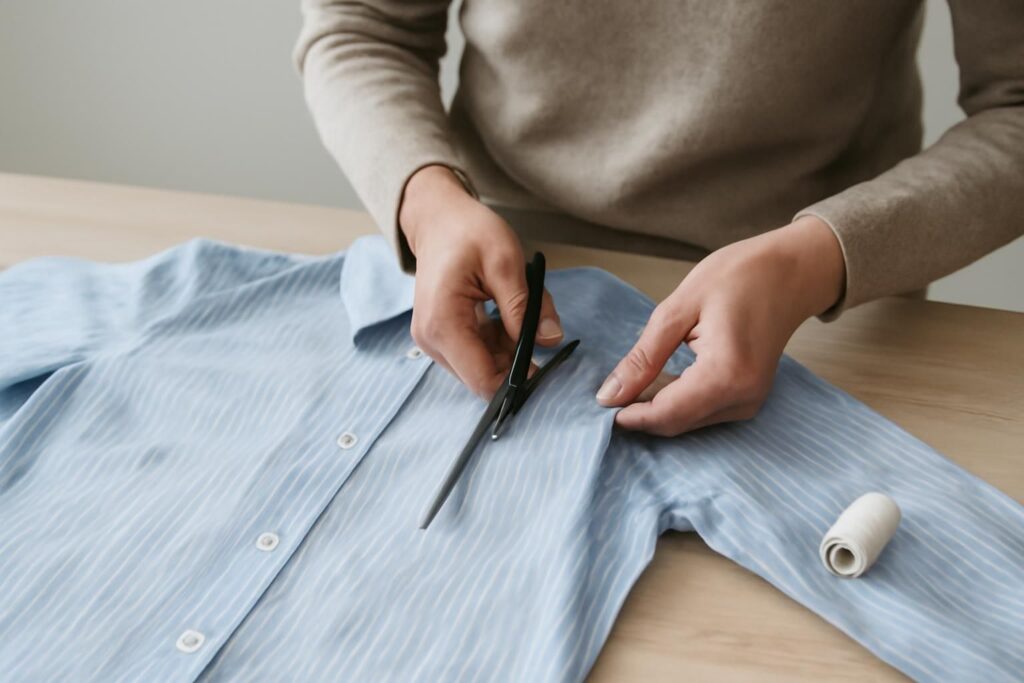
Method 1: Take in the side seams
This is a common method for a shirt that is the right length but too wide in the body.
- Turn the shirt inside out.
- Lay your well-fitting shirt on top, matching the shoulders and the centre.
- Trace the side seams of the smaller shirt onto the larger one with chalk, from the underarm down to the hem.
- Blend the new line smoothly into the existing sleeve seam at the underarm.
- Pin along the chalk line through both layers.
- Try the shirt on, still inside out, and adjust the pins if needed.
- Sew along the line. On a knit t-shirt, a narrow zigzag or stretch stitch lets the seam stretch with the fabric.
- Try it on again before cutting anything.
- Trim the excess, leaving a seam allowance of about half an inch.
- Finish the raw edges with a zigzag or overlock stitch, then press the seams.
To slim the sleeves, continue the same line down the underside of each sleeve to the cuff. On a button-up shirt with a cuff placket, keep the change small near the cuff or the placket will no longer line up.
Method 2: Shorten the hem
- Try the shirt on and mark the length you want with a pin.
- Lay it flat and measure from the existing hem to the pin.
- Mark the new hemline all the way round, adding the hem depth below it.
- Cut along the lower line.
- Fold the raw edge up, then fold again to enclose it, and press.
- Stitch close to the inner fold.
NMSU Extension’s hemming guide describes a hand blind stitch with small horizontal stitches 1/8 to 1/4 in from the edge, about 1/4 to 1/2 in apart, which should not show from the right side; it notes this suits non-stretch, non-ravelling fabrics, so it fits woven shirts better than jersey. The same guide covers fusible web (hem tape) as a no-sew option: test it on a scrap first, don’t slide the iron, keep the web at least 1/4 in from the cut edge, and avoid it on sheers and laces. A roll of Fusible Hem Tape Iron On on Amazon is handy for quick fixes. For more on hems, our How to Crop a T-Shirt (Cut, Knot or Sew) guide covers knit hems in detail.
Top-selling match on Amazon

- Keep Your Clothes In Place: Take control of your clothes with our premium double sided tape for clothes…
- Superior Hold: Our body tape is engineered for all-day use. Unlike other brands that falter after…
- Travel Tin Included: Stay prepared wherever you go with our sleek travel tin, perfectly sized to fit in…
If you move buttons on a button-up to take in the front slightly, the American Sewing Guild advises using a double strand of thread and stitching through each pair of holes at least twice. Our How to Sew a Button guide walks through it.
Method 3: Shrink it in the wash
A hot wash and a hot dryer is a common method for shrinking a cotton shirt, but there is no guarantee of how much it will change, and the result can be uneven. A P&G laundry scientist quoted in Martha Stewart Living says cotton and other natural fibres shrink most easily because they are “water-loving”, while polyester and nylon are “less likely to shrink because they do not tend to absorb moisture.” The same expert says water and the agitation in the washer drive shrinkage, not hot water alone.
- Check the care label and the fibre content first.
- Wash the shirt on a hot cycle, on its own or with similar colours.
- Dry it on a high heat setting.
- Try it on. Repeat once if needed, checking after each cycle.
Expect a change of a few percent at most on cotton that is already preshrunk. Heat can make spandex brittle, so skip this on stretch blends, and wool felting is described in a peer-reviewed review as irreversible. For a fuller walkthrough, see How to Shrink a Shirt (and Other Clothes) Without Ruining It and Does Cotton Shrink? Why It Happens and How Much. If it goes too far, How to Unshrink Clothes has some options.
Method 4: No-sew fixes
- Knot the hem at the front or side. See How to Tie a Shirt Knot (Front Knot, Side Knot and More).
- Tuck it in fully or with a front tuck; our How to Tuck In a Shirt guide shows several ways.
- Belt it over a long shirt worn as a tunic.
- Roll the sleeves to shorten long cuffs.
When to see a tailor
Seeing a tailor is a common choice for changes that go beyond a side seam: narrowing the shoulders, shortening a collar, adding back darts, or working on silk, linen with a fine weave, or a shirt you value. Tailors can also take in a button-up while keeping the original flat-felled seams, which is fiddly at home.
Common mistakes
- Cutting before trying on. Sew, try on, then trim.
- Taking in too much at the underarm. This restricts arm movement.
- Using a straight stitch on knits. It can snap when the fabric stretches.
- Ignoring the label. Hot washing a delicate fabric can damage it.
Thrift note
When thrifting, check the fibre content: 100% cotton responds to shrinking, while polyester mostly will not. Look at the side seams too. Plain side seams are the easiest to take in at home, and a shirt with lots of seam allowance gives you room to work.
Frequently asked questions
Can you make a shirt smaller without sewing?
Yes, for a small change. A hot wash can shrink cotton slightly, with no guarantee of the amount. Knotting, tucking and belting change the fit without altering the shirt.
How do you take in a shirt by hand?
Mark and pin the new side seam, then sew along it with a small backstitch, which is stronger than a running stitch. Try it on, trim the excess and finish the edges.
Will a polyester shirt shrink?
Not much. Polyester tends to resist shrinking, so sewing is the more reliable way to make it smaller.
How much does it cost to have a tailor take in a shirt?
Prices vary by tailor, city and how complex the change is, so ask for a quote first.
Shop the look on Amazon
Everything you need to build a secondhand-style wardrobe, delivered. We may earn a commission on purchases.