Curvy jeans are cut with extra room through the hip, seat, and thigh while keeping the waist small, so they fit bodies with a waist-to-hip difference of roughly 11 inches or more. Most standard denim is drafted around a 10-inch difference, which is why it gaps at the back waist and pinches at the thigh. Below you’ll find how curvy fit works, how to measure for it, the 10 best jeans for curvy women, and which cut suits which shape.
Curvy jeans fix a fit problem that standard sizing ignores. Conventional denim assumes a fairly straight silhouette, which leaves many women choosing between a waist that fits and thighs that can move. This guide is part of our Plus Size Denim coverage. It covers what makes a curvy fit work, from pattern grading and yoke shape to fabric weight and stretch recovery, and then turns that into specific pairs to buy.
What Makes Curvy Jeans Different From Standard Sizing
In denim, “curvy” means one specific thing: the pattern adds room through the hip and thigh without scaling the waist up to match. In a standard size 12, the waist might measure 32 inches and the hip 42. A curvy size 12 keeps the 32-inch waist but opens the hip to 44 or even 45 inches, depending on the brand.
Two or three inches sounds small on paper. On a body, it’s the difference between jeans that dig into your outer thighs by noon and jeans you forget you’re wearing. The rise changes too. Most curvy cuts add half an inch to a full inch of front rise compared with the same size in the standard line, so the extra hip fabric doesn’t drag the waistband down.
The hip differential varies by brand
Brands don’t agree on how much extra hip room “curvy” means. Comparing the same size across curvy lines, the extra hip room ranges from about 1.5 inches (KanCan) to about 3 inches (Judy Blue) over each brand’s standard fit. Your body can fit one brand’s curvy cut perfectly and still gap in another’s. There’s no universal curvy standard, so buying by size number alone leads to returns.
The back yoke and waistband
The back yoke is the other big difference. Curvy jeans use a deeper, more curved yoke seam across the back, which lets the fabric contour over the seat instead of pulling flat. If you’ve seen horizontal stress lines just below the waistband on standard jeans, that’s a flat yoke fighting a curved body. A well-drafted curvy yoke gets rid of those lines. Better curvy jeans also use a contoured waistband, shaped rather than cut straight, which follows the slope from waist to hip and is less likely to gap at the back or roll at the front.
Curvy vs. plus size
Curvy and plus size solve different problems. Plus size scales every measurement up in proportion. Curvy changes the ratio between waist and hip within a size. A size 6 can need curvy jeans, and a size 20 with straighter proportions can fit standard plus sizing well. The two overlap at higher sizes, and our Plus Size Jeans guide covers plus-specific sizing in detail.
Do You Need Curvy Jeans? The Waist-to-Hip Test
Your waist-to-hip differential is the single best predictor of whether curvy sizing will help. Subtract your natural-waist measurement from your fullest-hip measurement and use the table below.
| Waist-to-hip difference | What usually fits | Where to start |
|---|---|---|
| Under 10 inches | Standard sizing; curvy cuts tend to gap at the waist | Standard high-rise, or Levi’s 311 shaping skinny for light smoothing |
| 10 to 11 inches | Depends on the brand and your thigh measurement | Try one curvy and one standard pair side by side |
| 11 to 12 inches | Moderate curvy grading | KanCan, Vervet, Abercrombie Curve Love |
| 12 to 14 inches | Full curvy grading | Judy Blue, Good American, Flying Monkey |
| Over 14 inches | The most aggressive curvy or extended-curvy patterns | Judy Blue curvy, which runs to 24W |
Thigh room can override the table. Some women with an 11-inch differential prefer curvy jeans purely for the extra thigh space, even if a standard waist would technically fit.
How to Measure Yourself for Curvy Jeans
You need four measurements, not two. Waist and hip are the baseline; thigh and front rise complete the picture.
- Waist. Measure at the narrowest point of your torso, usually about an inch above the navel. Measure the actual narrowest point, not where you want the jeans to sit.
- Hip. Measure around the fullest part of your seat, keeping the tape parallel to the floor. Hip minus waist is your differential.
- Thigh. Sit down and measure around the fullest part of your upper thigh. Seated thigh can run about 2 inches larger than standing, and that 2 inches is exactly where tight jeans become painful jeans.
- Front rise. Measure from the crotch seam to the top of the waistband on a pair that fits you well. Without one, measure from your crotch to where you want the waistband to land, standing. Curvy high-rise jeans typically have an 11- to 13-inch front rise; curvy mid-rise falls between 9.5 and 11 inches.
Compare all four numbers to the brand’s size chart. If a brand lists only waist and hip, ask customer service for thigh and rise by style number. Any brand serious about curvy fit has those numbers. Charts don’t always match the finished garment, either. Judy Blue’s published chart, for example, has been reported to differ from actual garment measurements, so check retailer reviews for the specific style number before ordering.
How Curvy Jeans Fit Across Different Body Types
Thigh circumference
Thigh is the measurement most people skip. Two women can share identical waist and hip numbers but carry weight very differently through the upper leg. A standard skinny jean in a size 14 typically gives about 23 to 24 inches of thigh circumference; curvy cuts open that to 25 to 27 inches. If your seated thigh is around 27 inches, a “curvy skinny” with less than 25 inches of thigh in the pattern will feel restrictive.
Torso length and rise
Rise behaves differently depending on torso length. On a shorter torso, a 12-inch front rise in a curvy high-rise lands right at the narrowest part of the waist. On a longer torso, the same 12 inches sits lower, closer to the top of the hip, which can create what looks like waist gapping even when the circumference fits. If that’s you, look for a 13-inch or higher front rise, or choose a curvy mid-rise designed to sit at the hip instead of fighting its way up to the waist.
Which rise works best
High rise, roughly 11 to 13 inches, suits most curvy women because it sits at or above the natural waist, the narrowest point, and stays put. Mid-rise works when the hip fit is snug enough to anchor the jeans. Low rise is the hardest to get right on a curvy body: it tends to slide and can pull across the hip, though a stable waistband and the right fabric make it workable (more on that in the cut section below).
Best Jeans for Curvy Women
The 10 picks below were chosen on curvy-specific grading, fabric weight and recovery, rise length, and size range, drawing on brand specs, garment measurements, and long-run reviewer feedback about how each pair holds up after repeated washing. Prices are typical boutique or retail prices at the time of writing and move often.

| Pick | Extra hip room | Front rise (size 14) | Fabric weight | Typical price |
|---|---|---|---|---|
| Judy Blue High-Rise Curvy Skinny | ~3 in | 12.75 in | 9.5 oz | ~$75 |
| Judy Blue High-Rise Curvy Straight | ~3 in | 13 in | 10 oz | ~$78 |
| Vervet High-Rise Curvy Flare | ~2 in | 12.5 in | 9 oz | Under $65 |
| Good American Good Curve Bootcut | Drafted on curvy fit models | 13 in | 11 oz | $140–$160 |
| KanCan Mid-Rise Curvy Skinny | ~1.5 in | 10.5 in | 8.5 oz | Under $50 |
| Flying Monkey High-Rise Curvy Skinny | ~2.5 in | 12.5 in | 10.5 oz | $60–$80 |
| Torrid Bombshell Curvy Skinny | ~2 in | 12 in | 9 oz | $45–$65 |
| Levi’s 311 Shaping Skinny | Shaping panels, not regraded | n/a | 10 oz | $50–$70 |
| Abercrombie Curve Love Ultra High Rise | ~2 in | 12 in | 10 oz | $80–$100 |
| Universal Standard Seine | Mild, proportional | 12 in | 10 oz | $90–$110 |
1. Judy Blue High-Rise Curvy Skinny (Style 88776)
Judy Blue is the brand we recommend most often for curvy fits, and this style is the benchmark curvy skinny. Its curvy sizing runs from 0 to 24W, and the curvy pattern is genuinely regraded rather than just stretched: in a size 14 it carries about 3 inches more hip than Judy Blue’s standard 14, with a 12.75-inch front rise, among the longest in a curvy skinny at this price. The fabric is a 9.5-ounce cotton-poly-spandex blend with 2 percent spandex, enough stretch to sit comfortably for hours without the baggy-by-afternoon problem of higher-spandex blends.
Expect a little shrinkage in the first washes (around half an inch at the waist and a quarter inch at the hip), which tends to tighten the fit in a good way. The medium-dark indigo holds its color well, though lighter washes can fade at the inner thigh where friction is highest. It typically sells around $75 at boutiques, and Judy Blue’s curvy line generally costs 15 to 20 percent more than its standard line. The one drawback is an 11-inch ankle opening that can look out of proportion on fuller calves; the straight version below solves that. Our Judy Blue Jeans review covers the whole brand, and Is Judy Blue Jeans Plus Size Worth It? covers plus sizing. You can also find Judy Blue Curvy Jeans on Amazon.
2. Judy Blue High-Rise Curvy Straight (Style 88782)
Same curvy pattern as the skinny, but with a 15-inch leg opening that runs cleanly from knee to hem. The straight leg is more forgiving through the lower leg and creates a longer line. The fabric steps up to 10 ounces, which gives better structure and drape, and the 13-inch front rise reaches the natural waist on most torsos. The wider waistband has a contoured interior that stays flat through a full day.
This is the strongest workwear pick on the list: it looks polished with loafers or ankle boots and tucks cleanly into tall boots. It typically sells around $78, close to the skinny.
3. Vervet High-Rise Curvy Flare
Vervet, from the same parent company as Flying Monkey, has expanded into curvy sizing that competes directly with Judy Blue. Its curvy flare is the best-built curvy jean here under $65. The extra hip room is about 2 inches, less aggressive than Judy Blue, which suits an 11- to 12-inch differential. The 22-inch flare opening balances fuller hips, the rise is 12.5 inches, the back yoke is deeply curved, and the thigh is generous without excess fabric.
The 9-ounce mid-weight fabric has the best stretch recovery in this group: reviewers report it feels close to new even after 10 washes. A wider interior waistband elastic keeps the band from rolling, a common problem on curvy cuts where the extra hip fabric levers a thin waistband over. Pair it with platforms or boots, as covered in our Flare Jeans guide, and see our Vervet Jeans Review for the standard line. Secondhand pairs turn up on Poshmark: Vervet Curvy Flare Jeans on Poshmark.
4. Good American Good Curve Bootcut
Good American’s Good Curve line is the premium pick at $140 to $160. The pattern is developed on curvy fit models across the full size range, so the grading doesn’t distort at larger sizes the way scaled-up patterns can. The bootcut has a 20-inch leg opening, a 13-inch front rise, and an 11-ounce fabric that holds its structure exceptionally well. Sizes run to 32 through Good American’s own site and Nordstrom.
Its Always Fits fabric stretches under tension and recovers when relaxed, accommodating roughly a full size of variation, which matters if your measurements shift through the month. The only real downside is price: about twice Judy Blue, and while the quality gap is real, it isn’t double.
For a lower-cost bootcut, Lee’s Ultra Lux Comfort with Flex Motion bootcut is a widely stocked comfort-stretch alternative:

- Rise: 9.5 Inches, Leg Opening: 18.25 Inches, Inseams: Short: 30 Inches, Medium: 32 Inches…

- Rise: 9.5 Inches, Leg Opening: 18.25 Inches, Inseams: Short: 30 Inches, Medium: 32 Inches…
5. KanCan Mid-Rise Curvy Skinny
KanCan is the budget pick, typically under $50 at boutiques. Its curvy version adds about 1.5 inches of hip room and half an inch of rise over the standard fit, the smallest differential on this list. That makes it ideal for women at the lower end of the curvy range, around an 11- to 12-inch differential, who find standard jeans close but not quite right. The 10.5-inch front rise is a true mid-rise that sits at the hip.
The trade-off is fabric. At about 8.5 ounces it’s light and cool for warm weather but less structured; it tends to bag at the knees after a couple of days of consecutive wear and needs a wash to recover. It’s a good first curvy pair, not a buy-it-for-life one. See our Kancan Jeans Review for the standard line, or shop Kancan Curvy Skinny Jeans on Amazon.
6. Flying Monkey High-Rise Curvy Skinny
Flying Monkey has fewer curvy styles than Vervet, but its high-rise curvy skinny is solid. It has about 2.5 inches of extra hip, a 12.5-inch front rise, and the heaviest fabric here at 10.5 ounces. The denim is stiff for the first couple of wears, then softens into a comfortable firmness that holds its shape through 10-hour days. That weight makes these fall and winter jeans; they run warm in summer.
The back pockets can look slightly small in larger sizes, a cosmetic point only. At $60 to $80, construction is clean and consistent. Our Flying Monkey Jeans Review has the full brand picture.
7. Torrid Bombshell Curvy Skinny
Torrid’s Bombshell is the most size-inclusive skinny here, running from size 10 to 30, in store and online. In a size 14 the front rise is 12 inches, with internal smoothing panels that flatten without compressing. Extra hip room is about 2 inches and the thigh is generous. The 9-ounce fabric has 3 percent spandex: very comfortable at first, but it needs washing every couple of wears to hold its shape.
At $45 to $65, and less during Torrid’s frequent sales, the value is strong. Construction is a step below Judy Blue and Vervet, with occasional stitching irregularities reported, but for the price and size range it’s a good way into curvy denim.
8. Levi’s 311 Shaping Skinny
The 311 isn’t a true curvy cut. Levi’s 311 Shaping Skinny and 315 Shaping Boot use interior smoothing panels instead of a regraded pattern, so the outside fit stays close to standard Levi’s. It earns a spot because, for a 10- to 11-inch differential, the shaping is often enough to make a standard skinny work. The fabric is about 10 ounces, construction is consistent, and the price is $50 to $70. The 315 bootcut is a good balanced-silhouette option for the same body type.
The 311 is stocked at most department stores, which makes it the easiest pair here to try on in person. Use it as a test: if it gaps at the waist, you need a true curvy pattern. Levi’s shaping line also includes wide-leg and straight options:

- Mid Rise: 9 3/8"
- Mid Rise: 9 3/8",Leg opening: 25",Measurements based on size 27 waist

- Premium quality, super stretchy denim
- Hugs your curves and keeps its shape all day
9. Abercrombie Curve Love Ultra High Rise
Abercrombie’s Curve Love has become one of the better mall-brand curvy options. Expect about 2 inches of extra hip, a 12-inch front rise, and a dense 10-ounce blend with strong recovery. Waist sizes run 23 to 37. The fit is slightly more tailored than Judy Blue, which reads as sharper or more restrictive depending on preference. For a specific pick, see the Abercrombie Curve Love 90s Straight Jeans.
Reviews are consistently positive and the return policy is generous, which lowers the risk of ordering online. At $80 to $100 it’s mid-premium, and the washes and distressing skew younger.
10. Universal Standard Seine
Universal Standard built its brand on inclusive sizing, and the Seine runs from 00 to 40, with the pattern developed across the range instead of graded from one fit model. In a size 14 the rise is 12 inches, the fabric is 10 ounces, and construction is clean.
The curvy shaping is milder than other picks, but the proportions are more even overall. For a polished, work-appropriate jean without visible compression panels or trendy distressing, the Seine is the best option here. It typically costs $90 to $110.
How to Choose Between the Picks
- By differential: 12 inches or more, start with Judy Blue, Good American, or Flying Monkey. 10 to 12 inches, try Vervet, Abercrombie Curve Love, or KanCan. Under 10 inches, the Levi’s 311 shaping approach may be all you need.
- By budget: under $50, KanCan and sale-price Torrid. $50 to $90, Judy Blue, Vervet, Flying Monkey, and full-price Torrid. Over $90, Good American, Abercrombie, and Universal Standard.
- By silhouette: five picks are curvy skinnies. For straight leg, the Judy Blue curvy straight stands out. For bootcut, Good American leads. For flare, Vervet is the best value.
- By size range: Universal Standard (00–40), Good American (to 32), Torrid (10–30), and Judy Blue (0–24W) cover the widest spans.
Curvy Jeans by Cut
Not every silhouette translates equally well to curvy proportions. Here’s how each cut behaves, with a dedicated guide for each.
Curvy skinny jeans
Skinny is the easiest curvy cut to find and the most common starting point. The pattern adds hip and thigh room, but the leg still tapers, which can create a tight-casing effect below the knee if the fabric is too stiff. Look for at least 2 percent spandex and a fabric weight under 10 ounces. Full guide: Curvy Skinny Jeans. For skinny fit in general, see Skinny Jeans.
Curvy straight-leg jeans
Straight leg is underrated. A consistent opening from knee to hem lets the extra hip and thigh room flow into the leg with no pinch point, so it’s the most forgiving curvy cut for women who carry weight in the lower thigh or knee. Full guide: Curvy Straight Leg Jeans, plus styling ideas in Straight Leg Jeans.
Curvy bootcut jeans
Bootcut sits between skinny and wide leg: a slight flare from the knee (typically an 18- to 20-inch opening) balances fuller hips without the volume of a full wide leg, and it works with boots in winter and sandals in summer. Full guide: Curvy Bootcut Jeans, and see Bootcut Jeans for styling.
Curvy wide-leg jeans
A generous leg opening balances wider hips well, but the waistband becomes critical. Wide-leg jeans carry more fabric weight pulling down from the hip, so the band has to be secure without being tight; contoured waistbands stay in place much better than straight ones. Full guide: Curvy Wide Leg Jeans. For sizes 14 and up, see Plus Size Wide Leg Jeans.
Curvy flare jeans
Flares push the bootcut effect further with an opening of 22 inches or more. A dramatic flare can overwhelm a petite frame, but on women about 5 feet 5 inches and taller it creates a strong hourglass line. See Flare Jeans for proportions and hemming.
Curvy low-rise jeans
Low rise is the trickiest curvy cut because there’s less fabric above the hip to anchor the waistband. It works best with low spandex, a wide or contoured band, and a hip fit snug enough to hold. Full guide: Curvy Low Rise Jeans.
Petite, tall, maternity, and Levi’s 501 Curve
- Petite and curvy: shorter inseams and rises need proportionally scaled curvy patterns, not just hemmed legs. See Best Jeans for Petite Curvy Women.
- Tall and curvy: long inseams with a rise that still reaches the waist on a longer torso. See Curvy Tall Jeans.
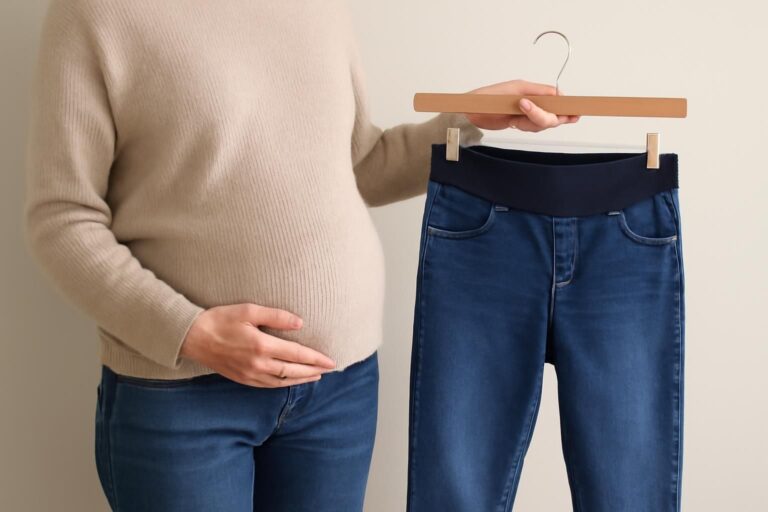
- Maternity: panel and under-bump options that respect a curvy hip. See Maternity Jeans for Curvy Women.
- Levi’s 501 Curve: Levi’s curvy take on its classic 501, a different approach from the 311/315 shaping panels. See Levi’s 501 Curve.
Common Curvy Jeans Problems and How to Fix Them
Waistband gapping
Gapping is the most common complaint about curvy jeans, even though they’re supposed to fix it. Usually the jeans are right at the hip but slightly large at the waist. Under an inch, a thicker belt solves it. One to two inches, look for an adjustable internal waistband or switch to a brand with a different ratio. Over two inches, the cut is wrong for your body; choose a brand with less hip differential. A tailor can take in a waistband for roughly $15 to $30, but can’t add thigh room or reshape the crotch curve.
Thigh chafing and twisted inseams
Chafing happens when the inseam rubs as you walk. Curvy cuts reshape the crotch curve for fuller thighs, so the inseam sits differently than in standard jeans. Lay the jeans flat: if the inseam twists toward the front or back instead of falling straight, the pair isn’t graded correctly for your proportions.
Rise slippage
A high-rise that slowly slides into a mid-rise by afternoon has too much stretch and not enough recovery. Jeans with more than 3 percent spandex are especially prone to it. A heavier fabric, 10 ounces or more, and a wider waistband, which spreads the holding force and resists rolling, both help.
Knee bagging and stretch-out
All jeans bag at the knee, but curvy cuts show it more because the extra thigh fabric migrates downward. Because there’s more fabric through the hip and thigh, curvy jeans can also stretch out more overall. Higher cotton content (90 percent or more) stretches out less but is less comfortable at first; a blend around 93 percent cotton, 5 percent polyester, and 2 percent spandex balances stretch and recovery well. Washing in cold water and tumble drying on medium heat resets the stretch, while air-drying leaves stretchy denim in its bagged-out shape longer.
The Verdict
Curvy jeans aren’t a marketing label. They’re a pattern-engineering fix for bodies standard sizing was never drafted to fit. If your waist-to-hip differential is 12 inches or more, curvy-specific sizing will change how denim fits you. Judy Blue’s curvy skinny and curvy straight are our top overall picks for fit accuracy, fabric, and price; Vervet has the best long-term recovery; Good American leads on construction at a premium; and KanCan and Torrid prove curvy fit doesn’t have to be expensive. Take your four measurements, compare them against two or three brands’ charts, pick a cut from the section above, and order from a retailer with an easy return policy. The right pair won’t need adjusting every time you stand up.
Shop the look on Amazon
Everything you need to build a secondhand-style wardrobe, delivered. We may earn a commission on purchases.
Browse picks on Amazon →FAQ
What is the difference between curvy jeans and plus size jeans?
Curvy jeans change the waist-to-hip ratio within a size, adding hip and thigh room without enlarging the waist. Plus size jeans scale every measurement up proportionally. A size 6 can need curvy jeans, and a size 20 with straighter proportions can fit standard plus sizing. See our Plus Size Jeans guide for plus-specific fit.
How do I know if I need curvy jeans or regular jeans?
Measure your waist at the narrowest point and your hip at the fullest. A difference of 11 inches or more usually means curvy jeans will fit better; under 10 inches, standard sizing should work. Between 10 and 11 it depends on the brand, so try a curvy cut from a store with a good return policy next to your best-fitting standard pair.
What brands make the best curvy jeans?
Judy Blue has the most aggressive curvy grading. Vervet has the best stretch recovery over time. Good American has the most consistent grading across a wide size range, at a premium price. KanCan is the most affordable entry point. Levi’s 311 and 315 use smoothing panels rather than a true regrade, which suits women who want light shaping in familiar sizing.
What rise is best for curvy women?
High rise, about 11 to 13 inches, works for most curvy women because it sits at or above the natural waist and stays put. Mid-rise works when the hip fit is snug enough to hold the jeans. Low rise tends to slide on curvy bodies unless the waistband and fabric are chosen carefully.
How tight should curvy jeans feel when new?
Snug but not restrictive. You should be able to sit comfortably and slide two fingers between the waistband and your skin. If they feel fine standing but dig in when you sit, the thigh is too tight, not the waist, so size up or pick a brand with more thigh room. Jeans with 2 percent or more spandex relax by about half a size after the first couple of wears.
Can curvy women wear non-curvy jeans?
Yes. With a differential under 11 inches, standard jeans may fit fine, and some women with larger differentials prefer standard jeans with a belt or a tailored waist. Taking in a waistband costs roughly $15 to $30, but tailoring can’t add thigh room, so if your thighs are tight the answer is a curvy cut.
Where can I find curvy jeans in plus sizes?
Judy Blue’s curvy line runs to 24W through boutique retailers (Judy Blue Curvy Jeans Plus Size on Amazon). Good American goes to size 32 through its own site and Nordstrom, Torrid stocks curvy styles to size 30, and Universal Standard runs to 40. For lower prices, Poshmark regularly lists Judy Blue and Good American in plus sizes (Curvy Jeans Plus Size on Poshmark).
What jean styles work best for short curvy women?
Short curvy women usually do best in a high rise with a straight or bootcut leg cut on a petite curvy pattern. On a shorter torso a 12-inch curvy high rise lands right at the narrowest point of the waist, and a straight leg flows from hip to hem without a pinch point. Dramatic flares can overwhelm a petite frame, and hemming alone won’t fix a standard-length rise.
Are barrel jeans flattering on a curvy figure?
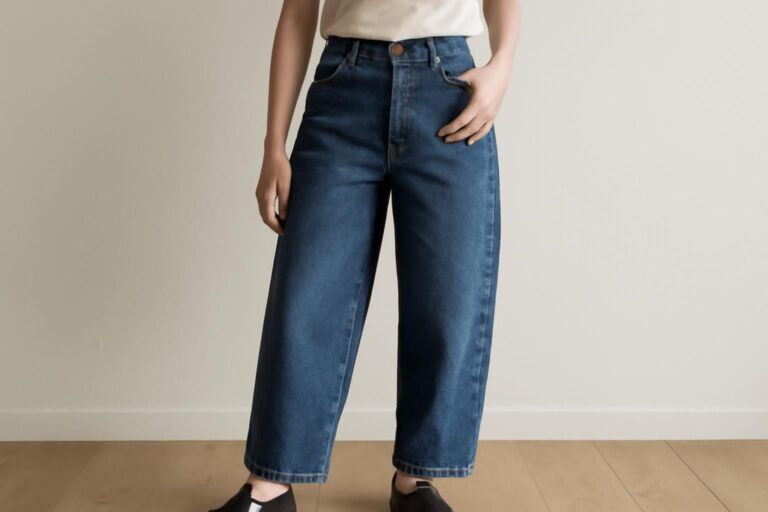
Barrel jeans can flatter a curvy figure when the cut fits the waist first. Choose a high rise in your true waist size, since the loose leg can’t hold the jeans up, and pick a rigid or low-stretch denim so the curve holds its shape. The widest point should sit at the knee rather than mid-thigh, and a fitted, tucked top keeps the waist defined.