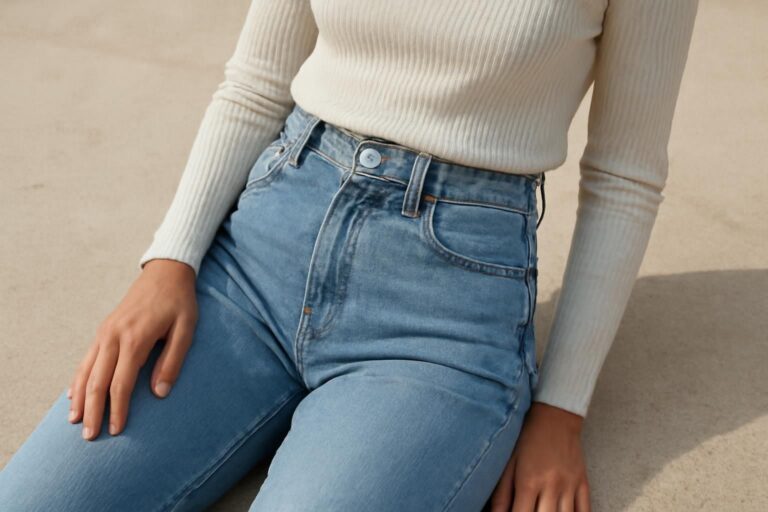
Buying maternity jeans is the shopping task most first-time pregnant shoppers overthink and overspend on. The math isn’t complicated once you know the framework, but the framework isn’t obvious from product pages or in-store signage.
The three classic first-pregnancy mistakes are buying too many pairs, buying too early, and buying everything in one panel type. A smaller number of pairs, bought at the right moments and spread across two or three panel types, usually covers a pregnancy more comfortably and for less money. This guide walks through that process step by step, from the first fit signal to care and resale. The Brand Guides hub has the broader maternity framework; this post is the shopping process.
When to buy your first pair of maternity jeans
The signal is fit, not weeks. Most wearers hit the fit threshold between weeks 10 and 14, but some hit it earlier and some later. The signal:
- Your regular jeans feel tight at the button when you sit
- The button imprint shows on your abdomen after wearing
- You’re using a hair tie or belly band workaround to close regular jeans
- The waistband rolls or folds during sitting-standing transitions
Any two of the four means it’s time. For the first pair, under-belly or secret-fit is usually the right starting type — you’ll outgrow secret-fit by month 5 or 6, and under-belly will carry through to third trimester for shorter wear. Maternity Jeans Under Belly and How to Wear Non Maternity Jeans When Pregnant (long-tail) cover the transition period.
How to size maternity jeans
Rule: buy your pre-pregnancy size. The panel accommodates waist growth; hip and thigh measurements stay close to pre-pregnancy for most builds through most of pregnancy.
Size up only if:
- Your hip measurement grows by more than 2 inches during pregnancy
- Your thigh measurement grows by more than 1.5 inches
- You’re buying specifically for late third trimester and your rigid fabric feels tight at the hip
- The brand’s sizing runs smaller than expected (Motherhood, H and M often run one size small)
What not to do: size up because you think you’ll grow into it. The panel handles bump growth. Sizing up means the hip and thigh fit loose, the pair migrates downward during wear, and the panel bunches.
Do You Buy Maternity Jeans in Your Normal Size (long-tail) goes deeper on this sizing question specifically.
Where to try on vs buy online
Try on in store for:
- First-ever maternity pair (calibrate panel feel, sizing accuracy)
- New brand or cut you haven’t worn before
- Tall or petite blocks (inseam and rise proportions vary more)
- Plus-size maternity (brand-to-brand sizing differs significantly above size 18)
Buy online for:
- Repeat purchases of brands you’ve fit-verified
- Washes you can’t find in store
- Sale pricing (online beats in-store by 10 to 25 percent during sale events)
- Secondhand (Poshmark, ThredUp)
Motherhood’s in-store try-on is the most accessible. Target’s maternity try-on varies by location. Gap stocks limited maternity in stores; online is usually the better option for Gap.
How to try on maternity jeans effectively
The fitting room checklist:
- Put the pair on sitting down first — maternity waistbands can fit on standing but dig when seated
- Stand, move through a walk cycle, bend at the knee. The panel should stay in place.
- Check the back waistband in a three-way mirror for gaps. A gap between the waistband and lower back means the cut doesn’t accommodate your hip-to-waist ratio.
- Check the inseam hem against your shoe. Where does it break? Is it where you want?
- Lift your arms overhead. Does the panel shift or roll?
- If you’re early-pregnancy, imagine the panel stretched further. If you’re late-pregnancy, assess the current fit carefully — late-term fit doesn’t forgive the way early fit does.
Any fitting room failure in these six items means the pair isn’t right. Don’t buy hoping it’ll break in — maternity pairs usually don’t improve with wear.
How many maternity jeans to buy
An efficient count for most pregnancies:
Minimum three pairs:
- 1 under-belly (for months 3 to 6 and postpartum)
- 1 full-panel (for months 7 to 9)
- 1 of either (for rotation)
Comfortable five pairs:
- 2 under-belly (different cuts — one skinny, one straight or wide leg)
- 2 full-panel (one work-appropriate, one casual)
- 1 side-panel hybrid
Buying two full-panel pairs and nothing else is one of the most common mistakes. You lose under-belly comfort for early pregnancy and postpartum.
Budget planning for maternity jeans
Realistic price expectations per pair:
- Budget (Old Navy, H and M MAMA): 20 to 35 on sale
- Mid (Gap Maternity, Target Ingrid and Isabel): 35 to 55 on sale
- Specialist (Motherhood): 24 to 35 on sale
- Premium (Madewell, Good American): 100 to 175
- Secondhand mid: 15 to 25
- Secondhand premium: 40 to 80
A three-pair rotation at mid-tier pricing runs 100 to 150. At premium, 300 to 450. At budget, 60 to 90.
A sensible default: one mid-tier pair (full panel, durable) plus one budget pair (under-belly, rotation) plus one secondhand premium pair (if hunting) hits 80 to 150 and covers the pregnancy well.
Panel type selection by trimester
First trimester (weeks 10 to 14): under-belly or secret-fit. Minimal support needed.
Second trimester (weeks 14 to 28): side-panel or full-panel. Under-belly still works for shorter wear.
Third trimester (weeks 28 to 40): full-panel daily. Side-panel for lighter days. Under-belly for short wear and around-the-house.
Postpartum (weeks 1 to 10): under-belly and side-panel. Full-panel reads baggy.
Full breakdown of panel types: Types of Maternity Jeans.
Fabric composition: the spec that predicts longevity
Check the fabric composition before buying. The ideal:
- 95 to 99 percent cotton
- 1 to 3 percent elastane or spandex
- 10 to 12-oz fabric weight
Red flags:
- Cotton under 90 percent (durability drops)
- Elastane over 3 percent (waistband stretches out fast)
- Fabric weight under 9 oz (pair reads thin on longer inseams, wears faster at stress points)
- Significant polyester content (pills at inner thigh)
Compositions vary by style and season even within one brand, so read the label on the specific listing rather than assuming. As a rule of thumb, budget lines such as Old Navy and Motherhood are more likely to include polyester, while Gap and Madewell maternity denim is more often cotton-rich.
Cut selection based on wearing context
Match the cut to your actual rotation:
- Office daily: skinny or straight maternity with full panel or side panel
- Weekend / casual: straight or wide leg with under-belly
- Dressed-up occasions: bootcut or wide leg high-rise with full panel. Maternity Jeans Boot Cut and Maternity Jeans Wide Leg.
- Summer: wide leg or cropped with under-belly or side panel
- Winter: full-panel with any cut for added warmth
Match cuts to your pre-pregnancy rotation if possible — you’ll wear the maternity pairs more often when they feel consistent with your existing style.
Inseam selection
Maternity inseam options are narrower than non-maternity. Typical ranges:
- Short / petite: 27 to 29 inches
- Regular: 30 to 32 inches
- Long / tall: 33 to 36 inches
Match your pre-pregnancy inseam preference. If you wore 32-inch non-maternity, look for 32-inch maternity. For tall: Maternity Jeans Tall Women. For short: Maternity Jeans for Short Women.
Mistakes to avoid
The five most common maternity jean buying mistakes:
- Sizing up. Buy your pre-pregnancy size. The panel handles waist growth.
- Buying three of the same panel type. Mix at least two types across your rotation.
- Buying too early. Wait until your regular jeans don’t fit; don’t buy on week 6 anticipating.
- Skipping fabric checks. Low-cotton, low-fabric-weight pairs don’t survive a pregnancy.
- Overspending on premium pairs for a single pregnancy. Cost per wear rarely justifies 150-plus spending on a single-pregnancy wear.
Return policies and maternity
Return windows matter more for maternity than for regular clothes because your body is changing week to week. What to check before buying:
- Return window (30 days minimum ideally; Gap and Old Navy both 30-45)
- Whether returns are free (most major brands have free returns in-store; online-only returns sometimes charge shipping)
- Whether the return policy specifies “worn” vs “tags on” — some brands allow “worn if sized wrong”
Final sale maternity is a risk for most buyers. Skip final sale unless you’ve already fit-verified the specific pair and wash.
Where to buy maternity jeans
Primary sources:
- Gap directly (widest mainstream mid-tier)
- Old Navy directly (budget, widest size range)
- Target for Ingrid and Isabel (mid-tier, in-store try-on)
- Motherhood (specialist, in-store)
- Madewell for premium
Secondary sources:
- Poshmark secondhand — Gap Maternity on Poshmark or Madewell Maternity on Poshmark for specific brands. Maternity Jeans Poshmark (long-tail).
- ThredUp for secondhand mid-tier
- Amazon for Amazon-specific brands — Maternity Jeans Full Panel on Amazon. Quality varies. Maternity Jeans Amazon (long-tail).
- Walmart for budget — Maternity Jeans Walmart (long-tail).
- Nordstrom for premium and department-store selection — Maternity Jeans Nordstrom (long-tail).
Timing purchases around sales
Major maternity denim sale events:
- Gap: 40 to 50 percent off sitewide, twice a month typically
- Old Navy: rolling 30 to 50 percent off, almost weekly
- Target / Ingrid and Isabel: seasonal sales, typically 20 to 30 percent
- Madewell: major seasonal sales in August and December
- Abercrombie: rolling 25 percent off, frequently
- Poshmark: no scheduled sales; constant price variation
Plan purchases around Gap’s sitewide 40 percent or higher — their maternity is rarely at full price during the right sale timing. Don’t buy Gap at full retail if you can wait a week.
Care and longevity after purchase
After-purchase care affects how many pregnancies a pair covers:
- Wash inside out in cold water
- Wash every 5 to 8 wears unless visibly soiled
- Hang dry to preserve panel elastic
- Skip bleach — degrades panel fabric
- Spot clean around the panel transition seam to preserve fabric integrity
Cotton-rich pairs respond best to this care and are the likeliest to last into a second pregnancy. Light, polyester-heavy budget pairs will still show wear sooner, whatever the care routine.
Planning for a second pregnancy
If you’re likely to have a second pregnancy, buy higher quality pairs in your first pregnancy. The math:
- One premium pair at 130 across two pregnancies: 65 per pregnancy
- One mid-tier pair at 45 across two pregnancies: 22.50 per pregnancy
- One budget pair at 30 for one pregnancy (retired before round two): 30 per pregnancy
Mid-tier pairs offer the best cost-per-wear across multi-pregnancy use. Budget pairs have lower absolute cost per pregnancy but don’t survive for round two.
The verdict
How to buy maternity jeans comes down to timing, sizing, panel selection, and fabric verification. Buy your first pair when regular jeans stop fitting, not before. Buy your pre-pregnancy size. Mix at least two panel types across a three-pair rotation. Verify fabric composition before buying — 95-plus percent cotton with 1 to 3 percent elastane at 10-plus oz is the durable combination. Gap Maternity and Target Ingrid and Isabel are the reliable mid-tier picks. Old Navy is budget for single pregnancy. Madewell is premium for multi-pregnancy. Skip premium pairs for single-pregnancy wear unless you’re certain on fit. Return windows matter — check before buying.
Shop the look on Amazon
Everything you need to build a secondhand-style wardrobe, delivered. We may earn a commission on purchases.
FAQ
When should I buy my first pair of maternity jeans?
When your regular jeans feel tight at the button, typically weeks 10 to 14. Under-belly or secret-fit is usually the right first type.
What size do I buy in maternity jeans?
Your pre-pregnancy size. The panel accommodates waist growth; hip and thigh measurements stay close to pre-pregnancy through most of pregnancy.
How many pairs of maternity jeans do I need?
Minimum three pairs across two panel types. Five pairs is comfortable if you wear denim most days. Two pairs is workable but stretched.
Should I buy maternity jeans in store or online?
In store for first-ever maternity purchase, new brands, tall / petite, and plus-size. Online for repeat brands and sale pricing.
Can I return maternity jeans after wearing them?
Depends on the brand. Gap and Old Navy typically allow returns of unworn or minimally-worn pairs within 30 to 45 days. Final sale items can’t be returned. Read return policies before buying, especially online.