A western buckle is the one piece of jewelry many people wear every day without calling it jewelry. Here is how the main styles differ, what a trophy buckle means, and how to wear one well.
A western belt buckle is a decorative buckle, usually larger and more ornate than a plain dress buckle, worn on a leather belt with jeans or trousers. Styles range from simple engraved silver ovals to ranger sets with matching keepers and tips, rodeo trophy buckles and pieces set with turquoise. This guide explains each style, how to size a buckle to your belt, how to wear a belt buckle with different outfits, and what to look for when buying one secondhand. For the wider world of belts, from dress belts to woven ones, see our Types of Belts hub.
Quick answer
Western buckles come in four broad styles: plaque or oval buckles (a single decorative piece), ranger sets (a buckle with matching keepers and a tip), trophy buckles (awarded for winning an event) and concho or stone-set buckles. Wikipedia’s summary notes that “western-style” buckles became popular through cowboy movies and are traditionally awarded to rodeo winners as prizes or trophies. To wear one, match its strap width to your belt, keep other jewelry quieter, and match its metal to your other hardware.
| Type | Key feature | Best for |
|---|---|---|
| Plaque / oval buckle | One decorative piece, often engraved or with an overlay | Everyday jeans, the most common western buckle |
| Ranger set | Buckle plus matching keepers and a metal tip | Tapered belts, dressier western looks |
| Trophy buckle | Large, often engraved with an event and year | Worn by the person who won it |
| Concho / stone-set buckle | Concho-like silverwork, sometimes set with turquoise or other stones | Statement outfits, collectors |
| Small or slim western buckle | Western shape at a smaller scale | Office wear, slimmer belts, a quieter look |
Where the big western buckle comes from
According to Wikipedia’s summary of belt buckles, “western-style” buckles became popular through cowboy movies. They are traditionally awarded to rodeo winners as prizes or trophies, a practice later adopted by ultra-marathons such as the Western States Endurance Run. Summary sources on western wear also describe western jeans worn with “kippy belts featuring metal conchos and large belt buckles”. The FIT Fashion History Timeline notes that “wide belts with big buckles” were an early-1970s look, which helps explain how many large buckles turn up in vintage shops today.
Western belt buckle styles
Plaque and oval buckles
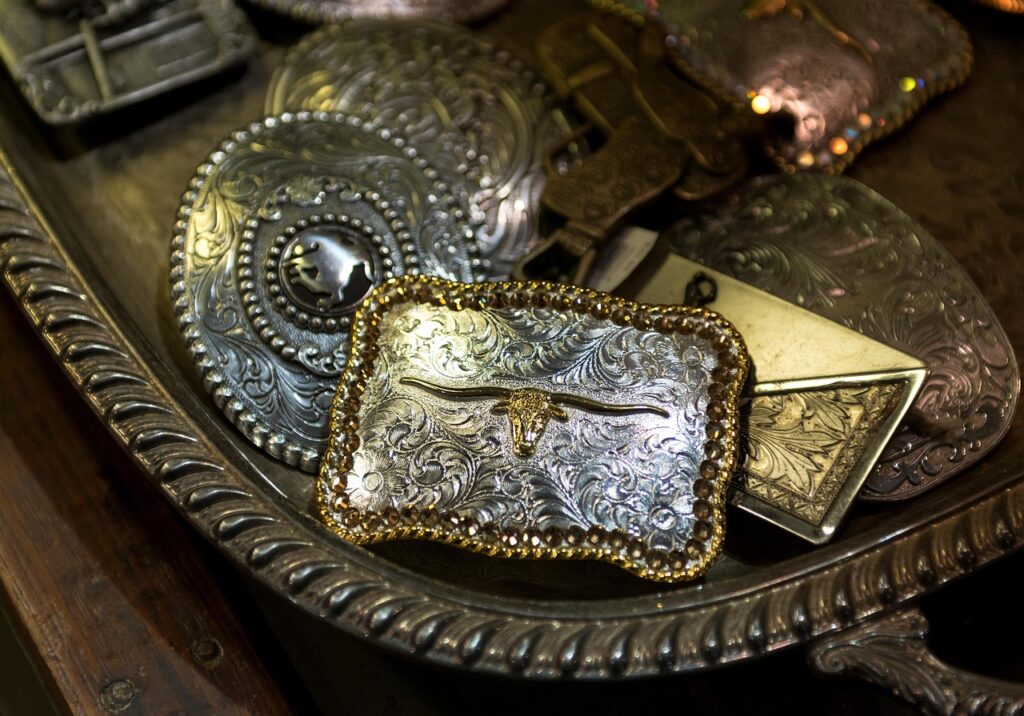
The plaque buckle is a single piece, usually oval or rectangular, attached to the belt by a post and hook on the back. Many have engraved scrollwork, rope edging or a raised overlay such as a horse, a steer head or initials. This is the most common western buckle and the easiest to swap between belts, because most western belts have snaps at the buckle end for this purpose.
Ranger belts and ranger sets
A ranger belt uses a ranger-style buckle set. Wikipedia’s summary describes the set as a buckle, one or more matching keepers (the loops that hold the belt end), and a metal tip for the tongue end, sometimes with concho-like fittings. Ranger belts are often tapered, wider around the waist and narrower where they pass through the buckle, which makes them look tidy with dressier western outfits. If you like a coordinated look, a ranger set is the most polished option.
A plain leather belt with a three-piece ranger set is a good everyday buy: Ranger Belt Buckle Set Western on Amazon.
Similar style on Amazon

- Silver Belt Buckle Size: 9.9*7.9cm (3.9*3.1 in).Weight: 85.4g; Western belt buckle Suitable for 1.5inch Wide…
- Material: This belt buckle is made of top-quality zinc alloy, with fine engraving and…
- Belt Bukle For Men Women: Design with the elements of engraved flowers, vintage and unique, shows your own…
Trophy buckles
A trophy buckle is awarded for winning an event, most famously at rodeos. They are typically large and engraved with the event name, the category and the year. In rodeo circles, wearing a trophy buckle you didn’t win is often frowned upon. That is common custom rather than a written rule, and attitudes vary, but it is worth knowing before you wear a thrifted one. Many people who pick up a vintage trophy buckle display it rather than wear it, or wear it only in casual settings where it reads as a found object rather than a claim.
If you want the size and drama of a trophy buckle without the event engraving, look for buckles sold as “trophy-style” or “rodeo-style”, which use the shape without naming a win.
Concho and stone-set buckles
Concho buckles use round or oval silverwork, often stamped or repoussé, and some are set with turquoise, coral or other stones. Turquoise is closely tied to the Southwest; Arizona law names it the official state gemstone (A.R.S. 41-858).
Much of the most admired silver-and-turquoise work comes from Navajo (Diné), Hopi, Zuni and other Pueblo silversmithing traditions, whose silversmiths summary sources credit with bolo tie work since the mid-20th century. If you buy this kind of piece, treat the makers’ work with respect and buy carefully. The U.S. Department of the Interior explains that under the Indian Arts and Crafts Act of 1990, it is illegal to offer or sell “any art or craft product in a manner that falsely suggests it is Indian produced” or the product of a particular tribe or artisan. So:
- Only treat a buckle as made by a Native artist or a particular nation if the seller documents it, for example with an artist’s hallmark and provenance.
- Ask sellers directly about the maker. A reputable seller will tell you what they know and what they don’t.
- Where possible, buy directly from Native artists, tribal enterprises or galleries that work with named artists.
- Avoid listings that use vague tribal-sounding labels as decoration. If origin isn’t documented, describe the piece simply as a silver-and-turquoise buckle.
For a related piece of western jewelry, see our guide to How to Wear a Bolo Tie (Casual to Formal).
Slim and small western buckles
Not every western buckle needs to be the size of a saucer. Smaller engraved buckles on narrower belts give a western nod that sits easily under a blazer or with office trousers. They are a good choice if you want one buckle you can wear most days.
Western buckle sizes: matching buckle to belt
“Size” means two different things for a buckle: the width of strap it fits, and the size of the buckle face itself.
Strap width
Interchangeable buckles are made to fit a particular strap width, and a buckle won’t sit properly on a belt that is too wide or too narrow for it. Sellers list the strap width a buckle fits. Measure your belt across the strap near the buckle end and match it to the listing. Also check that the belt has snaps or a removable buckle end, since stitched-on buckles can’t be swapped without a leatherworker.
Buckle face
The face size is about proportion and taste. A large buckle makes a strong statement on its own; a medium buckle works with most jeans; a small one keeps things quiet. There is no correct size, but a common styling point is that a larger buckle looks best when the rest of the outfit is simple.
Belt length
Western belts are usually sized by waist measurement. Because a large plaque buckle adds length at the front, check the brand’s guidance on whether its belt sizes include the buckle. Our Men’s Belt Size Chart explains how to measure for a belt.
How to wear a belt buckle
Knowing how to wear a belt buckle mostly comes down to balance. A few points of common styling advice:
- Centre it. The buckle should sit in line with the fly of your jeans or trousers.
- Tuck or half-tuck your shirt. A buckle covered by a loose shirt can’t do its job. A full tuck shows the whole belt; a front tuck shows just the buckle.
- Match metals. Pairing the buckle’s metal with your other hardware, such as shirt snaps, rings, a watch or a bolo tip, is common styling advice and keeps things looking deliberate.
- Let it be the focal point. With a large buckle, keep other jewelry smaller and the shirt plainer.
- Choose belt colour with your boots. Matching belt leather to boot leather is the classic approach, though contrast can also look good.
Outfit ideas with a western belt buckle
- Classic western: a plaque buckle on a brown leather belt, a tucked Pearl Snap Shirts style shirt, dark bootcut jeans and cowboy boots. Add a hat from our Types of Cowboy Hats guide for the full look.
- Ranger belt, dressed up: a tapered black ranger belt with a silver set, a white shirt, dark trousers or jeans and polished boots.
- Belted dress: a western buckle on a slim belt over a denim or prairie-style dress, with boots. See How to Wear Cowboy Boots With a Dress.
- Casual tee: a plain tee tucked into straight jeans with a medium silver buckle and sneakers or boots.
- Concert night: a statement buckle with a simple top and denim; see Country Concert Outfits for more.
For a simple engraved buckle to start with, look at interchangeable oval styles in silver tone: Western Belt Buckle Silver Oval on Amazon.
Pair it with a plain leather belt that has snaps at the buckle end, so you can swap buckles later: Western Leather Belt Snap On Buckle on Amazon.
Caring for a buckle
Most buckles need little care. Wipe them with a soft dry cloth after wear. For silver, a gentle silver-polishing cloth removes tarnish; avoid harsh dips on pieces with stones, enamel or overlays. Keep turquoise and other stones away from oils and chemical cleaners. For the leather belt itself, our How to Clean Leather Shoes and Keep Them Conditioned guide covers the same basic clean-and-condition routine that suits most smooth leathers.
How to thrift a western belt buckle
Western buckles are easy to find in thrift stores, flea markets, antique malls and estate sales, often in jewelry cases or in a bin near the belts. Things to check:
- Back hardware: make sure the post and hook are intact and firmly attached.
- Strap width: measure the opening against your belt.
- Metal and marks: look for maker’s marks or stamps on the back; a magnifying glass helps. Don’t assume solid silver without a mark.
- Stones: check for loose, cracked or missing stones.
- Trophy engraving: decide how you feel about wearing someone else’s award.
- Origin claims: if a seller says a piece was made by a Native artist or a particular nation, ask how they know.
Belts themselves are thrift staples too. Look for full-grain leather with snaps at the buckle end; our What Is Full-Grain Leather? Grain Types Explained guide explains what to look for.
Shop the look on Amazon
Everything you need to build a secondhand-style wardrobe, delivered. We may earn a commission on purchases.
FAQ
What is a ranger belt?
A ranger belt uses a ranger-style buckle set: a buckle, one or more matching keepers and a metal tip on the tongue end, sometimes with concho-like fittings. The belt is often tapered toward the buckle.
Can you wear a trophy buckle you didn’t win?
Nothing legally stops you, but in rodeo circles it is often frowned upon. Many people display thrifted trophy buckles or choose trophy-style buckles without event engraving.
Do western belt buckles fit any belt?
No. Interchangeable buckles are made for a particular strap width, and the belt needs a removable buckle end, usually snaps. Check the seller’s listed strap width against your belt.
Should a belt buckle match your boots?
The belt leather usually matches the boots. The buckle’s metal is more often matched to other hardware such as shirt snaps, rings or a watch.
How do I know if a turquoise buckle is Native American made?
Only through documentation, such as an artist’s hallmark and a seller who can name the maker. The Indian Arts and Crafts Act of 1990 makes it illegal to sell a product “in a manner that falsely suggests it is Indian produced”. If origin isn’t documented, don’t assume it.
Can women wear western belt buckles?
Yes. Buckles look good on women’s jeans, skirts and belted dresses, and smaller buckles suit slimmer belts.