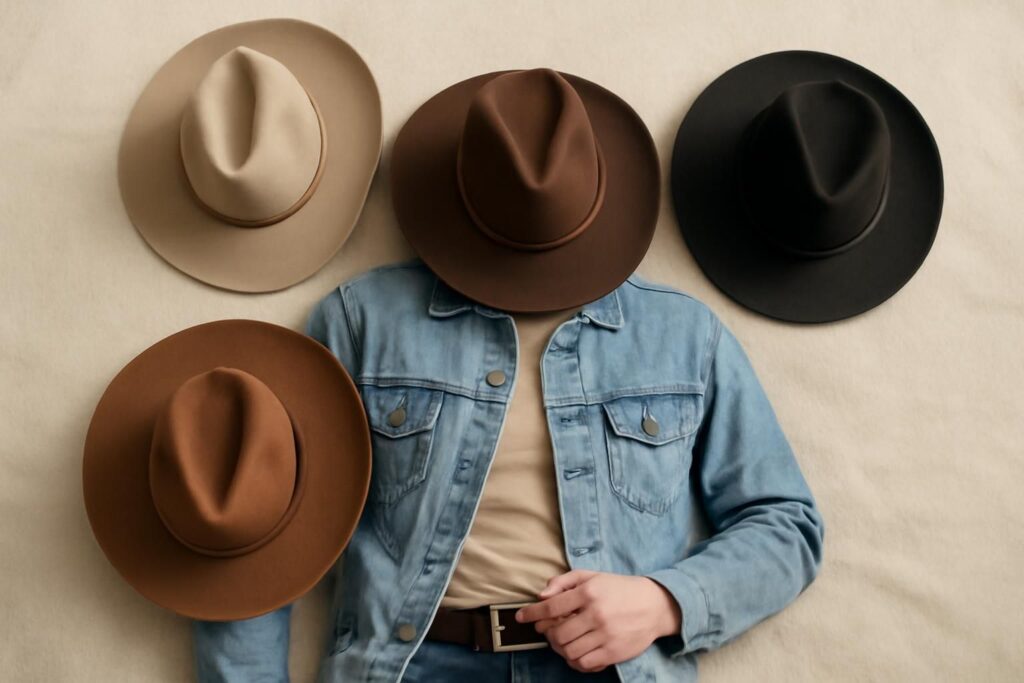
A cowboy hat looks simple from across a room, but the crease in the crown, the roll of the brim and the material all change how it reads. Here is how to tell the main styles apart.
The types of cowboy hats you see today are sorted in three main ways: by material (felt, straw or, less often, leather), by the crease pressed into the crown, and by the width and roll of the brim. Learn those three and you can read almost any western hat on a shelf or at a thrift store. A hat is also the natural partner to a good pair of boots, so if you are building a full western wardrobe, our Cowgirl Boots covers the footwear side. This guide walks through materials, crease names, brims, the X numbers printed inside some felt hats, and how to buy one secondhand.
Quick answer
Most cowboy hats are either felt (for cooler months) or straw (for summer), with a tall crown and a wide brim. The crown is shaped with a named crease, such as the Cattleman, Gus or Brick, and the brim is rolled or kept fairly flat. According to Wikipedia’s summary of the cowboy hat, modern versions are made from “fur-based felt, straw or, less often, leather”, and many are sold already creased and rolled. Everything else, from the hatband to the colour, is personal choice.
| Type | Key feature | Best for |
|---|---|---|
| Felt hat | Fur-based or wool felt; holds a crease and keeps some warmth | Fall and winter, evening events, dressier western outfits |
| Straw hat | Woven, lighter and more breathable | Summer, outdoor festivals, rodeos in hot weather |
| Leather hat | Less common; rugged and usually more casual | Casual wear and rain-prone days, depending on the finish |
| Cattleman crease | Centre dent with a pinch on each side | A classic, all-purpose look |
| Gus crease | Tall crown that slopes down toward the front, with side pinches | An old-time, trail-era look |
| Brick crease | Squared-off crown with straighter sides | A neat, structured shape |
| Cool Hand Luke / Minick creases | Variations with their own dents and pinches | Wearers who want a less common silhouette |
| Boss of the Plains style | Open or straight-sided crown with a flat brim | A historic, plainer look |
The parts of a cowboy hat
Before getting into styles, it helps to know the vocabulary. Wikipedia’s summary describes a tall rounded crown, a wide brim and a sweatband inside, with a decorative hatband usually around the outside and sometimes stampede strings, which are cords that run under the chin or behind the head to keep the hat on in wind.
- Crown: the top part of the hat that sits over your head. Its height and the dents pressed into it define the crease.
- Brim: the flat or curved rim around the hat. Width and how much it curls up at the sides (the “roll”) change the look a lot.
- Sweatband: the band inside the crown, usually leather or fabric, that touches your forehead. It is also where a little padding can go if the fit is loose.
- Hatband: the decorative band around the base of the crown, in ribbon, leather, braided horsehair, beads or metal conchos.
- Stampede strings: optional cords for windy days or riding.
Because the crown and brim can be reshaped, the same blank hat can end up looking very different on two people. That flexibility is part of why there are so many named styles. For the broader family of hats beyond western shapes, see Types of Hats, and for a breakdown of brim widths across all hats, see Types of Hat Brims.
Felt vs straw cowboy hat
The felt vs straw cowboy hat question is the first decision most buyers make. Felt and straw are different materials with different care needs. The common custom is felt for the cooler months and straw for summer, though nothing stops you from wearing a light felt in spring or a straw hat on a mild fall afternoon. This is common advice rather than a rule from any single source.
Felt cowboy hats
Felt hats are made from fur-based felt or wool felt. Felt holds a crease well, keeps some warmth in, and tends to look dressier, which is why felt hats show up at weddings, holiday events and evening concerts. Felt is also more sensitive to rain and heat than many people expect. Village Hat Shop’s care guidance recommends brushing felt counter-clockwise with a soft brush, handling the hat by the brim rather than the crown, and storing it crown-down in a box, away from direct sun, heat and humidity.
Colours run from black, silver-belly and sand to browns and the occasional bold shade. Black and dark brown read more formal; lighter neutrals look relaxed and outdoorsy.
Straw cowboy hats
Straw hats are woven, lighter and more breathable, which makes them the usual pick for summer heat, outdoor rodeos and festivals. Village Hat Shop notes that heat and sun make straw brittle and advises never soaking a straw hat. Straw tends to be cheaper than felt and is often treated as a more casual, working or seasonal hat.
If you want a summer hat for a festival or a Country Concert Outfits look, straw is the practical choice. A natural or white straw with a simple band goes with almost any outfit: Straw Cowboy Hat on Amazon.
Top-selling match on Amazon

- Material: This cowboy/cowgirl cowboy hat is made of straw, sturdy structure, durable and very…
- Size: This shapable cowboy hat/mean size, (Head Circumference 22.4-23.2 inch, Hat Height…
- Breathable: These straw cowboy/cowgirl hats are breathable and comfortable design. with a long…
Leather cowboy hats
Leather cowboy hats are the least common of the three. They tend to look rugged and casual and usually have a softer, less sharply creased crown. They are more of a personal-style choice than a staple, and are worth a look if you like a worn-in, outdoors feel.
Cowboy hat styles by crown crease
The crease is the shape pressed into the crown, and it is what most people mean when they talk about cowboy hat styles. Crease names in common use include the Cattleman, Cool Hand Luke, Minick, Brick and Gus. Wikipedia’s summary notes that historically it “was often possible to tell where a cowboy hat was from… simply by looking at the crease”. Treat that as a general summary rather than a precise map, since crease habits varied and makers today sell every style everywhere.
Cattleman crease
The cattleman crease is the shape most people picture first: a long dent running front to back down the centre of the crown, with a pinch on each side. It looks balanced and traditional, works on felt and straw, and is the safest choice if you are buying your first hat. Many pre-creased hats on store shelves are some version of a cattleman.
Gus crease
The Gus has a tall back that slopes down toward the front, with pinches on the sides. It reads as an old-time, trail-era look and suits people who want a hat with a bit of character.
Brick crease
The Brick has a squarer, more structured crown with straighter sides and a dent across the top. It looks neat and tidy and pairs well with a flat brim.
Cool Hand Luke and Minick creases
These are less common variations with their own arrangements of dents and pinches. They are worth knowing by name if you browse vintage hats or talk to a hatter, because a seller may list a hat this way.
Open crown
An open crown has no crease at all, or only a very soft one. Some people buy open-crown felt hats specifically so a hatter can shape them to order. Shaping is covered step by step in our guide to How to Shape a Cowboy Hat (Felt and Straw).
Historic styles: Boss of the Plains and the ten-gallon
According to Wikipedia’s summary, Stetson made the original Boss of the Plains in 1865. It was flat-brimmed with a straight-sided crown and rounded corners, and was “natural in color, with four-inch crowns and brims.” The front-creased “Carlsbad” followed it. Etymonline records that John B. Stetson (1830–1906) “started his company in Philadelphia in 1865”, and dates “Stetson” as a trademark name to 1902. The Boss of the Plains is described as having “become dominant by the 1870s” in summary sources.
The same summary notes early Stetson grades ranged “from one-grade material at five dollars apiece to pure beaver felt hats for thirty dollars each”. That is a historical detail about one maker’s pricing in its day, not a guide to grading hats now.
The “ten-gallon hat” is a popular nickname for a tall-crowned cowboy hat. Its origin is uncertain. Wikipedia says the term “likely” comes from the Spanish galón (a braid trim, galloon) or tan galán (“very handsome”), and it notes Stetson’s own observation that a so-called ten-gallon hat holds only about three-quarters of a US gallon. Both points are worth treating as likely explanations rather than settled fact.
Brim shapes
The brim matters as much as the crown. A few common shapes:
- Flat brim: little or no roll. Reads as old-fashioned or minimal, and pairs naturally with a Brick or open crown.
- Moderate roll: sides curl up gently. This is the everyday cowboy look.
- Deep “taco” roll: sides curl up steeply. Common on straw hats and with younger, rodeo-influenced styles.
- Down-turned front: the front dips slightly to shade the eyes, which many riders and outdoor workers prefer.
Brim width is also a matter of taste and proportion. Wider brims give more shade and make a stronger statement; narrower brims feel easier to wear around town. There is no fixed rule here, so try a few widths in a mirror and pick the one you like.
What the X on a felt hat means
Some makers mark felt hats with an X number, such as 4X or 10X, on the sweatband or box. It is tempting to read these as a universal grade, but brands use their own scales, so the X number isn’t a standard measure of fur content or quality across brands. A 6X from one maker and a 6X from another may not be comparable at all.
The practical takeaway: within a single brand’s range, a higher X usually signals a higher tier in that brand’s line. Across brands, ignore the number and judge the hat directly. Feel the felt (it should be smooth and dense, not papery), check that the crown holds its shape, and look at the finishing of the sweatband and hatband.
How to style each type
Common styling advice is to build an outfit around one or two western pieces rather than a head-to-toe costume. A few pairings that work:
- Felt cattleman: dark jeans, a Pearl Snap Shirts style shirt or a plain knit, and leather boots. Add a jacket and it works for an evening out.
- Straw hat: a sundress or denim shorts and a tee, with boots or sneakers, for festivals and summer rodeos. Our What to Wear to a Rodeo guide has more full outfits.
- Black felt: an all-black outfit, or black with one accent colour, for a sharper look.
- Brim and belt: repeat the hatband’s leather or metal in your belt; see Western Belt Buckles for buckle ideas.
For tips on wearing a hat day to day without it looking like a costume, read How to Wear a Cowboy Hat Without Looking Like a Costume. If you are buying online, a felt cattleman in a neutral colour is the most versatile starting point: Felt Cowboy Hat Cattleman Crease on Amazon.
Top-selling match on Amazon

- Adjustable Sizing: Minimalistic design matched with two size ranges. With moisture wicking elastic…
- Timeless Western Design: Sparkling rhinestone décor pink felt cowgirl hat with wide 3.8 inches shape it to…
- Upgrade Felt Fabric: Featuring natural suede like napped finish softness and improved durable…
How to get the size right
A hat in the wrong size will either slide around or press uncomfortably. Stetson’s fit guide suggests measuring “where your hat will sit”, at the middle of your forehead and about 1/8 inch above the ear, and describes a good fit as “reasonably snug so that a light wind won’t blow it off your head, but not be so tight as to cause discomfort.” Sizes vary between brands, so check each maker’s own chart. Our Cowboy Hat Size Chart and How to Measure Your Head walks through measuring and Stetson’s chart in detail.
How to thrift a cowboy hat
Western hats turn up regularly in thrift stores, vintage shops and estate sales, particularly in regions with a ranching or rodeo culture. A secondhand felt hat can be a very good buy if you know what to check:
- Check the size label first. Look inside the crown or on the sweatband. If there is no label, measure the inside circumference and compare it to the brand’s chart.
- Inspect the sweatband. Stains are normal, but cracks, tears or a loose band mean extra repair work.
- Look at the crown. Small dents can usually be steamed out, but deep cracks or holes at the pinches are hard to fix on felt.
- Feel the brim. It should hold its shape. A floppy or warped brim may have been left in heat.
- Read the brand and X mark if there is one, remembering it only compares within that brand.
- For straw, look for cracks or broken strands, especially where the crown meets the brim.
Once home, a gentle brushing and a light steam often bring a thrifted felt hat back to life. Our How to Clean a Hat (Baseball Caps, Wool and Straw) guide covers the basics. Village Hat Shop advises against stretching any hat more than two sizes, so don’t buy a hat that is far too small and hope to fix it later.
If you would rather buy new, a basic hat box or hat rack protects the shape between wears: Cowboy Hat Storage Box on Amazon.
Shop the look on Amazon
Everything you need to build a secondhand-style wardrobe, delivered. We may earn a commission on purchases.
FAQ
What are the main types of cowboy hats?
The main types are sorted by material (felt, straw or leather), by crown crease (Cattleman, Gus, Brick, Cool Hand Luke, Minick or an open crown) and by brim shape (flat, moderate roll or deep roll).
What is the most common cowboy hat crease?
The cattleman crease, with its centre dent and side pinches, is the shape most people picture and the one most often seen on pre-creased hats. It is a safe choice for a first hat.
Should I buy a felt or straw cowboy hat?
Common custom is felt for cooler months and dressier occasions, and straw for summer heat and outdoor events. If you only want one hat and live somewhere warm, straw is the more practical pick; for evening events, felt looks dressier.
Is a 10X hat better than a 4X hat?
Only within the same brand, and even then it reflects that brand’s own scale. X numbers aren’t a standard across makers, so compare hats by the felt, construction and fit rather than the number.
Where does the term ten-gallon hat come from?
The origin is uncertain. Wikipedia says it “likely” comes from the Spanish galón or tan galán, and notes Stetson’s point that such a hat holds only about three-quarters of a gallon.
Can I change the crease on a cowboy hat?
Often yes, especially on felt, using gentle steam. Straw handles reshaping less well and can crack. See our guide to shaping a cowboy hat, or ask a hatter for a major change.