A hem is the finished edge at the bottom of a sleeve, leg or skirt, and the way it is sewn says a lot about how a garment was made and how easily it can be changed.
This guide covers the main types of hems in two senses: hem finishes, meaning how the edge is folded and sewn, and hemline styles, meaning the shape and length of the edge. If you want to shorten a pair of trousers today, our How to Hem Pants guide has the full method, and this page helps you identify what you are working with first.
According to the Online Etymology Dictionary, “hem” comes from Old English, meaning “a border” of cloth or a garment. Wikipedia defines a hem as “a garment finishing method in which the edge of a piece of cloth is folded and sewn to prevent unravelling.” Hems are built from stitches, which our Types of Stitches guide explains.
Hem types at a glance
| Hem | Key feature | Typically found on |
|---|---|---|
| Blind hem | Stitches do not show on the outside | Trousers, skirts, coats |
| Double-fold hem | Edge folded twice, raw edge enclosed | Shirts, jeans, casual pieces |
| Rolled hem | Very narrow rolled edge with tiny stitches | Scarves, handkerchiefs, sheer fabrics |
| Overlocked-and-folded hem | Serged edge turned once and stitched | Mass-produced garments |
| Coverstitched hem | Parallel rows outside, loops inside | T-shirts, knit tops |
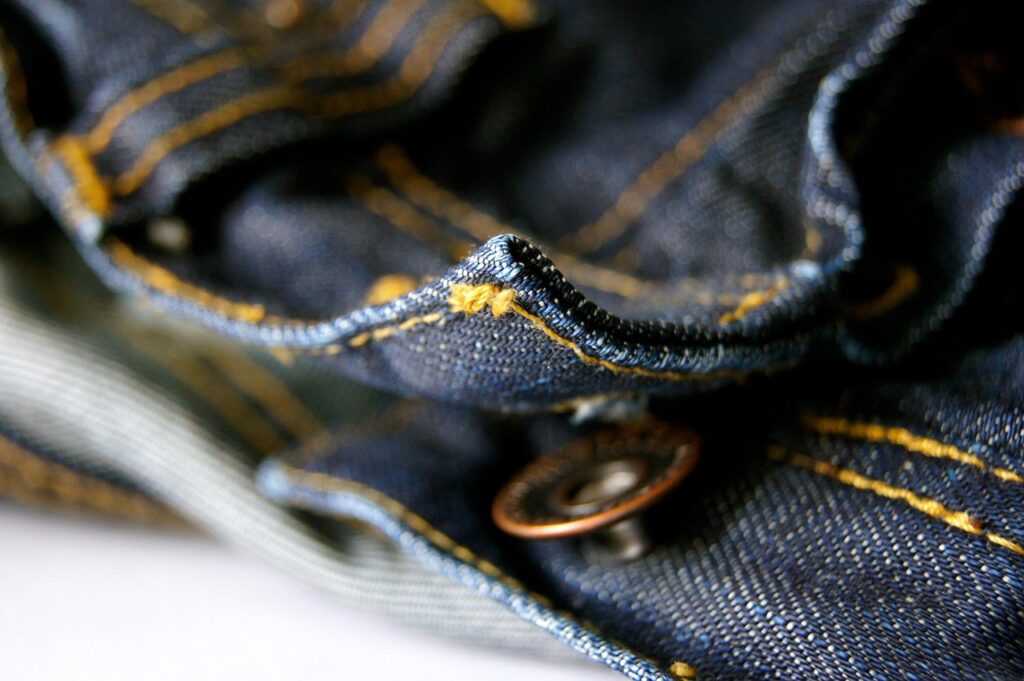
| Chain-stitched hem | Looped underside that can rope | Jeans |
| Fused hem | Held with heat-set adhesive web | Quick alterations |
| Cuffed hem (turn-up) | Hem folded back on the outside | Tailored trousers |
| Raw or frayed hem | Cut edge left unfinished | Cut-off denim |
Hem finishes
Blind hem
Wikipedia describes the blind hem as one “sewn down with a line of invisible stitches or blind stitch.” NMSU Extension Guide C-314, “Making Perfect Garment Hems”, explains the hand version, also called a tailor’s hem: finish the raw edge, then work small horizontal stitches 1/8 to 1/4 inch from the edge, about 1/4 to 1/2 inch apart, without pulling tight, so the stitches do not show from the right side. The guide says it suits non-stretch, non-ravelling fabrics. It also describes the machine blind hem as durable and fairly inconspicuous for sportswear in sturdy fabrics. Spot it: small spaced catches inside, little or nothing visible outside.
Double-fold hem
Wikipedia lists the double-fold hem among common hem types. The edge is turned up twice so the raw edge is enclosed, then stitched. Spot it: one visible row of stitching outside and a clean fold inside with no serging.
Rolled hem
Per Wikipedia, in a rolled hem the fabric is “hand rolled and then sewn down with tiny stitches (still seen as a high-class finish to handkerchiefs).” Machine rolled hems made on a serger are a common shortcut. Spot it: a very narrow, firm edge on scarves, chiffon and silk.
Overlocked-and-folded hem
Also listed by Wikipedia, this hem has its raw edge serged, turned up once and stitched. Spot it: serger loops visible inside the hem.
Coverstitched and chain-stitched hems
A coverstitch hem, commonly used on T-shirts, shows two parallel rows outside and stretches with knit fabric. A chain-stitched hem, common on jeans, has a looped underside that can twist over time. Keeping the original jeans hem by cutting above it and stitching the hem band back on is a common method for preserving factory fading; see How to Hem Jeans and Keep the Original Hem.
Fused hem
NMSU’s guide describes fusible web (hem tape) as a heat-sensitive adhesive set with heat, moisture and pressure. It advises testing on scrap first, not sliding the iron, keeping the web at least 1/4 inch from the cut edge, and using 3/4 to 1 inch strips (2 inches for heavy fabric). It is not suitable for sheers and laces. A roll of Fusible Hem Tape on Amazon is handy for quick fixes on sturdy fabrics.
Top-selling match on Amazon

- High-Quality Material: 2 rolls of fabric tape width is 0.59 inches, each roll is about 70 yards in length…
- No Sewing: The hem tape requires no sewing, will not leave marks on the fabric, strong and…
- How To Use: Place the hemming tape between 2 pieces of fabric, wet the fabric, and iron it with…
Cuffed hem (turn-up)
The Online Etymology Dictionary dates “cuff” in the sense of the “turned-up hem of trousers” to 1896. Spot it: a folded band on the outside of the trouser leg. See Types of Cuffs for shirt and trouser cuffs.
Hem depth
NMSU’s guide says pants and jacket hems are usually 1 to 2 inches deep, while skirts, dresses and coats are usually 2 to 3 inches. Wikipedia gives around 0.6 cm for delicate items. A deep hem on a thrifted skirt or trousers leaves room to lengthen it.
When to hem at home and when to see a tailor
Seeing a tailor for lined trousers, trousers with cuffs, tapering or waist changes, and suit jackets is common advice. Simple, unlined hems on cotton, linen or denim are often a reasonable home job. Before you start, check the care label and pre-wash the garment if it may shrink; our Does Cotton Shrink? Why It Happens and How Much guide explains why that matters.
Hemline styles
These are commonly used names for the shape of the edge rather than its construction:
- Straight hemline: level all the way round.
- High-low hemline: shorter at the front than the back.
- Asymmetric hemline: angled or uneven from side to side.
- Handkerchief hemline: falls in points.
- Curved shirttail hem: rounded at the sides, common on shirts.
- Split or vented hem: with a slit at the side or back, sometimes paired with a kick pleat; see Types of Pleats.
Hemline lengths are covered in our Types of Skirts guide.
Checking hems when thrifting
- Turn the hem inside out and identify the finish.
- Look for loose sections, dropped stitches or a hanging thread.
- Measure the hem depth if you might lengthen the piece.
- Check for a faded line where a hem was let down before.
- On jeans, check whether the original hem is intact.
These are common checks, not an official standard. A loose blind hem is a quick fix; NMSU advises picking up only one thread of the garment, keeping stitches about 1/4 inch apart and locking them every 12 inches or so. A Hand Sewing Kit on Amazon covers it.
Top-selling match on Amazon

- Complete Upholstery Repair Kit: The sewing kit includes 8 colors of sewing thread, 32 pcs needles, 2 pcs awls, 2 pcs…
- Upholstery Needle And Thread: 8 colors of sewing thread, providing you with sewing threads of commonly used colors…
- Portable Storage Bag: The zipper bag comes with elastic bands and net pockets for partitioned storage…
Types of hems FAQ
What is the most invisible hem?
A hand blind stitch, sewn as NMSU describes, should not show from the right side on suitable non-stretch fabrics.
What hem is used on jeans?
Usually a double-fold hem, often chain-stitched. See Types of Seams for the flat-felled seams nearby.
Is hem tape a permanent fix?
Fusible web is set with heat, moisture and pressure. NMSU notes it is not suitable for sheers and laces, so check the fabric first and follow the care label.
How do you hem stretchy knit fabric at home?
Hem knit fabric with a stitch that stretches, such as a twin-needle stitch or a narrow zigzag, so the thread does not snap when the fabric pulls. That copies the coverstitch hem used on T-shirts, which shows two parallel rows outside. A blind hem suits non-stretch fabrics better, and fusible hem tape is not a good fit for very stretchy knits. Test the stitch on a scrap first and avoid stretching the fabric as you sew.
Shop the look on Amazon
Everything you need to build a secondhand-style wardrobe, delivered. We may earn a commission on purchases.