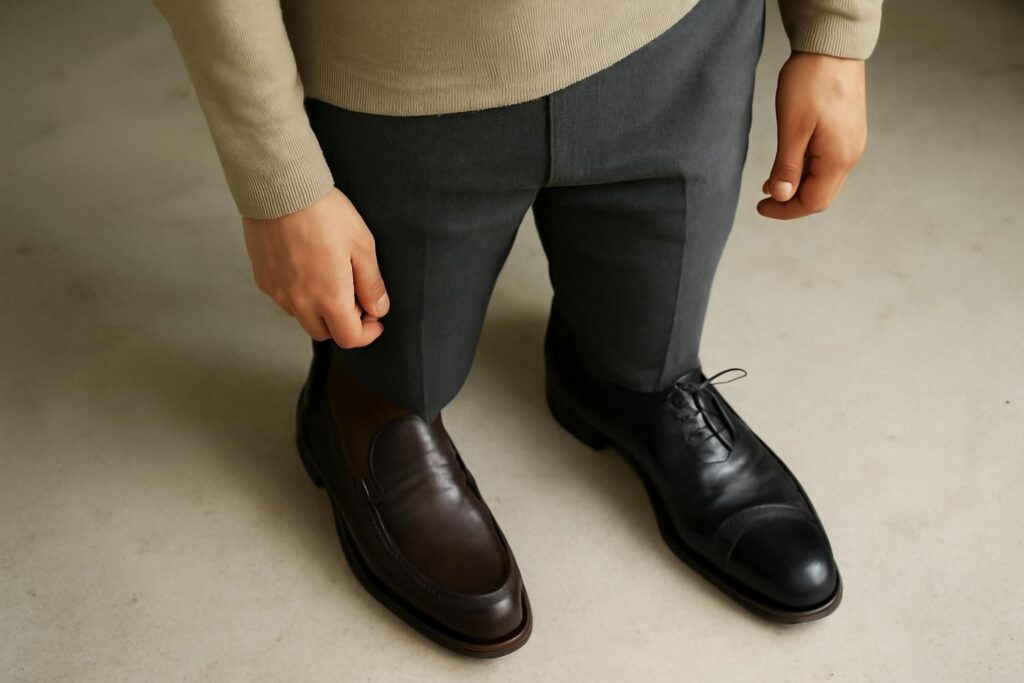
One laces, one slips on. That single difference shapes how formal each shoe reads, how it fits and where it belongs in a wardrobe.
The loafers vs oxfords question is a lace up vs slip on question at heart. An Oxford is a laced shoe with a closed lacing system, and a loafer is a laceless shoe you step into. Both can be made from the same polished leather, and both can sit under a suit, but they read differently. If you are still sorting Oxfords from their laced cousins, start with our Oxford vs Derby Shoes comparison, which explains open and closed lacing in detail. This guide covers what separates Oxford shoes vs loafers, when to wear each, and what to check when buying either secondhand.
The quick answer
An Oxford is a laced shoe with closed lacing: the eyelet tabs are stitched under the front of the shoe, so the laces close a neat V. It is generally treated as the more formal choice. A loafer is a slip-on shoe with no laces, usually with a low vamp and often a strap, tassel or metal bit across the top. It is generally treated as the more relaxed choice. Both are leather shoes, and both can be dressed up or down, but if a dress code is formal, the plain black Oxford is the common default.
Loafers vs Oxfords: comparison table
| Feature | Oxford | Loafer |
|---|---|---|
| Fastening | Laces, closed lacing | None, slip-on |
| Eyelet tabs | Stitched under the vamp (“closed tab”) | No eyelets |
| Typical details | Plain toe, cap toe, broguing | Penny strap, tassels, horsebit hardware |
| Fit adjustment | Laces tighten or loosen the fit | Fixed opening; fit depends on size and shape |
| Common formality | Business to formal | Casual to business casual, some dressier styles |
| Word history | Oxford-cut shoes attested 1721 | “Loafer” as a shoe from 1937 |
Where the names come from
The Online Etymology Dictionary describes the Oxford as “a type of shoe laced over the instep,” attested from 1721 in the phrase “Oxford-cut shoes.” The Victoria and Albert Museum defines it by construction: a “closed tab shoe” whose eyelet tabs are stitched under the vamp, unlike the Derby, blucher and Gibson, which the museum calls “open-tab.” According to the V&A, the Oxford was “the predominant style in men’s footwear” in the 1920s and 1930s.
“Loafer” as a type of informal shoe dates from 1937, per Etymonline. Several brands tell origin stories for the style. G.H. Bass says it introduced its Weejun loafer in 1936. That is the brand’s own account rather than an independent record. The Metropolitan Museum of Art holds Gucci loafers dated around 1972; the 1953 date often given for Gucci’s horsebit loafer is the brand’s claim. For the softer, moccasin-built relative of the loafer, see Loafers vs Moccasins.
How to tell them apart
- Look for laces. Laces mean it is not a loafer. No laces and no buckle usually means loafer.
- Check the eyelet tabs. If the tabs holding the eyelets are sewn under the front panel and close together, it is an Oxford. If they are sewn on top and flap open, it is a Derby.
- Look at the top of the foot. A strap with a slot (the “penny” strap), tassels or a metal bit point to a loafer.
- Check the opening. Loafers have a low, open throat you step into. Oxfords have a tongue under the laces.
- Watch for hybrids. A buckle shoe is a monk strap, not an Oxford or a loafer; our Monk Strap Shoes guide covers that style.
Formality: where each one sits
A common styling order, from most to least formal, runs: plain black Oxford, then Derby, then brogue, then loafer. This is styling convention rather than a rule from any single source, and plenty of polished loafers sit higher than a heavily brogued, brown Derby. Color and finish matter as much as shape: black and smooth reads dressier than brown suede in either style.
For black tie, the main etiquette sources describe black patent shoes; our Suit vs Tuxedo comparison and Black Tie Attire guide go through the full outfit. Below black tie, a plain black or dark brown Oxford is a safe pick for a suit. For business casual, both shoes are common, and loafers become the easier choice with chinos or tailored trousers.
When to wear each
Wear Oxfords when
- The dress code says business formal, formal or “suit and tie.”
- You are wearing a dark suit to an interview, a funeral or a formal wedding.
- You want the shoe to look sleek and quiet under trousers.
Pair a crisp shirt with them; Oxford Shirt vs Dress Shirt explains which shirt reads dressier.
Wear loafers when
- The code is business casual or smart casual.
- You are wearing chinos, cropped trousers or a casual suit.
- You want a shoe that is quick to put on and take off, such as when travelling.
Our Loafers Outfit Ideas guide has outfit ideas, and Business Casual Shoes for Men and Women compares the wider set of options.
Fit: lace up vs slip on
Laces let you adjust an Oxford across the instep, which helps when one foot is a little different from the other or when socks vary in thickness. A loafer has no adjustment, so the fit relies on the size, width and shape of the shoe. Many shoppers try loafers on with the socks they plan to wear. Sizes vary by brand, so check each brand’s own size chart rather than assuming your size carries over. If a pair is slightly snug, our How to Stretch Shoes That Are Too Tight guide covers common methods.
Thrift tips for both
- Check the soles and heels. Leather soles can usually be resoled by a cobbler if the upper is in good shape.
- Flex the upper. Deep cracks across the toe crease are harder to fix than surface scuffs.
- Look inside. Worn linings and a collapsed heel counter are common on loafers, because they are stepped into.
- Clean and condition before wearing; our How to Clean Leather Shoes and Keep Them Conditioned guide walks through it.
Buying new instead, search for Mens Black Oxford Shoes on Amazon, Penny Loafers on Amazon or Womens Leather Loafers on Amazon and compare the construction details listed above.
Top-selling match on Amazon

- 【Helpful Tips】 This style runs small. We recommend ordering a half size larger for a…
- 【Versatile Styling】 Effortlessly pairs with jeans, trousers, skirts, dresses – these horsebit…
Top-selling match on Amazon

- Designed For Comfort: A soft leather lining and cushioned latex insole offer day-to-night comfort in these…
- Secure Grip: These men's dress shoes provide reliable traction, ideal for polished office floors…
- Sturdy Build: These men's dress shoes feature a durable, reliable build, with a synthetic leather…
Shop the look on Amazon
Everything you need to build a secondhand-style wardrobe, delivered. We may earn a commission on purchases.
FAQ
Are loafers more casual than Oxfords?
Generally, yes. The common styling order places the plain black Oxford at the top of formality and the loafer lower, though finish and color shift where any single pair sits.
Can you wear loafers with a suit?
Many people do for business casual or less formal events. For formal dress codes, an Oxford is the more common choice.
Is an Oxford the same as a Derby?
No. The V&A describes the Oxford as closed-tab and the Derby as open-tab. See Oxford vs Derby Shoes for more.
Where did the loafer come from?
There is no single verified origin. Etymonline dates the word to 1937, and brands such as G.H. Bass give their own origin accounts.
Do loafers look better with dress socks or no-show socks?
Both options are common: loafers can be worn with dress socks or with no-show socks for a bare-ankle look. Dress socks that blend with the trousers suit business settings and cooler months, while no-show socks pair well with chinos, cropped trousers and warm-weather smart casual outfits. Because a loafer has no laces to adjust the fit, it helps to try a pair on with the sock thickness you plan to wear.