A self-tie bow tie uses the same knot as a shoelace bow, just tied around your neck, and once the sequence clicks it takes about a minute.
Knowing how to tie a bow tie is a small skill that pays off at every black tie dinner, wedding and gala. The knot looks intricate, but it is built from a handful of moves: cross, loop, fold, push through and tighten. This guide breaks the bow tie knot into numbered steps, explains the difference between self-tie and pre-tied styles, covers bow shapes and sizing, and sums up what etiquette sources say about bow ties at formal events. For long neckties, our main guide on How to Tie a Tie covers five knots from the four-in-hand to the full Windsor.
The steps below are a common method rather than the only approach. They assume you are facing a mirror, and they start with one end hanging lower on your left. Left-handed readers can mirror every instruction.
Self-tie, pre-tied and clip-on bow ties
Bow ties come in three main forms:
- Self-tie (freestyle). A single strip of fabric shaped at both ends, which you tie yourself. Many have an adjustable sliding clasp at the back to set the neck size.
- Pre-tied. The bow is already formed and stitched, attached to a band that fastens at the back of the neck with a hook or clasp.
- Clip-on. A pre-formed bow that clips directly onto the collar without a band.
Etiquette sources lean firmly toward the self-tie. On black tie, Debrett’s advises wearing a soft-collared white or cream shirt with a bow tie, and says to avoid clip-on or ready-tied ties and learn how to tie your own. The slight irregularity of a hand-tied bow is part of its appeal; a pre-tied bow tends to look perfectly symmetrical, which is exactly what gives it away. That said, the host and the event set the tone, and nobody is turned away from a party for wearing a pre-tied bow.
What you need
- A self-tie bow tie sized to your neck. If yours has an adjustable clasp, set it to your shirt collar size before you start. A plain black silk Self Tie Bow Tie Black Silk on Amazon is the most versatile choice for formal events.
- A shirt with a fold-down or wing collar, buttoned at the neck. Turn a fold-down collar up while you tie, then fold it over the band afterward.
- A mirror, at least for the first few attempts.
How to tie a bow tie: step by step
Part 1: Set up and make the first knot
- Drape the bow tie around your neck, under the raised collar, so the left end hangs about 1.5 inches lower than the right end.
- Cross the longer left end over the shorter right end, close to your neck.
- Bring the longer end up and under the crossing point, through the neck loop, so it comes out on top.
- Pull both ends gently to snug the first knot against your collar. Not too tight: you need room to work.
Part 2: Form the front bow
- Let the longer end hang over your shoulder for now, out of the way.
- Take the shorter end that hangs at the front and fold it in half horizontally, forming a bow shape. Hold the fold so its wide part sits sideways across your collar. This is the front loop of the bow.
- Bring the longer end down from your shoulder over the centre of that front bow, so it hangs straight down in front.
Part 3: Make the back loop and tighten
- Pinch the front bow and the hanging end together at the centre with one hand.
- With the other hand, fold the hanging end back on itself to form a second bow shape.
- Push that second bow through the small opening behind the front bow, the gap between the front bow and your collar. Push it through folded end first.
- Pull it through until both bows are roughly equal in width.
- Adjust by tugging the folded loops and the free ends in opposite directions. Pulling the loops tightens the knot; pulling the free ends loosens it.
- Straighten the bow so it sits level, then fold the collar down over the band.
Expect a few attempts. The step that trips most people up is step 10: the back loop has to go through the gap behind the front bow, not over it. If you are struggling, practise around your thigh or a chair leg first so you can see both sides of the knot.
Bow tie shapes and sizes
Common shapes
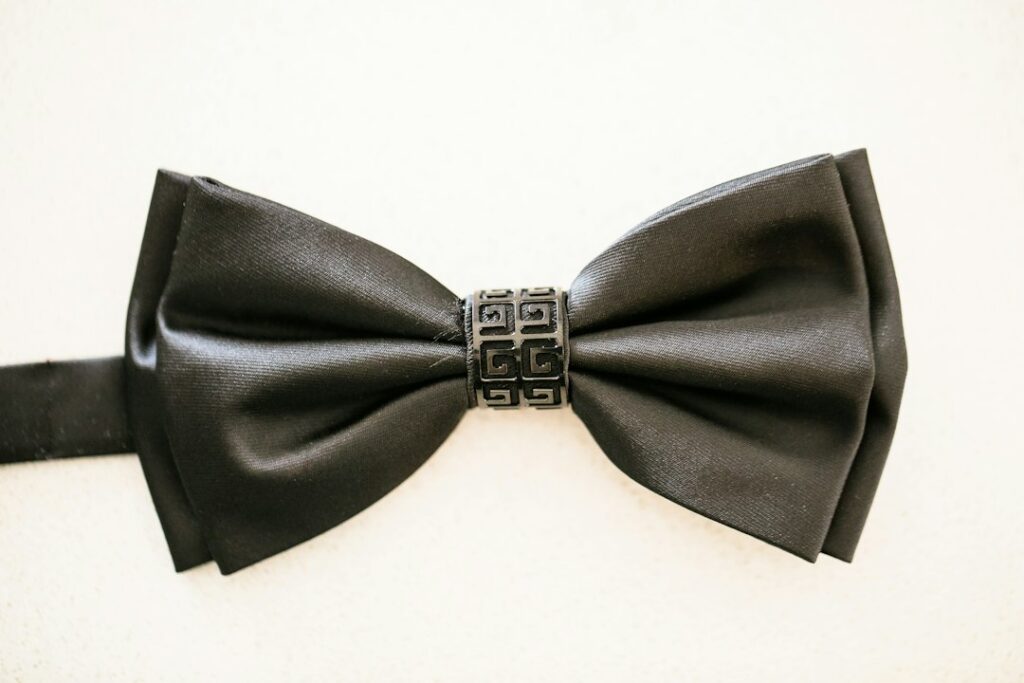
The two classic shapes are the butterfly (also called the thistle), which flares out at the ends into a fuller bow, and the batwing, which is straight and narrower. As a general menswear rule of thumb, a black silk butterfly is the traditional choice for black tie, while a batwing reads a little more modern and pared back. Other variations, such as pointed ends or the diamond tip, tie the same way and simply change the outline of the finished bow.
Getting the size right
Adjustable self-tie bow ties have a sliding clasp on the band with neck sizes marked along it. Match it to your shirt collar size. If your bow tie is a fixed length, check the brand’s sizing before buying, as fit varies between makers. A bow tie that is too long gives oversized, floppy wings; too short and the knot will be cramped and hard to tie.
Once tied, a common guideline is that the bow should not extend much wider than the outer edges of your face, and the knot should sit snugly at the top button without gaps.
Bow ties and black tie: what the etiquette sources say
Bow ties are most closely tied, so to speak, to evening dress codes. Here is how the main sources describe them. Remember that dress codes are conventions, not laws, and the invitation or host has the final word. For a full outfit breakdown see our guide to Black Tie Attire.
Black tie
Debrett’s describes black tie for men as a black wool single-breasted dinner jacket with no vents, silk peaked lapels or a shawl collar and covered buttons, worn with tapered trousers with a single row of braid, a soft-collared white or cream shirt and a bow tie that you tie yourself. Debrett’s calls black tie the most frequently encountered formal evening wear. Emily Post’s guidance, as summarised, lists a black tuxedo jacket and matching trousers, a formal white shirt with studs and cuff links, a black bow tie, black patent shoes and black dress socks.
White tie
White tie is the most formal evening dress code. Debrett’s describes it as a black single-breasted tailcoat worn with a white shirt with studs, a detachable wing collar and a thin white bow tie. If you are invited to a white tie event, a black bow tie is not the right fit.
Relaxed and creative black tie
Debrett’s notes that for a more relaxed or creative black tie event, a normal tie in place of a bow tie may be acceptable. Definitions of creative black tie vary between guides, so when in doubt, a classic black bow tie is the safe option. Our Men’s Formal Wear hub and What Men Should Wear to a Wedding as a Guest, by Dress Code guide cover these codes in more detail.
Matching the bow to the jacket
A menswear convention often cited is to match the bow tie’s finish to the jacket’s lapel facing: satin with satin, grosgrain with grosgrain. This comes from menswear writers rather than Debrett’s, so treat it as a styling preference rather than a rule.
Common bow tie problems and fixes
- Uneven bows. Pull the longer side’s loop slightly while holding the centre, or untie and adjust the starting length in step 1.
- The knot is loose. Tighten the first knot in step 4 more firmly, and pull the loops (not the ends) outward to snug the centre.
- The bow droops or tilts. Check that the band sits evenly under the collar on both sides, then level the bow with small tugs.
- The back loop will not go through. The gap behind the front bow is small. Loosen the first knot slightly, push the fold through with a fingertip, then retighten.
- Too much fabric left over. The neck size is likely set too long. Shorten the adjustable clasp and retie.
Bow tie care and where to find one
Untie a self-tie bow by pulling one free end slowly rather than yanking, and store it flat or loosely rolled so the creases relax. Many silk bow ties are labelled dry clean only, so check the care label before washing or pressing. If you need to press out creases, a low iron setting with a pressing cloth is the gentle option; our How to Iron a Shirt in 7 Steps guide explains the iron temperature dots on care labels.
Bow ties turn up regularly at thrift and vintage shops, often in silk and in widths that are hard to find new. Check the fabric for snags and the band for a working clasp. If you are building a formal kit on a budget, a secondhand dinner jacket plus a new Mens Tuxedo Bow Tie Set on Amazon is a practical combination. Our Men’s Thrift Store Shopping guide has more tips for shopping the men’s section.
Frequently asked questions
Is tying a bow tie harder than tying a regular tie?
It feels harder at first because the final step, pushing the back loop through, is less intuitive than tucking a necktie. After a few practice runs most people find it takes about as long as a half Windsor.
Is a pre-tied bow tie acceptable for black tie?
Debrett’s advises avoiding clip-on or ready-tied ties at black tie and learning to tie your own. In practice, many events are relaxed about it, but a self-tie bow is the traditional choice.
What colour bow tie goes with black tie?
Black is the traditional choice, usually in silk. White tie calls for a thin white bow tie, per Debrett’s. Creative black tie events may allow colour or pattern; check the invitation.
Can I wear a bow tie without a tuxedo?
Yes. Bow ties also work with suits, blazers and even knitwear for smart casual events. The formal conventions above apply only to black tie and white tie.
How do I know my bow tie size?
Match the adjustable clasp to your shirt collar size. For fixed-length bow ties, check the brand’s own size chart, as sizing varies.
Should my bow tie be perfectly symmetrical?
Not necessarily. A slightly uneven hand-tied bow is often seen as part of the charm, and perfect symmetry is a common sign of a pre-tied bow.
Shop the look on Amazon
Everything you need to build a secondhand-style wardrobe, delivered. We may earn a commission on purchases.