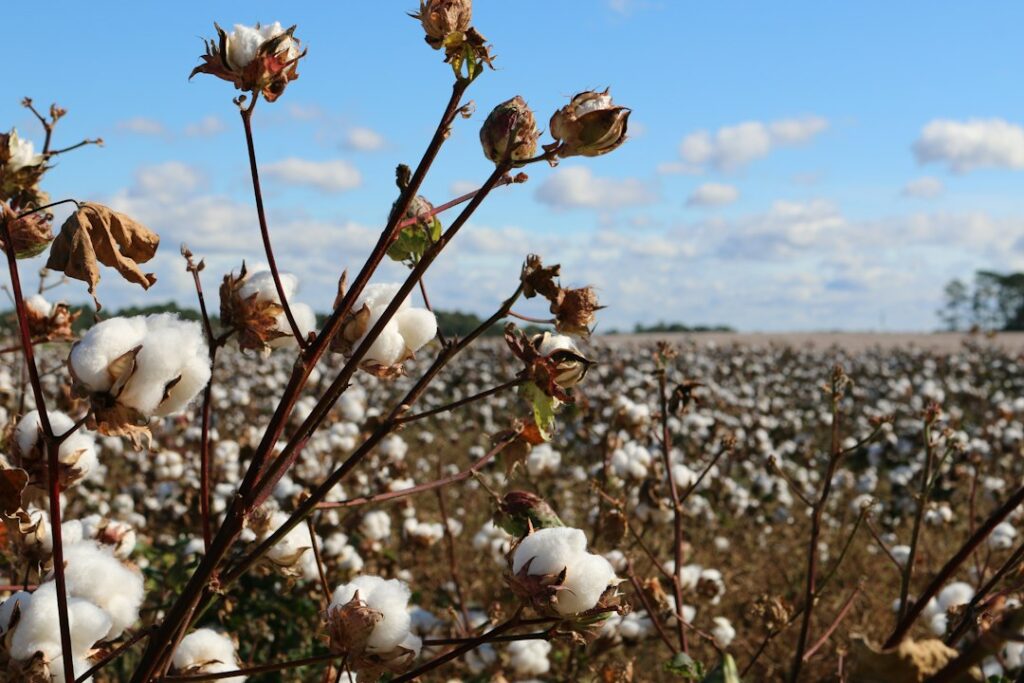
Pima and Egyptian cotton are sold as the premium end of everyday cotton, from T-shirts to bedsheets. Here is what the names actually mean, how they differ from regular cotton, and how to read the label before you pay extra.
What is pima cotton, and is it worth the higher price on a tag? Pima is one of the long-staple cottons, a group prized for fine, lustrous fibers. Egyptian cotton belongs to the same top group. Regular cotton, the kind in most basics, has shorter fibers. If you are still weighing cotton against synthetics in general, our guide to Cotton vs Polyester covers that bigger comparison. This article focuses on the differences inside the cotton family: what “long staple cotton” means, how pima and Egyptian cotton compare with regular cotton, what US labelling rules say about cotton names, and how to care for and shop these fabrics secondhand.
Quick answer: Pima is a long-staple cotton. Britannica places pima, Egyptian and Sea Island cottons in its top group of fine, lustrous fibers with a staple length of about 2.5 to 6.5 cm, compared with about 1.3 to 3.3 cm for medium-staple Upland cotton. Under FTC guidance, a label can name a cotton type only if the name is truthful and not deceptive.
What “staple length” means
A cotton fiber’s staple is its length. When people talk about “long staple cotton” or “extra-long staple cotton,” they mean the individual fibers inside the boll are longer than average. Longer fibers can be spun into finer, smoother yarns, which is why long-staple cottons are associated with soft shirts and fine sheeting.
Britannica groups cotton into classes by fiber quality. Its top group covers fine, lustrous fibers with a staple of roughly 2.5 to 6.5 cm, and it names Sea Island, Egyptian and pima cottons as members of that group. It lists the species Gossypium barbadense as “extra-long staple cotton.” By contrast, Britannica describes Upland cotton, the workhorse of most everyday clothing, as medium-staple, at roughly 1.3 to 3.3 cm.
Those ranges are broad and overlap, and the length of the fiber is only one part of how a finished garment feels. Yarn construction, the knit or weave, finishing and fabric weight all matter too. A long-staple label is a useful clue, not a guarantee of how a particular shirt will feel or wear.
Pima vs Egyptian vs regular cotton
Here is how the three compare, based on what the sources say. Where a point is general shopping advice rather than a sourced fact, it is marked as such.
| Point | Pima cotton | Egyptian cotton | Regular (Upland) cotton |
|---|---|---|---|
| Britannica group | Top group: fine, lustrous | Top group: fine, lustrous | Medium staple |
| Staple length (Britannica) | About 2.5–6.5 cm (group range) | About 2.5–6.5 cm (group range) | About 1.3–3.3 cm |
| Who vouches for the name | The seller, under FTC truthful-naming guidance | The Egyptian Cotton Association licenses its Egyptian Cotton™ mark | No type name needed; “cotton” is enough |
| Typical price | Usually higher than basic cotton (general shopping observation) | Usually higher than basic cotton (general shopping observation) | The everyday baseline |
| Common uses | T-shirts, polos, knit basics, sheets | Sheets, towels, dress shirts | Almost everything cotton |
Pima cotton
Pima sits in Britannica’s top group of fine, lustrous cottons. In clothing, you will most often see it in knit tees, polos and loungewear, where brands use the name to signal a smoother, softer hand. You will also see trademarked brand names for American-grown pima. Treat those as brand programs and check what the brand itself says about its sourcing and licensing. To see the range of basics on offer, browse Womens Pima Cotton T Shirt on Amazon or Mens Pima Cotton Polo on Amazon.
Top-selling match on Amazon

- Pima Interlock: Premium cotton Pima for an ultra-soft, elevated feel.
- Clean Silhouette: Regular, slightly fitted cut for everyday polish.
- Timeless Collar: Two-button polo collar with refined structure.
Top-selling match on Amazon

- Designed for low-impact workouts or daily wear
- Super soft, skin-friendly and lightweight fabric keeps you comfortable
Egyptian cotton
Egyptian cotton also falls in Britannica’s top group. The Egyptian Cotton Association, an industry body, runs licensing and accreditation for the Egyptian Cotton™ mark and says it uses DNA testing to check that a product’s fiber is genuine. The association dates Egyptian cotton cultivation to 1821. Its descriptions of Egyptian cotton’s quality are the association’s own claims. The practical point for shoppers: the words “Egyptian cotton” on a tag are a seller’s statement, and the licensed mark is the association’s way of backing that statement up.
Regular cotton
Most cotton clothing uses medium-staple Upland cotton, which Britannica describes as having fibers of roughly 1.3 to 3.3 cm. It is the default fiber in jeans, tees and work shirts. Plenty of excellent, long-lasting garments are made from regular cotton, so a missing “pima” or “Egyptian” label is not a sign of poor quality. Weave and construction often matter more, as our guides to What Is Twill? The Diagonal Weave Behind Jeans and Chinos and What Is Denim? Twill Weave, Indigo and How Jeans Fade explain.
What US labels can say about cotton types
The FTC’s guide to textile labelling, “Threading Your Way Through the Labeling Requirements,” addresses cotton names directly. A label may name a type of cotton “as long as the name is truthful and not deceptive.” If only part of the cotton is the named type, the label must show the share. The FTC’s own example is “100% Cotton (50% Pima).”
That example is worth reading closely, because it tells you how to decode a tag:
- “100% Pima Cotton” claims that all of the cotton is pima.
- “100% Cotton (50% Pima)” means the garment is all cotton, but only half of that cotton is pima.
- “Pima blend” with no percentage leaves you guessing. The FTC example shows that a partial blend should state the share, so a vague label is a reason to look more closely.
The same logic applies to Egyptian cotton wording. Naming the cotton type is the seller’s responsibility, and the guidance requires that name to be truthful. A label is a claim, so the more specific it is, the more useful it is to you.
Where you will see long-staple cotton
- T-shirts and knit basics. Pima is a common selling point on premium tees and tanks.
- Polos and casual shirts. Our roundup of Cotton Polo Shirts vs Performance covers what to look for in a polo.
- Woven shirting. Fine cottons are often woven into crisp shirting cloth. Our explainer on What Is Poplin? The Crisp Shirting Fabric Explained covers the plain-weave fabric behind many dress shirts.
- Lightweight plain weaves. Muslin, a plain-woven cotton made in various weights, is covered in our guide to What Is Muslin? The Plain-Weave Cotton Explained.
- Underwear and sleepwear. Soft cottons are popular next to the skin. See Organic Cotton Underwear for a related guide, or browse Pima Cotton Pajamas on Amazon.
How to care for pima and Egyptian cotton
Long-staple cotton is still cotton, so it follows the usual cotton rules. The care label comes first: under the FTC Care Labeling Rule, if a product needs regular ironing, the label must give ironing information, and it should say “Do not iron” if a hot iron would harm it.
Washing
- Read the care label and follow its temperature and cycle.
- Sort by color so dark dyes do not transfer onto pale pieces.
- Turn knits inside out to reduce surface wear, a common method.
- Wash in cool water, a common method for limiting shrinkage and fading.
- Line dry or tumble dry on low if the label allows. Our guide on How to Prevent Clothes From Shrinking in the Wash explains why heat is the main risk.
- Iron while slightly damp if needed, another common method.
Ironing temperature
According to the widely used ISO laundry symbols, an iron symbol with three dots means a hot setting of about 200°C, intended for cotton and linen. Always follow the garment’s own label first, because blends with synthetics need a cooler iron. Our guide on How to Iron a Shirt in 7 Steps walks through the steps.
Bleach and whites
The Smithsonian Museum Conservation Institute notes that repeated chlorine bleach use causes yellowing and weakening in cotton and linen over time, so use it sparingly and only where the label permits. Never mix bleach with ammonia, vinegar or other cleaners. If anyone is exposed to a household chemical, US Poison Control is 1-800-222-1222. Our guide on How to Wash White Clothes and Keep Them Bright covers gentler approaches.
Thrifting pima and Egyptian cotton: what to check
Premium cotton basics show up often on thrift racks, and they can be a good way to try the fiber without paying full price. Use these checks:
- Read the fiber content label. Look for the cotton type and its share, such as “100% Cotton (50% Pima).”
- Look for a licensed mark on Egyptian cotton. The Egyptian Cotton Association licenses the Egyptian Cotton™ mark. A plain “Egyptian cotton” tag is the seller’s claim.
- Check the surface. Pilling, thinning at the elbows or collar, and shine at stress points all show wear.
- Check the shape. Twisted side seams and stretched necklines usually do not wash out.
- Feel it. The name on the label matters less than how the piece feels and fits now, after its previous life.
For more secondhand tips, our guide to How to Find Vintage Clothing covers where and how to search.
Frequently asked questions
What is pima cotton in simple terms?
It is a long-staple cotton. Britannica places pima in its top group of fine, lustrous cottons, alongside Egyptian and Sea Island cotton, with a staple length of roughly 2.5 to 6.5 cm.
What is Egyptian cotton?
Egyptian cotton is another member of Britannica’s top group of long-staple cottons. The Egyptian Cotton Association licenses an Egyptian Cotton™ mark and says it uses DNA testing to verify fiber in products that carry it.
Is pima better than Egyptian cotton?
Britannica places them in the same top group, so neither is simply better. The finished feel depends on the yarn, the knit or weave and the finishing, so compare actual garments rather than names alone.
What does “extra-long staple cotton” mean?
It refers to cotton with especially long fibers. Britannica lists Gossypium barbadense as “extra-long staple cotton.”
Can a label say pima if only some of the cotton is pima?
Only with the share shown. The FTC gives “100% Cotton (50% Pima)” as the example of how to label a partial blend, and any cotton type name must be truthful and not deceptive.
Does pima cotton shrink?
It is cotton, so heat in washing and drying can shrink it like any cotton. Washing cool and drying low or on a line are common methods for limiting shrinkage. Follow the care label first.
Does pima cotton pill less than regular cotton?
Pima cotton usually pills less than regular cotton, because its longer fibres can be spun into smoother yarns with fewer loose ends at the surface. Pills form when friction tangles short fibre ends, so longer staple cotton tends to stay smoother for longer. Construction still matters: a loosely knit or brushed pima tee can pill more than a tightly made Upland cotton one. Washing inside out on a gentle cycle reduces friction for any cotton.
Shop the look on Amazon
Everything you need to build a secondhand-style wardrobe, delivered. We may earn a commission on purchases.