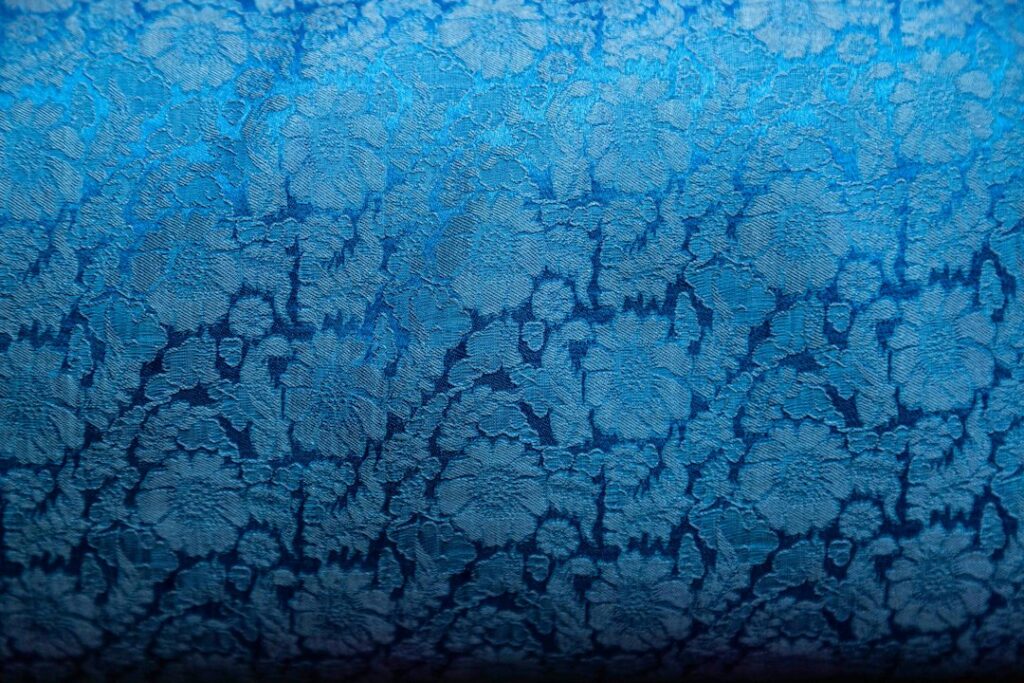
Damask is the quiet member of the woven-pattern family: one colour, a soft sheen, and a design you only fully notice when light hits it at an angle.
What is damask? It is a patterned woven fabric, usually in a single colour, where the design is created by contrasting two different weaves rather than two different colours. Like brocade, it is a jacquard relative, so our What Is Jacquard? Woven Patterns Explained guide explains the loom behind it. Below you will find where the name comes from, how damask fabric is made, how it compares with brocade, and how to wear, care for and thrift it.
Quick answer: Damask is a woven fabric, typically one colour, in which the pattern and the background use two different weaves so the design shows through contrast in sheen. It is reversible: the back shows the same pattern in “negative.” The name means “cloth from Damascus.”
Where the name comes from
According to Etymonline, “damask” has been used in English since the late 14th century for a “costly textile fabric woven in elaborate patterns.” It literally means “cloth from Damascus,” the Syrian city noted for its fabric. As an adjective meaning “woven with figures,” it dates from the 1640s.
The Vintage Fashion Guild adds that silk damasks originated in China, that European damasks were made of linen from the 15th century, and that modern table linens are often cotton or blends. So the name points to Damascus, while the fabric itself has a longer and wider history.
How damask is made
The VFG describes damask as “characteristically one color but two different weaves, to set the patterns apart from the ground.” In practice, one area of the cloth is woven so that threads float in one direction, and the neighbouring area is woven so they float the other way. Light reflects differently off each, which makes the pattern visible even though the colour is the same.
Because the design comes from the weave structure, flipping the cloth swaps the two weaves. That is why the VFG says damask “can be reversed, although the reverse will feature the woven-in pattern in ‘negative.'”
Damask vs brocade
| Damask | Brocade | |
|---|---|---|
| Colour | Typically one colour | Often several colours and metallic threads |
| How the pattern shows | Two weaves contrasting in sheen | Raised figures in colour, texture or both |
| Reversible | Yes, pattern in negative on the back | No, floats show on the back |
| Surface | Flat and smooth | Raised, textured |
| Typical uses | Table linens, upholstery, shirts, dresses | Evening jackets, festive suits, skirts |
Both are jacquard-woven relatives, according to the VFG. Our What Is Brocade? Woven Raised Patterns Explained explainer covers the raised, metallic side of the family.
Feel and performance
| Pros | Cons |
|---|---|
| Pattern is woven in, so it cannot wash or rub off | Satin-weave areas can snag |
| Reversible, with no loose floats on the back | Silk damask needs delicate care |
| Smooth, with a subtle sheen | Linen and cotton versions crease |
| Comes in silk, linen, cotton and blends | Heavier upholstery damasks are too stiff for clothing |
How to wear damask
The damask pattern is tone-on-tone, so it reads more subtle than most prints. That makes it easy to style:
- Damask shirt or blouse: a single-colour damask adds interest without competing with a patterned tie or skirt.
- Damask dress or skirt: in silk or a blend, it works for weddings and evening events. Pair it with plain accessories. A Damask Jacquard Dress Women on Amazon is a simple way in.
- Jackets and waistcoats: tone-on-tone damask gives texture to formal wear without the shine of brocade.
- Pattern mixing: because damask is quiet, a common approach is to pair it with one bolder pattern, such as What Is Paisley? The Teardrop Pattern’s History in a scarf or a fine stripe.
At home, damask is a classic for tablecloths and napkins, and thrift stores often carry vintage linen sets. A Damask Tablecloth on Amazon or Damask Fabric By The Yard on Amazon are options if you want new.
Top-selling match on Amazon

- Elegant Damask Pattern: Luxurious woven damask fabric adds a touch of sophistication to your table setting…
- Versatile Design & Styling: Available in a variety of everyday and seasonal colorways. With sizes and shapes to…
- Premium Quality: Crafted from 100% durable polyester, our tablecloth offers both durability and…
How to care for damask
The fibre decides the care, so start with the label. The FTC Care Labeling Rule requires labels to say whether to wash by hand or machine and to give a water temperature if hot water would harm the item.
- Silk damask: avoid enzyme detergents and chlorine bleach. The Smithsonian Museum Conservation Institute says protein fibres “can be damaged by protein enzymes or alkali” and that chlorine bleach “will dissolve silk or wool.” See our How to Wash Silk Without Ruining It guide.
- Linen damask: MCI notes that repeated chlorine bleach on cotton and linen causes yellowing and weakening over time, so use it sparingly and only if the label allows. Our How to Wash Linen Clothes guide covers the rest.
- Cotton and blend damask: follow the label; a common method is a gentle cycle and line drying to protect the sheen.
- Ironing: per ISO 3758 care symbols, three dots is about 200 °C (cotton, linen) and one dot about 110 °C (synthetics, silk). Follow the garment’s label first. Pressing on the reverse is a common method that protects the sheen.
- Dry clean only: take it to a professional cleaner.
Thrifting damask: what to check
- Turn it over. A true damask shows the same pattern in negative on the back.
- Check the fibre. Linen, cotton, silk and blends behave differently; vintage table linen is often linen or cotton.
- Look for yellowing and fold lines on stored table linens.
- Look for snags in the shinier weave areas.
- Hold it to the light. Thin spots show up quickly on well-used linens.
For more on how woven fabrics compare, browse our Types of Fabric hub and the Satin vs Silk explainer, since satin-weave areas give damask much of its sheen.
Shop the look on Amazon
Everything you need to build a secondhand-style wardrobe, delivered. We may earn a commission on purchases.
FAQ
What does damask mean?
Etymonline says it literally means “cloth from Damascus,” the Syrian city noted for its fabric.
Is damask reversible?
Yes. The Vintage Fashion Guild says it can be reversed, with the reverse showing the pattern in negative.
What is the difference between damask and brocade?
Damask is typically one colour with the pattern made by two contrasting weaves, and it is reversible. Brocade often uses several colours and metallic threads, and it is not reversible.
Is damask a print?
True damask is woven, not printed. “Damask pattern” is also used loosely for printed designs in a similar style, so check the back of the fabric.
What is damask usually made of?
Silk, linen, cotton or blends. The VFG notes that silk damasks originated in China, European damasks were linen from the 15th century, and modern table linens are often cotton or blends.