Jacquard is the name behind damask-style tablecloths, patterned sweaters, brocade-look jackets and many textured dresses. It refers to how the pattern gets into the cloth, not to a single fabric.
What is jacquard? The word comes from a loom invented in the early 1800s that could weave complex patterns automatically, and today it is used for fabrics whose pattern is woven in rather than printed on. That makes jacquard a way of making cloth, much like velvet is defined by its pile weave (see our What Is Velvet? Pile Fabric, Types and Care guide). This page covers the history of the jacquard loom, what people mean by jacquard fabric, how it compares with brocade and with prints, how to care for it, and what to check when you find a jacquard piece secondhand.
Quick answer: Jacquard takes its name from Joseph Marie Jacquard, a French inventor whose loom, dated to 1804 by the Science Museum Group, used punched cards to control the pattern. “Jacquard fabric” is commonly used for any cloth with a pattern woven in on a jacquard-type mechanism, in any fibre.
The jacquard loom: a short history
The Science Museum Group’s record for Joseph Marie Jacquard (1752–1834) describes him as a French inventor born in Lyons. Its timeline lists a treadle loom in 1800, a net-weaving loom in 1803, and in 1804, “invented the Jacquard Loom”.
What made the loom special was its punched cards. According to the Science Museum Group, the cards controlled the pattern being woven, and that idea is often cited as a forerunner of programming. That is a fair description of its influence; it would be wrong to say Jacquard invented the computer, and the museum doesn’t claim that.
The Science Museum Group collection includes Jacquard punched cards, a hole punch for making Jacquard cards (1870), a card-lacing machine and a silk hand loom fitted with a Jacquard machine from about 1825. Together they show how the cards were made, linked and used on real looms long after the invention.
What jacquard fabric is
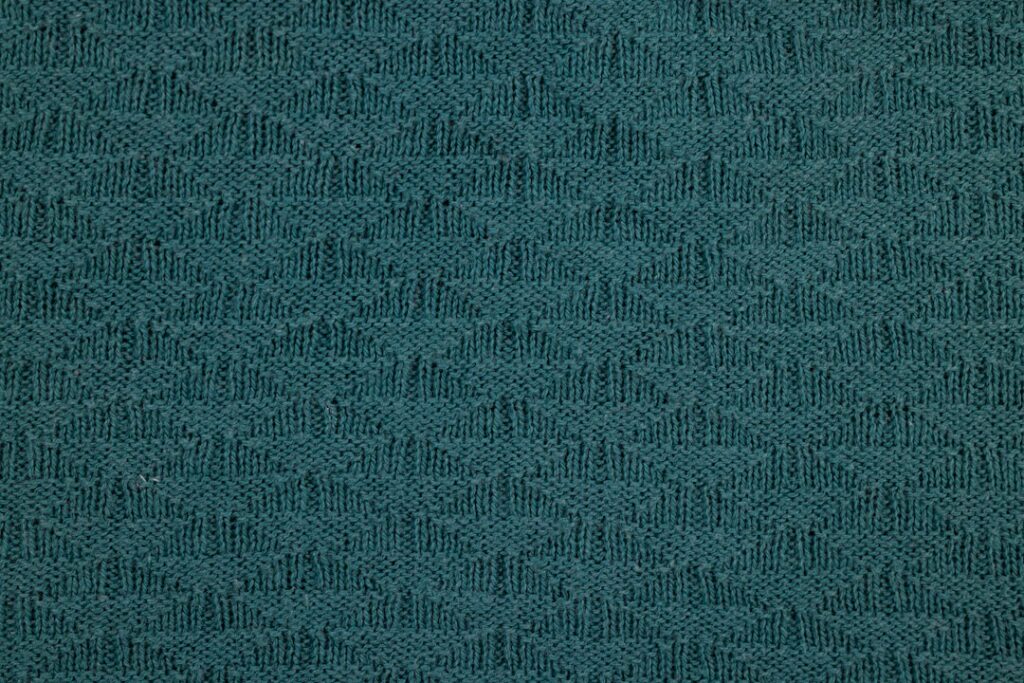
On a basic loom, the weaver repeats a simple pattern of lifting warp threads, which produces the three basic weaves: plain, twill and satin. A jacquard mechanism lets threads be lifted individually, so the pattern can change from one row to the next. The result is commonly described as a cloth where motifs such as florals, geometrics, paisleys or lettering are part of the structure, often with different textures or shine in different areas.
Jacquard fabric can be made from almost any fibre: cotton, silk, wool, polyester, viscose or blends. That is why you will see “cotton jacquard”, “silk jacquard” and “knit jacquard” on labels and listings. Knitwear uses the word too, for sweaters with patterns knitted in; the principle, pattern built into the structure, is the same.
Woven pattern vs printed pattern
Printed fabric has the design applied to the surface after weaving. History offers a contrast: Britannica notes that in Mughal India the fine muslins of Dhaka were sometimes printed or painted (see What Is Muslin? The Plain-Weave Cotton Explained). With jacquard, the pattern is in the weave itself. A quick test is to look at the back: a woven jacquard pattern usually shows on the reverse, often as a mirror image or with floating threads, while a print is usually paler or blank on the back.
Jacquard vs brocade (and damask)
These names overlap, and our sources don’t define brocade or damask, so here is how they are commonly described. Brocade is usually used for richly decorated fabrics with raised motifs, sometimes with metallic-looking threads, which look embroidered but are woven. Damask is usually used for reversible patterns with contrasting shine, common on table linens. Both are commonly made on jacquard looms, which is why many shops treat “jacquard” as the umbrella term. When a listing uses one of these names, rely on the photos and fibre content rather than the label alone.
How jacquard feels and performs
| Trait | Upside | Downside |
|---|---|---|
| Woven-in pattern | Pattern is part of the cloth, not printed on top | Long floats on the back can snag on rings and zips |
| Texture | Adds depth and interest without extra trims | Some jacquards feel stiff until worn in |
| Weight | Many jacquards have body, good for jackets and skirts | Heavier versions can feel warm in summer |
| Fibre range | Available in cotton, silk, wool and synthetics | Care varies widely, so the label matters |
These are general observations, not test results. Jacquard is popular for blazers, skirt suits, dresses, sweaters and home textiles. If you are shopping new, try Jacquard Midi Skirt on Amazon or Jacquard Knit Sweater on Amazon to see the range of patterns and weights.
How to care for jacquard
Because jacquard can be any fibre, care depends on the label. Under the FTC Care Labeling Rule, the label must say whether to wash by hand or machine, and give a temperature if hot water would harm the item. Structured jackets and silk jacquards are often dry clean only; if yours is, take it to a professional. For washable pieces, a common method:
- Turn the garment inside out to protect the face of the pattern.
- Wash on a gentle cycle at the temperature the label gives, or hand wash.
- Use a mild detergent; for silk or wool jacquard, choose one without enzymes.
- Skip wringing and press water out gently.
- Dry flat or on a hanger, out of direct heat, unless the label allows the dryer.
- Press on the reverse at the label’s iron setting, ideally through a cloth.
The Smithsonian Museum Conservation Institute notes that silk and wool can be damaged by protein enzymes or alkali, and that chlorine bleach will dissolve them, which matters for silk and wool jacquards. For a wool jacquard sweater, see How to Wash a Wool Sweater Without Shrinking It; for silk, see How to Wash Silk Without Ruining It.
What to check when thrifting jacquard
- The back. Turn it over. Pulled or broken floats show as loops or gaps, and they can spread.
- Fibre content. Silk, wool, cotton and synthetic jacquards need different care.
- Wear on raised areas. Raised motifs rub first at cuffs, elbows and hems.
- Pattern matching. On good tailoring, the pattern lines up across seams and pockets.
- Measurements. Vintage sizing differs from modern sizing, so measure the garment flat.
A Fabric Pilling Shaver on Amazon can tidy knit jacquards, used lightly. If you are into woven structure, see also What Is Twill? The Diagonal Weave Behind Jeans and Chinos and What Is Bouclé? The Looped-Yarn Fabric Explained.
Top-selling match on Amazon

- 【Portable Fabric Shaver】– Special designed for removing fuzz, pills, and lint from sweaters…
- 【Innovative Blades】 — Upgraded 6 Leaf Blades, razor-sharp, double cleaning efficiency…
Shop the look on Amazon
Everything you need to build a secondhand-style wardrobe, delivered. We may earn a commission on purchases.
Browse picks on Amazon →FAQ
Who invented the jacquard loom?
Joseph Marie Jacquard, a French inventor from Lyons. The Science Museum Group dates the loom to 1804.
Is jacquard a fabric or a weave?
It describes how the pattern is made. Jacquard fabric can be cotton, silk, wool or synthetic.
Did Jacquard invent the computer?
No. The Science Museum Group says his punched cards are often cited as a forerunner of programming.
Is brocade a type of jacquard?
Brocade is commonly described as a decorative fabric often woven on jacquard looms, so the names overlap.
Woven Patterns
Brocade and damask explained.