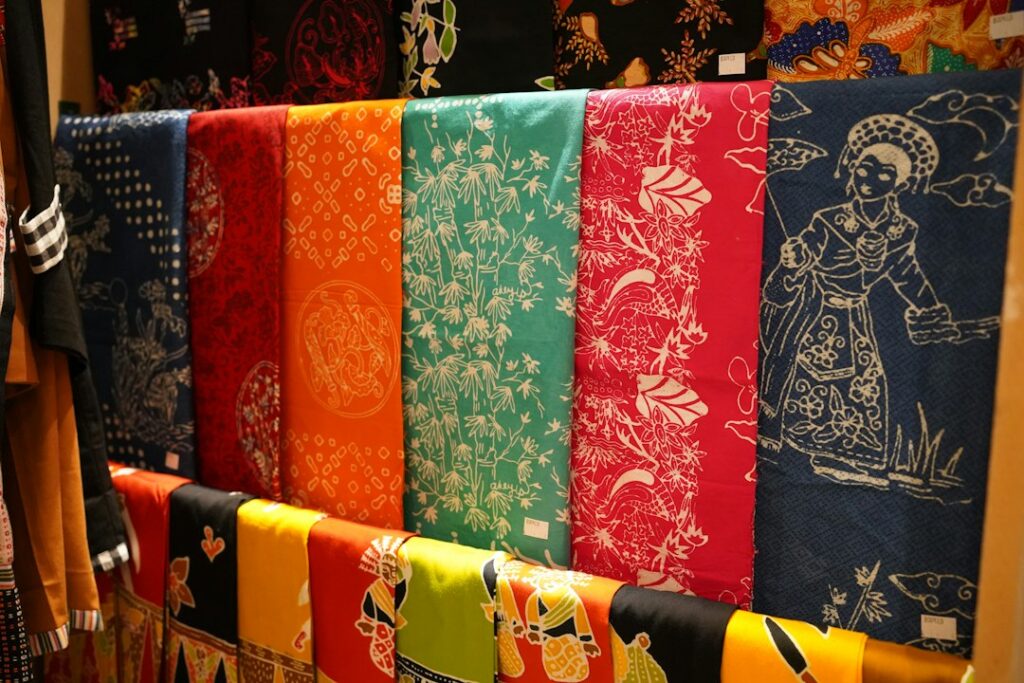
Batik is a way of drawing on cloth with hot wax so that dye cannot reach the lines, and in Indonesia it is a living tradition that follows people through every stage of life.
What is batik? It is a wax-resist dyeing technique: designs are drawn onto fabric in hot wax, the cloth is dyed, and the waxed areas stay the original colour. It is often grouped with home dyeing projects, and our How to Tie Dye a Shirt guide covers the simpler fold-and-bind method many people try first. This explainer covers how batik is made, why Indonesian batik is recognised by UNESCO, how it differs from tie dye, and how to care for batik fabric you buy or thrift.
Quick answer: Batik is a resist-dyeing method in which hot wax is applied to cloth in dots and lines to block dye. The cloth is dyed, the wax is removed, and the steps are repeated for each colour. UNESCO inscribed Indonesian Batik on its Representative List of the Intangible Cultural Heritage of Humanity in 2009.
Indonesian batik and UNESCO recognition
In 2009, UNESCO inscribed Indonesian Batik on the Representative List of the Intangible Cultural Heritage of Humanity. UNESCO’s description makes clear that batik is far more than a fabric finish. It says batik accompanies Indonesians “from birth to death,” appearing in baby slings, wedding and pregnancy rites, puppet theatre and funerary shrouds, and that it “is intertwined with the cultural identity of the Indonesian people.”
UNESCO also notes that batik motifs reflect many influences, from Arabic calligraphy and European bouquets to Chinese phoenixes, Japanese cherry blossoms and Indian or Persian peacocks. That variety is part of what makes batik such a rich tradition, and it is worth remembering that wax-resist dyeing is practised in other places too. Indonesian batik is the inscribed tradition, not the only one.
The word itself, according to Etymonline, entered English around 1880 for a “Javanese technique of textile design,” via Dutch from Malay mbatik, which is said to come from amba, “to write,” and titik, “dot, point.” The idea of writing with dots fits the method closely.
How batik is made
UNESCO describes the process in a few stages. Here it is as a simple sequence:
- Craftspeople draw designs on the fabric using dots and lines of hot wax.
- The cloth is dyed. The wax resists vegetable and other dyes, so the waxed lines stay undyed.
- The wax is removed in boiling water.
- For more colours, the waxing and dyeing are repeated.
UNESCO notes that the technique is used on cotton and silk. The Vintage Fashion Guild points out that fine crackle lines, where the wax cracked and let a little dye seep in, are part of the batik look rather than a defect.
Batik vs tie dye
Both are resist-dyeing methods, but they block dye in different ways, and batik should not be described as “just tie dye.”
| Batik | Tie dye | |
|---|---|---|
| Resist | Hot wax drawn onto the cloth | Folding, twisting and binding the cloth |
| Look | Controlled lines and motifs, often with fine crackle | Softer, radiating or blotchy shapes |
| Colour building | Repeated waxing and dyeing for each colour | Often several dyes applied at once |
| Skill and time | High; designs are drawn by hand or stamped | Lower barrier for beginners |
| Cultural standing | Indonesian batik is UNESCO-inscribed heritage | Many traditions, including Indian bandhani |
The Smithsonian Magazine notes that bandanas trace back to Indian bandhani tie-dye kerchiefs, another resist tradition with its own history.
Feel and performance of batik fabric
| Base fabric | Pros | Cons |
|---|---|---|
| Cotton batik | Breathable, easy to wear in warm weather, often machine-washable on a gentle cycle | Hand-dyed colours may bleed in early washes |
| Silk batik | Drapes well, takes dye richly | Needs gentle protein-fibre care |
| Batik-style print | Usually cheaper and widely available | No wax process; pattern often sits on one side |
For more on base fabrics, see our Types of Fabric hub and the What Is Muslin? The Plain-Weave Cotton Explained explainer.
How to wear batik respectfully
UNESCO describes batik as part of Indonesian life from birth to death, and it is also widely worn outside Indonesia. A few points keep it respectful: name it as Indonesian batik when that is what it is, buy from makers or sellers who describe where and how the cloth was made, and avoid describing it as a generic print stripped of where it comes from. A batik shirt with plain trousers, a batik scarf, or a Batik Sarong Cotton on Amazon are all simple ways to wear it. If you sew, a length of Batik Fabric Cotton on Amazon can become a shirt, skirt or wrap.
Top-selling match on Amazon

- Singer Batik Collection Fabric: Vibrant, richly colored batik print with a handcrafted look. A great choice for…
- Match Along The Collection: Part of the SINGER Batik Collection. Pair it with other batik colors in the same…
- Care And Color Note: Prewash before sewing and press with a warm iron to smooth wrinkles. Batik dye…
Styling-wise, batik already carries a lot of pattern, so a common approach is to pick one colour from the design and keep the rest of the outfit solid. Pieces like a plain What Is Linen? Flax Fiber, Feel and Care shirt or a denim jacket sit easily alongside it. Other patterns in this series, such as What Is Paisley? The Teardrop Pattern’s History and What Is Madras? The Lightweight Plaid Cotton, also have South and Southeast Asian roots worth reading about.
How to care for batik
Start with the care label. Under the FTC Care Labeling Rule, labels must say whether to wash by hand or machine and give a temperature if hot water would harm the item.
- Cotton batik: a common method is to wash in cold water, separately for the first few washes in case of dye bleed, and dry out of direct sun.
- Silk batik: the Smithsonian Museum Conservation Institute says silk can be damaged by protein enzymes or alkali, and that chlorine bleach “will dissolve silk or wool.” Use a gentle, enzyme-free detergent. Our How to Wash Silk Without Ruining It guide walks through the steps.
- Bleach: follow the label’s bleach instruction; a “Do not bleach” label means every bleach would harm the item, per FTC guidance. Never mix bleach with ammonia, vinegar or other cleaners, and if anyone swallows or inhales a cleaning product, call Poison Control.
- Ironing: follow the label’s iron setting; turning the cloth over and pressing on the reverse is a common method to protect the surface.
Thrifting batik: what to check
- Look at both sides. A common rule of thumb is that dyed-through batik shows its pattern clearly on the back, while a much paler back suggests a surface print.
- Look for crackle lines. Fine veins of colour are a normal batik feature, per the Vintage Fashion Guild.
- Check the fibre. Cotton and silk are the bases UNESCO names.
- Check for fading or dye transfer at seams and folds.
- Wash it on its own first, in cold water, before mixing it with other laundry.
Shop the look on Amazon
Everything you need to build a secondhand-style wardrobe, delivered. We may earn a commission on purchases.
FAQ
Where does batik come from?
Wax-resist dyeing is practised in several places, but Indonesian batik is the tradition UNESCO inscribed on its intangible cultural heritage list in 2009. The English word comes via Dutch from Malay, per Etymonline.
Is batik the same as tie dye?
No. Both are resist methods, but batik uses hot wax drawn onto the cloth, while tie dye uses folding and binding.
Are cracks in batik a flaw?
No. The Vintage Fashion Guild notes that fine crackle lines, where the wax cracked and let dye in, are part of the look.
Can you machine wash batik fabric?
Many cotton batiks can go on a gentle cold cycle, but check the label first. Silk batik and anything labelled dry clean only need gentler handling or a professional cleaner.
Can I make batik at home?
People do, with care, because the method uses hot wax and boiling water. If you want an easier first resist-dye project, start with our How to Tie Dye a Shirt guide.