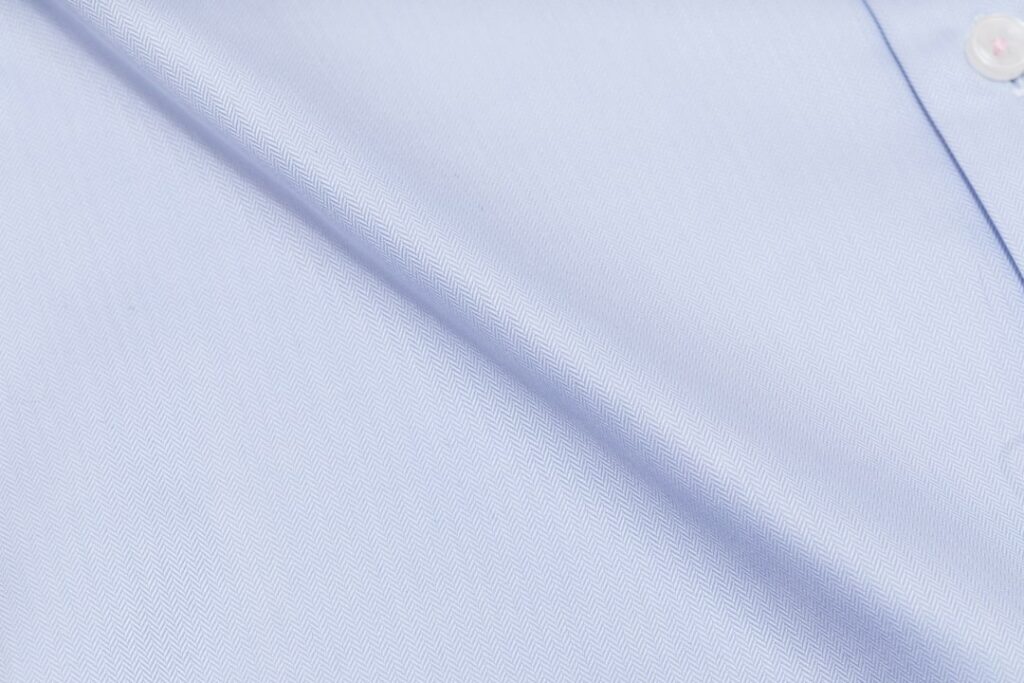
Look closely at a classic grey overcoat or a tweed jacket and you will often see tiny columns of V-shapes running up the cloth. That is herringbone, and it is a weave, not a print.
What is herringbone? It is a twill weave in which the diagonal line reverses direction at regular intervals, creating a zigzag that looks like the backbone of a fish. To understand it, it helps to know the weave it comes from, so our What Is Twill? The Diagonal Weave Behind Jeans and Chinos guide is a good companion. This page covers how herringbone is made, herringbone vs chevron, herringbone tweed, how to wear it and how to care for it.
Quick answer: The Vintage Fashion Guild defines herringbone as “a reversing (broken) twill weave which creates a zigzag pattern, resembling a fish backbone.” It is also called chevron weave. It was originally made in wool and is now wool or blends, often in two colours, and is used for coats, suits, jackets and skirts.
How herringbone is woven
According to Britannica, twill is one of the three basic weaves and produces a diagonal rib or wale, usually at about 45°. Each crosswise yarn passes over and under groups of lengthwise yarns, stepping along one place per row, and that step builds the diagonal line you can see on denim or gabardine.
Britannica describes herringbone as a twill variant made by reversing the direction of the twill line. The weaver runs the diagonal one way for a set number of threads, then flips it to run the other way. The point where it flips is “broken,” meaning the two diagonals are offset rather than meeting in a neat point. Repeat that across the width of the cloth and you get vertical columns of zigzags.
The Vintage Fashion Guild notes herringbone is often a two-colour zigzag stripe, which makes the pattern stand out, but single-colour versions exist. In a single-colour herringbone the pattern shows only as texture, catching the light differently on each diagonal.
Where the name comes from
Etymonline gives the word as herring plus bone, from the 1650s, and notes it was originally also used for a stitch. Earlier it had a use in masonry (herringbone brickwork), and from 1903 it was even used for a cloud type. In every case, the image is the same: rows of slanted lines branching from a central spine, like a fish skeleton.
Herringbone vs chevron
This is where terms get slippery. The Vintage Fashion Guild lists “chevron weave” as another name for herringbone, so in fabric language the two can mean the same thing. In everyday shop copy, though, “chevron” is often used for a bold, continuous V-shaped stripe, usually printed or knitted, where the lines meet cleanly at a point. Herringbone, as a broken twill, has that small offset where the direction changes. A common way to tell them apart:
| Herringbone | Chevron (common shop use) | |
|---|---|---|
| Where the lines meet | Offset (“broken”) at each turn | Meet in a clean point |
| How it is made | Woven, reversing twill | Often printed or knitted |
| Scale | Usually small, reads as texture | Often large, graphic stripes |
| Typical garments | Coats, suits, jackets, skirts | Sweaters, dresses, home décor |
Herringbone tweed
Tweed is a rough-surfaced wool cloth, and according to Britannica its variants include herringbones, diamonds, chevrons and checks. Herringbone tweed is the classic jacket and overcoat cloth: hard-wearing, textured and easy to pair. Read more in What Is Tweed? Scottish Wool Cloth Explained. Herringbone also turns up in flannel, wool suiting and cotton twills for trousers and workwear.
Where you will see herringbone
According to the Vintage Fashion Guild, herringbone was originally a wool cloth and is now made in wool or blends, used for coats, suits, jackets and skirts. On a thrift rack, you are most likely to find it in:
- Wool overcoats and blazers, often in grey, brown or charcoal two-tone herringbone.
- Wool flannel trousers and skirts, where the zigzag is small and soft. See What Is Flannel Fabric? Brushed Cotton and Wool Explained for how flannel differs from other wool cloths.
- Cotton twill workwear, such as jackets and trousers, where a herringbone twill adds texture.
- Scarves and caps, a small, easy way to try the pattern.
For a broader map of weaves and fibres, see our Types of Fabric guide.
Herringbone: pros and cons
| Pros | Cons |
|---|---|
| Twill weave is durable and drapes well | Wool versions often need hand washing or dry cleaning |
| Reads as a textured neutral from a distance | Heavy tweeds can feel scratchy without a lining |
| Easy to pair with other patterns | Moths target wool, so storage matters |
| Lint and small marks show less than on flat solids | Pattern matching at seams adds cost to good tailoring |
How to wear herringbone
Common styling approaches:
- Overcoat: a grey or brown Herringbone Wool Overcoat on Amazon works as a neutral over almost anything. See Women’s Wool Coats for shapes.
- Blazer: a Herringbone Tweed Blazer on Amazon with a turtleneck or an oxford shirt is a classic smart-casual look.
- Pattern mixing: because small herringbone reads as texture, it pairs easily with stripes, checks such as What Is Houndstooth? The Broken-Check Pattern Explained, or a Plaid vs Tartan scarf.
- Skirts and trousers: herringbone wool skirts pair well with fine knits and boots in autumn.
Top-selling match on Amazon

- Premium Fabric: Wool Blend for Ultimate Comfort – Crafted from a premium blend of 75% Polyester and…
- Timeless Style: Vintage Herringbone Tweed Design – This men's blazer features stylish peaked lapel…
- Functional Pockets: Convenience and Style Combined – Featuring multiple available pockets, including 1…
How to care for herringbone
Follow the care label. For wool herringbone, The Woolmark Company recommends lukewarm water (about 30°C) with a mild wool detergent if hand washing, a cold final rinse, no wringing or twisting, and drying flat. Tailored coats and blazers are usually dry clean only. Between wears, brush wool gently and let it air out; wool, Woolmark says, is naturally odour-resistant and “requires less washing.”
Thrifting herringbone
- Check the fibre label for wool content.
- Hold the cloth to the light to spot moth holes.
- Look for the zigzag lining up at seams and lapels, a sign of careful tailoring.
- Check the lining for tears; relining a coat is possible but adds cost.
Shop the look on Amazon
Everything you need to build a secondhand-style wardrobe, delivered. We may earn a commission on purchases.
FAQ
Is herringbone a weave or a pattern?
Both. It is a weave, a reversing twill per Britannica, and the weave creates the zigzag pattern.
Is herringbone the same as chevron?
The Vintage Fashion Guild calls herringbone “chevron weave,” so in fabric terms they can overlap. In shop copy, chevron often means a continuous, clean-pointed V-stripe, while herringbone has an offset at each turn.
What is herringbone tweed?
Tweed woven in a herringbone twill. Britannica lists herringbones among tweed’s variants.
What is the difference between herringbone and houndstooth?
Herringbone is a reversing twill that forms vertical columns of zigzags, while houndstooth is a broken check that forms rows of jagged four-pointed shapes. Both are twill-based woven patterns and often come in two colours, so they look similar from a distance. Up close, herringbone reads as stripes of V-shapes, and houndstooth reads as a check. Because small herringbone works like a textured neutral, it can be worn alongside houndstooth in the same outfit.
Is herringbone formal or casual?
Herringbone works for both, and the cloth decides which way it leans. Fine wool herringbone in grey or charcoal suiting and overcoats reads as smart and city-appropriate, while rough herringbone tweed blazers and caps read as country or smart-casual. A tweed herringbone blazer with a turtleneck or oxford shirt is a classic smart-casual look, and a small two-tone herringbone overcoat sits over almost anything as a neutral.