
The quickest test for vintage band tees is the tag and the hem together. A merch-company tag (Winterland, Brockum, Giant) or a period blank (Screen Stars, Hanes Beefy-T) on a single-stitched body fits the 1980s to mid-1990s. A modern blank such as Gildan Soft-Style or Bella+Canvas under a 1980s graphic is a reprint.
Band shirts are the most reprinted category in vintage clothing, and the printed copyright date is the detail that fools most buyers. It dates the design, not the shirt. This guide, part of the thrift and resale guides hub, lays out the merch-company and blank tag eras collectors use, a step-by-step check from tag to care label, the tricks reprinters use, and what drives value. All dates are approximate windows from collector sources such as Defunkd, and where sources disagree the disagreement is noted rather than smoothed over.
The fastest way to tell if a band tee is vintage
Turn the shirt inside out and look at two things: the neck tag and the hems. The neck tag tells you who made or printed the shirt. The hems tell you roughly which generation of blank it was printed on.
Single stitching on both sleeves and the bottom hem “strongly suggests pre-1996,” per one Las Vegas vintage shop, which also says a tee sold as 1994 with a double-stitched hem “is a reprint in 95% of cases.” That is a seller’s heuristic, not a law. Defunkd points out there are plenty of double-stitched 1970s and 1980s shirts and that every stitching rule “has a ton of exceptions.” The full stitching story is in the guide to single stitch T-shirts.
Modern reprint blanks are easier to rule out. The same shop lists Gildan Soft-Style (post-2010), Bella+Canvas 3001 (post-2008), Next Level 3600 (post-2008) and Comfort Colors 1717 (heavy 2010s use). Tagless Hanes blanks launched in 2002. Any of those under a “1985 tour” graphic ends the question.
Vintage band t shirt tag eras
These are the tag windows collectors cite most. Ranges overlap and vary by source.
| Tag / maker | Label features | Approximate window (per collectors) |
|---|---|---|
| Winterland (first tag) | Original Winterland tag, with variations | Introduced 1982, variations used until 1988 (Defunkd) |
| Winterland under MCA | Mostly printed on Hanes blanks after the 1988 sale to MCA | Roughly 1988 to 1991 |
| Winterland “Productions Worldwide” | Returned Winterland tag; Made in Jamaica/Mexico versions from 1994; sleeker black-text tag most common from 1997 | 1992 to 1997, then later variants |
| Brockum, early | No Brockum tag; usually a generic “Made in Canada” tag with RN 69761 | 1974 to 1987 |
| Brockum, branded | “OG silver tags” after the 1988 sale to Labatt; black “Worldwide” tag; “Group” tags | Silver from 1988; black Worldwide 1991 to 1994; bought out circa 1997 |
| Giant | Three tags used interchangeably; Giant/Tultex tag first credited to Nirvana’s 1993 “Heart-Shaped Box” shirt; later “Skull” tag | 1991 to 1995/96 for the early tags; Skull tag late 2004 to 2008. Defunkd gives 1991 to 1996, 1991 to 2008 and longer in different places |
| Screen Stars | Fruit of the Loom printable blank, RN 13765; first tag in blue/white/orange; later “Screen Stars Best” red-bar 50/50 tag | 1980 to 1994 (cheatsheet); red-bar tag from about 1987, some say 1986 |
| Hanes Beefy-T | Red-and-blue block-letter tag, size on a separate flag | Roughly 1985 to 1995 (one retailer) |
| Other blanks | Fruit of the Loom, Hanes, Ched/Anvil, Gildan | Defunkd cheatsheet: FOTL 1970 to 1998, Hanes 1989 to 1997, Ched/Anvil 1976 to 1988, Gildan 1995 to 2002 |
A few background facts help read that table. Winterland Productions was founded in 1974 by Dell Furano, his brother Dave and Bill Graham, growing out of Grateful Dead merchandise sold at Graham’s Winterland Ballroom. Some sources give 1968; Defunkd and Wikipedia say 1974. Furano bought the company back in 2001. Brockum, per Defunkd, started in England in 1974 as Krimson Corp., moved to New Jersey, and was bought by Toronto’s Concert Productions International in 1984; other sources simply call it a Toronto company. Giant was a joint venture of Irving Azoff and Warner Bros.
The generic RN 13765 tag of the 1970s came before the Screen Stars name. Fruit of the Loom branded its printable blanks “Screen Stars” in 1980.
How to tell if a band tee is vintage: step-by-step
1. Identify the tag
Match the neck tag to the table above. A merch-company tag narrows the window more than a plain blank tag. Keep in mind that a missing merch tag does not prove a bootleg: Defunkd notes Brockum often sewed its own label into Fruit of the Loom blanks but sometimes used other blanks with no Brockum tag at all. A jeweler’s loupe such as a Jewelers Loupe Magnifier 30X on Amazon makes worn tag print and tiny copyright text easier to read.
Top-selling match on Amazon

- Precision Instrument: Ideal for gems, jewelry, coins, stamps, rocks, watches, hobbies, antiques, models…
- Dual Lens Loupes: Equipped with a primary lens of 30x22mm and a supplementary lens of 60x12mm. The…
- Illuminating Led Light: This LED loupe illuminates your subject at the right angle and amount, ensuring the…
2. Inspect the tag itself
Counterfeit merch tags exist. Defunkd notes that bogus Brockum tag fonts “are all taller and thinner” than the originals. Compare the lettering against confirmed examples before trusting a tag.
3. Check the stitching
Single on all hems is the early profile. Mixed stitching (single on one hem, double on another) is “common 1994 to 1998,” per one shop. Double on all hems is “post-1996 in most cases.” Be aware that Screen Stars has been reissued with “Single Needle” stitching and a vintage wash, so a Screen Stars tag plus single stitching no longer guarantees age.
4. Read the copyright line
The copyright date marks when the design copyright was completed or registered, “not necessarily the date the shirt was printed,” per Defunkd. Its example: Metallica Ride the Lightning tees carried a 1994 date into the 2000s. Bootleggers copy copyright lines too, and many band shirts dropped them in the early 2000s.
5. Read the tour back
Dates and cities on the back help place a shirt, especially for shirts made after copyright lines disappeared. A tour back is only as good as the shirt it is printed on, so check it against the tag and stitching.
6. Check care, RN and origin labels
- Care label: issued in late 1971 and in force from July 1972, so a permanent care label means 1972 or later. Symbol-only care labels on U.S. garments mean mid-1997 or later.
- RN: dates the company’s FTC registration, not the shirt. The current RN series dates to 1959.
- Origin: one seller’s heuristic puts Mexico as the common transitional origin around 1996 to 2002, and Bangladesh or Cambodia as usually post-2005.
7. Measure the body
A real vintage tag sewn into a newer shirt is a known trick. Defunkd’s example is a 1982 Screen Stars tag on a shirt with the wrong measurements. Measure pit to pit and length with a Soft Tape Measure For Clothes on Amazon and compare against other shirts on the same blank.
Top-selling match on Amazon
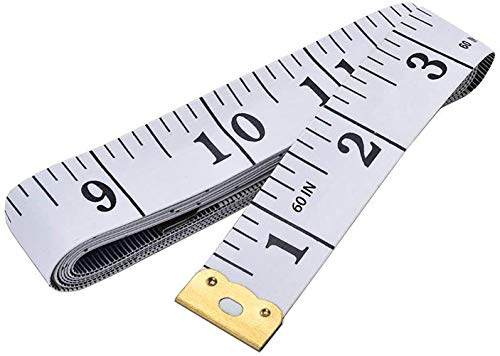
- Measuring Range: 0 to 60 inches and 0 to 150 centimeters. There is a centimeter scale on the back…
- Great Material: Tailor Vinyl tape measure won't stretch or deform, provides superior measurement…
- Operate And Read: Black markings on bright white tape is big enough for you to read, the tape has…
Real vintage band shirts vs reprints: the common tricks
Reprints come in a few familiar forms. Shirts on modern blanks are easy to spot once you know the blank list above. The tricky pieces are new prints made to pass as old.
- Old blanks, new prints. Counterfeiters print on worn vintage blanks because a worn tee and tag “lend credibility,” per Defunkd. The tag and stitching look right, so the print, copyright line and back have to carry the check.
- Tag swaps. A real vintage tag sewn into a newer body. Check the measurements against the tag’s era.
- Copied copyright lines. A perfect copyright line proves nothing on its own.
- Reissued vintage blanks. Single-needle Screen Stars reissues with a vintage wash.
Fabric is a supporting clue. Per one vintage shop, 50/50 cotton-poly blends are common through the 1970s, 1980s and early 1990s, while ringspun cotton is the default from the mid-1990s onward. The same layered approach is used for denim; identifying vintage Levi’s and reading vintage Levi’s tags follow the same cross-check logic. Licensed non-music shirts follow the same rules, and vintage Harley-Davidson shirts are a good example of licensee tags doing the dating work.
What makes vintage band tees valuable
No fixed price list exists for band shirts, and the same design can vary widely depending on the specific shirt. The factors that matter:
- Authenticity. A shirt whose tag, stitching, print and back all agree is worth far more than one with a single conflicting clue.
- Band and tour. Demand follows the band’s following, and specific tours or album designs attract more interest than generic logo shirts.
- Condition. Cracked prints, holes and staining reduce value, though collectors accept honest wear on older pieces.
- Size. Wearable sizes sell more easily. List actual measurements.
- Rarity. Short runs and shirts from early in a band’s career are harder to find.
Price by comparing completed sales of the same design, tag and condition. For listing, the guide to selling vintage clothing online covers photographing tags and hems, and the Etsy fees breakdown shows what a vintage-friendly marketplace takes. For the broader definition of what qualifies as vintage, see true vintage clothing.
The verdict
Real vintage band tees are identified by agreement, not by a single feature. The tag and hem give the first read in seconds: a Winterland, Brockum, Giant or period Screen Stars tag on a single-stitched body is promising, and a post-2008 blank under an old graphic is a reprint. The copyright line only sets the earliest year the design existed. The traps are real: worn blanks reprinted, tags swapped, Screen Stars reissued with single-needle hems. Where collector sources disagree, such as Giant’s tag window or Winterland’s founding year, treat dates as ranges. Check every clue before paying vintage money, and price on condition, band, rarity and demand rather than on the date printed on the front.
Shop the look on Amazon
Everything you need to build a secondhand-style wardrobe, delivered. We may earn a commission on purchases.
FAQ
How can you tell if a band tee is vintage?
Check the neck tag against known tag eras, look for single stitching on the hems, read the copyright line as the earliest design year, and confirm with the care label, origin and measurements. Several clues should agree.
Does a copyright date mean the shirt is from that year?
No. It marks when the design was copyrighted. Designs were printed for years afterward, and reprints copy the line exactly.
Is a band tee without a merch-company tag a bootleg?
Not necessarily. Brockum, for example, sometimes printed on blanks without its own tag. A missing tag is a reason to check the other clues more carefully.
Are single stitch band shirts always vintage?
No. Single stitching suggests a pre-1996 blank, but there are exceptions in both directions, and Screen Stars has been reissued with single-needle stitching and a vintage wash.
What blanks do band shirt reprints use?
Common modern reprint blanks include Gildan Soft-Style, Bella+Canvas 3001, Next Level 3600 and Comfort Colors 1717, which one vintage seller dates to 2008 or later (Comfort Colors 1717 mainly to the 2010s).
How should you wash a vintage band tee?
Wash a vintage band tee inside out in cold water on a gentle cycle, then hang or lay it flat to dry. Heat and friction are what crack old prints and thin worn cotton, so skip the dryer and avoid ironing directly on the graphic. Hand washing is gentler still for fragile shirts. These are general care rules; condition is one of the main drivers of a vintage tee’s value, so careful washing protects resale price.