Business casual is the most common office dress code and the least precisely defined one, which is exactly why so many men second-guess it on a Monday morning.
Ask ten offices what business casual men should wear and you will get ten slightly different answers. That is not a failure of etiquette; it is how the code works. Business casual sits between a full suit and weekend clothes, and the exact line moves depending on your employer, your industry and even your role. This guide explains what the code broadly means, where the line usually falls, ten outfit formulas that cover most workplaces, what tends to be in and out, and how to build the whole wardrobe secondhand. For how business casual fits alongside every other code, from smart casual up to black tie, see our Dress Codes Explained hub.
What is business casual for men?
There is no universal definition. Career guidance from Indeed describes business casual broadly as a blend of traditional business wear and a more relaxed style that still reads as professional. That middle ground is the whole idea: you look like you came to work, but you do not look like you are heading to a board meeting or a wedding.
The same guidance is clear that the code varies by employer and industry. It shifts with company culture and career level as well. A tech company may lean casual, while a financial firm is likely to lean formal. Some offices allow jeans on any day; others never do. Indeed’s advice is simple: check the employee handbook. If your company has written guidance, that document overrides anything in this article, including the tables below.
In practice, most business casual workplaces in the US land somewhere in this range for men:
- Trousers: chinos, wool or wool-blend dress trousers, sometimes dark jeans with no distressing.
- Shirts: collared shirts, such as oxford-cloth button-downs, poplin dress shirts worn without a tie, and in some offices polo shirts.
- Layers: blazers or sport coats that are not part of a matching suit, crew-neck or V-neck sweaters, cardigans, quarter-zips.
- Shoes: leather lace-ups, loafers, chukka or Chelsea boots, and in more relaxed offices clean minimal leather sneakers.
- Ties: usually optional. Business casual is generally understood as the code where the tie comes off.
Treat that list as a common pattern, not a rulebook. The single most useful habit is to look at what people a level or two above you wear on an ordinary day, then dress at that level.
Business casual versus business professional and smart casual
Business professional is the more formal neighbor. Indeed describes business professional as a dark suit, a button-down shirt, a tie and closed-toe shoes with classic, understated accessories. Business casual keeps the shirt and the good shoes but drops the matching suit and usually the tie.
Smart casual is the more relaxed neighbor, and it is even harder to pin down. Debrett’s, the British etiquette authority, lists smart casual as a code that can be the hardest to interpret. A common description mixes polished business pieces with casual ones: a blazer over dark jeans, an oxford shirt with chinos, polished shoes rather than athletic ones. In many offices the two codes blur together. Our Smart Casual Dress Code guide covers that code on its own.
If you are reading this for a partner or colleague, the women’s version of the code follows the same logic; see Business Casual for Women and, for extended sizes, Plus Size Business Casual.
Why business casual changes from office to office
It helps to understand the forces that push a given workplace up or down the formality scale, because then you can read a new office quickly instead of guessing.
Industry. Indeed’s own example is the clearest one: tech tends to sit at the relaxed end, finance at the formal end. Law, consulting and client-facing banking roles often expect the dressier version of business casual on ordinary days and a suit for client meetings. Creative agencies and startups may treat business casual as a ceiling rather than a floor.
Company culture. Two firms in the same industry can dress very differently. Look at the company’s social media, team photos and careers page. Indeed recommends this same research before interviews, and it works just as well for a first week on the job.
Career level and role. Indeed notes that expectations change with seniority. Someone who meets clients, presents to leadership or represents the company at events may be expected to dress up more than someone who works mainly with an internal team.
The day itself. Many offices run a dressier version Monday to Thursday and a relaxed version on Friday. A client visit, a presentation or a performance review can all justify stepping up for one day.
Climate and region. A summer office in a hot city will often accept lighter fabrics, short sleeves and loafers without socks in ways a northern winter office might not. This is general observation rather than a rule, so watch your colleagues.
The core business casual wardrobe
You do not need many pieces to cover a full working week. A dozen well-chosen items, mixed and matched, will produce dozens of combinations.
Trousers
Chinos are the foundation. Khaki, navy, olive, gray and stone cover nearly everything. Look for a flat front, a clean crease or none, and a hem that just touches the top of your shoe or sits a little higher for a modern line. Add one or two pairs of wool or wool-blend trousers in gray or navy for days that need to look sharper; they pair with every shirt color and every jacket. Our guide to Men’s Work Pants covers fabrics and fits in more depth.
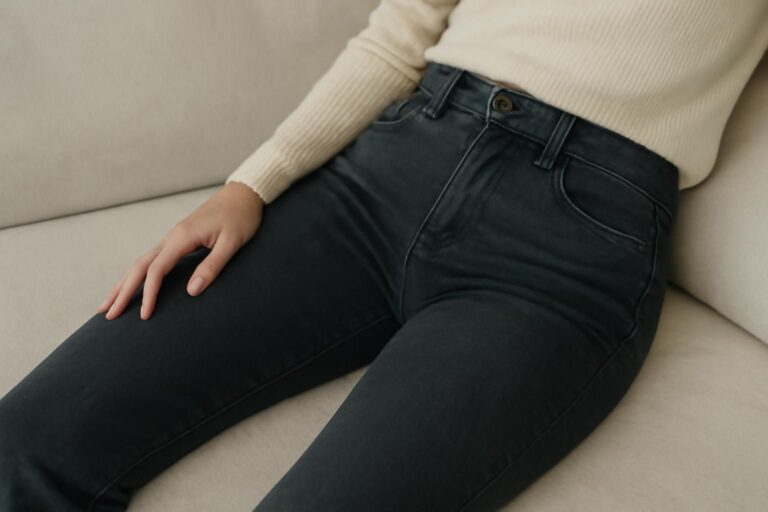
Dark jeans are the variable. Where they are allowed, choose a dark, even wash with no rips, whiskering or heavy fading, in a straight or slim cut. A dark indigo pair styled with an oxford and a blazer reads very differently from a faded pair with a hoodie. See Men’s Dark Wash Jeans for what to look for.
Shopping ideas: Mens Stretch Chino Pants Slim Straight on Amazon or Mens Wool Blend Dress Trousers Gray on Amazon.
Top-selling match on Amazon

- Slim Fit: Fitted through hip and thigh, with tapered leg. Sits below the waist.
- Cotton Chino: Washed for softness, this breathable cotton twill has a bit of stretch for comfort…
- Khaki Chino Styling: Classic khaki chino trousers in a light garment washed fabric for a wardrobe staple…
Shirts
The oxford-cloth button-down is the single most useful business casual shirt. It looks right with or without a tie, tucked under a blazer or with sleeves rolled. Light blue and white are the starting pair; add pale pink, university stripe and a subtle check after that. Our Mens Oxford Shirts guide explains the fabric and collar.
Poplin or twill dress shirts work too, especially in more formal offices. Worn without a tie, a dress shirt with a spread collar can look a little unfinished, so button-down or semi-spread collars tend to sit better open at the neck. For specific picks and how to wear them open, see Business-Casual Dress Shirts That Actually Work and our broader guide to Mens Dress Shirts.
Polo shirts are accepted in many relaxed business casual offices, particularly in summer. Choose a solid color, a collar that holds its shape and a fabric with some weight. Logos should be small or absent. Our guide to Polo Outfits for Men has combinations that keep a polo looking deliberate.
Layers: blazers, sport coats and knitwear
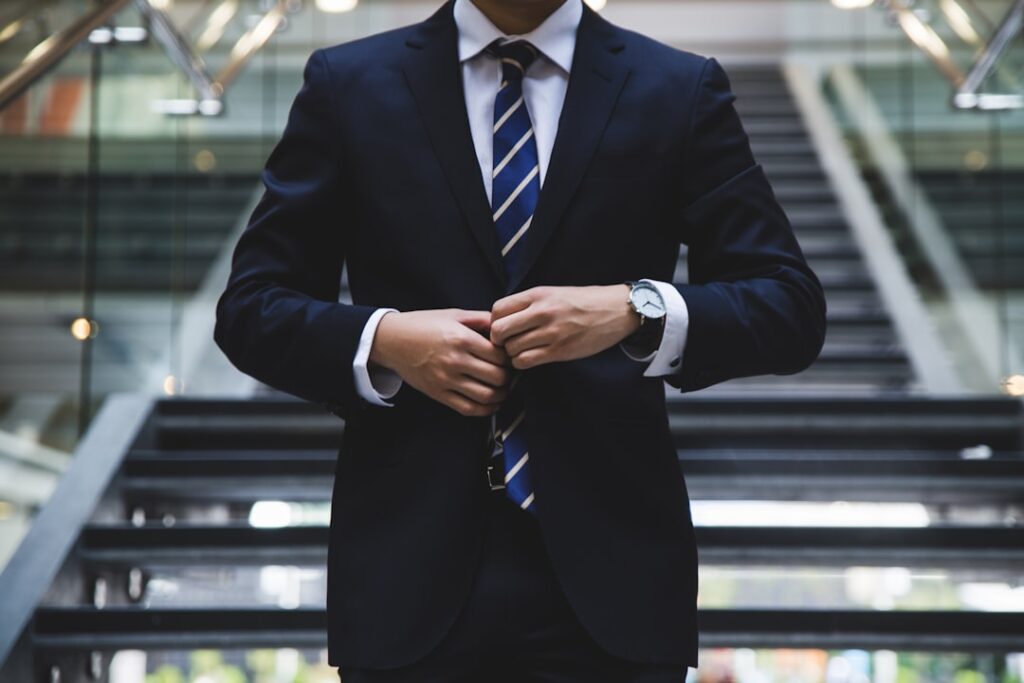
An unstructured navy blazer is the piece that turns chinos and an oxford into an outfit. Gray, tan and a subtle check are good second jackets. The jacket should be a separate, not the top half of a suit; suit jackets worn alone often look like you lost the trousers, partly because suit cloth tends to be smoother and shinier than sport-coat cloth.
Knitwear is the quiet workhorse. A merino or cotton crew neck over a collared shirt, with the collar sitting outside, works in almost every business casual office. Quarter-zips and cardigans fill the same role in more relaxed settings. For pairing a jacket with denim specifically, see How to Pair Men’s Blazers with Jeans.
Shoes and belts
Brown leather is the business casual default because it works with khaki, navy, gray and denim. Penny loafers, plain derbies, brogues, chukka boots and Chelsea boots all qualify. Black leather works but reads a little more formal. Clean, minimal leather sneakers in white or a neutral color are accepted in many relaxed offices and almost never in formal ones.
Match your belt roughly to your shoes, keep the buckle simple, and choose a width that suits trouser loops rather than jeans loops. Our guide to Best Men’s Belts for Jeans covers widths and leathers.
Shopping idea: Mens Leather Penny Loafers Brown on Amazon.
10 business casual outfit formulas for men
These formulas run roughly from most formal to most relaxed. Pick the band that matches your office and rotate within it.
- The near-suit: gray wool trousers, light blue oxford or poplin shirt, navy blazer, brown leather derbies, optional knit tie. Good for client days and presentations.
- The classic: khaki chinos, white oxford, navy blazer, brown loafers. If you only learn one formula, make it this one.
- The knit layer: navy chinos, light blue oxford, gray merino crew neck with the collar out, brown suede chukkas.
- The tonal look: charcoal trousers, white shirt, charcoal or black fine-gauge sweater, black loafers. Clean and slightly more modern.
- The sport coat and denim: dark indigo jeans, pale pink or striped oxford, tan or gray sport coat, brown boots. Only where jeans are allowed.
- The summer version: stone chinos, short-sleeve or rolled-sleeve linen-blend shirt, loafers. Works in hot climates and relaxed offices; check that short sleeves are accepted.
- The polo day: navy chinos, solid white or navy polo, brown leather sneakers or loafers. A Friday staple in many offices.
- The quarter-zip: gray chinos, white oxford, navy quarter-zip sweater, white leather sneakers. Common in tech and sales.
- The cardigan: olive chinos, light blue shirt, navy or gray cardigan, brown derbies. Softer than a blazer but still tidy.
- The winter layer: gray flannel trousers, tattersall or check shirt, brown or navy shetland sweater, Chelsea boots, overcoat for the commute.
Notice what repeats: a collared shirt, a trouser that is not athletic, leather shoes, and an optional third layer. That is the skeleton of business casual almost everywhere.
Business casual: what’s usually in and what’s usually out
This table reflects common practice in US offices. Your employer’s handbook and what your colleagues wear take priority over it.
| Item | Usually in | Depends on the office | Usually out |
|---|---|---|---|
| Trousers | Chinos, wool or wool-blend trousers | Dark, clean jeans | Ripped or faded jeans, cargo pants, joggers, shorts |
| Shirts | Oxford button-downs, dress shirts without a tie | Polo shirts, short-sleeve button-ups | Graphic tees, tank tops, athletic jerseys |
| Layers | Blazers, sport coats, crew or V-neck sweaters | Quarter-zips, cardigans, chore or shirt jackets | Hoodies, sweatshirts with large logos |
| Shoes | Loafers, derbies, brogues, chukkas, Chelsea boots | Clean minimal leather sneakers | Running shoes, slides, flip-flops, worn-out sneakers |
| Ties | Optional | Expected in some formal offices or on client days | Novelty ties in conservative settings |
| Outerwear | Overcoat, trench, mac, simple quilted jacket | Bomber, waxed jacket | Very sporty or heavily branded outerwear |
Fit notes: what makes business casual look intentional
The difference between a man who looks put together in business casual and one who looks underdressed is rarely the clothes themselves. It is usually fit and condition.
- Shoulders: on a blazer, the shoulder seam should end where your shoulder ends. Shoulders are the hardest and most expensive thing to alter, so get this right first.
- Jacket length and sleeves: the jacket should roughly cover your seat, and a little shirt cuff should show past the jacket sleeve.
- Shirt fit: no billowing fabric at the sides when tucked, and buttons that lie flat without pulling. Our guide to Untucked Shirts for Men explains which shirts can be worn untucked and which cannot; in most business casual offices, dress shirts should be tucked.
- Trouser length: a small break or no break at the shoe. Puddling fabric looks careless; hemming is one of the cheapest alterations there is.
- Condition: pressed shirts, clean shoes, no fraying collars or pilled sweaters. A crisp inexpensive shirt beats a creased expensive one.
Comfort matters too. Business casual exists partly so that people can work comfortably, and there is no prize for wearing trousers that pinch. Stretch blends in chinos and trousers are common now and still look tailored.
Business casual for interviews, first days and special situations
Interviews
Indeed’s interview guidance is that even when a company’s dress code is casual, it may help to look more professional than required, and that it is better to overdress than underdress. It goes further: if the company is business casual, consider a full suit for a first in-person interview. UMass Dartmouth’s career center gives a related rule of thumb, which is to dress one level above the typical attire for the role. So for a business casual employer, the dressiest formula above (or a suit) is the safe interview choice. Our full guide to What to Wear to an Interview covers video interviews and other industries.
Your first week
Start at the dressier end of the range, then adjust once you have seen what your team actually wears. It is easy to take a blazer off and drop a level; it is harder to recover from showing up in a polo when everyone else is in jackets.
Work events, dinners and conferences
Invitations to work events sometimes say business casual and sometimes say nothing at all. For an evening event at a nice restaurant, the near-suit formula is a safe bet. For a conference, a blazer you can take off, comfortable leather shoes and a shirt that does not wrinkle easily will carry you through long days. If an invitation says cocktail or semi-formal instead, that is a step up from business casual; see Semi-Formal Attire and Men’s Formal Wear.
Remote and hybrid work
On video calls, only the top half usually shows, but a collared shirt or neat knit still signals that you are at work. On office days in a hybrid schedule, follow the in-office norm, which may be a little dressier than it was before remote work became common in some companies and more relaxed in others.
Common business casual mistakes
- Treating business casual as just casual. The word “business” is doing real work. Gym clothes, hoodies and graphic tees are almost always out.
- Wearing a suit jacket as a blazer. Suit jackets usually look orphaned without their trousers. Keep separates separate.
- Athletic sneakers with tailored trousers. If sneakers are allowed, choose minimal leather ones in clean condition.
- Ignoring the handbook. Indeed’s advice to check your employer’s written policy is the best single tip in this guide.
- Too many statement pieces at once. One interesting element, such as a patterned shirt or a textured jacket, is enough.
- Letting clothes go tired. Faded black trousers, scuffed shoes and shirts with frayed collars pull down an otherwise correct outfit.
How to build a business casual wardrobe secondhand
Business casual is one of the easiest dress codes to thrift because the core pieces are classic, made in huge numbers and change slowly. A navy blazer from fifteen years ago can look almost identical to one made last season.
What to look for in thrift stores
- Blazers and sport coats: head to the men’s suit and jacket rack and check the shoulders first. Look at the fabric label; wool and wool blends usually drape better and last longer than all-polyester jackets. Check the lining, the underarms and the sleeve ends for wear.
- Oxford shirts: inspect the collar and cuffs, where wear shows first, and the armpits for staining. Cotton oxfords from established makers often turn up in large numbers.
- Chinos and trousers: check the seat and inner thighs for thinning, and the hem for fraying. Trousers with generous fabric in the hem can often be lengthened by a tailor.
- Knitwear: look for merino, lambswool or cotton. Check for moth holes by holding the sweater up to the light, and for pilling under the arms.
- Leather shoes: look for leather uppers and stitched soles if you can find them, check that the uppers are not cracked across the flex point, and budget for a resole if the soles are worn.
Our guides to Men’s Thrift Store Shopping shopping and Second Hand Clothes for Men cover where to look and how to shop efficiently. If you prefer to browse online, Best Men’s Online Thrift Store compares the main resale sites.
Budget the tailor into the price
A thrifted blazer that fits in the shoulders but has sleeves an inch too long is a bargain, because sleeve and trouser hems are inexpensive alterations at most tailors. A jacket that does not fit in the shoulders is not a bargain at any price. Think of the thrift price plus a modest alteration as the real cost, and you will often still spend far less than buying new.
Care for longevity
Follow each item’s care label. Hang blazers on shaped hangers, let leather shoes rest a day between wears, and wash cotton shirts and chinos in a way that avoids excessive heat if you want to limit shrinking. If a thrifted shirt is slightly large, our guide to How to Shrink a Shirt (and Other Clothes) Without Ruining It explains what is realistic and what is risky.
A five-day business casual capsule
Here is how ten pieces can cover a full week in a typical middle-of-the-range office:
- Pieces: navy blazer, gray merino sweater, khaki chinos, navy chinos, gray wool trousers, white oxford, light blue oxford, striped oxford, brown loafers, brown chukka boots.
- Monday: gray trousers, light blue oxford, navy blazer, loafers.
- Tuesday: navy chinos, white oxford, gray sweater, chukkas.
- Wednesday: khaki chinos, striped oxford, navy blazer, loafers.
- Thursday: gray trousers, white oxford, gray sweater, loafers.
- Friday: navy chinos, light blue oxford with sleeves rolled, chukkas; or dark jeans if your office allows them.
Swap in a polo or a quarter-zip for relaxed offices, or add a tie and darker trousers for formal ones. For off-duty versions of the same pieces, see Men’s Casual Outfits.
Shopping idea for the capsule’s anchor: Mens Unstructured Navy Blazer on Amazon.
Top-selling match on Amazon

- Size Tips: Fit differs by body type, choose sizing up for relaxed fit comfort, or sizing down…
- Comfortable Knit Fabric: This men's casual unstructured blazer is made from stretch knit fabric, which is…
- Versatile Look: Mens sport coat is easy to pair with t-shirts, hoodies, jeans, slacks, and sneakers…
Shop the look on Amazon
Everything you need to build a secondhand-style wardrobe, delivered. We may earn a commission on purchases.
Browse picks on Amazon →FAQ
Can men wear jeans for business casual?
Sometimes. Indeed notes that some offices allow jeans and others don’t, which is why checking the handbook matters. Where jeans are allowed, a dark, clean wash with no distressing, paired with a collared shirt and leather shoes, keeps the look on the business side of the line.
Do I need a tie for business casual?
Usually not. Business casual is commonly understood as the code where ties become optional. Some formal offices still expect one on client days, so follow local practice.
Are polo shirts business casual?
In many relaxed offices, yes, especially in summer or on Fridays. In more formal workplaces a woven collared shirt is safer. Choose solid colors and small or no logos.
Are sneakers business casual?
Clean, minimal leather sneakers are accepted in many relaxed and tech-leaning offices. Running shoes and worn athletic sneakers generally are not. In finance, law and other formal settings, stick with leather shoes.
Is a sweater acceptable without a blazer?
Yes. A fine-knit crew neck or V-neck over a collared shirt is one of the most common business casual combinations, and many offices treat it as equal to a blazer.
What’s the difference between business casual and smart casual?
Neither has a single fixed definition. Business casual is generally framed around the workplace, while smart casual usually describes a polished-but-relaxed mix for social settings. In many offices they overlap almost completely. Debrett’s notes smart casual can be the hardest code to interpret.
What should I wear to a business casual interview?
Dress up. Indeed suggests considering a full suit for a first in-person interview at a business casual company, and UMass Dartmouth’s career center recommends dressing one level above the role’s everyday attire.
Verdict
Business casual for men is a range, not a single outfit. The common core is a collared shirt, chinos or wool trousers, leather shoes and an optional blazer or sweater, but the line moves with industry, company culture and role, so the handbook and your colleagues have the final say. Start a new job or an interview at the dressier end, then adjust. Build around a navy blazer, two or three oxford shirts, a few pairs of chinos and one good pair of brown leather shoes, and you can cover nearly any business casual office. Most of those pieces are classics that turn up constantly in thrift stores, so with a little patience and a tailor for small fixes, a complete working wardrobe can cost far less than buying new.
Business Casual Shoes
What shoes work with business casual, from loafers to dress sneakers.