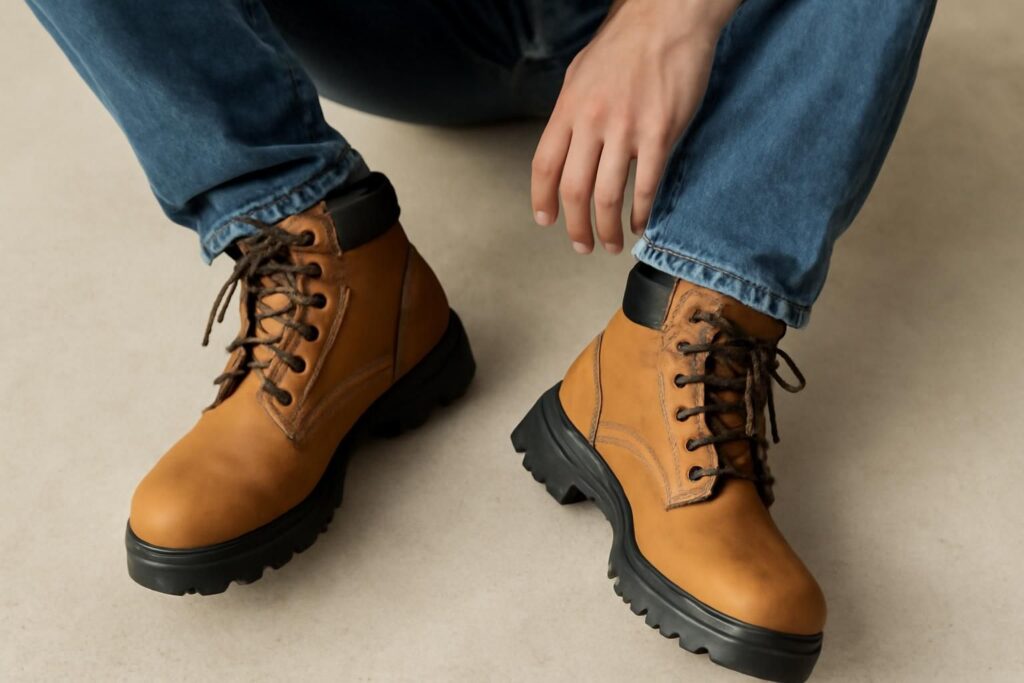
Composite toe caps solve three everyday annoyances of steel: cold toes, metal detectors and weight. They do it without lowering the toe-cap rating, which is the part most buyers misunderstand.
Composite toe work boots have moved from niche to mainstream, and most big work-boot brands now sell them. But the marketing around them is muddled. Some product pages imply composite is a compromise on protection; others imply it is an upgrade. Neither is right. This guide explains what composite caps are made of, how they are tested, how the composite toe vs steel toe decision actually plays out, and which kinds of work benefit most. It is part of our Men’s Work Boots guide, which covers fit, waterproofing and break-in across the category. One ground rule: this page explains labels and trade-offs. It is not advice on what your job requires. That is set by your employer’s hazard assessment, and the boot’s label tells you whether a pair meets it. We have not lab-tested any boots for this guide; the safety facts come from the ASTM standard, OSHA and safety-footwear industry sources.
What composite toe caps are made of
Composite toe work boots: current Amazon prices
As an Amazon Associate we earn from qualifying purchases. Prices and availability are accurate as of November 2026 and may change. Specs are as stated in each Amazon listing.

- Composite Toe ASTM F2413-11 M I/75 C/75 EH
- Flexible, athletic contour welt construction moves with you by bending and flexing at…

- Anti-Fatigue Technology: A comfort system designed with shock-absorbing, geometrical technology that returns…
- Composite Safety Toe: Lightweight, non-metallic, asymmetrical-shaped toe cap that meets US safety…
- Waterproof Membrane: Delivers maximum waterproof protection and meets ASTM F1671-07 safety standard.

- Composite Safety Toe. Identifies protection against impact and compression hazards with a…
- Electrical Hazard (Safety Toe). Identifies secondary protection against incidental contact…
“Composite” is an umbrella term for non-metal safety caps. Common materials include Kevlar, polycarbonate, fibreglass and carbon fibre, used alone or in combination. What they share is that none of them is metal, and that drives all of their practical advantages:
- They conduct cold less than steel or alloy, so toes stay warmer in winter.
- They won’t corrode, which matters in wet work.
- They won’t set off metal detectors, which matters at airports, secure sites and some factories.
- They don’t conduct electricity through the cap itself.
That last point needs a careful reading. A non-conductive cap is not the same as an electrical-hazard rating. Electrical protection on a boot is certified separately and shown on the label as EH, and even then it is a secondary barrier that helps reduce shock risk under dry conditions, not primary protection. A composite toe without an EH marking carries no electrical-hazard rating at all.
How composite safety toe boots are rated
All safety-toe footwear in the US is rated to ASTM F2413. The current edition is ASTM F2413-24, which replaced F2413-18 in 2024, with test methods in the companion standard ASTM F2412. To carry the ASTM marking, footwear must be certified by independent third-party labs.
The key fact for composite buyers: steel, alloy and composite toes all have to pass the same F2413 impact and compression tests. In those tests, a clay cylinder under the toe cap must stay at least 0.5″ tall. A composite cap marked “I/75” and “C/75”, the highest commonly used impact and compression ratings, has met the same requirement as a steel cap with the same marking. The material changes the weight, warmth and detector behaviour; it does not change what the rating means.
Other protections on composite safety toe boots are separate and must be marked individually: PR for a puncture-resistant plate, Mt for metatarsal protection, SD for static dissipative and EH for electrical hazard. If it is not on the label, it cannot be claimed.
Composite toe vs steel toe: the real trade-offs
Since the rating is shared, the choice between composite and steel comes down to practical differences. Here is how they line up, along with alloy, the third option.
Steel is the cheapest cap. It conducts cold and sets off metal detectors.
Alloy (usually aluminium-based) is lighter than steel but costs more, and it conducts cold like steel.
Composite conducts cold less, won’t corrode, won’t set off detectors and doesn’t conduct electricity.
So when is composite worth it? We would choose it in four situations: outdoor work in cold weather, any job that involves passing through metal detectors, wet environments where corrosion is a concern, and long days where a lighter boot makes a difference. Steel still makes sense when cost is the main factor and none of those apply. Our Steel Toe Work Boots guide covers the steel side in more depth.
A note on shape: toe-box shapes vary a great deal between boots, whatever the cap material. Some feel roomy, others snug or tall. Try them on and judge the shape for yourself rather than assuming one material always fits a certain way.
Who benefits most from composite toe work boots
Cold-weather outdoor workers. Because composite caps conduct cold less than metal, they are a natural match for winter work. Pair them with an insulated, waterproof boot and you address the two biggest sources of cold feet. Our Waterproof Work Boots and Insulated Work Boots guides cover the rest of that equation.
Anyone who passes through metal detectors. Airports, secure facilities and some manufacturing sites screen workers. A composite toe avoids taking boots off at every checkpoint.
People who walk a lot. If your job involves covering distance on foot, the weight saving of a composite or alloy cap adds up over a shift. Comfort-focused ranges such as Skechers Work, which includes composite, alloy and steel safety-toe styles, are worth a look; see our Skechers Work Boots Review.
Wet and corrosive environments. Since composite caps won’t corrode, they suit work where boots are regularly soaked.
Examples of composite toe work boots
The best-known example is the Timberland PRO Boondock 6″ Waterproof Comp-Toe Work Boot, whose official name spells out its key features: 6″ height, waterproofing and a composite toe. Timberland PRO also sells a Boondock HD. Our Timberland PRO Work Boots Review compares the Boondock with the steel-toe Pit Boss and the Direct Attach.
Skechers Work includes composite safety-toe styles alongside alloy and steel, as well as slip-resistant and electrical-hazard styles. Cat Footwear, made under license from Caterpillar Inc. by Wolverine World Wide, is another major work-boot name to compare. Across all brands, features such as EH or PR vary by SKU, so read the label on the exact boot rather than assuming a whole line shares them.
Four myths about composite toes
“Composite caps offer less toe protection than steel.” The rating is what matters, and steel, alloy and composite caps all have to pass the same F2413 impact and compression tests. A composite cap marked “I/75 C/75” has met the same requirement as a steel one with the same marking.
“A non-metal toe means the boot is electrically rated.” No. A composite cap doesn’t conduct electricity, but electrical-hazard protection is a separate certification marked EH. Without that marking, the boot has no electrical-hazard rating, and even with it, EH is a secondary barrier under dry conditions.
“Every boot in a line has the same protections.” Features vary by SKU. Two boots with similar names can carry different codes, so read the label on the exact pair you buy.
“Any safety standard on the box is current.” The current edition is ASTM F2413-24. OSHA’s footwear rule names older standards as acceptable references too, but when you compare boots today, look for the F2413 marking and the protection codes printed with it, because those tell you what each pair has actually been certified for.
How to choose and fit a composite toe boot
Confirm your requirements first. Under OSHA 29 CFR 1910.136, the employer must make sure each affected employee wears protective footwear where there is a danger of foot injury from falling or rolling objects or objects piercing the sole, or where footwear protects against an electrical hazard. More broadly, OSHA 1910.132(d) requires employers to assess the workplace for hazards that call for PPE. Find out which protections are required (for example, EH or PR), then shortlist boots whose labels list them.
Check the toe box shape. Stand and crouch in the boot. Your toes should not touch the cap in either position. If a composite toe box feels tall or wide, try another model; shapes vary considerably.
Fit late in the day with work socks. Feet swell over a shift, and work socks take up space. A boot that feels perfect in the morning in thin socks will be tight by afternoon.
Fix width with width. If the forefoot pinches, look for a wider fit rather than a longer size, because a boot that is too long lets your foot slide forward into the cap.
Match the rest of the boot to the job. The cap is only one part. Waterproofing, insulation, sole grip and height all matter as much for comfort and suitability.
The verdict
Composite toe work boots are the better choice for most people who work outside in the cold, pass through metal detectors, work in wet conditions or walk long distances. They pass the same F2413 impact and compression tests as steel, so you are not trading away toe-cap protection by choosing them; you are trading a lower price for less cold, no detector alarms and no corrosion. Steel remains sensible if cost is your main concern and none of those factors apply. Whichever you choose, start with your employer’s required protections, confirm them on the label, and do not mistake a non-conductive cap for an EH rating. For a single all-round outdoor boot, a waterproof 6″ composite toe like the Timberland PRO Boondock is where we would start: Composite Toe Waterproof Work Boots Men on Amazon.
Shop the look on Amazon
Everything you need to build a secondhand-style wardrobe, delivered. We may earn a commission on purchases.
FAQ
Do composite toes pass the same tests as steel toes?
Yes, for toe impact and compression. Steel, alloy and composite toes all have to pass the same ASTM F2413 tests, and the label shows the rating each boot has achieved.
Do composite toe boots set off metal detectors?
Composite caps won’t set off metal detectors. Other metal parts in a boot, such as eyelets or shanks, may still do so, so check the boot’s description if this matters for your work.
Are composite toe boots warmer?
Composite caps conduct cold less than steel or alloy, so toes are less likely to get cold through the cap. Insulation and waterproofing matter just as much for overall warmth.
Does a composite toe protect against electrical hazards?
The cap itself doesn’t conduct electricity, but electrical-hazard protection is a separate rating marked EH on the label. EH footwear is a secondary barrier under dry conditions, not primary protection.
Should you replace composite toe boots after a heavy impact?
Composite toe boots should generally be replaced after a heavy impact or crush, because a non-metal cap can be cracked or weakened without showing obvious damage on the outside. Unlike steel, a composite cap does not dent visibly, so a serious blow is the safer trigger for replacement than looks alone. Many employers have their own rules on replacing safety footwear after an impact, and the manufacturer’s guidance for that specific boot applies too.