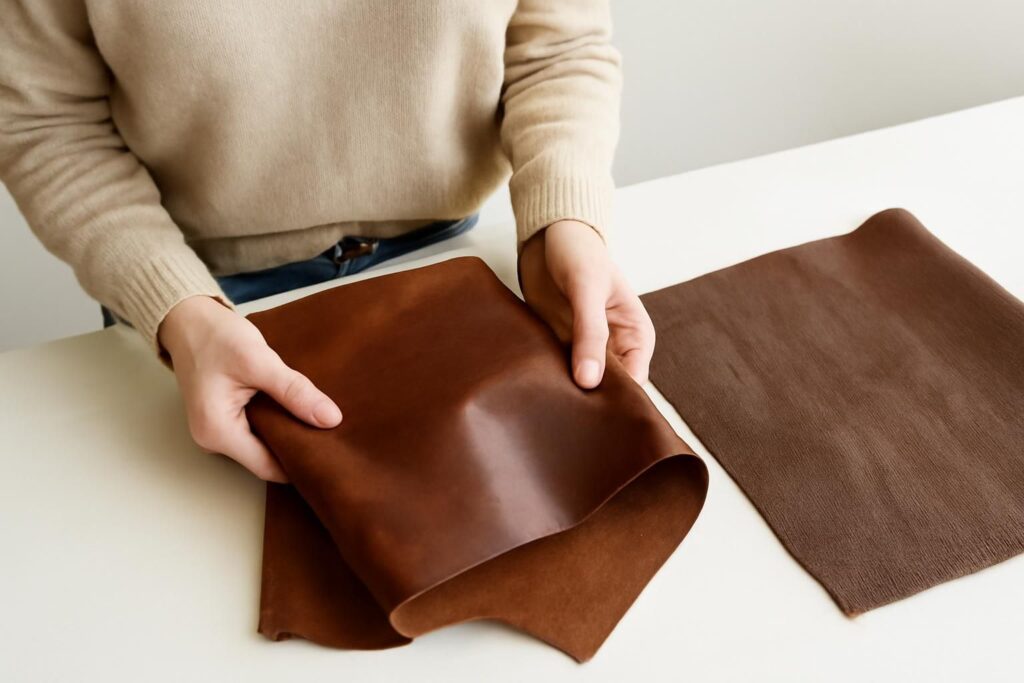
A thrifted jacket, bag or pair of boots can be full leather, bonded leather or a PU (polyurethane) leather-look material, and the label plus a few close looks will usually point you in the right direction.
Knowing how to tell real leather starts with the label, then moves to the cut edge, the grain and the way the surface creases. None of these checks is proof on its own, but together they give you a good read before you pay a leather price. For what the label phrase “genuine leather” means and how it compares with other grades, see our What Is Genuine Leather? Leather Grades Explained hub.
Quick checks at a glance
| Check | Leather usually shows | Leather-look materials often show |
|---|---|---|
| Label or stamp | “Leather”, the animal source such as lambskin, or “split” wording | “Not leather”, “Imitation leather”, “Vinyl”, PU or PVC |
| Cut edge | Dense fibres through the thickness | A fabric or knit backing under a coated layer |
| Grain | Irregular grain and pores | A perfectly repeating pattern |
| Creases | Flex creases that soften | Cracking or peeling surface |
Everything in the two right-hand columns is common advice rather than a lab standard. Use the checks as clues.
What counts as leather
According to SATRA, the footwear and leather technology centre, British Standard BS 2780 defines leather as animal skin “with its original fibrous structure more or less intact, tanned to be imputrescible”, meaning it won’t rot. Any surface coating must be 0.15 mm or less. That limit is why a heavily coated material with a fabric base doesn’t qualify.
SATRA also defines suede as leather “finished by abrasive action on the flesh side of the full skin to create a velvet-like suede appearance.” So real suede is a leather, just finished on the other side. Care differs, as our How to Clean Suede Shoes (Without Ruining Them) guide explains.
Leather label terms under the FTC Leather Guides
The FTC Leather Guides (16 CFR Part 24) cover “purses, luggage, wallets, footwear and similar products.” They don’t govern every leather garment, but they are a useful guide to what label wording means:
- Imitation leather: material that looks like leather but isn’t should be disclosed, for example “Not leather,” “Imitation leather” or “Vinyl.”
- Bonded or ground leather: should not be called plain “leather”, and its leather and non-leather percentages should be disclosed. Our What Is Bonded Leather? How It Differs From Genuine Leather guide goes deeper.
- Split leather: should be disclosed, for example “Split Cowhide”.
- Waterproof: allowed only if the material keeps water out under normal use “during the anticipated life of the product” (16 CFR § 24.3).
PU and PVC leather-look materials, sometimes sold as vegan leather, are a choice in their own right. Our What Is Vegan Leather? PU, PVC and Plant-Based Materials Explained guide covers them. The point here is only to know which one you are buying.
Genuine leather vs PU: how to check step by step
These steps are a common method, not an official test.
- Find the label or stamp, often inside a jacket’s lining, a bag’s interior or a shoe’s insole.
- Read the wording against the FTC terms above.
- Look at a cut edge, such as a strap end, belt hole or seam allowance.
- Check whether the edge shows dense fibres or a woven or knit fabric under a coated layer.
- Look closely at the surface grain in good light. A loupe helps. Jewelry Loupe 10X Magnifier on Amazon
- Compare several areas. Natural grain varies, while a printed grain tends to repeat.
- Look at existing creases at elbows, toe boxes or strap folds for softening versus cracking or peeling.
- If the price is high and you’re still unsure, ask the seller about returns or get a cobbler or leather specialist’s opinion.
Top-selling match on Amazon

- 𝙏𝙒𝙊 𝙇𝙄𝙂𝙃𝙏 𝙎𝙊𝙐𝙍𝘾𝙀𝙎 : This jeweler loupe magnifier comes equipped with both UV light and 6 LED…
- 𝙋𝙊𝙒𝙀𝙍𝙁𝙐𝙇 𝙈𝘼𝙂𝙉𝙄𝙁𝙄𝘾𝘼𝙏𝙄𝙊𝙉: With a 10x magnification power, this magnifier allows you to get up…
Condition checks once you know it’s leather
Confirming the material is half the job. A leather piece in poor shape can cost more to repair than it’s worth, so these common checks are worth a minute on the rack:
- Dryness and cracking. Bend a sleeve or strap gently. Light dryness often responds to conditioner, while deep cracks through the surface usually don’t.
- Lining. Torn or stained linings are common in older jackets. A tailor can replace one, but factor in the cost.
- Stitching and zips. Check seams at shoulders, pockets and bag handles, and run every zip from end to end.
- Odour. Musty or smoky smells can sometimes be aired out, but heavy mildew is harder to shift.
- Peeling on “leather” labelled pieces. If the surface is flaking off a fabric base, re-read the label. It may be bonded leather or a coated material.
What not to do
- Don’t burn it. Lighter and burn “tests” damage the item and are a fire risk. No source checked for this guide describes them, so they aren’t recommended.
- Don’t rely on smell alone. Leather can be treated, and other materials can pick up odours.
- Don’t assume “genuine leather” means top quality. It says the material is leather. It doesn’t describe the grade.
- Don’t use chlorine bleach on leather when cleaning a thrifted piece.
A thrift note
Leather jackets, boots and bags are some of the most rewarding thrift finds, and some of the most mislabelled on resale racks. Check the label, the edge and the creases, then the condition: lining tears, stretched buttonholes and dried, cracked areas. Our How to Clean a Leather Jacket at Home and How to Clean Leather Shoes and Keep Them Conditioned guides cover cleaning, and a leather conditioner helps a dry thrifted piece once it’s home. Leather Conditioner For Jackets on Amazon Our How to Thrift guide covers other checks before buying, and How to Tell Real Silk (and Real Cashmere) When Thrifting does the same for silk and cashmere.
Top-selling match on Amazon

- All-In-One And Multiple Purposes: Can be used as a leather conditioner, restorer, softener, protector or shoe polish…
- Ultra-Widely Applicable: Can be used on most types of leather include tanned, full-grain, and smooth…
- Easy To Use And Work Quickly: Only a small amount can be fully effective. Dip the SALTY FISH mink oil cream…
Shop the look on Amazon
Everything you need to build a secondhand-style wardrobe, delivered. We may earn a commission on purchases.
FAQ
Is “genuine leather” real leather?
Yes, the phrase describes leather, but it doesn’t indicate grade. See What Is Genuine Leather? Leather Grades Explained for how it compares with full grain.
What is PU leather?
PU (polyurethane) leather is a coated, leather-look material, usually on a fabric backing. Under the FTC Leather Guides, imitation leather should be disclosed as such.
Is suede real leather?
Per SATRA, suede is leather finished on the flesh side to create a velvet-like appearance.
Can a burn test tell real leather?
It isn’t recommended here. It damages the item, is a fire risk, and no source checked for this guide supports it.
Is bonded leather real leather?
It contains ground leather mixed with other materials. Under FTC guidance it shouldn’t be called plain “leather”, and its percentages should be disclosed.
Is split leather real leather?
Split leather is real leather, but it comes from the lower layers of the hide after the top grain has been separated. As general leather knowledge, splits are usually less durable than top or full grain and are often coated or finished as suede. Under the FTC Leather Guides, split leather should be disclosed on the label, for example as ‘Split Cowhide’, so check that wording before paying a top-quality leather price.