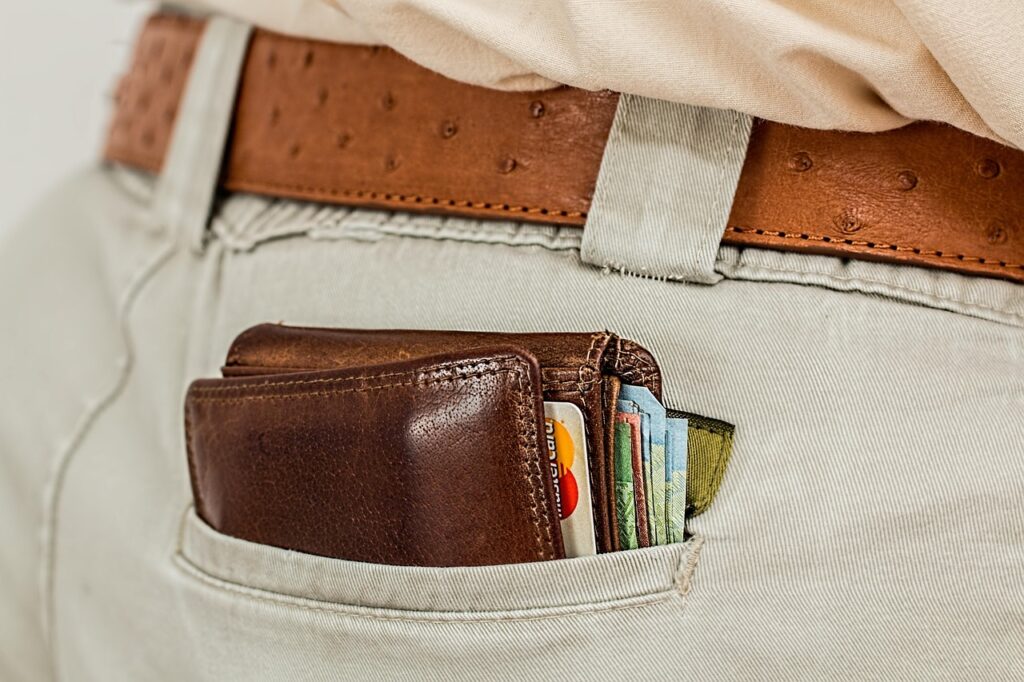
A pocket looks like a small detail, but the way it is cut and attached tells you a lot about how a garment was made and what it was made for.
This guide covers the main types of pockets you will meet on jeans, jackets, trousers, coats and skirts: what each one is, how to spot it, and what it says about a piece when you are flipping through a thrift rack. Jeans are a good place to start, because a single pair can carry four or five pocket styles at once. Our Types of Jeans hub walks through the cuts, and this page zooms in on the pockets themselves.
The word is older than most people expect. According to the Online Etymology Dictionary, “pocket” appears from the mid-14th century as pokete, a “small bag or pouch,” and the sense of a pouch “especially one sewn into a garment” dates from the early 15th century. For a long stretch of history, a pocket was a separate bag rather than part of the clothes.
Pocket styles at a glance
| Key feature | Typically found on | |
|---|---|---|
| Patch pocket | Sewn on the outside of the garment | Jeans back pockets, chore coats, polo coats, shirts |
| Welt (besom) pocket | A slit set into the garment, edged with a strip of fabric | Suit jackets, tailored trousers, coats |
| Flap pocket | A covering flap over the opening | Blazers, utility jackets, shirts |
| Slash pocket | An angled or straight cut opening at the front | Chinos, trousers, skirts |
| Cargo pocket | Large and utilitarian, often with a flap and gusset | Cargo pants, field jackets |
| Fob (watch) pocket | A small pocket originally for a pocket watch | Jeans, waistcoats |
| In-seam pocket | The opening sits inside a side seam | Dresses, skirts, coats |
| Kangaroo pocket | One wide pouch across the front, open at both sides | Hoodies, sweatshirts |
| Tie-on pocket | A separate pouch tied around the waist | Historic dress (museum pieces) |
Pockets sewn on the outside
Patch pocket
According to Wikipedia’s summary of pocket types, a patch pocket is sewn on the outside of the garment. You can spot one easily: it is a shaped piece of fabric stitched down on three sides, with the top edge left open. The back pockets on most jeans are patch pockets, and so are the chest pockets on many shirts. The Museum at FIT describes the classic polo coat, shown in a 1940 Brooks Brothers example, with patch pockets, a half-belt and turned-back cuffs, so the style is just as at home on tailored outerwear as on workwear. When thrifting, check the top corners. They take the most strain, and neat bar tacks or small reinforcing stitches there are a good sign.
Cargo pocket
Cargo pockets are large and utilitarian, per the same Wikipedia summary. On cargo pants they usually sit on the outer thigh and often have a flap and a pleat or gusset that lets them expand. Look at how the flap closes (button, snap or hook-and-loop) and whether the gusset folds flat. A pocket that bags open on the hanger may have been stretched by heavy use.
Flap pocket
A flap pocket has a covering flap over the opening. On a blazer, the flap usually sits over a welt pocket and can often be tucked inside so the jacket reads more formal. On utility shirts and field jackets the flap is part of a patch pocket and buttons shut. If the flap of a blazer pocket is still tacked down with loose basting thread, the pocket has probably never been opened, which is common on lightly worn suits.
Pockets set into the garment
Welt pocket (besom pocket)
Wikipedia groups besom, slit and welt pockets together as pockets set into the garment rather than sewn on top. The opening is a slit, finished with one or two narrow strips of fabric (the welts) that frame it. A single-welt pocket shows one strip, often on the chest of a suit jacket. A double-welt or besom pocket shows two narrow lips meeting in the middle, often on the back of tailored trousers. Clean, even welts with square corners are a quality cue on secondhand tailoring. Puckered corners or fraying at the ends of the slit point to a pocket that has been overloaded.
Slash pocket
“Slash pocket” is commonly used to describe a front pocket cut on a straight or slanted line into the trouser or skirt, rather than following the curve of a jeans scoop. You will see it on chinos, wool trousers and many skirts. Run a hand inside to feel the pocket bag: a sturdy cotton bag is easier to repair than a thin one, and a torn bag is a simple fix for most tailors.
In-seam pocket
An in-seam pocket tucks its opening inside a side seam, so from the outside you only see the seam line. It is common on dresses, skirts and coats. This is the descendant of an old idea: the Victoria and Albert Museum describes how women in the early 18th century reached their pockets “through openings in the gown and petticoat seams.” For more on how side seams are built, see our guide to Types of Seams.
Kangaroo pocket
“Kangaroo pocket” is commonly used to describe the single wide pouch on the front of a hoodie, open at both ends. Check the edges of the openings for stretched or cracked stitching, since this pocket carries a lot of hand traffic.
Small and specialist pockets
Fob (watch) pocket
Wikipedia describes fob pockets as made for pocket watches. On jeans it is the small pocket sitting above or inside the right front pocket, sometimes called the coin pocket today. Waistcoats may have a pair of them. On vintage denim, the details around this pocket (rivets, stitching and selvedge) are among the clues collectors use; our guide on How to Identify Vintage Levi’s covers what to look for.
Riveted pockets
Copper or metal rivets at pocket corners are a jeans signature. According to Levi Strauss & Co., the company and Jacob Davis received a U.S. patent in 1873 for an “Improvement in Fastening Pocket-Openings” by adding metal rivets to work pants. Rivets reinforce the points where a pocket is most likely to tear. You can read more about that heritage in What Makes Levi’s 501 Special? A Plain-English Assessment.
A short history: the tie-on pocket
For centuries, many women’s pockets were not part of their clothes at all. The V&A holds a pocket made between 1718 and 1720 that was “attached to a tape and tied around the waist as separate garments. Worn under the hoops and petticoats, they were accessed through openings in the gown and petticoat seams.” The museum’s collection also includes tie-on pockets dated 1760–1775 and 1875–1900 from Great Britain and 1775–1800 from Germany. According to Wikipedia’s summary, pockets were being sewn into men’s clothing by the 17th century while women’s often stayed as separate tie-on pouches.
How to thrift for good pockets
- Turn the garment inside out and look at the pocket bags. Firm cotton or twill bags last longer than thin, shiny linings.
- Check the corners of patch and welt pockets for reinforcing stitches, bar tacks or rivets.
- Feel along the bottom of each pocket bag for holes. A small hole is an easy repair; a frayed welt is harder.
- On tailored jackets, see whether the pockets are still basted shut. That often means light wear.
- Look at the closures. Buttons, snaps and zips on pockets should match and work; our guides to Types of Buttons and Types of Zippers explain what you are looking at.
If a pocket bag has worn through, a basic repair kit gets you most of the way: a Sewing Kit Beginners on Amazon plus some Iron On Pocket Repair Patches on Amazon can patch the inside of a bag. For workwear with plenty of patch and cargo pockets, our Men’s Work Pants is a useful next stop, and for jackets by style see Types of Jackets.
Top-selling match on Amazon

- Jeans Rescue Plan: Favorite jeans or denim jacket with holes and rips or fraying on the inner thighs…
- Size And Color: Denim Iron-on Patch Size: 3 x 4-1/4 inches, it can perfectly hide large and small…
- Easier To Use: Our denim iron-on repair patches can repair or decorate your clothes in minutes…
Top-selling match on Amazon

- Complete Sewing Set: The 160 piece sewing kit contains essential tools and supplies for basic repairs…
- Thoughtful Christmas Gifts: The sewing kit for adults is not only a reliable helper in daily life, but also a…
- Portable Design: Portable travel sewing kit keeps all sewing supplies organized and easily accessible…
Shop the look on Amazon
Everything you need to build a secondhand-style wardrobe, delivered. We may earn a commission on purchases.
FAQ
What is the difference between a welt pocket and a patch pocket?
A patch pocket is sewn on the outside of the garment, so you see the whole pocket shape. A welt pocket is set into the garment through a slit, so you see only the narrow fabric strip that edges the opening.
Is a besom pocket the same as a welt pocket?
The terms overlap. Wikipedia groups besom, slit and welt pockets together as set-in pockets. In common use, “besom” often means a pocket with two narrow welts, one above and one below the opening.
What is the tiny pocket on jeans for?
It is usually called the fob or watch pocket. Wikipedia describes fob pockets as made for pocket watches. Today it tends to hold coins or small items.
Should I cut open a basted pocket on a thrifted blazer?
That is a personal choice. Many people snip the loose basting stitches with small scissors so the pocket can be used. A common method is to cut only the temporary thread, not the welt seam itself.
Where can I buy pocket patches or replacement bags?
Craft stores and online sellers stock both; a search for Replacement Pocket Lining Fabric on Amazon brings up pre-cut pocket bag fabric for trousers and jeans.