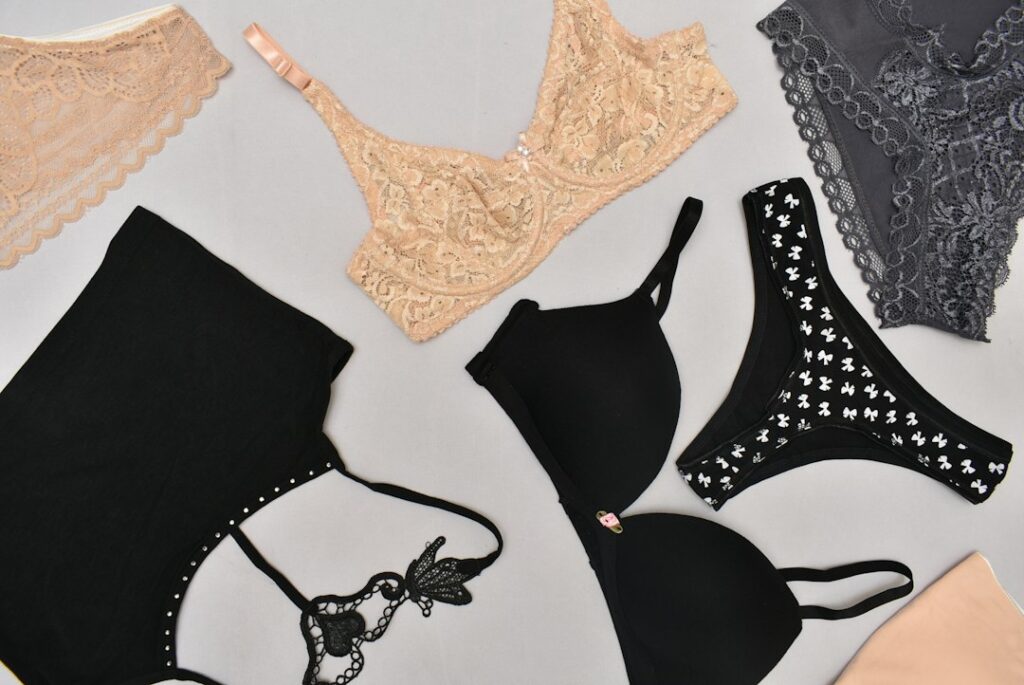
Most bra styles exist to solve a clothing problem: a deep V-neck, a strapless dress, a thin knit, a run. Knowing the names makes it much easier to pick the right one for the top you are planning to wear.
This guide covers the main types of bras, what each one looks like, how to spot it in a shop or a product photo, and which tops and dresses it is typically worn under. Because the neckline of your top decides so much, it pairs naturally with our guide to Types of Necklines, and there is a neckline-by-neckline cheat sheet further down. Everything here describes the garment itself. Fit advice is general, since sizing varies from brand to brand.
A short history of the bra
The word came before the modern garment. The Online Etymology Dictionary records “brassiere” by 1897, describing a “short, boned corset, silken or laced, worn by women just as a support for the bust.” It is a garment-trade borrowing from French brassière, which traces back to a word for an arm guard. The short form “bra” is recorded by 1923.
In 1914, Mary P. Jacob patented a brassiere design: US Patent 1,115,674, filed on February 12, 1914 and granted on November 3, 1914. The patent text places her design among “garments of the general type known as corset covers.” She did not originate the word or the idea, which were already in use, but her patent is one of the best-documented early designs.
The Victoria and Albert Museum adds another chapter. A V&A gallery label says that in 1926 Rosamond Klin of London-based Kestos Ltd. began experimenting by overlaying “two folded handkerchiefs” and adding shoulder straps and elastic ties. According to the V&A, the design offered support without bulk and suited the sleek clothes of the 1930s, and for years women “did not buy a brassiere, they bought ‘a Kestos’.” The museum’s example is cream silk with embroidered flowers and mother-of-pearl buttons.
Bra styles at a glance
| Style | Key feature | Typically worn with |
|---|---|---|
| T-shirt bra | Smooth moulded cups, no seams | T-shirts, fitted knits |
| Full-coverage | Cups cut high at the top and sides | Everyday tops, crew necks |
| Demi-cup | Cups cut lower, about half coverage | Scoop and square necks |
| Balconette | Horizontal top edge, wide-set straps | Square necks, wide scoops |
| Plunge | Deep centre gore, angled cups | V-necks, wrap tops |
| Bralette | Unstructured, usually wireless | Lounge wear, sheer layers |
| Wireless (soft cup) | Support from fabric and band, no wire | Everyday wear, casual tops |
| Underwire | Wire channel under each cup | Structured tops and dresses |
| Strapless | No straps, gripping band | Strapless and off-shoulder tops |
| Convertible / multiway | Detachable straps that rearrange | Halters, one-shoulder, crossbacks |
| Racerback | Straps meet between the shoulder blades | Racerback tanks, sleeveless tops |
| Sports bra | Firm band and wide straps for movement | Workouts, running |
| Front-closure | Clasp at the centre front | Racerback tops, everyday wear |
| Longline | Extended band below the cups | Cropped tops, corset-style outfits |
| Push-up | Graduated padding in the cups | Evening tops, structured dresses |
| Nursing bra | Cups that unclip and fold down | Everyday wear while nursing |
| Adhesive / stick-on | No band or straps, adheres to skin | Backless and very low-cut tops |
Style names below are common usage with no single authority, so one brand’s “balconette” may look like another brand’s “demi.” Look at the photo and the product description as well as the name.
Everyday bra styles
T-shirt bra
What it is: A bra with smooth, moulded foam or spacer cups and no visible seams.
How to spot it: The cup surface is seamless and slightly structured, so it keeps its shape even off the body.
How to wear it: Under T-shirts, fine-gauge knits and anything clingy where a seam or lace edge might show. A shade close to your own skin tone is a common choice under white and pale tops. Shop Womens T-Shirt Bra on Amazon by band size and cup, and see The White Tee Shirt for the tops themselves.
Top-selling match on Amazon
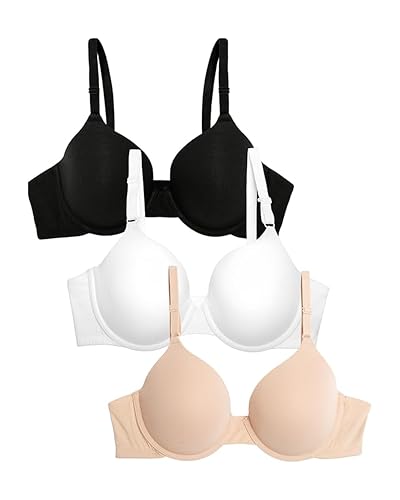
- Soft Cotton Comfort: Soft cotton fabric feels comfortable against the skin making this lightly lined…
- Smooth Under Clothes: Lightly lined cups create a smooth shape under tees and fitted tops helping reduce…
- Underwire Support: Flexible underwire helps provide lift shape and everyday support while the lightly…
Full-coverage bra
What it is: A bra whose cups extend higher at the top and sides.
How to spot it: The top edge of the cup sits close to the strap, and the straps attach near the centre of each cup.
How to wear it: Under crew necks, high necks and everyday tops. It is less suited to low or wide necklines, where the top edge may show.
Demi-cup bra
What it is: A bra with cups cut lower than full coverage, often described as half or three-quarter cups.
How to spot it: A lower top edge, often straight or gently curved, with straps set slightly wider.
How to wear it: Under scoop necks and square necks.
Wireless and underwire bras
What they are: Two construction types rather than styles. An underwire bra has a wire inside a channel under each cup. A wireless (soft-cup) bra gets its structure from the band, seams and fabric.
How to spot them: Press gently along the bottom of the cup: a firm curve means there is a wire. Many of the styles in this guide come in both versions.
How to wear them: This comes down to personal preference. Many people keep both: a wireless bra for lounging and casual days, an underwire for more structured outfits.
Bralette
What it is: A light, usually wireless and unpadded bra, often made of lace, cotton jersey or mesh.
How to spot it: Pull-on construction or a simple hook, thin straps, and no moulded cups.
How to wear it: For lounging, sleep, and under sheer or loose tops where a decorative strap or edge is meant to show. Our What Is Lace? Types of Lace and How to Care for It guide explains the lace types. Shop Cotton Bralette on Amazon for everyday versions.
Top-selling match on Amazon

- Comfort Flex Fit Design: Comfort Flex Fit 4-way stretch fabric adapts to your shape for a personalized…
- Cool Comfort Bras For Women: Cool Comfort moisture-wicking fabric helps wick away moisture from your skin…
- Wireless Light Support: These pullover bralettes offer gentle support with a smooth, elastic bottom band…
Neckline-driven bra styles
Balconette
What it is: A bra with a fairly horizontal top edge and straps set wide apart at the outer edge of each cup.
How to spot it: The neckline of the bra looks like a straight line across, and the straps sit far apart.
How to wear it: Under square necks, wide scoop necks and sweetheart necklines, where wide-set straps are less likely to show at the shoulders.
Plunge
What it is: A bra with a low centre gore (the piece between the cups) and cups angled toward the middle.
How to spot it: The cups form a deep V at the centre front.
How to wear it: Under V-necks, wrap tops and wrap dresses, where the low centre stays out of sight.
Balconette vs plunge
The two are close to opposites. A balconette has a horizontal top line and wide-set straps, so it matches wide necklines. A plunge has a deep V and straps set closer together, so it matches narrow, deep necklines. If the opening of your top is wide, try a balconette. If it is deep, try a plunge.
Strapless bra
What it is: A bra with no straps, held in place by a firm band, often with silicone grip strips along the edges.
How to spot it: A wider band, side boning in some styles, and a rubbery grip strip inside the top and bottom edges.
How to wear it: Under strapless dresses, off-shoulder tops and tube tops. Because there are no straps, band fit matters more than in other styles, so try it on and move around before wearing it out. Shop Convertible Strapless Bra on Amazon if you want one bra for several necklines.
Convertible or multiway bra
What it is: A bra with detachable straps that clip in different positions.
How to spot it: Small loops or hooks on the cups and back band.
How to wear it: Straps crossed for racerback tops, looped around the neck for halters, on one side for one-shoulder tops, or removed for strapless styles.
Racerback bra
What it is: A bra whose straps meet in the centre of the back.
How to spot it: A Y or T shape between the shoulder blades.
How to wear it: Under racerback tanks and sleeveless tops cut in at the shoulder.
Adhesive or stick-on bra
What it is: Cups that adhere to the skin with no band or straps.
How to wear it: Under backless and very low-cut tops and dresses where any band would show. Follow the maker’s instructions for use and care.
Function-driven bra styles
Sports bra
What it is: A bra built for movement, with a firm band and wider straps. Some are pull-on compression styles; others have separate cups.
How to spot it: Wicking knit fabric, a wide elastic band and often a racerback or crossback.
How to wear it: For workouts, running and sport. Brands often label sports bras by activity level. Browse our Amazon Sports Bras roundup for options.
Front-closure bra
What it is: A bra that fastens at the centre front instead of the back.
How to wear it: Often found with racerback straps, and chosen by people who find back hooks hard to reach.
Longline bra
What it is: A bra with a band that extends down toward the waist.
How to wear it: Under cropped jackets or as a visible layer, and for a smoother line under fitted dresses.
Push-up bra
What it is: A bra with graduated padding, thicker at the bottom and outer edge of the cup.
How to spot it: Feel the cup: the padding is noticeably thicker at the base.
How to wear it: A personal preference for evening tops and structured dresses.
Nursing bra
What it is: A bra with clips at the top of each cup so the cup can fold down.
How to wear it: Everyday wear while nursing. Many are wireless with a stretch knit.
Bra for every neckline: a cheat sheet
- Crew neck and high neck: T-shirt or full-coverage bra.
- V-neck and wrap: plunge bra.
- Scoop neck: demi-cup or T-shirt bra.
- Square neck and sweetheart: balconette.
- Strapless and off-shoulder: strapless or convertible bra.
- Halter: convertible bra with straps around the neck.
- Racerback: racerback, convertible or front-closure racerback.
- Backless: adhesive bra or a low-back style.
- Sheer blouse: a bra close to your skin tone, or a camisole over it. See Types of Blouses.
The same logic works for dresses. Our Types of Dresses guide lists the common dress necklines.
Bra sizing in brief
Bra sizes are commonly written as a band size plus a cup letter. This is general fit advice rather than a standard from any single authority, and sizing varies between brands, so the most reliable approach is to try sizes on. Common fit checks include:
- Fasten the band on the loosest hook, so it can be tightened as it stretches.
- Check that the band sits level all the way around.
- Check that the cups lie smoothly without gaps or spilling at the edge.
- Adjust the straps so they stay put without digging in.
- Re-measure from time to time, since sizes can change.
Measurements are just numbers for matching a brand’s chart, not a judgement on anyone’s body.
Caring for bras
Check the care label first; the FTC Care Labeling Rule requires it to say whether to wash by hand or machine. A common method:
- Fasten the hooks so they do not snag other items.
- Hand-wash in cool water with a mild detergent, or use a mesh laundry bag on a delicate cycle if the label allows.
- Rinse well and press out water gently; avoid wringing.
- Reshape moulded cups and air-dry. Many people skip the dryer for bras, since heat can affect elastic.
For silk pieces, see How to Wash Silk Without Ruining It.
How to thrift bras
Most people buy everyday bras new, but there is room to save:
- Look for new-with-tags stock. Thrift stores, outlets and off-price chains often carry unworn bras with tags still attached.
- Check the elastic. Stretch the band gently. If it crackles or stays stretched, the elastic is worn.
- Read the label for size and fibre. Vintage sizing can differ from today’s, so try it on rather than trusting the number.
- Consider vintage as a collectible. Older bras in silk and lace are sometimes bought as collector’s pieces rather than everyday wear, in the spirit of the V&A’s Kestos example.
Size charts: Bra Size Chart
For a specific pick, see the Nike Pro Women’s Indy Light-Support Sports Bra.
Types of bras FAQ
What is the difference between a balconette and a plunge bra?
A balconette has a horizontal top edge with wide-set straps and matches wide necklines. A plunge has a deep centre V and matches V-necks and wrap tops.
Who created the first bra?
No single person. The word “brassiere” was in use by 1897, according to the Online Etymology Dictionary. Mary P. Jacob patented a brassiere design in 1914, and Kestos produced an influential design from 1926 onward, according to the V&A.
What is a bralette?
A light, usually wireless and unpadded bra, often in lace or cotton, worn for comfort or as a visible layer.
What bra goes with a strapless dress?
A strapless bra or a convertible bra with the straps removed. For backless styles, an adhesive bra is a common option.
Where can I read about matching underwear styles?
See Types of Underwear for briefs, hipsters and more, and Types of Pajamas for sleepwear.
Shop the look on Amazon
Everything you need to build a secondhand-style wardrobe, delivered. We may earn a commission on purchases.
Browse picks on Amazon →