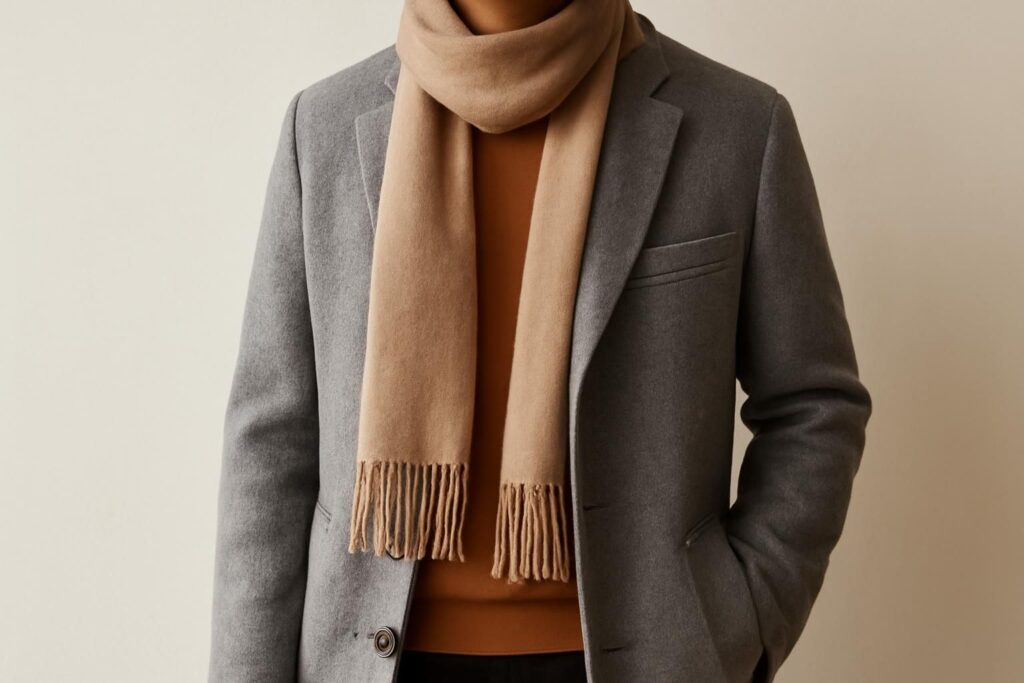
A scarf is one of the cheapest ways to make a winter coat look finished, and it does real work on a cold, windy morning. The trick is matching the fabric, the length and the knot to the weather and the outfit.
Buying a mens scarf looks simple until you are standing in front of a rack of merino, cashmere blends, acrylic and silk, in lengths that run from barely-around-the-neck to wrap-it-twice. This guide breaks the decision into parts: what each fabric does, what the label actually means, which lengths suit which knots, eight ways to tie a scarf step by step, outfit pairings, and how to wash and store wool so it lasts for years. For women’s styles and the wider winter range, our Winter Scarves hub covers the full category.
A note on sources: the fibre facts below come from The Woolmark Company, the Cashmere and Camel Hair Manufacturers Institute and the US Federal Trade Commission, and the knot instructions follow the men’s style site Real Men Real Style. Anything else is common styling advice and is labelled that way.
Men’s scarf fabrics compared
Fabric decides how warm a scarf feels, how it drapes, how it handles rain and how much care it needs. Here is the quick comparison, followed by detail on each.
| Fabric | Best for | Feel and drape | Care | What the sources say |
|---|---|---|---|---|
| Merino wool | Everyday winter wear | Soft, springy, medium weight | Hand wash or wool cycle if the label allows | Woolmark: manages moisture vapour, absorbs odour, stretches and recovers |
| Lambswool / standard wool | Cold, wet days; rugged looks | Warmer, sometimes scratchier, more texture | As merino | Woolmark: 100% natural fibre that decomposes in soil “in a matter of years” |
| Cashmere | Dressier coats, gifts | Very soft, lightweight for its warmth | Gentle hand wash; store folded | CCMI: defined by fibre fineness (average no more than 19 microns) |
| Wool-cashmere blend | A softer feel at a lower price | Between the two | As wool | FTC: blends must list percentages on the label |
| Silk | Dress coats, evening | Light, smooth, with a sheen | Follow the label; often dry clean | Common styling advice |
| Cotton / linen | Spring and autumn | Light, breathable, casual | Usually machine washable | Common styling advice |
| Acrylic | Budget, easy care | Soft but less breathable | Usually machine washable | Common styling advice: inexpensive wool alternative |
Merino wool
Merino is the default choice for a reason. According to Woolmark, merino helps regulate the body’s microclimate by absorbing moisture vapour and releasing it into the air, which is useful when you move between a cold street and a warm train. Woolmark also notes that merino absorbs odour molecules, reducing odour between washes, and that each fibre acts like a natural spring, so the fabric stretches and returns to shape. You will sometimes see a specific percentage quoted for how much moisture merino can hold; Woolmark’s own performance page describes “large quantities” without giving a figure, so treat precise numbers with caution.
Standard wool and lambswool
Coarser wools tend to feel warmer and more textured, and they suit tweed coats, waxed jackets and outdoor wear. Some people find them itchy against bare skin, which is common feedback rather than a rule: fibre fineness and finishing vary a great deal by maker. Woolmark points out that wool is a 100% natural fibre that decomposes in soil “in a matter of years”, which matters to shoppers trying to avoid synthetic fibres.
Cashmere and what the label means
The Cashmere and Camel Hair Manufacturers Institute defines cashmere as the fine, dehaired undercoat fibre of the Cashmere goat (Capra hircus laniger). To qualify, the fibre must average no more than 19 microns, with no more than 3% by weight over 30 microns. In the US, the Federal Trade Commission’s guidance under the Wool Products Labeling Act says blends must show percentages, for example “80% Wool, 20% Cashmere”, and goat fibre that misses the cashmere specifications must be labelled as wool. In practice, that means a label reading “cashmere feel” or “cashmere touch” tells you nothing about content. Read the fibre percentages.
Silk, cotton, linen and acrylic
Silk is lightweight with a sheen and suits dress coats and evening wear. Cotton and linen work for transitional weather when you want a bit of colour at the neck rather than serious warmth. Acrylic is an inexpensive, machine-washable alternative to wool, though it is less breathable. All three points are common styling advice rather than sourced claims, but they hold up well as a starting guide.
Scarf lengths and widths
Length decides which knots you can tie. Real Men Real Style lists these ranges in its knot guide; they are one style site’s figures, not an industry standard, and makers vary.
| Length (per Real Men Real Style) | Approximate size | Works well for |
|---|---|---|
| Short | 50–60 in | Drape, once-around, tucked into a coat |
| Standard | About 70 in | Parisian knot, reverse drape, most everyday knots |
| Long | About 82 in | Twice-around, reverse-drape cross, bulkier knots |
Width varies even more. Roughly 10 to 12 inches is common for wool winter scarves, but that is an observation rather than a sourced measurement. As a rule of thumb, narrower scarves sit neatly under a tailored coat collar, while wider ones fold into chunkier knots and give more coverage when the wind picks up.
If you are tall or plan to wear thick coats, a longer scarf gives you more options. If you want something that tucks into an overcoat without bulk, a shorter, narrower one is easier.
How to wear a mens scarf: 8 knots step by step
Real Men Real Style names a range of knots, from the simple drape to the four-in-hand. These eight cover most situations. The steps for the first four follow Real Men Real Style’s descriptions; the steps for the others are common descriptions of knots it names. For more styles, including women’s knots, see How to Tie a Scarf.
1. The drape
- Hang the scarf around the back of your neck.
- Even out the ends so they hang to the same length in front.
- Leave it unknotted, inside or outside an open coat.
Real Men Real Style describes this as a cool-weather option rather than a cold-weather one, since it offers little neck coverage. It suits a blazer or an unbuttoned overcoat.
2. The once-around
- Drape the scarf so one end is much longer than the other.
- Bring the long end around your neck once.
- Let both ends hang in front, or tuck them into your coat.
This is the everyday workhorse: quick, warm enough for most days and neat under a coat.
3. The reverse drape
- Start with the scarf draped and the ends even.
- Cross the left end over your right shoulder.
- Cross the right end over your left shoulder, so both ends hang down your back.
Real Men Real Style notes that this gives more neck protection than a plain drape. It looks tidy over a crewneck sweater.
4. The Parisian (European) knot
- Fold the scarf in half lengthwise so you have a loop at one end and two loose ends at the other.
- Drape it around your neck with the loop on one side and the loose ends on the other.
- Pull the loose ends through the loop.
- Tighten to the level of warmth you want.
This is probably the most popular knot for standard-length scarves. It sits neatly in the V of an overcoat and is easy to adjust.
5. The overhand
- Drape the scarf with the ends even.
- Tie one loose overhand knot at the front, as if starting to tie shoelaces.
- Adjust so the knot sits just below the chin.
Simple and casual, it works with chunkier knits.
6. The four-in-hand
- Drape the scarf with one end longer than the other.
- Cross the long end over the short end, then wrap it behind.
- Bring it across the front again and up through the neck loop.
- Pull it down through the front wrap, like a tie knot, and adjust.
Borrowed from necktie knotting, it gives a neat, compact knot under a tailored coat.
7. The reverse-drape tuck and reverse-drape cross
- Start with a reverse drape (step 3).
- For the tuck: pull both ends forward under the neck loop so they sit tucked in front.
- For the cross: bring the ends forward and cross them over each other before tucking under the loop.
Both versions keep the scarf secure on windy days and give a fuller look at the neck.
8. The twice-around
- Drape the scarf with one end much longer.
- Wrap the long end around your neck twice.
- Let the ends hang or tuck them in.
Real Men Real Style notes this one needs a longer scarf. It is the warmest of the eight and suits the coldest days.
Ascot-style knots, with the scarf tied high at the throat and tucked into an open shirt collar, have no authoritative standard. Tie the scarf loosely at the neck, fold the ends over each other and tuck them into the shirt; that generic description is about as precise as anyone can be.
Matching the knot to the weather
Common styling advice ties knot choice to temperature. A drape or loose once-around suits cool days. A Parisian knot or reverse drape suits typical winter days. A twice-around or reverse-drape cross in thick wool suits freezing, windy days. For full layering guidance by temperature, see What to Wear in 40 Degree Weather and What to Wear in 30 Degree Weather.
Outfit pairings for a men’s winter scarf
These pairings are common styling advice rather than rules. Use them as starting points.
| Outfit | Scarf fabric | Knot | Colour idea |
|---|---|---|---|
| Navy overcoat, suit or chinos | Merino or cashmere | Parisian or four-in-hand | Camel, grey or burgundy |
| Peacoat, jeans, boots | Chunky wool | Once-around or overhand | Grey, oatmeal or a tartan |
| Puffer jacket, hoodie | Acrylic or merino | Twice-around or tucked | Black, olive or a bright accent |
| Blazer, open collar | Silk, cotton or fine wool | Drape or ascot-style | A muted pattern |
| Waxed or field jacket | Lambswool or tweed-textured wool | Reverse drape | Brown, green or check |
| Spring trench or chore coat | Cotton or linen | Loose drape | Light grey, stone or blue |
Choosing a colour
A scarf is often the accent in an outfit. One editorial approach borrowed from interior design splits an outfit into roughly 60% main pieces (coat and trousers), 30% a secondary piece and 10% accents such as a scarf, which is a handy way to think about where colour goes. In fashion, navy, olive and brown are often treated as neutrals, so a camel scarf against a navy coat, or a grey scarf with olive, is easy to wear. Navy and camel also make a quiet contrast because navy is a dark blue and camel reads as a muted orange, which sit opposite each other on the traditional RYB colour wheel. Our guide to What Colors Go With Navy Blue? Outfit Pairings That Work covers more combinations.
Coats that pair well
A classic wool overcoat or Men’s Peacoat Guide gives a scarf a collar to sit in. A puffer jacket usually has a high collar of its own, so a thinner scarf tucked inside tends to sit better than a bulky knot. And if you are building a small cold-weather wardrobe from scratch, our Winter Capsule Wardrobe starter list shows where one or two scarves fit.
Where to buy a men’s scarf, new or secondhand
Scarves are one of the easiest things to buy secondhand. They have no sizing issues, wool lasts for decades when it is looked after, and thrift stores often have bins or racks of them. A few things to check:
- Read the fibre label. Under US rules, blends must list percentages, so a label tells you exactly what you are buying.
- Hold it to the light. Look for moth holes and thin patches, especially in wool and cashmere.
- Check for pilling. Some pilling is easy to remove (see the care section below), but heavy pilling on a blend may come back.
- Smell it. Odours usually wash out of wool, but heavy smoke can take several washes.
For new options, a plain Mens Merino Wool Scarf on Amazon covers most days, and a Mens Cashmere Scarf on Amazon makes a dressier choice or gift. Check the fibre percentages on any listing before buying. For something lighter in spring, a Mens Cotton Scarf on Amazon works well.
How to care for a wool scarf
Most wool scarves need washing far less often than you might expect, partly because, per Woolmark, merino absorbs odour between washes. When it is time, follow the care label first, then these steps.
Hand washing (Woolmark method)
- Turn the scarf inside out.
- Wash in lukewarm water, about 30°C, with a mild detergent.
- Soak for 10 minutes.
- Rinse in lukewarm water, then in cold water.
- Gently press out water without wringing, then dry flat in the shade, away from direct heat.
Machine washing
Woolmark says to machine wash wool only if the care label allows it, using the wool cycle (gentle, typically 40°C) or a delicates cycle, then dry flat. A laundry bag helps keep the surface looking new.
Why wool shrinks
Heat and moisture lift the scales on wool fibres, and agitation locks them together, a process known as felting. It cannot be reversed, which is why hot washes and vigorous scrubbing are the main risks for a wool scarf.
Pilling
Pills form when friction tangles short fibre ends into small balls. Strong synthetic fibres such as polyester anchor pills so they do not fall off, which makes blends especially prone. A fabric shaver or sweater comb removes them, and washing inside out on a gentle, cool cycle helps prevent them. The same care applies to knitwear; see How to Wash a Wool Sweater Without Shrinking It.
Storage
Common advice is to store wool scarves clean and folded, rather than hung, in a drawer or breathable box over summer. Moths are drawn to soiled wool, so washing before storage matters more than any deterrent.
Scarves beyond winter
Men’s scarves are not only for cold weather. A light cotton or silk scarf worn as a neckerchief has a long history, from 1960s Carnaby Street style (see our 60s Fashion guide) to western wear. A bandana tied at the neck does a similar job in summer; our guide on How to Wear a Bandana covers ways to tie one.
Frequently asked questions about men’s scarves
What is the best fabric for a mens scarf?
For most winter wear, merino wool is a strong all-rounder: Woolmark notes it manages moisture vapour, absorbs odour and stretches and recovers. Cashmere is softer and dressier. Acrylic is inexpensive and easy to wash but less breathable. Cotton, linen and silk suit milder weather.
How long should a men’s scarf be?
Real Men Real Style lists short scarves at 50–60 in, standard at about 70 in and long at about 82 in. A standard length handles most knots; choose long if you want the twice-around knot or plan to wear bulky coats.
How do you tie a scarf for men?
The Parisian knot is the most common: fold the scarf in half, drape it around your neck and pull the loose ends through the loop. For a quicker option, wrap one end around your neck once. Both are explained step by step above.
How can I tell if a scarf is real cashmere?
Read the fibre label. In the US, the FTC requires blends to list percentages, and goat fibre that does not meet the cashmere specifications must be labelled as wool. Phrases like “cashmere feel” are not a fibre content statement.
Should a scarf go inside or outside the coat?
Either works. Tucked inside looks neater and keeps the neck warmer under a buttoned overcoat. Worn outside, the knot becomes part of the outfit. Many people tuck the scarf in for work and wear it outside on weekends.
How often should I wash a wool scarf?
Only when it looks or smells like it needs it. When you do, follow Woolmark’s advice: lukewarm water around 30°C, a mild detergent, a 10-minute soak, rinses in lukewarm then cold water, and flat drying in the shade.
Shop the look on Amazon
Everything you need to build a secondhand-style wardrobe, delivered. We may earn a commission on purchases.