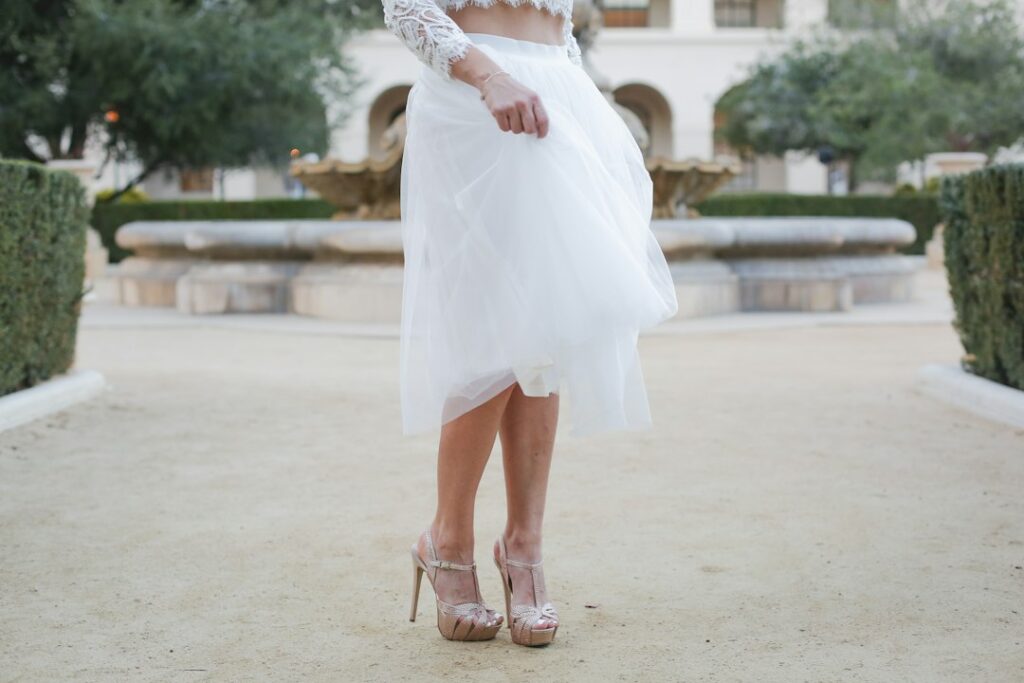
Tulle is the light, airy net behind bridal veils, ballet tutus and full-skirted party dresses, and its name comes from a small town in central France.
What is tulle? Tulle is a fine, lightweight net fabric made of tiny mesh holes, traditionally silk and now usually nylon or polyester. Because it is a net rather than a woven cloth, it builds volume through layers of air, which is why a tulle skirt can look full yet weigh almost nothing. This explainer covers the history of the name, how tulle is made, the main types, how it compares with organza, care, and what to check when thrifting. For its crisp woven cousin, see our What Is Organza? Sheer, Crisp Fabric Explained explainer.
What tulle is and where the name comes from
The Online Etymology Dictionary records “tulle” from 1817 and defines it as a “fine silk bobbin-net used for veils.” It was named after Tulle, a town in central France, “where the fabric was first manufactured.” That early definition still captures the fabric’s two most famous uses: it is a net, and it is associated with veils.
How tulle is made
The sources for this guide define tulle as a bobbin-net but do not describe the process in detail. In general terms, tulle is commonly explained like this:
- Fine yarns, traditionally silk and today mostly nylon or polyester, are set up on a net-making machine.
- Threads are twisted around each other to form small, regular openings, often hexagonal.
- The open mesh is finished to be soft or stiff depending on its intended use.
Stiffness varies widely. Soft tulle drapes for veils, while stiffer tulle and its coarser relative, netting, hold shape in petticoats and tutus.
Types of tulle
| Type | Typical feel | Common uses |
|---|---|---|
| Silk tulle | Very soft, fluid, fine mesh | Couture veils, high-end bridal |
| Nylon tulle | Soft to medium, light | Bridal veils, skirts, overlays |
| Polyester tulle | Stiffer, inexpensive | Tutus, petticoats, costumes, decor |
| Glitter or sequin tulle | Decorated mesh | Party dresses, holiday skirts |
| Embroidered tulle | Pattern stitched on net | Sleeves, bodices, veils |
For background on the synthetic fibres, see What Is Nylon? The Synthetic Fiber Explained and What Is Polyester? Pros, Cons and How to Care for It.
Tulle vs organza vs chiffon
- Tulle is a net. It creates volume through stacked layers of mesh and looks airy.
- Organza is a woven fabric that the Online Etymology Dictionary defines as “thin, stiff, transparent.” It creates a crisp, smooth surface with a defined edge.
- Chiffon, per Britannica, is a lightweight, sheer plain-weave fabric that looks delicate but is “relatively strong.” It drapes softly rather than standing out.
A useful way to remember it: tulle puffs, organza holds, chiffon flows. Our What Is Chiffon? Sheer Fabric, Fibers and Care explainer covers the softest of the three, and our fabric glossaries place all three in the wider fabric family.
How tulle is worn
Tulle skirts
A layered tulle skirt is a popular way to bring tulle into everyday wear. Styling advice commonly pairs a full tulle midi with something plain and fitted on top, like a fine knit sweater or a T-shirt, so the skirt does the talking. Our Types of Skirts glossary and Sweater and Skirt Outfits guide cover more combinations. Shopping new, a Womens Tulle Midi Skirt on Amazon is the easiest starting point.
Top-selling match on Amazon

- Material: 3 layers of soft tulle and 1 lining that makes fullness and beautiful flow
- Versatile Design: This tulle skirt is light and breathable. From casual to formal, this tutu skirt is…
- Comfy High Elastic Waist Skirt: The elastic waistband is comfy and suitable. It can be easily put on and make you…
Bridal veils and dresses
Veils remain tulle’s signature use, as its 1817 definition suggests. Many wedding and prom dresses also use tulle skirts over a lining. See Amazon Wedding Dresses and Prom Dresses for examples, or a Tulle Wedding Veil on Amazon if you are shopping for one.
Petticoats and party dresses
Stiffer tulle petticoats add fullness under circle skirts and vintage-style dresses. Glitter tulle appears often in Holiday Dresses.
How to care for tulle
Check the care label first. The FTC Care Labeling Rule requires it to say whether to wash by hand or machine and to give a water temperature if hot water would harm the item. Tulle garments with boning, beading or linings are often dry clean only.
Nylon and polyester tulle
Where the label permits, a common method is a gentle hand wash in cool water with a mild detergent, swishing rather than scrubbing, then hanging or laying flat to dry. Heat is the main risk: a common caution is that synthetic net can melt or pucker under a hot iron or high dryer heat.
Silk tulle
The Smithsonian Museum Conservation Institute notes that silk is a protein fibre that “can be damaged by protein enzymes or alkali,” that chlorine bleach “will dissolve silk or wool,” and that these fibres “tear more readily in water.” For a silk veil, a professional cleaner is the cautious choice.
Removing creases
Steam is a common method for tulle: hang it and steam from a distance, or hang it in a steamy bathroom for about 15 minutes, which, according to Maytag, relaxes lighter wrinkles. If you must iron, a commonly cited summary of the ISO 3758 symbols puts one dot at about 110°C for synthetics; use the lowest setting with a pressing cloth. A Handheld Garment Steamer on Amazon is the usual tool.
Top-selling match on Amazon

- 240ml Big Capacity 700W Portable Travel Steam Iron
- Leading technology, unique 304 stainless steel heating panel ensures anti rust, anti oxidation…
Thrift label check for tulle
- Read the fibre label: silk, nylon and polyester tulle need different care.
- Spread the layers and look for tears or holes in the mesh, which spread easily.
- Check the waistband and seams where tulle is gathered.
- Look for flattened or crushed layers; steaming can revive some, but not all.
- Smell for storage odours, since tulle traps smells between layers.
Secondhand prom and party racks often hold tulle skirts and dresses; our Thrift Store Prom Dresses guide has more tips.
Shop the look on Amazon
Everything you need to build a secondhand-style wardrobe, delivered. We may earn a commission on purchases.
FAQ
Why is it called tulle?
The Online Etymology Dictionary says it was named after Tulle, a town in central France, where the fabric was first manufactured, and records the word from 1817.
Is tulle the same as mesh?
Tulle is a type of fine net. “Mesh” is commonly used more broadly for any open-structured fabric, including sporty knits.
Is tulle itchy?
Stiff polyester tulle can feel scratchy; soft nylon and silk tulle feel smoother. Lined tulle skirts keep the net away from skin.
What is the difference between tulle and organza?
Tulle is a net that builds airy volume; organza is a sheer, stiff woven fabric with a smooth surface.
How do you fluff up a flat tulle skirt?
A flattened tulle skirt usually regains volume after steaming, then hanging upside down by the waistband so the layers separate as they cool. Gently shake out and pull apart each layer by hand before steaming, working from the inside layer outward. Keep the steamer moving and off the net, since synthetic tulle can pucker with too much heat. Storing the skirt hanging with space around it, rather than folded in a drawer, keeps the layers from crushing again.