
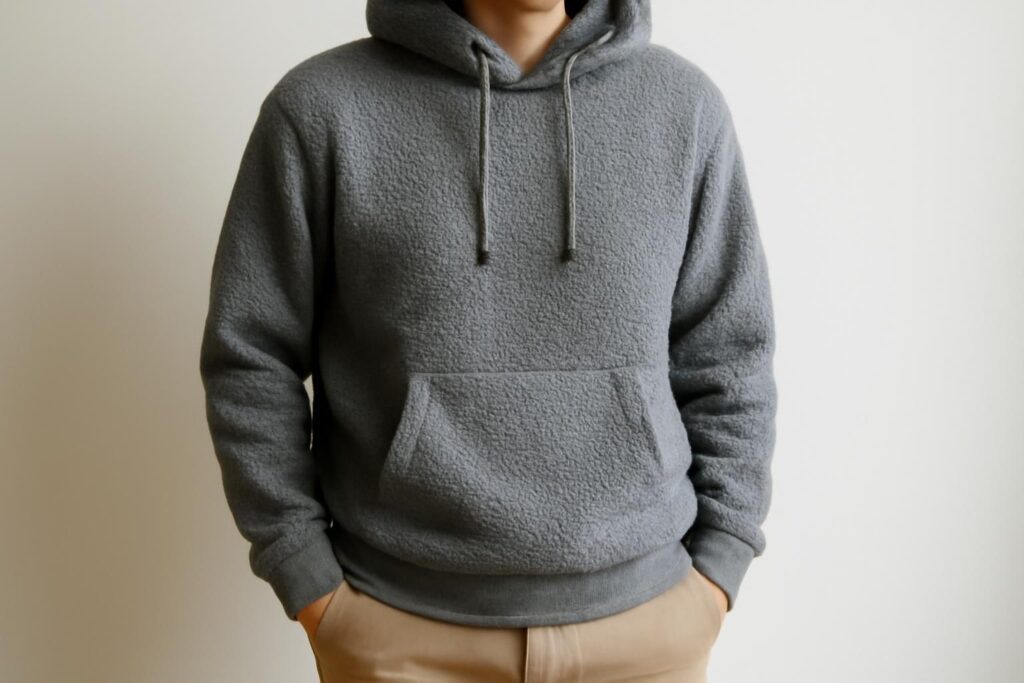
A fleece hoodie is the piece most closets already own and most shoppers still buy wrong, because the word “fleece” hides a warmth range that runs from a thin gym layer to a sherpa-lined jacket in everything but name.
Mens fleece hoodies are pullover or zip sweatshirts cut from polyester fleece, and the single spec that decides how warm one actually is comes down to the fleece weight and whether it is plain fleece or plush sherpa. That is the frame worth keeping in mind before you shop: a lightweight fleece hoodie is a breathable active layer, a heavyweight or sherpa-lined one behaves like a light jacket. We track this cozy-layer category for Tumbleweed Thrift readers as part of our Shackets & Casual Coats coverage, and the fleece hoodie is where most people start because it is the cheapest way into real winter warmth. Here is how to read the weight, spot the lining that matters, size it for layering, and pick the tier that fits how hard you will wear it.
What “fleece hoodie” actually covers
Fleece is a napped polyester knit, soft on both faces, that traps air and dries fast. A fleece hoodie takes that fabric and adds a hood, and from there the category splits. Standard fleece hoodies use a flat, brushed fleece and read as a warm sweatshirt. Sherpa hoodies for men swap in a curly, faux-shearling pile that is plusher and noticeably warmer, either as the whole shell or as a lining behind a smoother face fabric. Mens fleece lined hoodies usually mean a cotton or jersey shell with a sherpa or fleece interior, which is the warmest common build and the closest a hoodie gets to jacket territory.
The distinction matters because the warmth gap between them is large. A thin French-terry-backed fleece hoodie is a spring-and-fall layer; a sherpa-lined one with a hood pushes into genuine cold. Knowing which build you are looking at, before price or color, is the thing that keeps you from buying an active layer when you wanted warmth.
Fleece weight and warmth grades
Fleece is graded by weight, usually in grams per square meter, and the number tracks warmth closely. Lightweight fleece around 100 to 200 GSM is thin, stretchy, and breathable, built for movement and layering under a shell. Midweight fleece around 200 to 300 GSM is the everyday sweet spot, warm enough to wear alone in fall and light enough to layer. Heavyweight fleece above 300 GSM, and anything sherpa-lined, is the warm end that behaves like outerwear.
Heavier is not automatically the right buy. A high-loft sherpa hoodie runs hot and bulky and loses the versatility that makes fleece useful across a wide temperature range, while a thin fleece layers beautifully but disappoints anyone expecting warmth on its own. Product pages rarely print the GSM, so the words in recent reviews do the work: “thick,” “substantial,” and “cozy” point to real warmth, while “thin” and “lightweight” flag the active-layer end.
How mens fleece hoodies should fit
Fit depends on the job. An active fleece hoodie meant to sit under a shell should fit close, with sleeves that reach the wrist and a hem that stays put when you move. A cozy sherpa or fleece-lined hoodie worn as a light jacket should have room for a tee or a thin sweater underneath without pulling across the chest or riding up at the back.
The common sizing mistake is buying a plush sherpa hoodie in your normal tee size and finding the lining eats the interior room. Sherpa and heavy fleece add real bulk inside, so sizing up one restores the layering space if you plan to wear anything under it. Reviewers flag this fast, so reading whether a specific model runs trim, boxy, or short in the torso is the most reliable move before you buy. Our broader Hoodies covers fit and construction across the whole hoodie category if you want the full breakdown.
How mens fleece hoodies compare across tiers
The market runs from sub-$30 marketplace fleece to technical athletic pieces and heritage outdoor brands, and the right pick depends on whether you want warmth per dollar, performance, or longevity. Here is how the tiers line up on the specs that decide the buy.
| Tier | Fleece type | Warmth | Fit | Price range | Best for |
|---|---|---|---|---|---|
| Value (Amazon, Old Navy, Target) | Standard or sherpa-lined | Mid to high, best per dollar | Runs trim to true; size up | ~$25–50 | First cozy hoodie, warmth for the money |
| Athletic (Nike, Adidas, Under Armour) | Technical brushed fleece | Mid, moisture-managing | Athletic, true to size | ~$45–90 | Training, layering, streetwear look |
| Outdoor/heritage (Columbia, Patagonia, L.L.Bean) | High-loft or sherpa | High, durable loft | Fuller, relaxed | ~$70–150 | Cold weather, longevity, outdoor use |
The value tier is where most buyers should start, and it is where Amazon dominates. The marketplace is packed with $25 to $50 fleece hoodies, and a large share come sherpa-lined at that price, which is the best warmth-per-dollar in the category. Quality varies listing to listing, so lean on the reviews and the photos. A fast way in is Mens Sherpa Lined Fleece Hoodie on Amazon, which surfaces the lined versions that deliver real warmth rather than the thin unlined shells.
The athletic tier trades some warmth for fit and moisture management. These brushed-fleece hoodies wick better and hold a trimmer shape, which is why they double as streetwear. Nike leans direct-to-consumer and shows up inconsistently on Amazon, so shopping similar athletic fleece there is often the more reliable route; our Black Nike Sweatshirt and Athletic Hoodie guides dig into that end specifically. The outdoor and heritage tier costs more up front for high-loft fleece that holds its warmth and shape for years, and it is the buy-it-once option if the hoodie is going into permanent cold-weather rotation.
How to wear a fleece hoodie
A standard fleece hoodie is close to foolproof: worn under a shacket, a denim jacket, or a coat, it adds a warm, quiet mid-layer, and the hood gives the outfit a casual anchor. A sherpa or fleece-lined hoodie is bulkier and works better as the outer piece, over a tee with jeans and boots or clean sneakers, where the plush texture becomes the visual interest.
The one rule worth keeping is to let the fleece hoodie play one role at a time. A thick sherpa hoodie under a slim coat fights for room and bunches, while a thin fleece hoodie disappears under a shacket the way it should. Pair a loud graphic fleece hoodie with plain layers so it does not compete; our Graphic Hoodies guide covers that end if the print is the point.
Care and washing
Fleece is easy to care for as long as you respect the fibers. Wash cold on a gentle cycle and skip fabric softener, which coats the fleece and flattens the loft that holds heat. High heat is the real enemy: it melts and mats the pile, especially on sherpa, and that damage does not fully recover, so air-dry or tumble on low or no heat.
Reviewers consistently report that overwashing is what kills a fleece hoodie fastest, matting the surface and dulling the color. Fleece does not need washing after every wear the way a tee does, so spacing out washes keeps the loft alive longer. When a sherpa hoodie flattens, a soft brush over the dry pile lifts it back up.
The verdict
For most people the fleece hoodie to buy is a midweight or sherpa-lined value-tier piece, sized up one so it layers, for somewhere around $30 to $50. That build covers the widest temperature range and delivers the best warmth for the money, and the lining is what earns it a place past early fall. If you want a training and streetwear layer, step to the athletic tier for the trimmer fit and moisture management, knowing you trade a little warmth for it. If the hoodie is going into hard, cold-weather rotation, an outdoor or heritage high-loft fleece is the buy-it-once move. Skip the thin, unlined lightweight fleece unless you specifically want an active base layer, because that is the version that disappoints anyone expecting warmth. Size for the layer underneath, wash it cold, keep the heat and the softener away, and a fleece hoodie stays the most useful cozy layer in the closet.
Shop the look on Amazon
Everything you need to build a secondhand-style wardrobe, delivered. We may earn a commission on purchases.
FAQ
Are sherpa hoodies warmer than regular fleece hoodies?
Yes. Sherpa is a high-loft, curly pile that traps more air than flat brushed fleece, so a sherpa or sherpa-lined hoodie runs noticeably warmer and plusher. The trade-off is bulk and breathability: sherpa is warmer but heavier and hotter during activity, while standard fleece is lighter and better for movement and layering.
Should I size up in a fleece-lined hoodie?
Usually yes, if you plan to wear anything underneath. Sherpa and heavy fleece linings eat interior room, so sizing up one restores space for a tee or thin sweater without pulling across the chest. For a thin fleece hoodie worn on its own or under a shell, your normal size is fine.
Can you wear a fleece hoodie as a jacket?
A heavyweight or sherpa-lined fleece hoodie works as a light jacket in fall and mild cold, especially with a hood. It is not windproof, though, since fleece is a knit that air passes through, so in wind or deep cold it works best as a mid-layer under a shell rather than as the outer shell itself.
How do I keep a fleece hoodie from getting matted?
Wash it cold, skip the fabric softener, and keep it away from high heat, which is what mats and melts the pile. Wash less often than you would a tee, since overwashing is the main cause of matting, and brush a flattened sherpa pile back up with a soft brush once it is dry.
Is a men’s fleece hoodie better than a cotton hoodie?
A men’s fleece hoodie is the better choice for warmth and wet weather, while a cotton hoodie is better for breathability and a softer, natural feel. Polyester fleece traps air and dries fast, so it keeps insulating after sweat or drizzle, whereas cotton absorbs moisture and stays damp. Cotton tends to feel cooler indoors and pills less on the face, so many people keep one of each for different temperatures.


