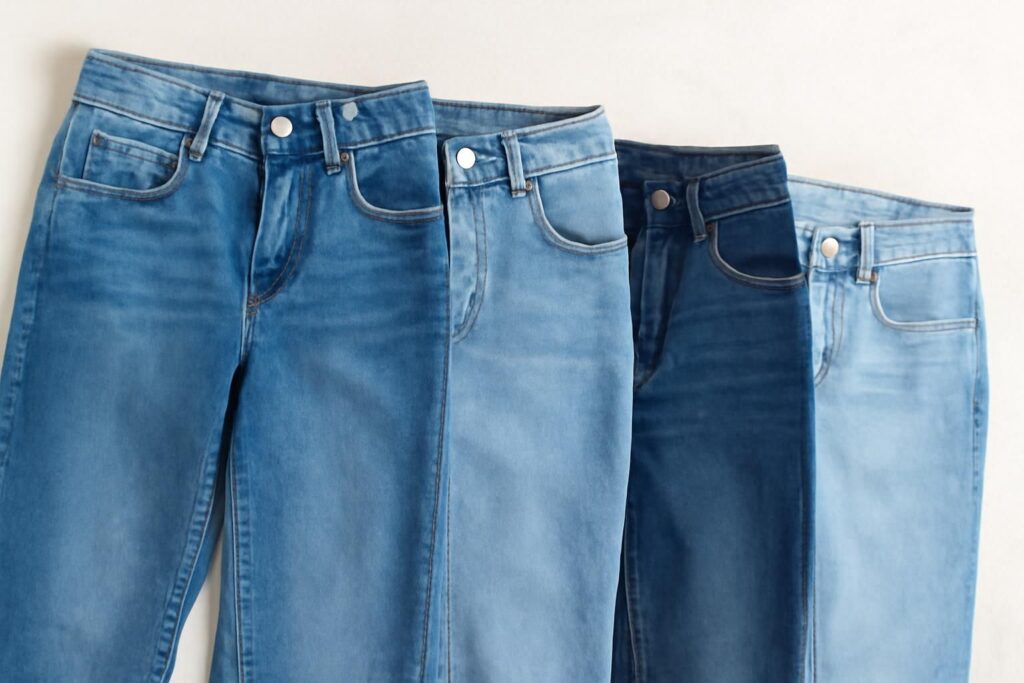
Denim labels throw around ounces, selvedge, sanforized and stretch as if everyone already knows them. Each term describes a different part of how the fabric was made, and once you can sort them, choosing a pair gets easier.
The types of denim you will see on labels fall into a few separate questions: how the fabric is woven, how heavy it is, whether it has been pre-shrunk, whether it has stretch, and how it was finished. A single pair of jeans has an answer to each, so “raw selvedge 14 oz rigid” is just four of those answers stacked together. This guide takes each one in turn using sourced definitions, then shows how to spot them on a thrift rack. For a broader introduction to the fabric itself, start with our What Is Denim? Twill Weave, Indigo and How Jeans Fade hub.
Key facts at a glance
| Question | Main types | Source |
|---|---|---|
| Weave | Twill, warp-faced | Britannica; Wikipedia |
| Edge / loom | Selvedge (shuttle loom) vs shuttleless | Wikipedia |
| Pre-shrinking | Sanforized vs unsanforized | Wikipedia; Google Patents |
| Weight | About 9 to 32 oz, with 11 to 14 oz typical | Wikipedia |
| Stretch | Rigid (100% cotton) vs stretch (elastane blend) | Common usage |
| Finish | Raw, rinse, stonewash, enzyme, acid | Wikipedia; common usage |
The weave: what makes denim denim
Britannica defines denim as “a durable twill-woven fabric with a coloured (usually blue) warp and white filling (weft) threads.” It is yarn-dyed and usually all-cotton, though often a cotton-synthetic blend. Twill is one of the three basic weaves and produces a diagonal rib, usually at about 45 degrees, which is the fine slanted line you can see on the face of most jeans.
Wikipedia adds that denim is “a sturdy, cotton, warp-faced textile in which the weft passes under two or more warp threads.” Levi Strauss & Co.’s Denim Dictionary defines the warp as “strong, vertical yarns held in tension across a loom” and the weft as “horizontal threads or yarns woven through tightly bound warp yarns.” Because the blue warp dominates the face and the white weft shows on the back, denim is blue outside and paler inside.
The name, according to the Online Etymology Dictionary, comes from French serge de Nîmes (1690s), and “denims” for trousers, originally overalls, is recorded from 1868. Fabrics that look similar but use a different weave, such as chambray, are compared in Denim vs Chambray.
Selvedge vs shuttleless denim
Per Wikipedia, traditional selvedge denim comes off shuttle looms in narrow bolts, typically about 30 inches wide, while “most denim made today is made on a shuttleless loom that produces bolts of fabric 60 inches (1,500 mm) or wider.” The narrow bolt has a finished self-edge that stops it unravelling, and that edge often carries a coloured line. Selvedge describes how the edge was woven, not how good the fabric is. Our Selvedge Denim guide explains how to spot it, and Japanese Denim covers the region best known for it.
Sanforized vs unsanforized (raw)
Wikipedia defines sanforization as “a treatment for fabrics to reduce shrinkage from washing,” developed by Sanford Lockwood Cluett. The patent, US 1,861,422, was filed in 1930 and published in 1932, and describes shrinking moistened fabric with compressive forces. Unsanforized denim has skipped that step, so it shrinks more on its first wash.
Raw denim simply means unwashed after sewing; it can be sanforized or not. Levi’s Shrink-to-Fit 501 is the best-known unsanforized example, and Levi’s says it shrinks on average “about 1 inch in the waist and up to 2-3 inches in length.” That figure is Levi’s and applies to that product. See Raw Denim for sizing and break-in, or browse Mens Raw Selvedge Denim Jeans on Amazon.
Denim weight
Denim weight is usually quoted in ounces per square yard. Wikipedia gives the range as “a yard of fabric weighing anywhere from 9 to 32 oz (260 to 910 g), with 11 to 14 oz (310 to 400 g) being typical.” As common guidance:
- Lighter denim (under about 11 oz) feels softer and cooler and shows up in shirts, summer jeans and dresses.
- Mid-weight (about 11 to 14 oz) is the everyday range most jeans fall into.
- Heavyweight (above about 14 oz) feels stiffer at first and takes longer to break in. The very top of the range is a niche enthusiast product.
Weight is not a quality score. A lighter fabric suits warm weather; a heavier one suits people who want a sturdy, slow-to-soften pair.
Stretch vs rigid denim
In common usage, rigid denim is 100% cotton with no elastane, while stretch denim blends in elastane, also called spandex. Rigid denim feels firm at first and gives with wear; stretch denim moves more from day one and may loosen over time. Check the fibre content on the care label to see which you have.
Care differs too. Whirlpool notes that hot washing or drying can damage spandex and ruin the stretch, so stretch pairs do best with cool washes and low or no dryer heat. Our Does Spandex Shrink? Heat, Stretch and Care guide explains more. Browse by type: Womens Stretch Skinny Jeans on Amazon or Rigid 100 Cotton Jeans on Amazon.
Finishes
Finally, the wash. Raw, rinse, stonewash, enzyme and acid wash are all finishes applied to the same basic fabric, and they change colour and softness rather than the weave. Our Denim Washes Explained guide covers each one.
How to spot denim types when thrifting
- Read the care label for fibre content to tell stretch from rigid.
- Turn up a cuff and look along the outseam for a clean selvedge edge.
- Look at the inside of the leg to compare face and back colour.
- Feel the weight in your hand; heavy denim is noticeably stiffer.
- Check fades: even, bright indigo with crisp creases often means raw or rinse.
- Measure flat, because older pairs may have shrunk; see How to Measure Jeans (Waist, Rise, Inseam and Leg Opening).
Shop the look on Amazon
Everything you need to build a secondhand-style wardrobe, delivered. We may earn a commission on purchases.
FAQ
What are the main types of denim?
Denim is sorted by edge (selvedge or shuttleless), pre-shrinking (sanforized or not), weight, stretch content and finish. Most jeans combine one answer from each.
What is a normal denim weight?
Wikipedia gives a range of 9 to 32 oz per yard, with 11 to 14 oz typical.
Is stretch or rigid denim better?
Neither is better overall. Rigid denim is firmer and moulds with wear; stretch moves more from the start but needs gentler heat.
Is selvedge denim always raw?
No. Selvedge describes the edge, raw describes whether it has been washed. A pair can be one, both or neither.
What is the difference between right-hand and left-hand twill denim?
Right-hand and left-hand twill describe which way the diagonal line on the face of the denim runs. In right-hand twill, the most common type, the diagonal rises toward the upper right, and the fabric tends to feel flatter and firmer. Left-hand twill runs the other way and is often described as softer, with a different fade pattern over time. Broken twill alternates the direction to reduce leg twist.