Sleeve length is the measurement that most often trips people up, because there is more than one way to take it and size charts do not always say which one they mean.
Learning how to measure sleeve length takes about five minutes and a soft tape, but the number you end up with depends on where you start the tape. Some shirt makers measure from the centre of the back of your neck, over the shoulder and down to the wrist. Many other size charts start at the shoulder seam instead. Neither convention is “the correct” one; they are simply two different systems, and the trick is knowing which one a brand uses before you compare your number with its chart. This guide covers both methods step by step, explains how dress shirt labels like “15½ 34” work, and shows how to measure a shirt you already own. It sits alongside our guide to How to Measure Inseam (for Pants and Jeans), which uses the same take-it-slowly approach for trousers.
Two sleeve conventions, and why the numbers differ
Before you pick up a tape, it helps to understand why two people can measure the same arm and get answers several inches apart.
- Centre back of neck to wrist. This method starts at the middle of your upper back, just below the collar, runs across to the point of your shoulder, then down the arm to the wrist. Charles Tyrwhitt, the British shirt maker, describes its sleeve measurement this way. Because it includes half the width of your upper back, the number is longer.
- Shoulder seam to wrist. Many casual and women’s size charts start the tape at the shoulder point or shoulder seam and run it down to the wrist. Because it skips the back, the number is shorter.
Neither figure is wrong. A shirt labelled with a centre-back sleeve of 34 inches and a jacket listing a shoulder-to-wrist sleeve of around 25 inches could fit the same arm. The only mistake is mixing them: taking a shoulder-seam measurement and comparing it to a chart built on the centre-back system, or the other way around. When a brand’s chart does not say where it starts, look for a diagram, a “how to measure” note, or a customer service page, and if there is still no answer, measure a garment that already fits you (see below) and compare garment to garment.
What you need
- A soft, flexible tape measure. A rigid metal tape will not follow the curve of your shoulder or elbow. If you do not own one, an Amazon search for Soft Tailor Tape Measure on Amazon turns up inexpensive options, and a soft tape is useful for every measurement on this site.
- A helper, if possible. Measuring your own sleeve means holding the tape at the back of your neck while it runs down your arm, which is awkward alone.
- A thin, close-fitting top, or a shirt you already like the fit of.
- Something to write on, so you can record each part of the measurement as you go.
Top-selling match on Amazon
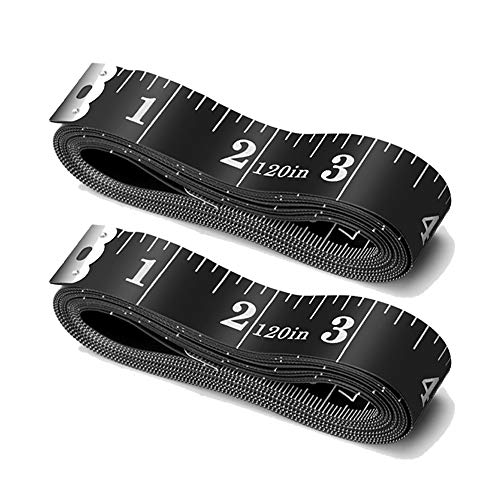
- Ultra Long Measuring Range: Different than normal 60 inch soft tape measure, ours are 120 inch long, which can…
- Clear Marks For Easy Reading: There are two units of fabric measuring tape, 120 Inch on one side and 300 cm on the…
- Wide Applications: This tape measure body measuring tape are great for weight loss, body measurements…
Method 1: centre back of neck to wrist (Charles Tyrwhitt)
This is the method Charles Tyrwhitt sets out in its guide to measuring for a shirt. It breaks the sleeve into three sections and adds them together, which is easier to do accurately than one long pull of the tape. Per Charles Tyrwhitt:
- Stand relaxed with your arm hanging naturally and your elbow slightly bent, as if your hand were resting near your hip.
- Have your helper place the end of the tape at the top of the centre back, just below where a collar would sit.
- Run the tape across to the peak of your shoulder and note that number.
- Measure from the shoulder peak down towards the elbow and note that number.
- Measure from the elbow to just above the wrist bone, or to wherever you prefer a shirt cuff to sit, and note that number.
- Add the three numbers together. The total is your sleeve length on the centre-back system.
A slightly bent elbow matters. A sleeve has to cover your arm when you reach for something, not only when your arm is straight at your side, so measuring with a soft bend gives a little room for movement. The final point, “wherever you prefer the shirt cuff to sit”, is a personal choice: some people like a cuff that just meets the wrist bone, others like it a touch longer so it shows below a jacket sleeve.
Measuring a finished shirt with this method
Charles Tyrwhitt describes a finished shirt’s sleeve length as starting at the middle of the collar at the back, going down past the shoulder seam and ending at the end of the cuff. To measure a shirt you own:
- Button the shirt and lay it face down on a flat surface.
- Smooth out the back and one sleeve so the fabric lies flat without stretching.
- Place the end of the tape at the centre of the collar where it meets the back of the shirt.
- Run the tape across to the shoulder seam.
- Continue down the sleeve, along its outer edge, to the end of the cuff.
- Read the total.
Method 2: shoulder seam to wrist (a common convention)
Many size charts, especially for casual tops, knitwear, outerwear and women’s clothing, measure the sleeve from the shoulder instead. This is a common method rather than one owned by a single brand, so check the chart you are using to confirm it.
- Stand with your arm relaxed at your side and your elbow slightly bent.
- Find the shoulder point: the bony edge at the top of your shoulder where a shirt’s shoulder seam would sit.
- Place the end of the tape on that point.
- Run the tape down the outside of your arm, over the elbow.
- Stop at the wrist bone, or wherever you like a sleeve to end.
- Read the number.
On a garment, the same method runs from the shoulder seam straight down the outer sleeve to the cuff edge or hem. Lay the piece flat, keep the sleeve smooth and do not pull it.
Converting between the two
There is no fixed formula for converting a shoulder-seam number into a centre-back number, because the difference depends on the width of your upper back and on where a garment’s shoulder seam sits. The practical approach is to measure both ways once and keep both numbers in your notes. Then, whichever system a chart uses, you have the matching figure.
How dress shirt sleeve sizes are labelled
Formal dress shirts are often sold by two numbers rather than S, M and L. According to Wikipedia’s article on the dress shirt, a label such as “15½ 34” means a neck size of 15½ inches and a sleeve length of 34 inches. The same article describes dress shirt sleeve length as measured from the midpoint of the back and shoulders to the wrist, which lines up with the centre-back method above. So if you are shopping for a dress shirt with a two-number label, your centre-back measurement is the one to use.
Some shirts sold in standard sizes give a sleeve range instead of one number, for example 32/33. That is a common way to cover more arm lengths with fewer stock sizes. If your measurement sits in the middle of a range, the shirt should be close; if it sits at the edge, the brand’s chart or a shirt with an exact sleeve may suit you better. For the neck half of the label, Charles Tyrwhitt suggests placing the tape flush around your neck and, for comfort, slipping two fingers between the tape and your neck. Our Men’s Shirt Size Chart covers neck sizes and S–XL sizing in more detail, and Mens Dress Shirts covers styles.
Jackets and suits
Jacket and suit sleeves are usually listed by the maker in their own way, so read the chart’s note on where the measurement starts. A few common points to keep in mind:
- A jacket is worn over a shirt, so many people like the jacket sleeve to end slightly shorter than the shirt cuff, letting a little of the cuff show. This is a styling preference, not a rule.
- Jacket sleeves are one of the more common alterations, so a jacket that fits well in the chest and shoulders may still be worth buying if the sleeves are a little long. A tailor can advise on what is possible for a particular jacket.
- Shoulder width matters as much as sleeve length for jackets. If the shoulder seam sits past your shoulder point, the sleeve will look longer than its measurement suggests. Our guide to How to Measure Shoulder Width covers that measurement.
For the other half of jacket sizing, see How to Measure Your Chest for Shirts and Jackets, and for an overview of jacket and suit styles, Types of Suits.
Common mistakes
- Mixing systems. A frequent cause of wrong sleeve sizes. Write down which method you used next to every number.
- Measuring with a locked-straight arm. A sleeve measured with the arm stiff and straight can feel short as soon as you reach forward. Keep a soft bend.
- Measuring over a bulky jumper. Thick layers add length over the shoulder and elbow. Measure over a thin top.
- Letting the tape drift. The tape should follow the outside of the arm, not cut across the inside of the elbow.
- Stretching knit garments. When measuring a sweater or T-shirt flat, smooth it but do not pull it to full length.
- Measuring alone without a mirror. If no one can help, measure a well-fitting shirt instead. It is often more accurate than wrestling with the tape.
Measuring sleeves when thrifting
Second-hand shopping makes the garment method especially useful. Older shirts and jackets may carry sizes that do not match today’s labels, labels may be missing or cut out, and a previous owner may have had sleeves shortened. The label is a starting point; the tape is the answer.
- Before you shop, measure a shirt and a jacket you already own and like the fit of, using both methods, and save the numbers on your phone.
- Carry a small tape in your bag. A compact retractable tape (Retractable Tape Measure Sewing on Amazon) fits in a pocket.
- Lay the garment flat on a counter or hang it straight, and measure the sleeve with the same method you used at home.
- Compare against your saved numbers rather than the label.
- Check the cuff and sleeve hem for signs of previous alterations, such as uneven stitching, if that matters for your plans.
Top-selling match on Amazon

- Non-Stretch Durable Material: The measuring tape is made of non-stretch fiberglass material, which is durable and…
If a thrifted shirt fits everywhere but the sleeves are a little long, a popular stopgap is to roll them; our guide on How to Roll Up Shirt Sleeves (3 Neat Methods) shows several neat ways. For a full set of measurements, pair this guide with How to Measure Your Waist for Clothing Sizes and How to Measure Your Hips for Clothing Sizes.
Keeping a measurement record
Once you have your numbers, keep them somewhere you can find on the go. A simple note works well:
- Sleeve, centre back of neck to wrist: your number, and the date
- Sleeve, shoulder seam to wrist: your number
- Neck: your number
- Favourite shirt, measured flat: sleeve and chest
- Favourite jacket, measured flat: sleeve and shoulder
Re-measure now and then, especially if you notice clothes fitting differently. Measurements are simply data for choosing clothes, and updating them is routine. Some people also keep a small sewing kit (Sewing Measuring Kit on Amazon) with a tape and marking chalk in the same drawer as their notes, so everything is in one place for the next online order.
Shop the look on Amazon
Everything you need to build a secondhand-style wardrobe, delivered. We may earn a commission on purchases.
Browse picks on Amazon →FAQ
Which sleeve measurement is correct, centre back or shoulder seam?
Both are legitimate conventions. Dress shirts labelled with two numbers usually use the centre-back system, and Charles Tyrwhitt measures this way. Many casual and women’s charts measure from the shoulder seam. Check which one the brand uses and match your number to it.
What does 34 mean on a dress shirt?
According to Wikipedia’s dress shirt article, in a label like “15½ 34” the second number is the sleeve length in inches, and the first is the neck size.
What does a sleeve size like 32/33 mean?
It is a range. Some shirts sold in standard sizes cover two sleeve lengths with one size, so a 32/33 is meant to suit arms measuring around 32 to 33 inches on the centre-back system.
Should I measure my arm straight or bent?
A slight bend is the common approach, and it is how Charles Tyrwhitt’s method is usually shown. It allows room for reaching and moving.
Can I measure my own sleeve length without help?
You can, but it is fiddly. Measuring a shirt that already fits you, laid flat, is often easier and gives a number you can compare directly with a brand’s garment measurements.
Do women’s tops use the same sleeve method?
Not always. Many women’s and casual charts use the shoulder-seam method, but practice varies by brand, so read the chart’s measuring note. For overall sizing, see our Women’s Dress Size Chart.
Related reading: How to Measure Shoulder Width.