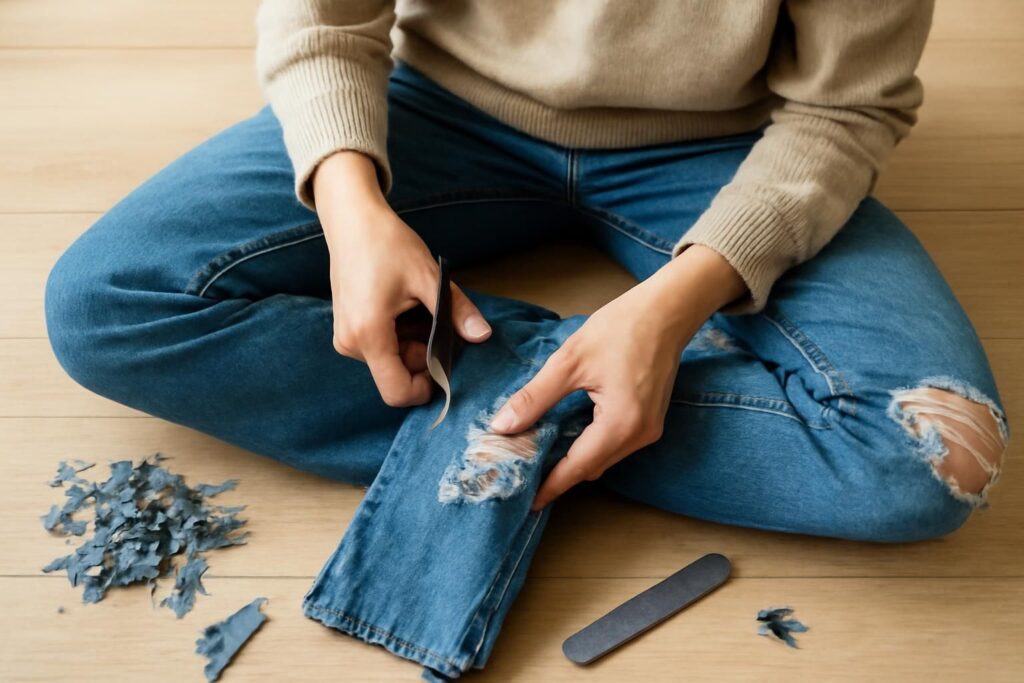
A pair of thrifted jeans and a few household tools are all it takes to create worn-in rips, frayed edges and faded patches. Working slowly, with a board inside the leg, keeps the process safe and the results controllable.
Learning how to distress jeans at home is a fun way to customise a plain pair, rescue jeans with an awkward length, or recreate a vintage look for a fraction of the price. This guide covers the tools, safety steps, and common methods for scuffing, fraying, ripping and hemming denim, plus how to wash the result so it lasts. If you also need to shorten your jeans, start with our guide to How to Hem Jeans and Keep the Original Hem, since a raw frayed hem is one of the easiest ways to distress denim. Every method below is a common DIY technique rather than an official process, so start small; you can always add more wear, but you cannot take it away.
How denim is woven, and why it frays the way it does
It helps to know a little about the fabric. Levi Strauss & Co.’s Denim Dictionary defines warp yarns as “the set of strong, vertical yarns held in tension across a loom”, and weft yarns as “the set of horizontal threads or yarns woven through tightly bound warp yarns.” Distressing works by breaking and pulling apart those yarns. Rips typically leave the horizontal threads behind as a ladder of strands, and scuffing is commonly described as exposing the lighter yarns underneath the darker surface colour. Levi’s notes that natural indigo “was used to dye some of our earliest overalls,” and indigo remains closely associated with blue denim today.
What you need
- A pair of 100% cotton or mostly cotton jeans. Stretchy, high-elastane denim tends to curl and run rather than fray neatly.
- Sharp Fabric Scissors on Amazon and a seam ripper or tweezers for pulling threads.
- A craft knife or razor (optional, for small slits).
- Sandpaper, a pumice stone or a coarse emery board for scuffing. A Pumice Stone on Amazon is a common choice.
- A cutting board, a stiff piece of cardboard, or a Self Healing Cutting Mat on Amazon to slide inside the leg.
- Tailor’s chalk or a washable marker.
Top-selling match on Amazon

- Arts And Crafts Staple: All Purpose Fiskars Scissors for cutting a wide variety of fabric and crafts…
- Precision Art Supplies: High-grade, precision-ground stainless steel blades offer a sharp edge that cuts all…
- Long Lasting And Reliable: A dependable addition to your quilting supplies and scrapbook supplies; Fiskars…
Safety first
The safety steps are the same whatever look you want:
- Put a board or cutting mat inside the leg so you never cut through to the back layer, or into your lap.
- Always cut and scrape away from your body and your other hand.
- Work slowly, a little at a time, with the jeans flat on a table rather than on your legs.
- Never cut or scrape while wearing the jeans.
- Store blades safely and away from children once you finish.
How to distress jeans, step by step
Step 1: Plan and mark
- Put the jeans on and mark where your knees and thighs naturally sit with chalk.
- Take them off and lay them flat.
- Mark small areas for each effect. Placing wear where jeans naturally wear, such as knees, thighs, pocket edges and hems, tends to look more natural.
Step 2: Scuff and fade
- Slide the board inside the leg under your marked area.
- Rub the area with sandpaper or a pumice stone in short strokes.
- Check often; stop when the surface looks softened and lighter.
- Repeat on pocket edges, belt loops and seams for subtle wear.
Step 3: Make a ladder rip
- Keep the board inside the leg.
- Make two or three short horizontal cuts, about an inch or two wide, a little apart from each other.
- Use tweezers or a seam ripper to pick out the vertical threads between the cuts.
- Leave the horizontal threads in place so they form a ladder.
- Rub the edges with sandpaper to soften them.
Step 4: Make a frayed hole
- Scuff the marked area thin with sandpaper or a pumice stone.
- Make one small slit in the thinned area.
- Pull loose threads at the edges to fray them.
- Remember the hole will grow in the wash, so keep it smaller than you want.
Step 5: Fray the hem
- Decide on the final length and mark it with chalk.
- Cut straight across, cutting a little longer than you want; fraying shortens the hem slightly.
- Pull out a few horizontal threads along the cut edge to start the fray.
- Wash the jeans to let the fray develop naturally.
- If you want to stop it fraying further, stitch a straight line just above the fray. See How to Hem Pants for basic stitching.
What not to do
- Do not start with big rips; small cuts expand in the wash.
- Do not cut through both layers; keep the board inside the leg.
- Do not distress right at the seams or crotch, where holes can grow quickly and weaken the jeans.
- Do not distress valuable vintage denim without checking its worth first; our guide on How to Identify Vintage Levi’s covers what to look for.
Washing distressed jeans
Distressed denim needs gentle care to keep rips from growing too fast. Levi’s Help Center recommends washing denim in cold water on a gentle cycle, with garments inside out and zippers closed, then drying inside out in the shade. It notes darker washes “may release excess dye initially”, so wash dark denim with other darks. Levi’s also suggests washing denim after about every 10 wears. Heat can also shrink cotton denim; see How to Prevent Clothes From Shrinking in the Wash for more.
Thrift note: distressing secondhand denim
Thrift stores are an ideal source for distressing projects. Look for rigid, 100% cotton jeans in a mid or dark wash; they show contrast best. Our guide on How to Find Vintage Clothing has sourcing tips. Wash secondhand jeans before you cut, so you work with their true shape. For more DIY projects, see How to Tie Dye a Shirt or How to Dye Clothes at Home (Which Fabrics Take Dye) to change the colour entirely. Matching jackets are covered in Cropped Denim Jacket Distressed.
Shop the look on Amazon
Everything you need to build a secondhand-style wardrobe, delivered. We may earn a commission on purchases.
FAQ
How do I make ripped jeans without them falling apart?
Keep rips small, away from seams and the crotch, and wash gently inside out. Stitching around the edge of a hole from the inside can also stop it spreading.
Can I distress stretch jeans?
You can, but high-stretch denim often curls and runs instead of fraying cleanly. Mostly cotton jeans give the most classic result.
How long does a frayed hem take to develop?
Pulling a few threads gives an immediate start, and each wash adds more fray. Most of the effect develops over the first few washes.
How do you add whiskers to jeans at home?
Whiskers are made by scuffing faint horizontal lines into the fold area at the front hips, where jeans naturally crease when you sit. Put the jeans on and chalk where the creases fall, then lay them flat with a board inside the leg and rub along each mark with sandpaper in short strokes. Keep the lines thin and fanned toward the pocket, and check often, since stopping early looks more natural.
Can you distress jeans with bleach?
Diluted household bleach is a common way to fade or spot denim, but it is harder to control than sandpaper and it also weakens the cotton. Work outdoors or in a well-ventilated space with gloves, protect the back layer with a board, test a hidden area first and rinse thoroughly afterwards. Never mix bleach with ammonia, vinegar or other cleaners, because the combinations release toxic gases.