The short answer is yes, you buy maternity jeans in your pre-pregnancy size. The longer answer is that this sounds counterintuitive enough that it’s the single most-asked question about maternity denim — and the most commonly botched first purchase.
Most maternity brands say the same thing in their own fit guidance: Gap, for example, tells shoppers to choose a maternity size based on their pre-pregnancy size, and Old Navy gives the same advice. The reasoning below explains why, and when the exceptions apply. Sizing up by default is the classic mistake, and it usually ends with a pair that is baggy everywhere except the panel. The pillar hub at Brand Guides has the broader maternity context. Related reads: How to Buy Maternity Jeans covers the whole purchase process, and How to Wear Non Maternity Jeans When Pregnant covers the transition window before you actually need maternity.
Why your pre-baby size is the right maternity size
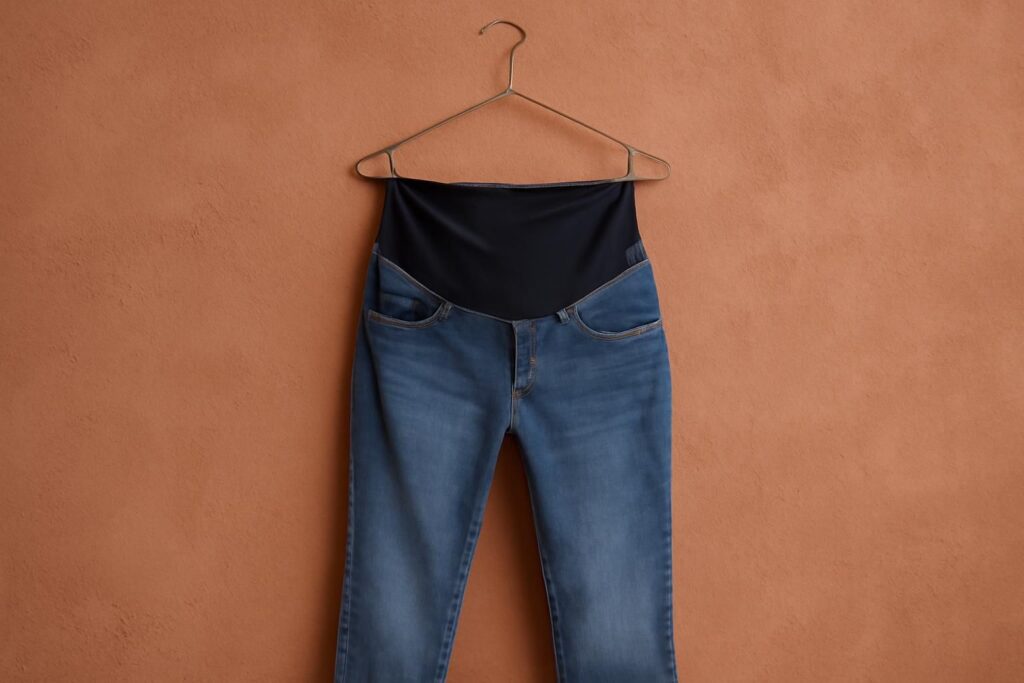
Maternity jeans are constructed so that the numeric size controls the hip, seat, and thigh fit. The belly accommodation lives entirely in the panel — jersey fabric that stretches to fit any belly size from 12-week soft middle to 40-week full term.
Your hips, seat, and thighs don’t grow linearly with your belly. Many people experience some softening and a pound or two of added fat in those areas during pregnancy, but the major volume change is the belly itself. If you size up in maternity to account for belly growth, you end up with a pair that’s loose in the hip and seat — areas that haven’t actually changed much — while the panel stretches to accommodate the belly regardless.
Result of sizing up: a pair that looks baggy through the non-belly areas and loses structure overall.
A sizing example: what happens when you size up
Take a hypothetical: someone who wears a 28 before pregnancy orders a maternity pair in 30, assuming the bump needs the extra room. Around the middle of the second trimester the pair may seem fine, because the hip and seat have room to spare. Later, as the stretch fabric relaxes with wear, the seat and thigh sag noticeably. The panel is doing its job; the rest of the pair is simply too big.
The same person in a 28 would get a pair that fits at hip and seat from the second trimester to the end, with the panel absorbing the belly growth. That is the whole logic of maternity sizing: the number covers the parts of you that change least.
If you have a second pregnancy, start from your current non-pregnant size in the same way, since your size may have shifted since the first.
Exceptions where sizing up makes sense
If you gain significant weight outside the belly — hip, thigh, seat — beyond the pregnancy’s demands. Some people do. Usually a pound or two, sometimes more. If your regular jeans are uncomfortable in the hip and thigh before you even start thinking about a maternity pair, size up one.
If your pre-pregnancy size was on the border between two sizes. A pre-pregnancy 27 that could also wear 28 should go 28 in maternity. The slight extra ease helps as the hip softens without creating excess bagginess.
If you’re wearing a brand that runs small (Paige, for instance, runs slightly smaller than listed). Check fit notes on the specific brand and size up to match your non-maternity fit in that brand.
If the brand specifies “sized up for comfort” or “order your usual size” and there’s ambiguity. Err on the side of your normal size; return if too tight.
Exceptions where sizing down makes sense
Some maternity lines, Ingrid and Isabel among them, can run slightly larger than their size labels suggest. If a pair in your usual size feels loose at the hip and seat early on, try the next size down, or the smaller letter size if you’re on the border between S and M.
Pull-on maternity pairs without a structured waistband sometimes run large because the pull-on construction has extra ease. If the pair feels baggy at the waist without much stretching to fit the body, size down one.
How maternity sizing labels work
Most maternity brands use the same numeric sizing as their non-maternity lines. A Gap maternity 28 corresponds to a Gap regular 28. Paige, Ingrid and Isabel, and A Pea in the Pod largely follow this pattern, though some maternity styles use letter sizes instead.
Some brands use letter sizing (S, M, L, XL). Conversion: XS matches 24 to 25, S matches 26 to 27, M matches 28 to 30, L matches 31 to 32, XL matches 33 to 34. Approximations — verify with brand size charts.
H&M Mama is sized on H&M’s own chart, in letter sizes in the US, so compare your hip and waist measurements to that chart rather than assuming it matches another brand’s number.
The belly-size confusion
A common confusion: “I’m at a 40-inch belly circumference, surely I need a bigger pair.” Belly circumference doesn’t map to pants size in maternity. The panel is designed to stretch from roughly 32 inches to 48 inches depending on brand. Your numeric size is about everything else.
Picture the panel as elastic fabric that covers the belly area. Picture the rest of the pair as regular jeans. Your hip and seat are the non-pregnancy jeans part; the belly is handled separately.
When you don’t know your pre-pregnancy size
Some people realize they’re pregnant early enough that they haven’t bought jeans in a while, or their regular size changed recently. Measure hip circumference at the widest point (standing, measuring tape parallel to floor) and match to the brand’s size chart.
For maternity specifically, hip measurement is the most reliable reference because the hip doesn’t change much during pregnancy. Waist measurement is less useful because the waist is where pregnancy hits first.
If between sizes, go up. Slight extra ease is easier to live with in maternity than slight tightness.
Postpartum sizing
For the first four to six weeks postpartum, your maternity size continues to fit. The panel compresses a still-soft belly without digging in.
Past six weeks, most people transition back toward pre-pregnancy size in regular (non-maternity) denim. Some people return to exact pre-pregnancy size; others stay a size or two up for months. There’s no correct timeline.
Maternity pairs don’t work past the six-week postpartum window because the panel is loose without a belly to fill it. They look inside-out loose.
Brand-specific sizing notes
Liverpool Los Angeles: sizes its regular jeans in standard numeric sizes. It does not currently offer a dedicated maternity line, so its pull-on styles are an early-pregnancy option in your usual size.
Gap Maternity: Gap advises choosing your maternity size from your pre-pregnancy size, and the fit follows its non-maternity sizing.
A Pea in the Pod: follows stated size, but if you’re between sizes, the larger one is usually more comfortable through the hip.
Ingrid and Isabel: can run slightly larger. If you’re between sizes, try the smaller one.
H&M Mama: uses H&M’s own chart. Measure and compare rather than relying on your usual number.
Old Navy Maternity: Old Navy advises ordering your pre-pregnancy size and sizing up if you’re between sizes.
Where to shop with confident sizing
For a non-maternity pull-on to wear early in pregnancy (Liverpool has no maternity line), check fit details on Liverpool’s own site or at Nordstrom: Maternity Jeans on Amazon. For mid-tier: Shop at Gap. For budget starter pair where sizing matters less because pairs are cheaper: Maternity Jeans on Amazon. For resale: Maternity Jeans on Poshmark.
The verdict
Do you buy maternity jeans in your normal size? Yes, almost always. The panel handles belly growth; the numeric size controls hip, seat, and thigh fit. Pre-pregnancy size is the right maternity size for 90 percent of bodies. Exceptions are specific brand quirks (Ingrid and Isabel can run large; H&M Mama uses its own chart) and individual bodies that gain beyond belly. If you size up without reason, you’ll end up with a pair that’s baggy through the non-belly areas. If you size down, you’ll have hip and thigh discomfort that doesn’t resolve. Start with your pre-baby size, return if it doesn’t fit, and trust the panel to handle the belly. The Gap Maternity category is a good starting point for testing sizing because Gap runs so true to its non-maternity fit.
Shop the look on Amazon
Everything you need to build a secondhand-style wardrobe, delivered. We may earn a commission on purchases.
FAQ
Do you buy maternity jeans in your normal size?
Yes. Your pre-pregnancy size is the correct maternity size for most brands. The panel handles belly growth separately from numeric sizing.
What if I’m between sizes pre-pregnancy?
Size up one in maternity. The slight extra ease accommodates hip softening better than tight fit.
Should I size up if my belly is large?
No. The panel stretches to fit any belly size from first trimester to full term. Sizing up creates a baggy hip and seat.
What brands run differently than expected in maternity?
Ingrid and Isabel can run large (size down one if between sizes). H&M Mama uses H&M’s own size chart, so measure and compare. A Pea in the Pod can feel slightly snug at the hip if you’re between sizes. Most other brands match non-maternity sizing.