Under-belly panels are the quietest category in maternity denim, which is strange because they’re the style many people end up wearing most by month five. Full panels get all the marketing. Under-belly cuts get the actual wear.
Many pregnant shoppers end up wearing under-belly styles most days in the second trimester, because the low-rise elastic band sits below the bump instead of covering it. That means no hot mid-section and no full panel rolling down from the ribcage every ten minutes. This guide covers how the cut works, how it tends to fit month by month, the main brands to compare, and where to find good deals, new and secondhand. The pillar hub at Brand Guides is the broader reference if you want the full maternity-denim framework; this one stays focused on the under-belly cut.
What maternity jeans under belly actually means
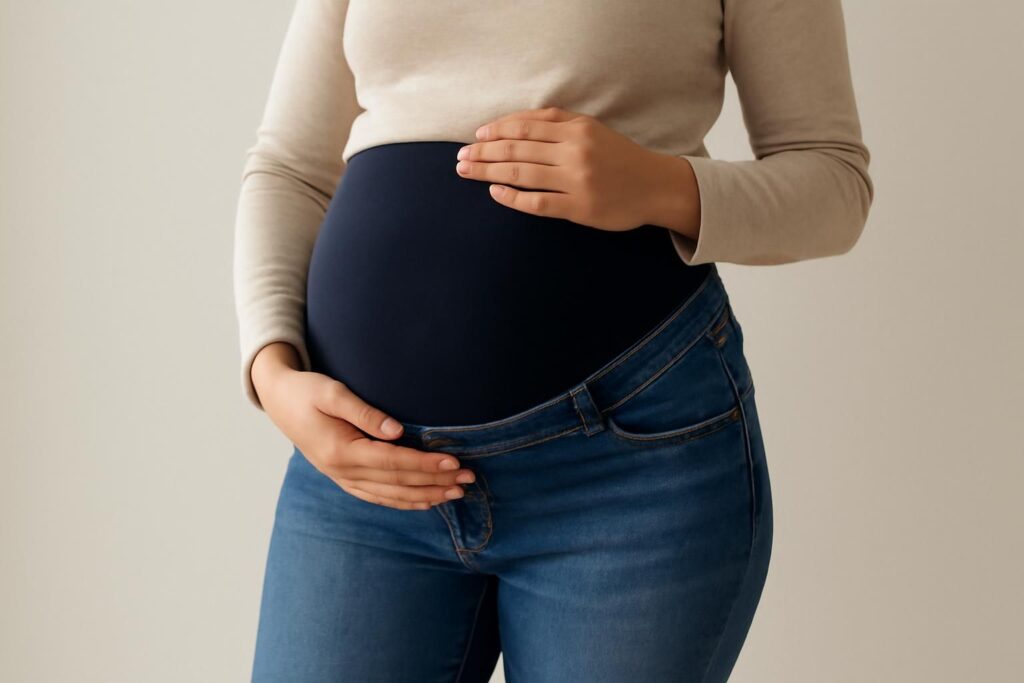
An under-belly maternity jean replaces the rigid front waistband with a 2 to 3 inch stretch elastic band that sits below the bump. No full panel across the belly, no side panels, no secret-fit. Just a flat elastic band at the low-rise point, fastened at the back with either a traditional button and zip or a stretch-only closure.
The appeal is specific. By the middle of the second trimester, many people are tired of full-panel jeans rolling down from the ribcage. A good under-belly band sits flush against the lower abdomen, doesn’t migrate during the day, and leaves the upper bump completely uncovered. For spring and summer pregnancies, that temperature difference is real.
The trade-off is support. A full-panel pair holds the bump weight more effectively in the third trimester; an under-belly pair does not. Month three and month seven wear very differently in an under-belly cut, as the timeline below shows.
Month by month: how under-belly maternity jeans fit through pregnancy
Month 3 to 4: under-belly is often all you need
From roughly week 10 to week 16 under-belly pairs are often all you need. The bump isn’t yet round enough to need panel support, and regular jeans typically start to feel tight at the button while still fitting fine at the hip. That is exactly the gap an under-belly jean fills: the elastic sits where the rigid waistband used to sit, so most people can stay in their usual pre-pregnancy size. Check each brand’s maternity size chart to confirm.
If you’re reading this in the first trimester, an under-belly pair is almost always the first maternity purchase worth making. Secret-fit panels and side-panel hybrids matter more later; the under-belly buys you time through month four without the commitment to a full panel you don’t yet need.
Month 5 to 6: under-belly becomes a daily rotation piece
Somewhere between weeks 20 and 24 many people switch to full-panel pairs for long days while keeping under-belly styles in heavy rotation for shorter wear. A well-made band holds below the bump without digging in. Where it sits depends on torso length, but on most frames the band lands a couple of inches below the navel, which keeps it clear of the bump’s widest point.
Elastic quality matters more than the brand name. A very cheap under-belly pair with a thin, loosely woven band is prone to rolling down during the day, while a wider band with elastane woven in and a dense weave is far more likely to hold all day. When shopping online, look at the band width and fabric content in the listing, and zoom in on product photos of the band itself.
Month 7 to 9: under-belly becomes occasional, full panel dominates
Third trimester, the physics shifts. The bump gets heavier and the elastic band alone usually cannot support that weight through a long day without sliding down. By month 8 many people move to full-panel pairs for anything longer than a few hours and keep under-belly styles for short errands, weekend wear, or around the house. Month 9 is often almost entirely full-panel.
That said, under-belly pairs with a wider elastic band (3 to 4 inches) tend to hold better late-term than narrow-band versions. Searching specifically for the wider-band style, such as Under Belly Maternity Jeans Wide Band on Amazon, narrows the options quickly.
Brand-by-brand: under-belly pairs to compare
Old Navy Front-Low Panel Rockstar
Old Navy’s front-low panel Rockstar Super Skinny is where under-belly maternity lives at a mass-market price. Old Navy has listed it at $45.99, and the brand runs frequent sales, so it is worth waiting for a promotion. Check the listing for current size and length options (Old Navy maternity styles are often offered in short, regular, and long lengths) and the fabric content, which tells you how much stretch to expect.
The likely negative at this price: softer, stretchier budget denim tends to pill at the inner thigh and wear first in high-friction spots. For the price, it’s still a reasonable buy; just don’t expect a single pair to last through several pregnancies.
Gap Maternity Under the Belly styles
Gap’s under-belly maternity styles are the upgrade pick. Gap groups them in an “Under the Belly” maternity jeans category; the Maternity Inset Panel Vintage Slim Jeans, for example, list at $79.95. Gap runs frequent sitewide promotions, so sale prices are often far lower than list. Gap’s denim is generally more structured than Old Navy’s, and a firmer band is what keeps an under-belly jean from sagging later in pregnancy.
Check the inseam options on the product page, and choose the length based on the shoes you wear most: a shorter length for sneakers, a longer one if you want the hem to break cleanly over boots. Note that Gap says maternity styles can’t be returned in store, though returns by mail are available, so measure before ordering. Lateral read: Maternity Jeans Low Rise covers the rise math more specifically.
Motherhood Maternity Secret Fit Belly (low panel variant)
Motherhood Maternity’s Secret Fit Belly line is one of the most widely available maternity denim options, and its low-panel versions are among the cheaper choices, especially on sale. Expect a thinner band and lighter cotton than Gap’s more structured denim. Motherhood uses its own maternity sizing, so check the size chart against your current measurements rather than assuming your usual jeans size. For a rotation pair at the price, it’s a reasonable choice; for a daily driver, a firmer, more structured pair is the safer bet.
Isabel Maternity by Ingrid & Isabel Crossover Panel at Target (honorable mention)
Isabel Maternity by Ingrid & Isabel, sold at Target, mostly does crossover panels, which aren’t strictly under-belly, but a crossover band can be folded down to sit under the bump at a similar height. Target has listed its crossover panel skinny jeans at $29.99. A wide crossover band is less likely to roll than a narrow elastic strip, which makes this a useful option if you want under-belly-style wear with more late-term support.
Poshmark secondhand under-belly pairs
Secondhand is where the real deals are. The economics work: maternity denim typically gets worn for only a few months per pregnancy, so secondhand pairs often have most of their life left. A saved search such as Gap Maternity Under Belly on Poshmark surfaces Gap pairs well below retail, and thredUP is worth checking too. One caveat: check the elastic band specifically for stretch-out before buying. If the seller photographed the band and it looks slack or rippled, skip it, and ask for a photo of the band if there isn’t one.
Fabric and stretch retention over time
A useful measure of a maternity jean’s value is how the fabric holds up through repeated washing. Under-belly pairs see a specific wear pattern: the elastic band takes the bulk of the flex and compression, and cheaper blends show fatigue there first.
What to look for when judging durability, whether new or secondhand:
- The elastic band: it should snap back when stretched; slack, rippled, or wavy elastic is the first sign a pair is worn out
- Inner thigh and knees: pilling and thinning show up here first on softer, stretchier budget denim
- Fading: even fading is normal; patchy, uneven fading usually points to a lower-quality dye or fabric
- Band construction: wider bands and crossover panels generally hold their shape longer than narrow elastic strips
The general pattern: mid-price pairs with firmer bands and more structured denim are more likely to last into a second pregnancy, while budget pairs may only last one. Cost per wear favors the mid-price tier if you’re planning a second pregnancy. For one and done, the budget pairs still make sense.
Under-belly fit by body shape
Hip-to-waist ratio matters in under-belly maternity the same way it matters in regular jeans, maybe more. The elastic band has to sit flush against a curved surface; a standard 7 inch hip-to-waist cut gaps at the back of the band on curvier builds, exactly the way non-maternity jeans gap.
For curvier bodies, look for under-belly styles cut with more room at the hip, and check the back of the band in a side-view photo or try-on: if it gaps when you sit, the cut is too straight for your hip-to-waist ratio. Brand-to-brand differences matter more here than size. For more hip-generous builds, see Maternity Jeans for Plus Size Women and Maternity Jeans for Curvy Women.
For petite frames, the 2.5 to 3 inch band can look proportionally wide on shorter torsos. Maternity Jeans for Petite Women covers that specifically.
Under-belly vs. full panel vs. side panel
The panel-type question is worth settling once. Here is how the four main panel types compare:
- Under-belly: most comfortable months 3 to 6, cooler, easier to layer under non-maternity tops. Less support late-term.
- Full panel: best support months 7 to 9, warmer, rolls down under lightweight tops. Best daily driver in third trimester.
- Side panel: hybrid — rigid front, stretch side inserts. Decent support without the hot belly issue. Mid-range in every dimension.
- Secret fit (hidden panel): best for transitional pregnancies where you want non-maternity appearance. Weakest support of the four.
Full panel: see Maternity Jeans with Side Panel for the side panel variant and Maternity Jeans Without Belly Band for pairs that skip panels entirely. The under-belly sits between no-panel and full-panel in support level.
Styling under-belly maternity jeans
The styling rule with under-belly pairs is simple: because the band sits below the bump, tops that drape or wrap naturally look cleaner than shorter fitted tops that might ride up and expose the elastic. Longer-length tees, tunic-length knits, and anything with a ruched side sits better than a cropped style.
Outfit formulas that work:
- Longer-length ribbed tee, under-belly skinny, white sneakers — weekend default
- Drapey button-down tied at the waist, under-belly bootcut, pointed flats — work-lunch
- Cotton ribbed tank under an open cardigan, under-belly straight, loafers — office
- Oversized flannel, under-belly wide leg, ankle boots — fall weekend
For outfit-specific guidance see Maternity Jeans Outfit.
Postpartum wearability
A feature that is easy to overlook: under-belly pairs often stay wearable for weeks postpartum, because the elastic band accommodates a lower abdomen that doesn’t snap back to its pre-pregnancy size right away. Rigid-waisted pre-pregnancy jeans are often uncomfortable in the first weeks after birth, while an under-belly maternity pair can bridge that gap.
How long that lasts varies a lot from person to person, but for many it means another month or two of wear on the same pair, which is worth factoring into the cost per wear calculation.
Shop our picks: Ingrid & Isabel Full-Panel Maternity Skinny Jean, Ingrid & Isabel Maternity Bootcut Jean with Full Belly Panel, Madewell Maternity Over-the-Belly Perfect Vintage Jean.
The verdict
Maternity jeans under belly are the most comfortable everyday option for many people, especially in months 3 to 6 and again postpartum. Gap’s under-belly styles are the best balance of quality and price, particularly on sale. Old Navy’s front-low panel Rockstar is the budget pick for a single pregnancy. Isabel Maternity’s crossover panel at Target is the pick for more late-term support. Skip the cheapest Amazon pairs unless the listing specs a wide elastic band and at least 2 percent spandex in the blend, and check secondhand for the best deals.
Shop the look on Amazon
Everything you need to build a secondhand-style wardrobe, delivered. We may earn a commission on purchases.
Browse picks on Amazon →FAQ
Are maternity jeans under belly comfortable in the third trimester?
Comfort tapers off around month 7 for most builds. The elastic band alone cannot support a third-trimester bump through a long day without sliding down. Under-belly works for short wear and casual contexts late-term, but full panel is usually the better daily driver by month 8.
Do I size up for under-belly maternity jeans?
Usually not. Most people can buy their pre-pregnancy size. The elastic band accommodates waist growth up to about 4 to 6 inches; the hip and thigh measurements stay close to your pre-pregnancy measurements through most of pregnancy. Check the brand’s maternity size chart, since some maternity lines use their own sizing.
What’s the difference between under-belly and low-rise maternity?
Low-rise describes how far below the natural waist the jean sits. Under-belly describes the panel type (stretch elastic band replacing a rigid waistband). Most under-belly jeans are also low-rise by default, but the terms aren’t identical. Maternity Jeans Low Rise has the fuller breakdown.
Can I wear under-belly maternity jeans postpartum?
Yes. Most builds can wear under-belly maternity for 6 to 10 weeks postpartum because the elastic band accommodates the healing lower abdomen. After week 10, most wearers transition back to regular rigid-waisted jeans.
Where can I buy cheap under-belly maternity jeans?
Old Navy’s front-low panel Rockstar on sale is one of the cheapest mainstream options, and Isabel Maternity at Target lists crossover panel jeans at $29.99. Secondhand Gap Maternity on Poshmark often sells well below retail. Amazon has budget pairs too, but quality varies, so look for listings that spec a 3 inch elastic band and at least 2 percent spandex.
How do you stop under-belly maternity jeans from sliding down?
Under-belly maternity jeans stay up best when the band is wide, firm and correctly sized. Look for a band of 3 to 4 inches with elastane woven in and a dense weave, since thin, loosely woven bands are the most prone to rolling during the day. Buy your pre-pregnancy size so the band grips without digging, and by month 8 switch to a full-panel pair for long days, because the bump’s weight eventually pulls any low band down.
Related reading: Best Jeans Under $50.