
Vintage Levi 501 Jeans Mens: The Practical Buyer’s Guide
Top Vintage Levi 501 Jeans Mens picks on Amazon
As an Amazon Associate we earn from qualifying purchases. Prices and availability are accurate as of November 2026 and may change. Specs are as stated in each Amazon listing.
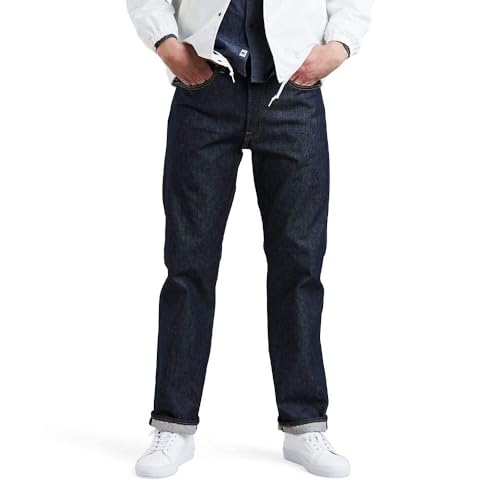
- Front Rise: 11 1/4",Knee: 17 1/2",Leg opening: 16",Measurements based on size 32

- Front Rise: 11 1/4", Knee: 17 1/2", Leg Opening: 16", Measurements based on size 32.

- Regular Through The Thigh
- Sits at your waist
Most “vintage 501 mens” advice focuses on which decade is “best.” The more useful question is which decade is best for your body and your price tolerance.
Vintage Levi 501 jeans mens is the most-searched vintage denim category for good reason — it’s the largest inventory in the most sizes. But the category spans 30+ years of production across multiple countries, and the wrong decade in the right price range can leave you with jeans that don’t fit the way you hoped. This piece breaks down the practical buying decisions: which decade, what size, what condition, and how much to spend. Builds on Vintage Levi’s 501 Men’s and Levi’s 501 Vintage Jeans; broader sourcing at Brand Guides.
The practical question is decade, not era
“Vintage” covers a wide range. For men’s 501s, the four decades you’ll encounter have meaningfully different fits:
1960s: rare, collector territory, often $300+. Big E red tab, single-stitch arcuate, hidden rivets. If you’re new to vintage 501s, skip this decade for now.
1970s: shrink-to-fit era. Heavy 14+ oz denim, highest rise, most generous thigh. Sizing is unpredictable because every pair was shrunk differently. $120–$400 depending on condition and big E status.
1980s: transition era from STF to pre-shrunk. Rise dropped slightly, thigh trimmed marginally, denim weight held. Consistent cut, reasonably predictable sizing. $60–$130 for common sizes.
1990s: pre-shrunk, made-in-USA, most predictable sizing. Slightly slimmer than 80s but still more generous than modern. $45–$90 for common sizes.
Sizing without trying on
Four measurements matter: waist flat across, front rise, inseam, and leg opening. Get these from a pair of jeans you already own and love — call this your “target.” Match the listing’s measurements to your target, not to your tag size.
A common mistake: buying based on the tag size of your current jeans. Modern “32 waist” isn’t vintage “32 waist.” Modern waist sizing has drifted larger over the decades (vanity sizing), so a modern 32 often measures closer to 33.5. A vintage 32 measures 32. If you wear a modern 32, you may want a vintage 31 or even 30 depending on brand and era.
For inseam, vintage pairs were often cut to 34″ or 36″ and shrunk or hemmed to the final length. Listed inseams reflect the current length, not the original. Match your target inseam exactly.
Condition tiers and what they mean for price
Deadstock / NOS (new old stock, never worn): pristine, often still has original tags. Rare, expensive, but no break-in required. Prices: $150–$400 depending on decade.
Excellent: lightly worn, minimal fade, no visible damage. Great condition for first vintage purchase. $80–$150.
Good / wearable: typical wear, normal fade, no active damage. The largest inventory category. $45–$90.
Fair: visible damage (small holes, thinning, repairs). Can be a good value if the damage is in forgiving places (knees rather than crotch). $25–$50.
Damaged beyond wear: crotch blown, major thinning, broken zipper. Only worth buying if you want them for a project or parts. Under $25.
What to inspect in photos
Crotch: the single most important area. Ask for a photo if the listing doesn’t include one.
Seat: thinning in the seat is typical on older pairs but active holes are a sign the pair is near end-of-life.
Knees: minor whiskers or creases are fine; visible blowouts need evaluation.
Inseam: check for fraying or splits, especially near the crotch.
Hardware: rivets should be intact, buttons shouldn’t be loose or missing.
Interior waistband: stamped lot/size info confirms era.
Care tag: country of origin confirms made-in-USA status (important for pricing).
Where to buy based on what matters to you
If you want the lowest price and you’re willing to hunt: thrift stores, estate sales, and shopgoodwill.com. Variable inventory and condition; highest reward for patience.
If you want predictable quality with some selection: Poshmark and eBay. Filter by size, decade, and seller rating. This is where most buyers will find the best balance of selection and price. Vintage Levis 501 Mens on Poshmark is a good saved search to check weekly, since new listings appear constantly.
If you want curated quality and don’t mind paying: specialty vintage stores online or in-person. 30–50% markup over Poshmark equivalents, but the vetting is done for you.
If you want to avoid hunting entirely: Levi’s Vintage Clothing line (LVC). These are reissues, not authentic vintage, but they’re made to historical specs. New pairs start around $250. Not vintage, but a close substitute. Levis 501 Vintage on Amazon also carries a mix of LVC and reissue options.
The hidden costs
Shipping: 3–8 oz denim shipped insured typically costs $10–15. Factor in.
Tailoring: hem adjustment $15–25; waist taken in $25–45; crotch reinforcement $40–60. A pair that fits “almost right” can become “exactly right” for a small tailoring investment.
Washing supplies: vintage denim does better with gentle detergent (Woolite or similar) and optionally indigo-setting additives for the first wash. $10–15 one-time.
Expectation: a “$65 vintage pair” often becomes a $95 vintage pair once you add shipping, a minor hem, and care products. Budget accordingly.
The downside
Vintage 501s are more variable than you’d expect for the same “brand and cut.” Every pair has lived a different life. Two pairs from 1987 can have a meaningful difference in break-in, fade, and structural integrity. This is the charm of vintage but it’s also the risk. If you want 100% predictable every time, buy new. If you want character and slight variation, accept that not every pair will be a home run.
The verdict
For a first pair: 1990s made-in-USA 501 in your measured waist, condition “good” or “excellent,” budget $60–$90. Use Poshmark and filter aggressively. Inspect the crotch and care tag photos before offering. Second pair: 1980s 501 to experience the slightly higher rise and heavier denim. Third pair (if you’re still into it): 1970s shrink-to-fit if you want the period silhouette. See Vintage Levi Jeans 501 and Vintage Levi’s 501 for more specific fit notes.
Shop the look on Amazon
Everything you need to build a secondhand-style wardrobe, delivered. We may earn a commission on purchases.
FAQ
What’s the easiest vintage Levi’s 501 mens to start with?
1990s made-in-USA pre-shrunk pairs. Sizing is predictable, inventory is deep, and prices are accessible.
Is it worth paying more for 1970s big E 501s?
Only if you want collector territory and the specific 1970s silhouette. For wearability, 80s and 90s pairs are equal or better.
How long do vintage 501 jeans last once you buy them?
A well-maintained pair can last 5–10+ years of rotation. Expect minor tailor work (crotch reinforcement, hem adjustment) over that lifespan.
Can I return vintage Levi’s 501 if they don’t fit?
Depends on platform. Poshmark allows case-by-case returns for misrepresented items; eBay has structured buyer protection; estate sales and thrift stores are generally final sale. Check before you buy.
Do vintage Levi’s 501 jeans shrink when you wash them?
Vintage Levi’s 501s from the 1990s are pre-shrunk, as are many from the 1980s, so a cold wash and hang dry cause little further shrinkage. The 1970s shrink-to-fit pairs were made to shrink, and most have already been shrunk by previous owners, which is why their sizing is unpredictable. Wash any vintage pair cold with a gentle detergent, skip the dryer, and buy from flat measurements rather than the tag size.