Vintage designer jeans can be some of the best-value denim you’ll ever buy, often for $40–$80. They can also be the worst purchase you make: pairs that photograph beautifully and fit wrong the moment you put them on.
Vintage designer jeans sit in a category where the upside is real (pre-2015 construction quality was often better than current, at lower prices on resale) and the downside is also real (fit unpredictability, potential damage, authentication risk). A simple, measurement-based process avoids most of the common mistakes. This guide sits in our Brand Guides pillar, and our Designer Jeans Brands overview covers the broader category.
What “vintage” actually means in denim
Top Vintage Designer Jeans picks on Amazon
As an Amazon Associate we earn from qualifying purchases. Prices and availability are accurate as of November 2026 and may change. Specs are as stated in each Amazon listing.

- SLIM FIT. This slim fit straight leg jean is designed with fashion-forward style. Built with a…
- RETRO STYLING. Designed with Retro style in mind, this slim straight jean provides a vintage…

- These Straight Six Freedom Flex Men’s Vintage Sanded Jeans feature a very light, washed-out…
- This pale vintage sanded finish creates a clean, sun-faded look that’s perfect for…
The term gets applied loosely. In the denim market, roughly:
True vintage: 20+ years old. Pre-2005. For designer jeans this primarily means early Seven For All Mankind, early Citizens of Humanity, early Paige, and late-era True Religion (which has a specific vintage collector market).
Modern vintage: 10–20 years old. 2005–2015. The pre-acquisition era for many premium denim brands, often considered the quality peak for brands like 7FAM and J Brand by collectors.
Near-new secondhand: Less than 10 years old. Not technically vintage but often sold under the label. Most Poshmark inventory falls here.
The real value is usually in modern vintage — the 2005–2015 range, when premium denim was hitting its stride and before several brand acquisitions changed construction standards. This is where you can find construction quality that matches or exceeds current production at 40–60% lower prices.
Why pre-2015 designer denim is often better
A specific pattern: several major premium denim brands changed ownership in the 2000s and 2010s. 7 For All Mankind went from its founders to VF Corporation in 2007 and to Delta Galil in 2016; J Brand was bought by Fast Retailing (Uniqlo’s parent) in 2012 and later moved to direct-to-consumer; Joe’s Jeans merged with Hudson; Rag & Bone changed hands in 2024. Not every brand declined after a sale. But “pre-acquisition” has become a signal for quality among denim collectors.
Concretely: collectors often describe early-2010s Citizens of Humanity pairs, such as the Racer, as sturdier than recent production, pointing to fabric weight and stitching. Compare fabric weight and stitch density yourself where you can, rather than relying on nostalgia.
This doesn’t apply universally. Current AGOLDE construction is as good as any era. Current Frame is fine. Current Mother is fine. But for 7 For All Mankind, J Brand, and earlier Citizens specifically, vintage is often a meaningful upgrade at lower cost.
Where to find vintage designer jeans
Four reliable sources.
Poshmark. The widest inventory of modern-vintage premium denim. Filter by brand and size, then sort by “price low to high” to find the bargains. Read seller descriptions carefully — signs of wear should be photographed, not vaguely described. Check Vintage Designer Jeans 28 on Poshmark for current listings.
eBay. Better than Poshmark for true vintage (pre-2005) and for specific collector cuts (vintage 7FAM A Pocket, early J Brand cuts, archival True Religion). Auction format can land below buy-it-now pricing. Authentication is limited; use for lower-risk buys until you trust a seller.
Depop. Younger user base, more style-driven listings. Good for specific vintage pieces being sold as part of a curated profile. Pricing is often higher than eBay but photographs are often better, which reduces fit risk.
Local vintage/consignment shops. The best path if you’re lucky enough to live near one. Being able to try on before committing solves the biggest problem with vintage denim buying (fit unpredictability). Buffalo Exchange and Crossroads Trading are multi-city chains that carry regular designer denim inventory, and New York’s Beacon’s Closet is another strong source.
How to evaluate vintage designer jeans before buying
Six checks to run before committing to a vintage pair.
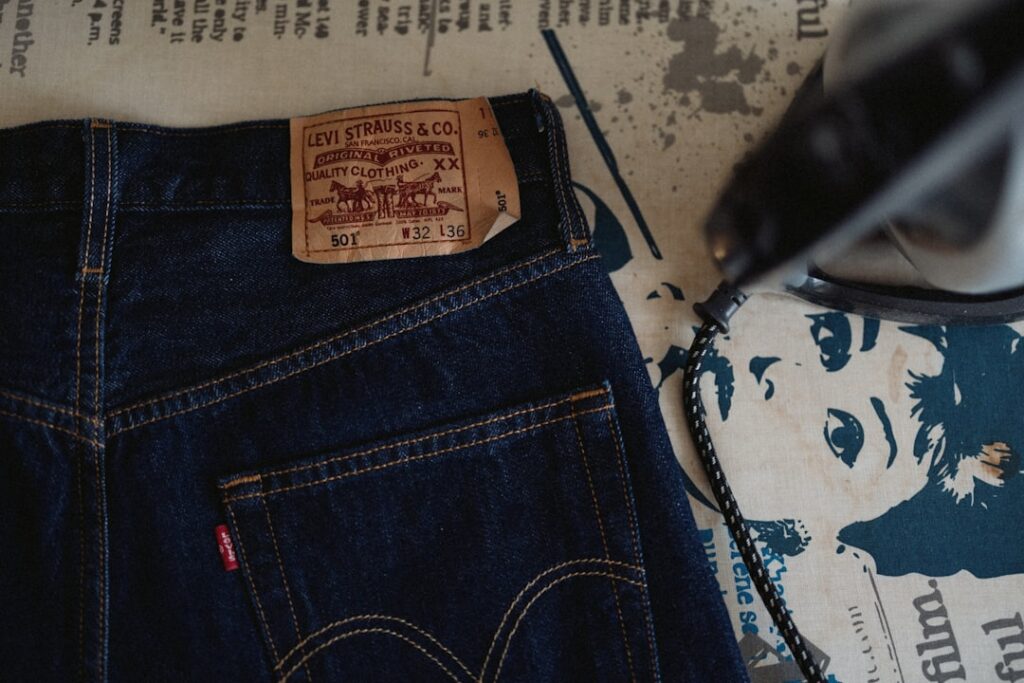
Check the tag. Authentic tags from 2005–2015 look different from current tags. Learn the specific tag variations for the brand, since labels change over the years. If you can’t find clear reference photos of period-correct tags, ask the seller for high-res photos.
Check the inseam and waistband measurements. Vintage sizing differs from current. Old “size 28” may fit modern “size 30” or vice versa. Get laid-flat measurements: waist, front rise, inseam, leg opening. Compare to a current pair you know fits.
Check the crotch and seat for wear. The crotch is the first place vintage jeans fail. Photos often hide crotch wear. Ask for interior photos. Any visible thinning or pinholes means the jean will blow out at that seam within months.
Check the knees. Knee bagging is visible in laid-flat photos — look for a raised or distorted area at the knee. Vintage denim with recovery issues will not recover with wear; that shape is permanent.
Check the rivets and buttons. Signs of rust around the hardware indicate extensive moisture exposure. Severely loose rivets suggest the jean has been stressed beyond its design intent.
Check for odor in the listing description. Honest resellers disclose mildew or smoke smells. If the listing doesn’t mention odor and the pair looks well-used, ask. Permanent musty smells don’t wash out reliably.
Authentication: how not to buy a fake
Fake premium denim exists, especially for specific collector cuts. The most commonly counterfeited brands in vintage markets: True Religion (heavy counterfeiting), vintage 7 For All Mankind (mid-level), vintage J Brand (lower volume).
Authentication signals: tag consistency (period-correct fonts, embroidery quality, tag placement), stitching quality (counterfeit stitching is usually looser), hardware (brand-embossed buttons should have sharp, consistent embossing), and pocket lining fabric (authentic pocket lining is higher-quality fabric than counterfeit).
For higher-value vintage ($200+), use The RealReal, which authenticates before listing. For under $200, learn the brand-specific signals or buy from sellers with extensive positive feedback. Counterfeit risk is lower on Poshmark for premium denim than on eBay for luxury denim.
Fit unpredictability and how to manage it
The single biggest risk in vintage designer denim: sizing has drifted, and vintage pairs fit differently from current pairs even in the same labeled size.
Three mitigation strategies.
Buy from sellers with generous photo policies and measurement listings. Any pair without laid-flat measurements is a gamble.
Use a known-good current pair as your reference. Measure its laid-flat waist, hip, front rise, thigh at the seam, and inseam. The vintage pair you’re considering should match within a quarter-inch on waist, a half-inch on hip, and within an inch on inseam (inseam being more flexible with hemming).
Accept that some vintage buys won’t work out. Budget for resale when this happens: say you bought a pair for $65 and it doesn’t fit, reselling for $45 is a $20 loss, not a $65 loss. Over a year of vintage buying, the wins more than compensate for the misses.
Vintage designer jeans that are worth hunting for
Specific pairs worth hunting:
Pre-2016 7 For All Mankind Roxanne in any dark wash. The pre-acquisition Roxanne is a cleaner skinny cut than current production, with heavier fabric.
2010–2014 Citizens of Humanity Racer. A low-rise skinny that’s coming back into style. Original CoH construction holds up beautifully.
Late-90s to early-2000s 7 For All Mankind A Pocket flares. Genuinely collector territory now, but the construction is excellent and the fabric has vintage patina you can’t fake.
2012–2015 J Brand before the recovery issues started. Maria skinny in dark washes, specifically.
Pre-2015 Paige Hoxton in non-stretch. Paige’s pattern stayed mostly consistent but the fabric quality has shifted slightly.
Skip: anything labeled “True Religion” where the embroidery looks off, anything over 10 years old in heavy stretch blends (the elastane has degraded), and anything with crotch or knee photos the seller won’t provide.
Current resale listings: Vintage Designer Denim on Poshmark. For authenticated higher-end pieces: Shop at The RealReal. Amazon is not a meaningful vintage denim source — skip for this category.
Related reading: Designer Jeans with M on Pocket
Shop our picks: 7 For All Mankind Women’s Jo High Rise Wide Leg Jean, 7 For All Mankind Women’s Slim Kick Flare Jean, 7 For All Mankind Women’s Dojo Trouser Jean.
The verdict
Vintage designer jeans are worth hunting if you’re willing to accept some fit misses, use measurement-based buying, and focus on modern vintage (2005–2015) from brands whose construction quality has drifted post-acquisition. A pre-2016 7 For All Mankind or a 2012 Citizens of Humanity at $60–$90 often outperforms a current pair at $220 on fabric, stitch quality, and longevity. Skip anything without laid-flat measurements, anything with suspicious tag photos, and anything with unexplained condition gaps in the listing. Budget for a small loss on pairs that don’t fit: resell, recover most of your money, and keep hunting. Bought carefully, vintage can be one of the best dollar-for-dollar denim sources. Our Designer Jeans on Sale piece covers complementary sale strategies for new designer denim.
FAQ
Are vintage designer jeans better than new ones?
Sometimes, depending on the brand. Pre-acquisition 7 For All Mankind, early 2010s Citizens of Humanity, and mid-2010s J Brand often have better construction than current production. Current AGOLDE and Frame production is comparable to their own vintage.
How do I know if vintage designer jeans are authentic?
Check the tag for period-correct details, the stitching density (authentic stitching is tight and consistent), the hardware (brand-embossed buttons and rivets should be sharp), and the pocket lining (authentic lining is higher-quality fabric). For high-value pieces, use The RealReal or a professional authentication service.
Where’s the best place to buy vintage designer jeans?
Poshmark has the widest selection in the 10–15 year vintage range. eBay is better for true vintage (pre-2005). Depop has curated listings. Local vintage shops let you try on before buying, which solves the biggest fit-risk problem.
Do vintage designer jeans hold up to regular wear?
If they’re in good condition when you buy them, yes. Denim from the 2010–2015 era was often made with heavier fabric and higher stitch density than current production. A well-cared-for vintage pair can last another decade.
How much should I pay for vintage designer jeans?
40–60% off current retail for equivalent-condition modern vintage (2010–2015 era). True vintage (pre-2005) in collectible cuts commands premium prices — some pre-2005 7FAM A Pocket flares sell above current 7FAM retail.
How should you wash vintage designer jeans after buying them?
Wash secondhand vintage designer jeans cold, inside out, on a gentle cycle, then air dry them before the first wear. Cold water and no dryer protect older cotton and any aging stretch fibers, and air drying avoids stressing seams at the crotch and knees, which are the first places vintage pairs fail. Mild odors usually lift with a wash and airing out, but a strong musty smell often does not wash out reliably.