Collar, cloth and cut are the three things that separate one shirt from another, and once you can read them, every rail in a thrift store gets easier to scan.
This glossary covers the main types of shirts you will meet in shops, closets and secondhand racks, from crisp dress shirts to soft flannels and knit polos. Each entry explains what the style is, how to recognise it on the hanger and how it is usually worn. Where a name has a documented origin, we cite the source. Where it does not, we say the term is common usage rather than invent a backstory. If you are shopping for office or formal shirts specifically, our Mens Dress Shirts hub goes deeper on fit and collar choices.
Most of these shirt styles are cut for everyone. Labels sometimes split them into types of shirts for men and types of shirts for women, but the difference is usually just the button side and the cut through the shoulders and waist. A women’s oxford is still an oxford, and a men’s camp-collar shirt works on anyone who likes the fit.
Shirt styles at a glance
| Style | Key feature | Typically worn with |
|---|---|---|
| Dress shirt | Stiff collar, full button front, fine cotton | Suit, tie, tailored trousers |
| Oxford button-down | Textured cloth, collar points buttoned to the shirt | Chinos, blazer, jeans |
| Poplin shirt | Smooth, light plain weave with fine crosswise ribs | Suits, skirts, tailored trousers |
| Chambray shirt | Light, denim-look cloth | Chinos, shorts, layered under knits |
| Denim shirt | Heavier twill, often with chest pockets | Chinos, black jeans, skirts |
| Flannel shirt | Soft, brushed cloth, often plaid | Jeans, boots, as a light jacket |
| Linen shirt | Flax fibre, airy, creases easily | Shorts, linen trousers, sandals |
| Seersucker shirt | Puckered, usually striped surface | Summer trousers, shorts |
| Polo shirt | Knit body, collar, short button placket | Chinos, shorts, casual skirts |
| T-shirt | Collarless knit, T shape laid flat | Everything casual |
| Henley | Collarless knit with buttoned placket | Jeans, overshirts, cardigans |
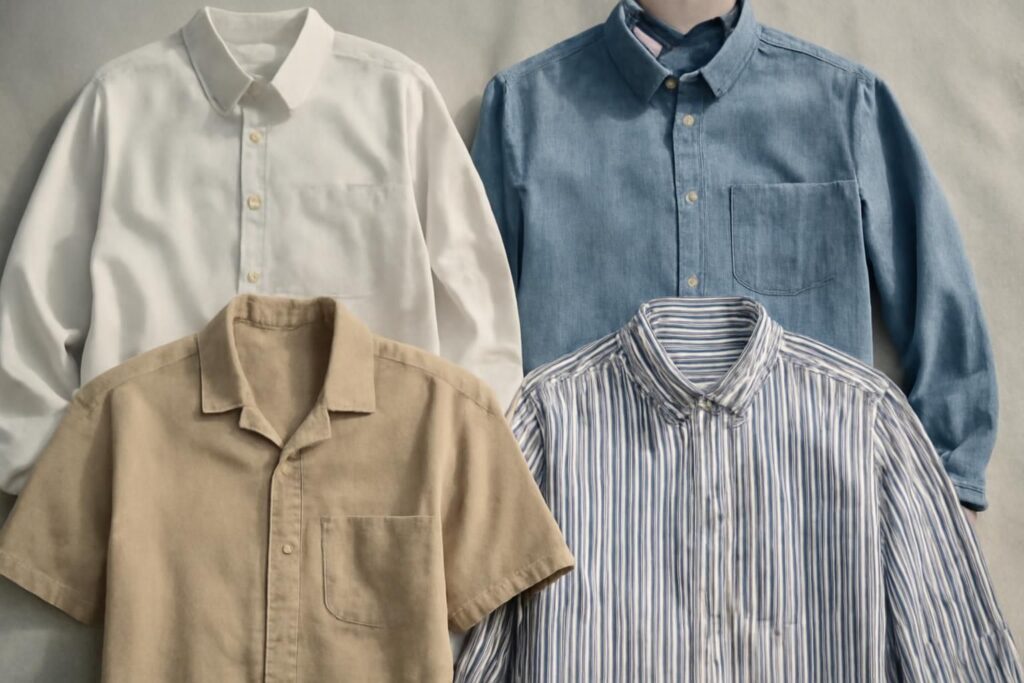
| Camp / Cuban collar | Flat, open one-piece collar, boxy cut | Shorts, light trousers |
| Western shirt | Shaped yokes, snap buttons | Jeans, boots |
| Overshirt / shacket | Heavy shirt worn as a layer | T-shirts, hoodies, jeans |
| Blouse | Softer, often drapier womenswear shirt | Skirts, trousers, under blazers |
| Band-collar shirt | Short stand collar with no points | Casual trousers, linen sets |
Woven button-front shirts
Woven shirts are cut from cloth made on a loom, so they hold a collar and press well. The cloth name usually tells you as much as the cut does, which is why our Types of Fabric guide is a useful companion to this section.
Dress shirt
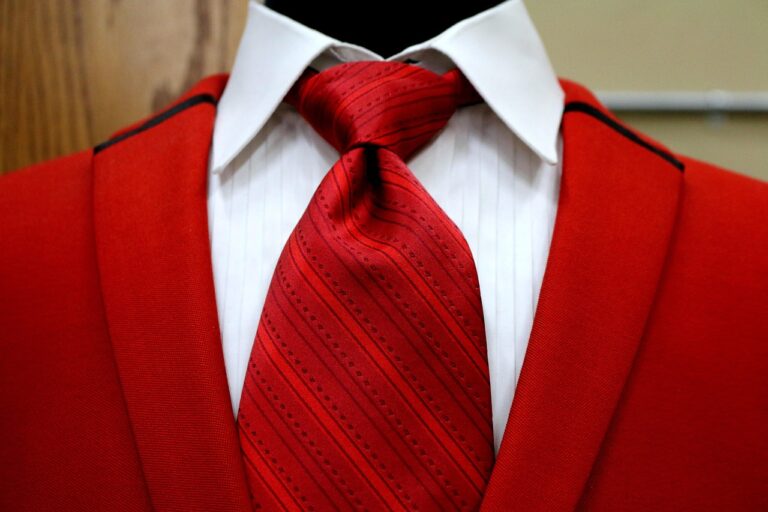
A dress shirt is the formal button-front shirt meant to be worn under a jacket, usually with a tie. How to spot it: a firm collar (often with removable or sewn-in stays), a long tail meant to be tucked in, and buttoned or French cuffs. Plain white and pale blue are the classic colours. How to wear it: with a suit or tailored trousers, tucked in. Our Best Dress Shirts for Men roundup covers current options, and the Types of Ties glossary explains what to knot over the collar.
Oxford button-down (OCBD)
The oxford cloth button-down is a collared shirt in a slightly textured, heavier cotton whose collar points fasten to the front with small buttons. Wikipedia’s entry on preppy style lists the oxford cloth button-down as a signature Ivy piece alongside the navy blazer, polo shirt and loafers. The origin of the name “oxford cloth” is not documented in a source we could verify, so we leave that story out. How to spot it: a visible, slightly nubby weave and buttons at the collar tips. How to wear it: with chinos or jeans, with or without a tie, often under a blazer. For the difference between a button-down collar and any shirt that simply buttons up the front, see Button-Up vs Button-Down; for buying advice, see Mens Oxford Shirts.
Button-downs have been around a long time in Britain too. The V&A holds a yellow, blue and red plaid button-down shirt made in Great Britain around 1972.
Poplin shirt
Merriam-Webster defines poplin as “a strong fabric in plain weave with crosswise ribs,” with the word coming from French papeline and first recorded in 1710. In shirts, poplin reads smooth, light and crisp. How to spot it: a flat, fine surface with almost no visible texture, and a cool, smooth feel. How to wear it: as a business shirt under a suit, or as a crisp white shirt with jeans or a skirt. Our What Is Poplin? The Crisp Shirting Fabric Explained explainer covers the cloth in detail.
Oxford vs poplin shirt
This is one of the most common questions at the shirt rail. Poplin is the smoother, lighter, dressier plain weave described above. Oxford cloth is commonly described as a heavier basket-style weave with a visible texture, which makes it read more casual and gives it a sturdier hand. A practical rule of thumb many shoppers use: poplin for suits and formal settings, oxford for everyday wear with chinos and jeans. Both iron well, and oxford still looks relaxed when slightly rumpled, which is part of its everyday appeal.
Chambray shirt
Chambray is a light cloth that looks like denim from a distance. According to the Online Etymology Dictionary, the name is an alteration of Cambrai, the French (formerly Flemish) city where the cloth was first made. Merriam-Webster and etymonline differ on the first recorded date, so the safe summary is the late 18th century. How to spot it: a soft, heathered blue surface that is lighter and smoother than denim. How to wear it: as a casual shirt with chinos, or open over a T-shirt. Read more in What Is Chambray? Chambray vs Denim.
Denim shirt
Britannica describes denim as a durable twill-woven fabric with a coloured warp and a white weft, which is why the inside of a denim shirt looks paler than the outside. How to spot it: a diagonal twill line on the face, heavier weight than chambray, and often two chest pockets. How to wear it: with chinos or dark jeans, or as a light layer. Our Men’s Denim Shirts guide covers fits and washes.
Flannel shirt
Flannel is, per the Online Etymology Dictionary, a “warm, loosely woven woolen stuff” recorded from around 1300. Its origin is probably the Welsh gwlanen, “woollen cloth,” though that derivation is not universally accepted and a French alternative has been proposed. Today flannel shirts are usually brushed cotton, sometimes wool. The FIT Fashion History Timeline lists flannel shirts among early-1990s grunge dress, alongside baggy jeans, Doc Martens and slip dresses. How to spot it: a soft, slightly fuzzy surface, often in a plaid. How to wear it: with jeans and boots, or open as a light jacket. See Flannel Shirts for more.
Linen shirt
Linen is the fibre, yarn and fabric made from the flax plant, according to Britannica. How to spot it: a dry, slightly slubby texture and creases that appear the moment you sit down. How to wear it: untucked with shorts or linen trousers in hot weather, with the creases treated as part of the look. Our Mens Linen Shirts page covers what to look for.
Seersucker shirt
Merriam-Webster defines seersucker as “a light fabric of linen, cotton, or rayon usually striped and slightly puckered,” first recorded in 1722, from a Persian phrase meaning “milk and sugar.” How to spot it: a crinkled stripe that stands slightly off the surface. How to wear it: as a summer shirt with plain trousers or shorts. More in What Is Seersucker? The Puckered Summer Fabric.
Western shirt
Western shirt is a widely used term for a button-front shirt with shaped yokes across the shoulders and snap closures, often with pointed pocket flaps. How to spot it: the curved or pointed yoke seams and pearl-style snaps. How to wear it: with jeans and boots, or as a statement piece with plain trousers. See Men’s Western Shirts.
Camp collar and Cuban collar shirts
These are commonly used names for short-sleeved shirts with a flat, open, one-piece collar that lies against the chest rather than standing up. The two terms are often used interchangeably. How to spot it: no collar band, a straight hem and a boxy cut, frequently in prints. How to wear it: untucked with shorts or light trousers.
Band-collar shirt
A band-collar (or grandad-collar) shirt keeps only the short stand of the collar and drops the points. This is common usage rather than a documented term. How to spot it: a neat strip of fabric around the neck with one button. How to wear it: buttoned to the top for a clean line, or open with linen trousers.
Blouse
Blouse is the usual term for a womenswear shirt, often in a softer or drapier cloth such as silk, crepe or chiffon, and sometimes with details like ties, ruffles or gathered sleeves. How to spot it: lighter fabric and more movement than a standard shirt. How to wear it: tucked into skirts or trousers, or under a blazer. Sheer styles are often cut in chiffon.
Knit shirts
Knit shirts are made from looped yarn rather than woven cloth, so they stretch and feel softer. They are rarely ironed and almost never take a tie.
Polo shirt
The Online Etymology Dictionary dates the term “polo shirt” to 1892 and says it “originally was a kind worn by polo players,” which ties the name to polo rather than tennis. The game itself was first played in England at Aldershot in 1871, per the same source. How to spot it: a knit body (often piqué), a soft collar and a short placket with two or three buttons. How to wear it: with chinos, shorts or a casual skirt. Our Cotton Polo Shirts vs Performance guide goes further.
T-shirt
According to the Online Etymology Dictionary, the word dates from 1920 and is “so called in reference to the shape it makes when laid flat.” The same source notes that the lower-case “t-shirt” spelling is technically incorrect and prefers T-shirt or tee-shirt. How to spot it: no collar, no buttons, a T shape when flat. How to wear it: on its own, or under shirts, overshirts and blazers.
Henley
A henley is commonly described as a collarless pullover with a buttoned placket, usually three to five buttons. The Online Etymology Dictionary defines Henley only as the Thames town that has held a regatta since 1839; it does not link the shirt to the town, so we do not repeat that story. How to spot it: a T-shirt-like body with a short button opening at the neck. How to wear it: with jeans, under an overshirt or open cardigan. Compare it with a plain tee in Henley vs Crew Neck.
Layering shirts
Overshirt and shacket
An overshirt (or shirt jacket, often shortened to “shacket”) is a heavy shirt cut slightly roomier so it can be worn over a T-shirt or knit like a light jacket. How to spot it: thicker cloth such as wool, heavy twill or quilted cotton, and patch pockets. How to wear it: open over a tee in spring and autumn. Our Shirt Jacket vs Overshirt vs Shacket guide sorts out the terms.
For layering in colder months, many of these shirts sit well under knitwear. Our Types of Sweaters glossary shows which necklines leave a collar visible.
How to thrift these shirts
Shirts are one of the easiest things to find secondhand, because so many are donated with plenty of life left. A few checks save disappointment:
- Read the fibre label first. Cotton, linen and wool are listed by name; blends show percentages.
- Check the collar and cuffs, the parts that wear fastest. Look for fraying at the fold and yellowing inside the band.
- Look at the underarms in good light for discolouration.
- Count the buttons, including spares sewn inside the placket or side seam.
- Measure a shirt you already like (chest flat across, sleeve from shoulder seam, back length) and compare, since vintage and brand sizing vary.
- Run a hand over the surface to tell poplin from oxford, or chambray from denim, by texture.
For new options, an Amazon search such as Mens Oxford Button Down Shirt on Amazon or Womens White Poplin Shirt on Amazon is a quick way to compare cuts, and Linen Camp Collar Shirt on Amazon turns up summer styles.
Top-selling match on Amazon

- Material: High-quality cotton is treated to be smooth and lustrous. It is soft and…
- Design: The button-down collar can be paired with a tie, and the collar is tailored to…
- Occasions: This shirt is easy to match and the casual Oxford shirt suits all styles.It can be…
Caring for thrifted shirts
The FTC Care Labeling Rule says a label must state whether a garment should be washed by hand or machine, and give a water temperature if regular hot water would harm it, so the label is the first place to look. For wool flannel or wool overshirts, the Woolmark Company recommends hand washing in lukewarm water of about 30°C with a mild wool detergent, and drying flat. The Smithsonian Museum Conservation Institute notes that chlorine bleach “will dissolve silk or wool,” so keep it away from silk blouses and wool shirts. For ironing, a common method is to work in this order: collar, cuffs, sleeves, yoke, then body.
Frequently asked questions
What are the main types of shirts?
The main groups are woven button-front shirts (dress, oxford, poplin, chambray, denim, flannel, linen, western, camp collar), knit shirts (polo, T-shirt, henley) and layering shirts such as overshirts.
What is the difference between an oxford and a poplin shirt?
Poplin is a smooth, light plain weave with fine crosswise ribs, per Merriam-Webster, and reads dressier. Oxford cloth is commonly described as a heavier, textured weave and reads more casual.
Did the polo shirt start as a tennis shirt?
The Online Etymology Dictionary dates “polo shirt” to 1892 and ties it to shirts worn by polo players. We could not verify tennis origin claims, so we do not repeat them.
Is a button-down the same as a button-up?
No. A button-up is any shirt that buttons down the front; a button-down has collar points that button to the shirt. The oxford entry above links a fuller explainer.
Which shirt styles work with a suit?
Dress shirts in poplin or a fine oxford are the usual choice. Our Types of Suits glossary covers the jackets they go under.
How do you know if a dress shirt fits you well?
A well-fitting button-front shirt has shoulder seams that sit at the edge of your shoulders and buttons that close across the chest without pulling or gaping. Sleeves should end around the wrist bone, and a dress shirt’s collar should fasten with room for about one finger inside it. Tails long enough to stay tucked suit dress shirts, while casual shirts worn untucked look neater with a shorter, straighter hem. Comparing measurements with a shirt that already fits helps when sizing varies.
Shop the look on Amazon
Everything you need to build a secondhand-style wardrobe, delivered. We may earn a commission on purchases.
Browse picks on Amazon →Tops Compared
Blouse vs shirt, cardigan vs sweater, romper vs jumpsuit.
Comparisons
How to Style Your Tops
Button-ups and graphic tees.
Styling Guides
More Tops Glossaries
T-shirts, blouses, hoodies and vests.
Glossaries
Basics Compared
Tights vs pantyhose, bralette vs bra, camisole vs tank, leggings vs yoga pants.