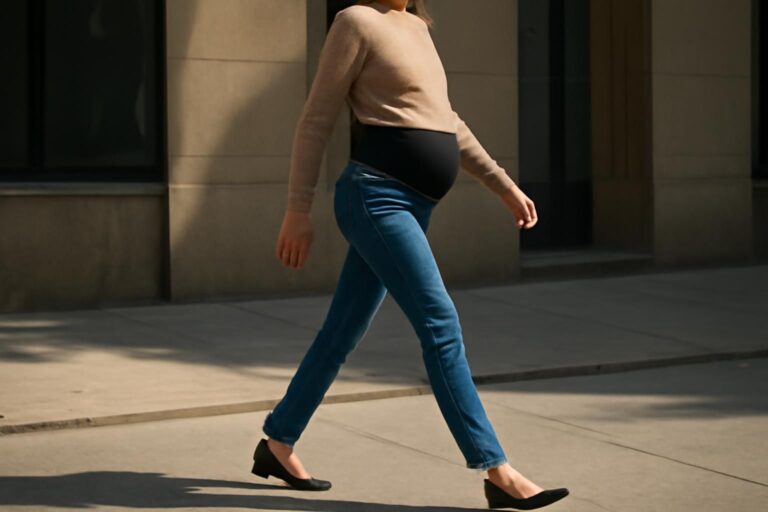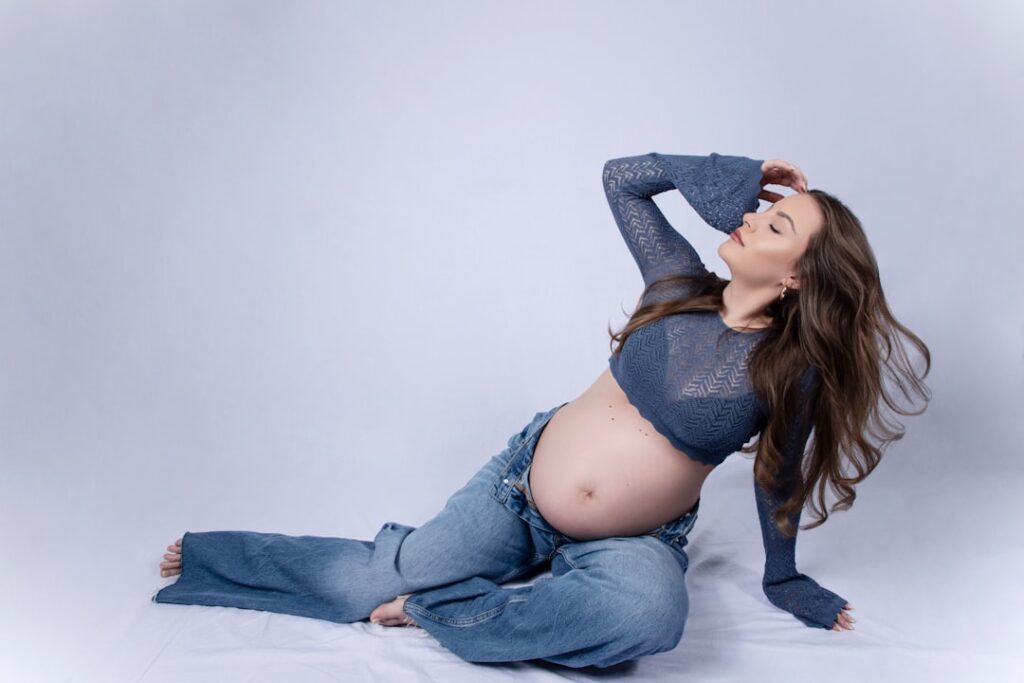
Low rise in maternity denim is an underexplored category because most brands default to full-panel, high-rise pairs that sell on support rather than fit aesthetics. For shoppers who want a maternity jean that reads like a regular low-rise and stays put, the options are narrower than they look.
Many first-time maternity shoppers buy only full-panel high-rise pairs because that’s what is marketed hardest, then discover that low-rise and under-belly styles are more comfortable for much of the first half of pregnancy and postpartum. This post covers what low rise means in maternity, when it makes sense, which brands offer it, and how it holds up, based on brand information and fit principles rather than personal wear. The Brand Guides hub has the broader maternity framework; this one stays focused on the low-rise cut.
What maternity jeans low rise actually means
Low rise in maternity denim is specifically the front rise measurement — the distance from crotch seam to the top of the front waistband or elastic band. For non-maternity jeans, low rise is typically 7 to 8 inches. For maternity low rise, the “rise” includes either a 2 to 3 inch elastic band or a short stretch panel that sits at or just above the hip bone.
Low rise maternity breaks down into three subcategories:
- Under-belly low rise: flat elastic band at hip level, no panel above. The most common low-rise cut.
- Low-rise side panel: rigid front fabric at hip bone with stretch panels at the sides only.
- Low-rise secret fit: short stretch panel (4 to 5 inches) that sits flush to the hip without covering the bump.
All three read less maternity-specific than high-rise full panel pairs. For shoppers who want to avoid the obvious maternity-jean look, low rise is the category that usually delivers.
When low rise maternity makes sense
Low rise makes most sense in the first half of pregnancy. Through months 3 to 6, the bump hasn’t reached the weight that requires full-panel support, and low rise feels natural because it sits where regular jeans sit. The elastic doesn’t roll the way full panels can, and the cooler, less-covered stomach is an advantage in warmer months.
By month 7, low rise becomes situational. For most people it works for shorter wear — errands, casual weekend days, early evenings. For 8-plus-hour days a low band tends to start sliding under the bump weight, which is the point to rotate to full-panel. In months 8 to 9 low rise is mostly around-the-house wear.
Postpartum low rise becomes useful again because the panel accommodates healing without the full-panel looking baggy over a non-bump abdomen. In the early weeks postpartum, low-rise maternity is often the most-worn category.
Brand-by-brand: the low rise maternity pairs worth buying
Gap Maternity low and inset panels
Gap’s lower-panel maternity styles, such as its inset-panel jeans, are the balance pick. Retail 79.95, real-world price 40 to 48 with 40 to 50 percent off sitewide sales. Gap’s denim is generally cotton-rich with a little stretch, which helps the pair hold its shape.
Bought in your pre-pregnancy size, a well-made low panel should sit flush at the lower abdomen without rolling and read like a regular low-rise jean under tops. A wider band distributes pressure better than a narrow one and is less likely to dig into the abdomen later in pregnancy, so check band depth in the product photos.
Old Navy Rockstar Low Panel
Old Navy’s low-panel maternity jeans are the budget anchor. Retail 44.95, sale 25 to 32. The fabric is lighter than Gap’s and often includes polyester. Old Navy advises ordering your pre-pregnancy size and sizing up if you’re between sizes.
Honest negative: lighter cotton-poly blends are prone to inner-thigh pilling, and a softer band can lose snap sooner. For a single pregnancy and casual rotation, it’s fine. For a second pregnancy, expect these to become weekend-only pairs.
Motherhood Secret Fit Belly (low rise variant)
Motherhood’s lower Secret Fit Belly styles use a short stretch panel instead of a flat elastic band. Retail 29.98, sale 19 to 24. The advantage: it holds shape better than flat elastic because the panel’s woven stretch distributes compression. The disadvantage: the panel is visible under thinner tops, which defeats some of the low-rise appeal.
Many styles use letter sizes, so match your pre-pregnancy measurements to Motherhood’s chart rather than assuming your usual letter. The fabric is lighter than Gap’s and the panel can show wear sooner, but the price per pregnancy works.
Isabel Maternity crossover (Target)
Ingrid and Isabel is known for a crossover band that wraps across the front, sold at Target under Isabel Maternity. Retail 39.99. A wider crossover band tends to stay put better than a narrow elastic, especially later in pregnancy, and sits around the hip bone.
Lateral pick for crossover styling: Maternity Jeans Without Belly Band.
H and M MAMA low-waist styles
H and M’s MAMA low-waist styles are among the cheapest mainstream low-rise maternity options. The fabric is light and the band is usually narrow. For a single pregnancy’s rotation, it’s usable; for daily wear, a narrow, light band is the first part to give out. Treat it as a rotation pair, not a primary.
How to check rise and band measurements
Rise numbers published by brands don’t always tell the whole story, and many maternity listings omit them. What to check on each listing:
- Front rise: crotch seam to the top of the band. Under about 10 inches including the band is genuinely low for maternity.
- Band height: deeper bands hold better; look at the photos if it isn’t listed.
- Fabric rise: crotch seam to the bottom of the band, which decides where the denim itself sits.
- Panel type: flat elastic, short stretch panel, or crossover band.
- Model height: where the band lands on the model tells you more than the label.
The measurement that matters most for fit is the fabric rise (how far up the crotch seam to the bottom of the band). That determines where the pair sits on your body and how the back waistband shapes. You can measure it on a non-maternity jean you like and compare.
Trimester by trimester: low rise maternity fit
Month 3 to 4: low rise maternity fits like regular low-rise jeans with elastic at the waistband. No visible band issues, no roll-down. Buy your pre-pregnancy size.
Month 5 to 6: bump visible but not heavy. Low rise usually holds position through most of the day. Deeper bands and crossover bands outperform narrow elastic in hold.
Month 7: shift point. Bump weight often starts pulling a low-rise band down by mid-afternoon. Rotate to side-panel and full-panel for long days.
Month 8 to 9: low rise becomes short-wear only for most people. Around-the-house and quick-errand wear.
Fabric composition and stretch retention
Low rise maternity wears differently than full panel because the narrower band takes more proportional stress per square inch. What the label suggests:
- Gap Maternity: cotton-rich with a little elastane. Band and fabric should hold well. Multi-pregnancy candidate.
- Old Navy low panel: lighter blends with polyester. Bands loosen and inner thighs pill sooner. Single-pregnancy.
- Motherhood Secret Fit: lighter fabric; panels can stretch. Single-pregnancy.
- Isabel Maternity crossover: budget line; read the composition.
- H and M MAMA: light fabric and narrow band. Rotation-only for a second pregnancy.
Pattern: cotton-rich, mid-weight fabrics with only a small amount of elastane generally outlast lighter, lower-cotton blends. Cost per wear favors Gap.
Low rise maternity by cut
Most cuts work in low rise; not all wear equally well through all trimesters.
- Skinny low rise maternity: sits cleanest under tops. Most versatile.
- Straight low rise maternity: reads structured, works late-term for short wear.
- Bootcut low rise maternity: flattering with heels; harder to find in true low-rise.
- Wide leg low rise maternity: limited availability. Most wide-leg maternity is cut high-rise.
- Flare low rise maternity: niche. Few mainstream brands stock this combination.
For cut-specific guides: Maternity Jeans Boot Cut, Maternity Jeans Wide Leg, Types of Maternity Jeans.
Styling low rise maternity jeans
Low rise pairs read less maternity-specific than high rise, which opens up styling. Longer-length tops aren’t required the way they are for high panel pairs; regular-length tops tuck cleanly.
Outfit formulas for low rise maternity:
- Fitted ribbed maternity tank tucked at band, low rise skinny, ankle boots
- Cotton tee tucked, low rise straight, white sneakers
- Drapey button-down half-tucked, low rise skinny, loafers
- Long-sleeve ribbed top tucked, low rise straight, pointed flats
One styling note specific to low rise: because the band sits at the hip bone, shorter-length tops that stop at the natural waistline expose the band. For months 3 to 6 this is fine (the band looks like a low-rise regular waistband). For month 7 plus when the bump starts to round out above the band, longer tops cover cleaner.
For outfit-level guidance: Maternity Jeans Outfit.
Where to buy low rise maternity jeans
Buy from:
- Gap directly during sale events (40 to 50 percent off)
- Old Navy directly with rolling codes
- Target for Ingrid and Isabel
- Motherhood in-store or online
- Poshmark secondhand for Gap and Old Navy low-rise pairs — Gap Maternity Low Rise on Poshmark surfaces secondhand pairs well below retail
Skip:
- Amazon listings without specified band height — the 2 vs 3 vs 4 inch difference is the main fit factor.
- “Low rise” pairs from brands that don’t publish a rise measurement — some mainstream maternity labels their 10-inch front rise as low, which is mid-rise by any standard measurement.
Maternity Jeans Low Rise Under Belly on Amazon narrows the Amazon search to listings that at least specify under-belly construction.
Low rise maternity for curvy and petite bodies
Low rise works differently depending on body shape:
Curvy (10-inch hip-to-waist difference or greater): the band can gap at the back because the elastic isn’t as adaptable as full panel stretch. Ingrid and Isabel’s crossover construction tends to hold better on curvy builds than flat elastic bands. Maternity Jeans for Curvy Women (long-tail) has more.
Petite: low rise maternity sits proportionally higher on shorter torsos, so a 10-inch front rise on a 5’1″ body can read mid-rise visually. Look for petite versions, which should bring the rise down. Maternity Jeans for Petite Women and Maternity Jeans for Short Women have fuller notes.
Plus size: low rise options narrow in extended sizes. Old Navy, with a dedicated plus maternity section, is the widest range. Maternity Jeans for Plus Size Women has plus-specific notes.
Postpartum wear in low rise maternity
Low rise maternity is often the most-worn category postpartum. In the first weeks postpartum, full-panel pairs can look baggy above the healing abdomen, while low rise pairs sat correctly at the hip and accommodated the lower-abdomen flex without looking oversized. By week 10 most wearers transition back to regular jeans, but those first 6 to 10 weeks postpartum, low rise maternity is the most flattering category.
Firmer, cotton-rich pairs such as Gap’s tend to hold their fit best postpartum, with crossover bands close behind. Lighter, softer bands loosen sooner, so budget pairs are often rotation-only by then.
The verdict
Maternity jeans low rise are the most under-marketed category in maternity denim and the one that solves months 3 to 6 and all of postpartum cleanly. Gap’s lower-panel maternity styles are the balance pick — solid fabric, durable. Ingrid and Isabel’s crossover band (Isabel Maternity at Target) is the pick for curvier builds and longer wear late-term. Old Navy’s low panel is the budget pick for a single pregnancy. Motherhood’s lower Secret Fit styles are rotation pairs. Skip H and M unless you need a cheap rotation pair and don’t expect it to last long.
Shop the look on Amazon
Everything you need to build a secondhand-style wardrobe, delivered. We may earn a commission on purchases.
FAQ
What counts as low rise in maternity jeans?
Roughly a front rise of up to about 10 inches including the elastic band at the top. Anything above 10 inches of total front rise is mid-rise. Below 8 inches is ultra-low, which is rare in maternity.
Are low rise maternity jeans comfortable in the third trimester?
Short answer: situationally. For daily 8-plus-hour wear in month 8 or 9, the low-rise band usually slides under bump weight. For shorter stretches, low rise works. Full-panel is the better daily driver in third trimester.
Do low rise maternity jeans sit under or over the bump?
Under. The elastic band sits below the bump at the hip bone. That’s what distinguishes low rise from full-panel maternity, where the panel covers the bump.
Can I wear low rise maternity jeans postpartum?
Yes. Low rise is often the most flattering maternity category for the first 6 to 10 weeks postpartum because the elastic accommodates the healing abdomen without looking baggy over non-bump tissue.
Where do I buy low rise maternity jeans under 30 dollars?
Old Navy’s low panel on sale. H and M MAMA low-waist styles. Secondhand Gap maternity on Poshmark. Under 20 consistently exists only on H and M and secondhand.
Is an under-belly panel the same thing as a low rise maternity jean?
Under-belly is one type of low rise maternity jean rather than a synonym for it. Low rise describes the front rise, the distance from the crotch seam to the top of the band, while under-belly describes a flat elastic band that sits below the bump at hip level. The guide splits low rise maternity into three subcategories: under-belly, low-rise side panel with stretch only at the sides, and low-rise secret fit with a short stretch panel sitting flush to the hip.