A cashmere sweater is soft, warm and often a real investment, whether you paid full price or found it on a thrift rack, so it is worth ten careful minutes at the sink to keep it that way.
Learning how to wash cashmere is mostly about avoiding three things: heat, agitation and harsh chemicals. Cashmere is an animal hair fibre, so it behaves much like fine wool in water. Washed cool to lukewarm by hand with a gentle detergent and dried flat, it can stay soft for years. This guide covers what you need, hand-washing steps, when a machine wool cycle is acceptable, drying, what to avoid, stains, storage and when a dry cleaner is the better choice. For background on where the fibre comes from and how to judge quality, see our What Is Cashmere? Where It Comes From and How to Judge Quality guide.
Quick answer: Check the care label, then hand wash in lukewarm water (around 30 °C, the temperature Woolmark gives for wool) with a mild wool detergent. Soak briefly, rinse, press out the water in a towel without wringing, and dry flat away from heat. Machine wash only if the label allows it, on a wool or delicates cycle.
What cashmere is, and why it needs gentle care
The US Federal Trade Commission defines cashmere as “the fine (dehaired) undercoat fibers produced by a Cashmere goat,” with an average fibre diameter of no more than 19 microns. That fineness is what makes it so soft, and also part of why it needs a light touch.
Like wool and silk, cashmere is a protein fibre. The Smithsonian Museum Conservation Institute (MCI) notes that silk and wool “can be damaged by protein enzymes or alkali,” and that chlorine bleach “will dissolve silk or wool.” MCI also explains that these fibres “stretch more easily, tear more readily in water,” so they should be supported while wet. Cashmere shares that protein make-up, which is why the same cautions are widely applied to it.
Why cashmere shrinks and felts
The Woolmark Company explains felting in wool this way: “Wool is a protein fibre with a natural scale structure. When exposed to heat and moisture the scales lift and with mechanical agitation start to lock onto the scales of other fibres in a ratchet-like mechanism.” Animal hair fibres such as cashmere are prone to the same tightening and matting when washed hot or roughly. A peer-reviewed review calls wool felting shrinkage “irreversible,” so prevention matters far more than repair.
A note on sources: the cashmere industry’s own care pages could not be checked for this guide, so the steps below combine Woolmark’s published wool guidance with common cashmere-care practice. Woolmark’s numbers are written for wool. Treat them as a close guide for cashmere, and let your garment’s label override them.
What you need
- A clean basin, sink or bucket
- A mild wool or cashmere detergent. Woolmark recommends “a neutral, mild wool detergent.” A Wool And Cashmere Wash Detergent on Amazon that is enzyme-free fits that description.
- Two clean, light-coloured towels
- A flat drying surface or mesh rack, such as a Flat Mesh Sweater Drying Rack on Amazon
- Optional: a mesh laundry bag, if your label allows machine washing
Top-selling match on Amazon

- 【Stable & Durable】Dimensions: Each lay flat mesh drying rack measures 28 x 28 x 5.71 inches…
- 【Mesh Design & Fast Drying】The open mesh netting prevents scratching and staining of delicate…
Top-selling match on Amazon

- Highly Concentrate: 42 Loads
How to wash cashmere by hand
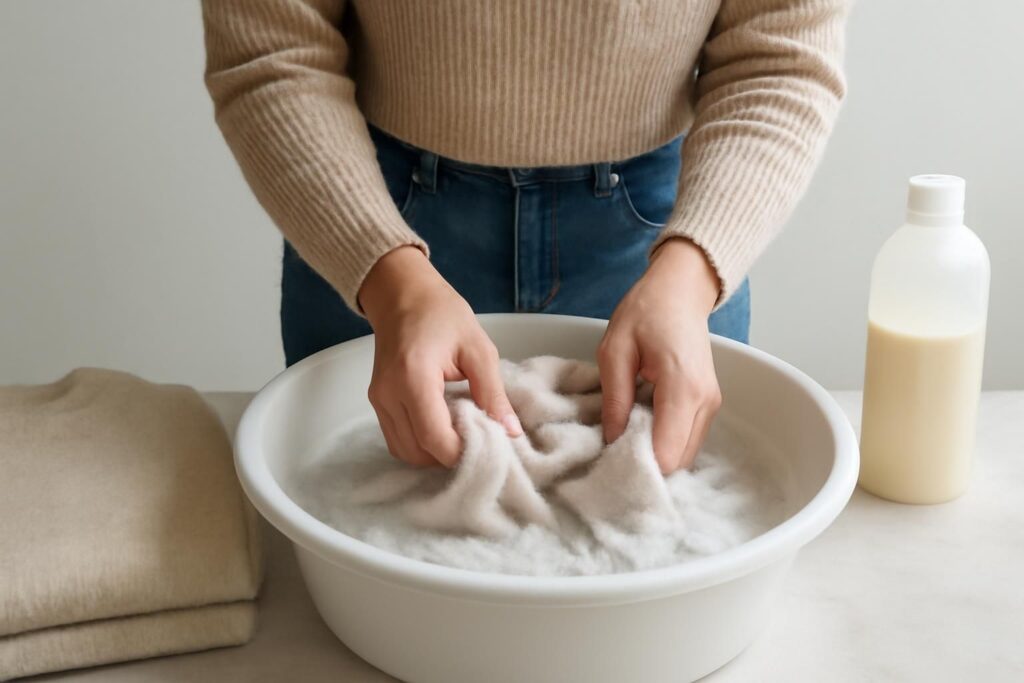
Woolmark’s wool hand-wash guidance is to “hand wash in clean, lukewarm water, approximately 30°C, using a mild and gentle detergent,” turn the garment inside out, soak for about 10 minutes, then rinse in lukewarm water followed by cold. Applied to a cashmere sweater, the routine looks like this:
- Read the care label and confirm hand washing is allowed.
- Turn the sweater inside out.
- Fill a basin with lukewarm water, around 30 °C.
- Add a small amount of mild wool detergent and swirl to dissolve it.
- Submerge the sweater and press it gently under the water. Don’t rub or scrub.
- Let it soak for about 10 minutes.
- Drain the basin, supporting the sweater so it doesn’t hang and stretch.
- Rinse in lukewarm water, pressing gently to release the suds.
- Give it a final rinse in cold water.
- Lift the sweater out in both hands, bundled, so its weight is supported.
Keep the rinse water close to the wash temperature until that final cold rinse. Our How to Hand Wash Clothes (Delicates, Wool and Dresses) guide covers basin setup for all delicates, and the process is very similar to How to Wash a Wool Sweater Without Shrinking It.
Can you machine wash cashmere?
Sometimes, but only when the care label allows it. Woolmark’s guidance for machine-washable wool is to use the “wool setting (usually gentle action at 40°C)” with a neutral, mild detergent, or a cold or delicates cycle if your machine has no wool setting. Woolmark is clear that you should machine wash only when the label permits. If your cashmere label says hand wash or dry clean, follow it.
If machine washing is allowed:
- Turn the sweater inside out.
- Place it in a mesh laundry bag.
- Select the wool cycle, or cold delicates if there’s no wool cycle.
- Use a mild wool detergent.
- Choose the lowest spin.
- Remove it as soon as the cycle ends and dry it flat.
How to dry cashmere
Woolmark says “Knitwear – such as sweaters – should be flat-dried in the shade.” Hanging a wet knit lets the weight of the water pull it out of shape. A common method for getting it there:
- Lay the sweater on a dry towel.
- Roll the towel up with the sweater inside.
- Press down on the roll to push water into the towel. Don’t wring or twist.
- Unroll and move the sweater to a second dry towel or a flat rack.
- Ease it into shape: straighten the ribbing, line up the shoulders and smooth the sleeves.
- Leave it to dry away from radiators, direct sun and heaters, turning it once if the underside stays damp.
Woolmark’s tumble-drying guidance couldn’t be confirmed for this guide, so keep cashmere out of the dryer.
What to avoid
- Hot water. Heat and moisture lift the scales that cause felting, according to Woolmark.
- Rubbing, scrubbing and wringing. Agitation is what locks those scales together.
- Enzyme or “bio” detergents. MCI warns protein enzymes can damage protein fibres.
- Chlorine bleach. MCI says it dissolves wool and silk. Clorox’s own expert also says, “I don’t recommend bleaching wool, silk, mohair, leather, spandex and non-colorfast colors.”
- Hanging wet. It stretches the shoulders and length.
- Tumble drying and radiators. Direct heat is a felting risk.
Stains and special cases
Blot spills promptly with a clean, damp cloth rather than rubbing. MCI advises testing any stain treatment on a hidden area first, because fibre and finish affect the result. Choose enzyme-free products, and never use chlorine bleach. If a stain hasn’t lifted after a gentle wash, don’t apply heat, which can set it. Hand the garment to a cleaner instead.
When to choose a dry cleaner
- The label says “Dry clean only.”
- The piece is a tailored coat, blazer or lined garment.
- It has embellishments, leather trim or mixed fibres with different needs.
- There’s an oily or set-in stain you can’t identify.
The FTC notes that “If an item can be washed and drycleaned, the label needs only one of these instructions,” so a plain “Dry clean” label doesn’t prove water will harm the garment. Washing against the label is still your risk, and for structured or valuable pieces a professional is the safer route. The FTC also says that if steam would damage a garment, the label should read “Dryclean. No steam.”
Maintenance between washes
- Wash less often. Woolmark says wool is naturally stain-, odour- and crease-resistant, so it “requires less washing.” Airing a sweater after wear is a common method for cashmere too.
- Deal with pills. Wool and cashmere pill in high-friction spots such as underarms and cuffs. A Cashmere Comb on Amazon or a fabric shaver lifts them off, used with light strokes in one direction. See How to Remove Pilling From Clothes (and Stop It Coming Back).
- Fold, don’t hang. Folding is a common method that keeps knits from stretching on a hanger.
- Store clean. Put sweaters away clean and dry, ideally in a breathable storage bag.
If your cashmere shrank
Be realistic here. Felted wool and cashmere can’t be fully restored, and the review cited above describes felting shrinkage as irreversible. Conditioner soaks may relax a knit that has tightened a little, but only partly. Our How to Unshrink Clothes guide explains the soak-and-stretch method and its limits, and How to Prevent Clothes From Shrinking in the Wash covers habits that stop it happening.
Thrift note: cleaning secondhand cashmere
Thrift stores are one of the best places to find cashmere at a fraction of retail. Before buying, check the fibre label for 100% cashmere or a blend, feel for matted or felted patches (especially under the arms), and hold it up to the light to spot thin areas or small holes. Give a secondhand sweater a cool hand wash before wearing, using the steps above. If the care label is missing, treat it as hand wash only. Browsing ideas? Our Cashmere Gifts and Types of Sweaters guides are good places to start.
Shop the look on Amazon
Everything you need to build a secondhand-style wardrobe, delivered. We may earn a commission on purchases.
FAQ
What temperature should I wash cashmere at?
Woolmark’s hand-wash guidance for wool is lukewarm water, around 30 °C, which is a sensible guide for cashmere. Follow your label if it says otherwise.
Can you machine wash cashmere?
Only if the care label allows it. Then use a wool cycle, or cold delicates, in a mesh bag with a mild wool detergent.
What detergent is best for cashmere?
A neutral, mild wool detergent without enzymes. MCI warns that protein enzymes and alkali can damage protein fibres.
Can I use hair shampoo on cashmere?
Some people use a gentle shampoo as a common method, but a dedicated wool detergent is the safer choice.
How often should cashmere be washed?
There’s no fixed schedule. Woolmark notes wool needs less washing than many fabrics, so airing between wears and washing when it looks or smells like it needs it is a common approach.
Can shrunken cashmere be fixed?
Not fully. Felting can’t be reversed, though a conditioner soak may relax a lightly tightened knit a little.