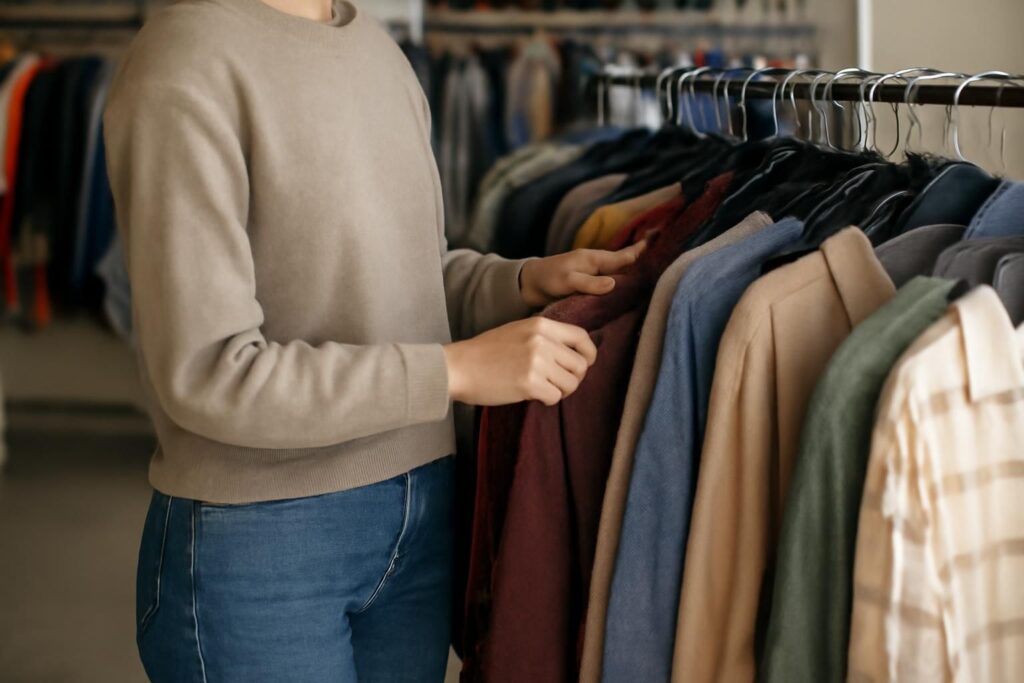
There are roughly 3,300 Goodwill stores across the US and Canada, and they are not the same chain in any operational sense. The Goodwill 8 miles from you might be a curated boutique with $40 jeans; the Goodwill 12 miles away might be a $1.59-per-pound bin store.
Searching “Goodwill thrift store near me” doesn’t tell you which Goodwill you’re walking into, which is the actual problem. Goodwill Industries International is a federation of 156 regional Goodwill organizations operating independently under the same brand, and the differences between regions are significant. After enough Goodwill trips across enough regions, the playbook becomes clear. The full chain-level coverage lives at the Thrift Store Chains hub. This guide focuses on finding the right Goodwill near you, what the different store types mean, and the honest reality of Goodwill pricing in 2026.
How to actually use the Goodwill locator
The official locator at goodwill.org/locator is the best single tool for finding Goodwill locations near you. Enter your zip and the locator returns every Goodwill within a default 25-mile radius, with addresses, hours, phone numbers, and which type of Goodwill location each one is. Google Maps surfaces most Goodwills but occasionally misses outlet locations and donation-only sites, so the locator is more reliable for full coverage.
The locator also distinguishes store types, which matters more than most shoppers realize. “Goodwill Retail” is the standard thrift store. “Goodwill Outlet” is the bins (priced by weight). “Goodwill Boutique” is the curated higher-end format. “Goodwill Donation Center” is donation-only with no retail. “Goodwill Books” is the book-specialty format. Knowing which type you’re driving to before you go saves the wasted trip to a donation-only site.
What the locator doesn’t tell you is which regional Goodwill operates each store. The regional org is the operational reality; pricing, policies, color-tag rotation, senior discount day, and outlet pricing per pound all vary by region. Goodwill Southern California prices apparel meaningfully higher than Goodwill of the Heartland (Iowa). Goodwill Industries of Greater Detroit runs different sale cycles than Goodwill Industries of Houston. To find your region, check the “About this store” link on the locator page, or look at the bottom of the receipt at any local Goodwill.
The four Goodwill store types and which one you want
Standard Goodwill Retail is the format most shoppers know: apparel, housewares, books, electronics, furniture, all priced by tag with a weekly color-tag rotation. Apparel typically runs $4 to $12, housewares $2 to $15, furniture $20 to $80. Senior discount Tuesdays at most regional Goodwills give 10 to 25% off depending on region. This is the right format for routine thrifting, browsing, and most apparel needs.
Goodwill Outlet stores (the bins) are the deep-discount format. Inventory that didn’t sell at the standard Retail stores after several weeks gets rotated to the Outlet, where it’s sold by the pound (typical pricing $1.59 to $2.99 per pound for clothing, $0.49 to $0.99 per pound for housewares). The Outlet is the right format if you’re buying for resale, sourcing fabric for craft projects, or willing to dig through unsorted bins for genuine finds. The catch: Outlet shopping is physical work. Bring Goodwill Outlet Gloves on Amazon for the dig and expect to spend an hour or more sorting. The competitive resellers who shop the Outlet daily are aggressive, and bin rotations bring out the regulars.
Goodwill Boutique is the curated format Goodwill rolled out in major metros over the last decade. These stores hand-pick higher-quality donations and price them closer to consignment-shop levels. A Boutique tee that would be $5 at standard Retail might be $15 at the Boutique. The format works if you want pre-curated brand-name finds without the dig, but the value-per-dollar drops significantly. Skip if you’re price-sensitive.
Goodwill Books is a small specialty format in some regions. Used books sorted and priced for the book-buyer market, with paperback trade fiction usually $1 to $3 and hardcovers $3 to $7. Niche, but useful if you read a lot.
How Goodwill pricing actually works in 2026
Goodwill pricing has gotten a lot of online criticism over the last five years, much of it conflating two distinct issues. The honest picture.
Standard apparel pricing at Goodwill Retail has crept up modestly since 2020, mostly on jeans and outerwear. A pair of jeans that was $7 in 2018 is typically $9 to $12 in 2026. Brand-name pieces that volunteers or staff recognize sometimes get tagged at “boutique” prices ($14 to $25) even at standard Retail locations, which is the change most thrifters complain about. The pricing creep is real, but it’s still well below retail thrift competitors and dramatically below buying new.
The bigger pricing variability is regional. The same brand of jeans might be $8 at a Goodwill in Tulsa and $14 at a Goodwill in San Diego. This is not corporate price gouging; it’s the regional Goodwill setting prices to match the local donation-volume-to-buyer-demand ratio. High-cost-of-living regions price higher because donation volume is higher and buyer demand can absorb it. Comparing Goodwill prices across regions on social media misses this.
Outlet pricing per pound varies less than retail pricing. Most regions price clothing at $1.59 to $2.49 per pound, with smaller items (shoes, books) priced individually. The exact rate is posted at the entrance to every Outlet.
The CEO compensation criticism that surfaces in social media discussions is largely outdated and conflated. Goodwill Industries International is a federation, and CEO compensation varies by regional org. Some regional Goodwill CEOs earn $200,000 to $700,000+ depending on org size, which is consistent with nonprofit executive compensation at organizations of similar revenue (regional Goodwills with $100M+ in annual revenue have nonprofit-typical CEO comp). The “Goodwill is a scam” framing online is mostly misinformed; Goodwill is a 501(c)(3) nonprofit that funds workforce development and job training programs, and that mission is real.
Best days and times to shop Goodwill
Mondays are the strongest day at most Goodwills because weekend donation surge gets processed Monday morning and hit the floor Monday afternoon. Tuesdays are second-strongest plus the senior discount day in most regions. Wednesdays through Fridays are progressively picked-over.
Color-tag rotations vary by region. Most Goodwills run weekly tag colors with a specific color discounted to half-price each week (the color rotates on a 6 or 7-week cycle). The discounted color is posted at the entrance and on tag stickers. Showing up the morning of a half-price color day means you’re competing with regulars but the value math is hard to beat.
Senior discount day is Tuesday at most regional Goodwills, with discounts typically 10 to 25% off for shoppers 55 or 60+. Some regions also run student discount days or military discount days. Check at the register the first time you visit a new Goodwill.
The “thrift store open near me” question matters because Goodwill hours vary significantly by region and store. Most retail locations open 9am or 10am and close 7pm or 9pm, but smaller suburban stores sometimes close at 5pm. The locator shows current hours, but call ahead for any drive over 15 miles, especially Sundays when many Goodwills run shortened hours.
How Goodwill compares to other major chains
Versus Salvation Army, Goodwill typically has more apparel volume but Salvation Army has better furniture sections in larger Family Store locations. Pricing is comparable on apparel, with Salvation Army occasionally lower on housewares. The Salvation Army Thrift Store coverage gets into the head-to-head.
| Store | Pricing | Selection | Nonprofit status | Best for |
|---|---|---|---|---|
| Goodwill | Lower on standard apparel | More apparel volume; consistent | 501(c)(3) nonprofit | Apparel breadth & consistency |
| Salvation Army | Occasionally lower on housewares | Better furniture in Family Stores | Varies | Furniture (Family Stores) |
| Savers / Value Village / Unique | Higher on standard apparel | Curated, consistent floor | For-profit | Curated presentation |
| St. Vincent de Paul | Lower on housewares | Less consistent store-to-store | Varies | Housewares pricing |
Versus Savers and the Savers/Value Village/Unique umbrella, Goodwill is generally lower-priced on standard apparel but Savers has a more curated and consistent floor presentation. Savers is also for-profit, while Goodwill is 501(c)(3) nonprofit, which matters if mission alignment factors into your decision.
Versus St. Vincent de Paul, Goodwill is more consistent store-to-store but typically higher-priced on housewares. SVdP wins on housewares pricing in most markets; Goodwill wins on apparel breadth and operational consistency.
The “Is Goodwill a Thrift Store? How It Works Explained” question that comes up in search is mostly definitional. Yes, Goodwill is a thrift store in the standard sense. The reason the question gets searched is because Goodwill’s branding has shifted toward “Goodwill” as a standalone identity rather than “Goodwill thrift,” which confuses some shoppers about whether the format is the same.
The verdict
Goodwill is the most consistent thrift chain in the US for routine apparel and housewares shopping, and the locator at goodwill.org makes finding nearby locations straightforward. The catch is knowing which store type and which regional Goodwill you’re walking into, and using that information to set expectations on pricing. For everyday thrift, hit your standard Retail Goodwill on Mondays or Tuesdays for senior discount and best-stock timing. For deep-discount sourcing, drive to your nearest Goodwill Outlet on a weekday morning. Skip the Boutique format unless you specifically want curated convenience and don’t mind paying for it. Goodwill won’t deliver the highest-end finds in any market, but it’s the reliable baseline that makes the rest of your thrift circuit possible.
Shop the look on Amazon
Everything you need to build a secondhand-style wardrobe, delivered. We may earn a commission on purchases.
FAQ
What’s the cheapest day at Goodwill?
The half-price color-tag day, which rotates weekly through 6 or 7 colors. Check the entrance signage at your specific store for the current week’s discount color. Senior discount Tuesdays add 10 to 25% off for qualifying shoppers in most regions.
Are Goodwill Outlet bins really cheaper?
Yes, significantly. Outlet pricing typically runs $1.59 to $2.99 per pound for clothing versus $4 to $12 per item at standard Retail. The catch is the physical work of digging through unsorted bins and the competitive resellers who shop daily. Worth it for resale or volume sourcing; less worth it for casual shopping.
Why do Goodwill prices vary by region?
Goodwill Industries International is a federation of 156 regional Goodwill organizations, each operating independently. Each region sets its own pricing based on local cost of living, donation volume, and buyer demand. Same Goodwill brand, different regional operations.
Does Goodwill negotiate prices?
No. Goodwill prices are fixed at the tag. Asking for a discount won’t work at corporate-operated locations, though damaged-item discounts are sometimes available if you flag a defect at the register before purchase.
Is Goodwill actually a nonprofit?
Yes. Goodwill Industries International and all 156 regional Goodwill organizations are 501(c)(3) nonprofits. Proceeds fund workforce development, job training, and employment services in the regions where the stores operate.