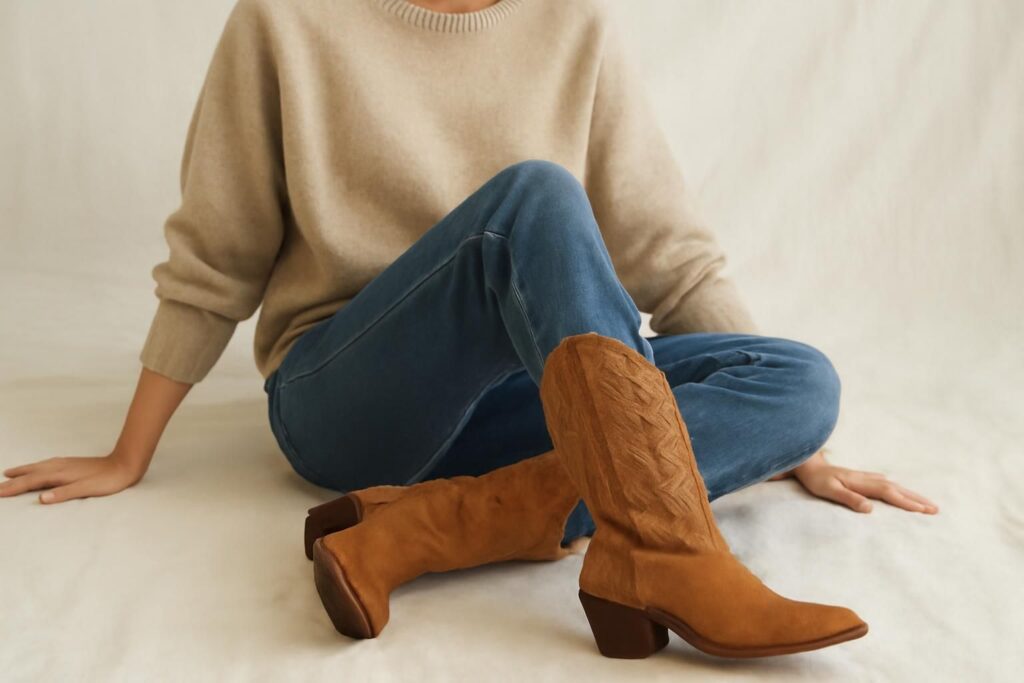
Ariat is the cowboy-boot brand most likely to actually hold up to a full day on your feet, and that single quality is why it dominates a lot of women’s western-boot rotations.
This guide walks Tumbleweed Thrift readers through Ariat women’s cowboy boots across the brand’s main lines, compares them with the heritage competition, and pulls out the picks worth your money. Founded in 1993, Ariat is the new kid in heritage cowboy-boot terms, but it built its position by leaning into something the older houses largely ignored: comfort technology that lasts past the first hour. If you want the broader category map first, the Cowgirl and Western Boots hub lays it out. Otherwise, here’s where Ariat earns its price tag and where it does not.
Ariat women’s at a glance
Ariat was founded in California in 1993 by Beth Cross and Pam Parker, with a stated goal of bringing athletic-shoe comfort technology into the heritage Western boot. That positioning still drives the brand. Where Justin and Tony Lama lead with century-old heritage and Lucchese leads with handcrafted luxury, Ariat leads with engineered comfort, work-readiness, and a price tier most people can actually afford.
Pricing typically lands in the $150 to $400 range for women’s styles, with most popular cuts sitting around $200 to $280. Sizes run 5 to 12 in standard women’s, with select cuts available in wide sizing and wide-calf options. Strongest categories are work boots, ranching boots, and the comfort-everyday lines that get worn for actual ten-hour shifts rather than two-hour photo opportunities.
Best Ariat women’s cowboy boot lines
The lineup splits cleanly by use case. Heritage Western is the brand’s classic line, sitting around $200 to $300, and it reads most traditional in silhouette. Round Toe Roper is the work-friendly daily-wearer, typically $180 to $250, with a low heel and a forgiving toe shape that suits anyone on their feet a lot. Fatbaby Heritage is the mid-calf casual western piece, usually $150 to $220, with a chunkier sole and a more relaxed shaft. Riata Western sits at the premium leather end, around $250 to $350, and looks the most heritage-coded of the comfort-tech lines. Caballera is the statement-occasion cut, around $300 to $400, where Ariat tries to compete on appearance rather than just performance.
Of those, the Round Toe Roper is the workhorse. Its low heel and roomy round toe make it the easiest Ariat to live in for full days once broken in. Heritage Western is the one to pick for traditional aesthetics. Fatbaby is divisive: the chunkier sole reads either casual-cool or clunky depending on your taste, so try before you buy if you can.
What Ariat does well
Comfort technology is the whole point. Ariat’s ATS, Advanced Torque Stability, is a forked-shank stabilizer combined with a cushioned insole, and it makes a real difference at hour six and beyond. Compared with similarly priced Justin and Dan Post boots without a comparable stabilizing shank, that design is aimed squarely at all-day wear, particularly on hard and uneven surfaces.
Construction holds up. Ariat’s Heritage western styles are listed with Goodyear welt construction, which means the boot can be resoled; other lines vary, and some styles are listed as cement construction, so check the construction on the product page. Wide-calf compatibility is broader than at Justin or Lucchese, with the Round Toe Roper Wide Calf as the entry pick for anyone with a 16 to 18 inch calf circumference; our Wide Calf Cowboy Boots for Women guide covers the measuring nuance. The size range is also broader than the heritage competition, which still treats women’s sizing as a footnote on some lines.
What Ariat does poorly
If you want fashion-statement boots, Ariat is not the answer. Old Gringo and Frye lead at the runway-coded end, with bolder appliques, more dramatic silhouettes, and the kind of statement coloring Ariat rarely attempts. Exotic leathers are similarly absent from most Ariat lines; for ostrich, lizard, or alligator, Lucchese Women’s Cowboy Boots is the move.
The price relative to entry-tier heritage is also a real conversation. Justin’s value-tier cuts come in $50 to $100 cheaper than equivalent Ariat pieces. You are paying for the ATS technology and the construction; if you primarily want a heritage look for occasional wear, the Justin entry tier may serve you better. Fit also varies between lines, which we’ll cover below.
Ariat women’s sizing reality
Sizing varies by line and toe shape, so treat your usual shoe size as a starting point rather than a guarantee. A roomy round-toe cut like the Round Toe Roper fits differently from a narrower square or pointed toe at the same tagged size. Ariat’s own size chart advice for anyone between sizes is to order the smaller size for a tighter fit or the larger size for a looser fit. With cowboy boots, a snug instep and a little heel slip that settles with break-in are normal; a toe box that pinches is not. If you have narrower feet, the smaller of two sizes is usually the better place to start.
Calf fit is where things get more variable. Standard cuts run around 14 to 15 inches at the calf opening, which is tight for many women. Ariat’s wide-calf cuts, particularly Round Toe Roper Wide Calf, expand that to roughly 17 to 18 inches. Always measure first; the Wide Calf Cowboy Boots for Women guide explains how to take the measurement and what brands publish chart data. For taller shafts, our Tall Cowboy Boots for Women guide covers the height ranges and which Ariat cuts hit which numbers.
Ariat ATS technology, does it actually matter
Yes, particularly past the four-hour mark. The forked-shank stabilizer prevents the foot from rolling laterally on uneven ground, which is genuinely useful for ranching, working a property, walking on cobblestones at a festival, or any context where you are not on a flat office floor. The cushioned insole is more standard, but the two together are why Ariat is the brand to reach for when you know it is going to be a long day.
The trade-off is honest: ATS construction adds slight bulk and slightly modernizes the silhouette. If pure heritage feel is what you want, you will notice the difference next to a Justin Heritage or Lucchese smooth ostrich. The shank break-in is also a real thing, and full ATS comfort typically arrives at the ten-to-fifteen-wear mark rather than out of the box. For most women, that trade-off is the right one. For collectors and statement-buyers, it may not be. Our Comfortable Cowboy Boots for Women guide goes deeper on what comfort tech actually does and which brands lead.
Ariat vs Justin vs Dan Post, head to head
Three brands, three different value propositions. Ariat wins on comfort and all-day wearability, with ATS as the real differentiator. Justin wins on heritage value, particularly the Gypsy line for fashion-coded picks and the classic Ropers for traditional cuts at lower prices than Ariat. Dan Post sits in the middle on price and edges Ariat slightly on color and embellishment range, with mid-tier reliability that is genuinely solid even if the comfort tech is a step behind.
The simple decision tree: if you are on your feet all day and want one boot that does it, Ariat. If you want heritage feel at the lowest credible price point, Justin (see Justin Cowgirl Boots). If you want mid-tier embellishment and reliable construction at a softer price, Dan Post. None are wrong; they are answering different questions.
Where to buy Ariat women’s cowboy boots
Ariat.com is the safest first stop, with the full lineup and direct returns. Boot Barn carries the broadest in-person selection across most US regions and is the easiest place to actually try the cuts on. Cavender’s is the strong pick across the Southwest and Texas. Zappos is worth checking for the return policy if you are between sizes and want easy exchanges. Amazon carries Ariat through both the brand storefront and third-party sellers; for premium pieces, verify the storefront is Ariat-direct rather than a third-party reseller, since counterfeit listings exist on the periphery. Searching Ariat Heritage Western Women Cowboy Boots on Amazon for the Heritage line or Ariat Fatbaby Cowgirl Boots on Amazon for the casual line both surface authentic listings consistently.
Shop our picks: Ariat Women’s Heritage R Toe Western Boot, Ariat Women’s Fatbaby Heritage Western Boot, Ariat Women’s Round Up Bliss Western Boot.
The verdict
Ariat is the right answer for women who want one cowboy boot that holds up to all-day wear at a credible price tier. The ATS comfort technology is real, the Heritage line is listed with Goodyear welt construction, and the brand’s broader sizing and wide-calf options make it more accessible than the heritage competition. The Round Toe Roper at $180 to $250 is the value pick; the Heritage Western at $200 to $300 is the daily-driver classic; the Riata at $250 to $350 is the closest Ariat gets to heritage-leather feel.
Skip Ariat for fashion-statement pieces, where Old Gringo and Frye lead, and for exotic leathers, where Lucchese is the only real answer. Skip Ariat if your budget is under $150 and Justin’s entry tier or Smoky Mountain serve the use case. For everyone else who wants reliable, comfortable, properly-constructed western boots, Ariat earns the price tag. For the wider conversation on what counts as authentic cowgirl construction in the first place, our Real Cowgirl Boots piece covers the heritage-vs-fast-fashion line, and Cowgirl Boot Brands sets the broader brand landscape. The picks across Best Cowgirl Boots also cross-reference Ariat repeatedly for a reason.
Shop the look on Amazon
Everything you need to build a secondhand-style wardrobe, delivered. We may earn a commission on purchases.
Browse picks on Amazon →FAQ
Are Ariat cowboy boots true to size for women?
Start with your usual shoe size, but expect line-specific variation by toe shape and last. Ariat’s size chart advice for anyone between sizes is to order the smaller size for a tighter fit or the larger size for a looser fit. Try the specific line before committing if you can.
Are Ariat boots worth the price?
For all-day wearers, yes. The ATS comfort technology is genuinely effective past the four-hour mark, and on welted styles the boot can be resoled, which extends its life considerably; check the construction listed on the product page. For occasional wear or fashion-only use, Justin’s entry tier or fast-fashion brands may be more proportionate to the use case.
How long do Ariat women’s cowboy boots last?
Many years for the heritage and work lines with regular care, depending on how hard they are worn, including conditioning every five to ten wears and storage with boot trees. On welted styles, resoling once the original sole wears down extends the life significantly; check the construction on the product page.
What is Ariat ATS technology?
Advanced Torque Stability. It is a forked-shank stabilizer combined with a cushioned insole that reduces foot fatigue on long wear days. The shank prevents lateral foot roll, particularly on uneven ground, and the insole softens impact. It is the brand’s main comfort differentiator versus heritage competitors.
Do Ariat women’s boots come in wide calf?
Yes, on select cuts. Round Toe Roper Wide Calf is the most popular wide-calf option, fitting roughly a 17 to 18 inch calf circumference. Heritage Western has wide-calf variants on some styles. Always check the brand’s published calf measurement before ordering, particularly for taller shaft heights.
What are the pros and cons of Ariat women’s cowboy boots?
Ariat’s main strength is all-day comfort, thanks to its ATS forked-shank stabilizer and cushioned insole, backed by Goodyear-welted Heritage styles and broader wide-calf and size options than most heritage brands. The drawbacks are style and price: Ariat rarely does bold statement designs or exotic leathers, ATS adds slight bulk to the silhouette, fit varies by line and toe shape, and Justin’s value cuts come in $50 to $100 cheaper.