Wrangler has not manufactured a majority of its jeans in the United States since 2002. Knowing where the brand produces now tells you more about what you are buying than most of the marketing copy does.
Where are Wrangler jeans made is a question many owners start asking when they notice the country-of-origin tags on their pairs changing over the years: Mexico on one, Bangladesh or Nicaragua on another, and almost never Made in USA. That is not unusual in 2026 — it reflects where Kontoor Brands (Wrangler’s parent company) actually runs its supply chain. This guide covers what the company discloses and what the tags mean, sorted by actual production details rather than marketing claims. For broader Wrangler context, the Wrangler Jeans piece covers the lineup; the Men’s Denim hub has the rest.
The short answer on where Wrangler jeans are made
Top Where Are Wrangler Jeans Made picks on Amazon
As an Amazon Associate we earn from qualifying purchases. Prices and availability are accurate as of November 2026 and may change. Specs are as stated in each Amazon listing.

- ORIGINAL FIT. Designed with a functional fit in mind, these jeans are made to stack over your…
- CLASSIC COWBOY JEAN. Made for authentic cowboys and worn by world champions, this original…

- SLIM FIT. This slim boot cut jean is designed with fashion-forward style. Built with a slim…
- RETRO STYLING. Designed with Retro style in mind, this boot cut jean provides a vintage look…

- TROUSER LEG. Your favorite high-waisted jeans just got even better. A slim fit through the…
- CLASSIC RETRO STYLE. You can't beat the original, unless you are the original. With the new…
Wrangler jeans sold in the US market in 2026 are primarily manufactured in Mexico, Nicaragua, and Bangladesh. A very small percentage of the lineup — specific heritage cuts and certain workwear — is still produced in the United States, typically under licensing arrangements with domestic denim mills and sewing facilities.
Wrangler’s parent company, Kontoor Brands, was spun off from VF Corporation in 2019 and inherited a global manufacturing footprint that had been consolidated over the previous two decades. VF closed most of its US Wrangler sewing plants in the early 2000s, moving that work to Mexico, Central America and Asia; by late 2004 a single plant in Fabens, Texas, was its last US jeans factory. It was part of the same wave that shuttered most mainstream American denim production.
If you are specifically looking for Wrangler jeans made in USA, your options in 2026 are narrow: the Rooted Collection, launched in 2019 and expanded in 2022, which Wrangler described as grown, cut and sewn in the USA (cotton traceable to specific farms, denim woven at Mount Vernon Mills in Trion, Georgia, and cut and sewn by Excel Manufacturing in El Paso, Texas), plus older deadstock pairs sold on secondary markets. Rooted jeans were priced around $100 at launch, versus around $50 to $60 for a standard 13MWZ at western retailers.
What current tags typically show
Country of origin varies by line, wash and production run, and the same style can come from different plants over time. Kontoor’s annual report for fiscal 2024 says the company owns and operates seven manufacturing facilities in Mexico, which made about 30% of its units; the rest came from contract manufacturers. What that means line by line:
Wrangler 13MWZ Cowboy Cut: the flagship, heavyweight 14.75-ounce cotton. Mexico is a common origin on the tag, which fits with Kontoor’s own plants being there, but check the label on the pair in front of you. Cotton origin is not disclosed on the tag.
Wrangler Authentics: the mass-retail line, built to a lower price with lighter fabric and simpler construction. With roughly 70% of Kontoor’s units coming from contract manufacturers, a budget line like this may carry a tag from any of several countries rather than Mexico.
Wrangler 20X: the rodeo-focused line. Like the rest of the lineup, its origin can change from run to run, so the care label on the specific pair is the only reliable answer.
Fashion and women’s styles: these are often produced by contract manufacturers in a wider range of countries, so treat each style’s tag as the only reliable answer.
Stretch styles: the elastane content and the origin both vary by style, so read the care label for both before you buy.
Outside the Rooted Collection and old deadstock, expect none of these to carry a Made in USA tag. US-made Wrangler, when you can find it, costs well above the standard lineup.
Is “Made in USA” worth the premium
Made in USA Wrangler pairs, such as the Rooted Collection at around $100 at launch, cost noticeably more than similar cuts produced globally. For most buyers, the premium is not recoverable in quality. The Mexico and Nicaragua production facilities Wrangler uses are high-volume plants with quality control that is broadly comparable to US domestic production at the same tier. The fabric and cotton are typically sourced globally even for US-sewn pairs, which limits the “American” story to the sewing labor.
There are two buyer types for whom the premium is defensible. First, buyers who specifically want to support domestic manufacturing as a value statement — the premium is the cost of that choice. Second, buyers looking at the heritage-collection pairs that use US-grown cotton and US selvedge denim mills, which is a smaller subset of Wrangler’s Made-in-USA lineup. Those pairs offer genuinely different fabric, not just different sewing labor.
For everyone else, the mainstream global-production Wrangler is the honest purchase. A Mexico-sewn 13MWZ is heavyweight cotton built to a pattern that has been in production for decades, and that matters more to how long it lasts than the country on the tag. Origin alone does not predict quality.
How the supply chain actually works
Wrangler’s manufacturing sits under Kontoor Brands, which also owns the Lee jeans brand. Kontoor sources cotton globally — primarily from the United States, India, Brazil, and Pakistan — and the cotton is milled into denim at plants across Asia, Mexico, and Central America. The finished denim ships to sewing plants, typically nearer final distribution, which handle construction and washing.
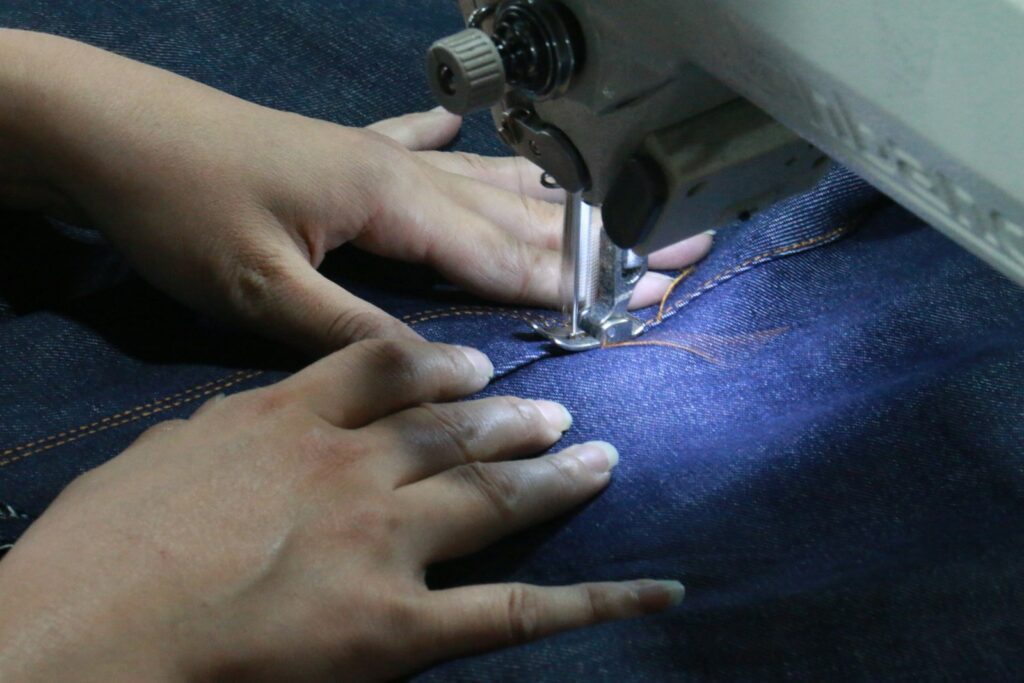
What this means for you as a buyer: the “Made in Mexico” tag on a Wrangler 13MWZ does not mean Mexican cotton or Mexican denim. It means Mexican sewing. The fabric may have been woven in Pakistan or Bangladesh and the cotton may have been grown in Texas. Supply chains in denim are deeply internationalized, and the country-of-origin tag reflects only the final sewing step.
Some Wrangler pairs carry a “US-Grown Cotton” callout on the hangtag. This is a specific Kontoor program designed to support American cotton farmers and is tracked through a chain-of-custody verification. If the cotton origin matters to you, look for that specific callout, not just the country-of-origin tag.
Does origin change quality?
Differences between Wrangler pairs come mainly from the line and price tier, not from the country printed on the tag. What to check, whatever the origin:
Stitching and bartacks: look for straight, even bartacks at the pocket corners and consistent stitch density along the seams. These are the first places weak construction shows.
Thread and contrast stitching: small differences in thread weight between production runs are normal and mostly cosmetic.
Inside finishing: turn the jean inside out. Rough inseam finishing and lightly anchored belt loops are typical of budget lines like Authentics, wherever they are sewn, and they are where a lower price shows.
Hardware: rivets should be firmly set and the zipper should run smoothly. Heavier lines such as the 13MWZ and 20X use sturdier hardware than the mass-retail lines.
None of this is damning to any specific origin. Kontoor uses its own Mexico plants alongside contract factories, and quality control applies across both, so the line you buy is a better guide to construction than the country on the tag.
Where to verify Wrangler origin before buying
The hangtag on a new pair lists country of origin. If you are buying in store, check the hangtag before purchase.
The interior care label, sewn into the waistband or seat, also lists country of origin. This is the legally-required tag.
Online product pages sometimes omit country of origin from the main product description. Scroll to the specifications or materials section — if it is listed at all, it is there. If not listed, ask customer service before buying if origin matters to you.
Amazon listings for Wrangler include country of origin in the product details (Wrangler Jeans Made In Usa on Amazon). ShareASale merchant programs occasionally highlight Made in USA runs (Shop on Amazon). Poshmark and secondary markets are where you occasionally find older Made in USA deadstock (Wrangler Made In Usa on Poshmark).
How this compares to Levi’s origin story
Levi’s followed a similar path. Most mainstream Levi’s production moved offshore in the 2000s, primarily to Mexico, Bangladesh, and various Southeast Asian countries. The Levi’s Made in USA program today covers the LVC (Levi’s Vintage Clothing) archive reproductions and a small selection of Premium cuts — usually at $150 to $300 per pair.
Wrangler’s Made in USA lineup is smaller than Levi’s but more affordable within that category. Levi’s LVC tops out around $300; Wrangler’s premium domestic pairs were priced around $100 at launch. If you want American-made heritage denim at a reasonable price, Wrangler’s Rooted Collection is worth investigating before Levi’s.
The Levi’s vs Wrangler guide compares the two brands across more than just origin.
Are wrangler jeans made in the USA the best Wrangler pairs
Not automatically. The fabric and construction on Mexico-sewn Wranglers is equivalent to US-sewn pairs across most of the mainstream lineup. The Rooted Collection is genuinely different — US-grown cotton, US-woven denim, US-sewn construction — and that full-stack domestic sourcing does produce a distinctively different pair. But the mainstream global Wrangler is not inferior because it is not US-made. It is priced lower because the labor is cheaper, not because the quality is worse.
If your priority is supporting domestic manufacturing, the Rooted Collection or select Made in USA runs are worth the premium. If your priority is getting a good pair of jeans, the mainstream Wrangler global-production lineup delivers excellent value without paying the American-labor premium.
The downsides on Wrangler’s current sourcing
Wrangler’s transparency around specific factory locations is limited. Other brands (Everlane, Patagonia) publish factory lists. Kontoor Brands does not publish a public list of specific manufacturing facilities, which makes it harder to verify labor conditions or environmental practices at the plant level.
Sustainability claims are mixed. Kontoor’s “Rooted Collection” is the most transparent program in the lineup. The mainstream Wrangler production does not carry specific sustainability verifications beyond standard retail certifications.
Small-batch or heritage US-made Wrangler pairs are inconsistent in availability. The Rooted Collection rotates production, and specific SKUs can be out of stock for months. If you want Made in USA Wrangler, expect hunting.
The verdict
Wrangler jeans in 2026 are made primarily in Mexico, Nicaragua, and Bangladesh, with a small and more expensive Made in USA lineup through the Rooted Collection. Mainstream global-production Wrangler is not lower quality than the US-made equivalents — the price difference reflects labor cost, not fabric quality. If you want American-made heritage denim at a reasonable price, the Rooted Collection is worth the premium when you can find it. If you want a great pair of jeans without paying for origin branding, the mainstream 13MWZ, 20X, or Authentics Stretch delivers excellent value wherever it was sewn. Where are Wrangler jeans made matters more for some buyers than others — be honest about which buyer you are.
Shop the look on Amazon
Everything you need to build a secondhand-style wardrobe, delivered. We may earn a commission on purchases.
Browse picks on Amazon →FAQ
Are Wrangler jeans made in the USA anymore?
Only in small quantities, through the Rooted Collection and specific Made in USA runs of the 13MWZ. Most mainstream Wrangler production is in Mexico, Nicaragua, Bangladesh, and Egypt.
Where is Wrangler jeans made most commonly in 2026?
Mexico is the anchor: Kontoor’s own seven manufacturing facilities are there, according to its fiscal 2024 annual report. About 70% of units come from contract manufacturers, so tags from Central America and Asia, including Nicaragua and Bangladesh, are also common.
Are Wrangler jeans made in the USA better quality?
The Rooted Collection uses US cotton and US-milled denim and represents the top of Wrangler’s lineup. Standard Made in USA runs are similar quality to Mexico-sewn pairs. Global production is not lower quality than domestic for most mainstream cuts.
How do I find wrangler jeans made in usa?
Look for the Rooted Collection on Wrangler’s own site, check the hangtag for “Made in USA” explicitly, and search secondary markets for deadstock from older domestic production runs. Expect to pay well above the price of the standard global-production lineup.
Does where Wrangler jeans are manufactured affect durability?
Minimally. The line and price tier matter far more: heavyweight lines like the 13MWZ and 20X outlast budget lines like Authentics regardless of where either was sewn. Origin alone does not predict durability.
Related reading: Wrangler Jeans Near Me: Where to Actually Buy Them and Which Store Wins.
Related reading: Wrangler Jeans for Kids: Infant to Big Kids Sizing, Cuts and Fit Guide.