Vintage Levi Jacket 1960: Collector Territory With a Wearable Pathway
Top Vintage Levi Jacket 1960 picks on Amazon
As an Amazon Associate we earn from qualifying purchases. Prices and availability are accurate as of November 2026 and may change. Specs are as stated in each Amazon listing.

- The original jean jacket designed with superior craftsmanship and a cozy sherpa lining
- This iconic essential truly looks good on everyone, even when sized up or down

- Durable cotton construction with classic utility styling
- Laydown corduroy collar adds contrast and vintage appeal
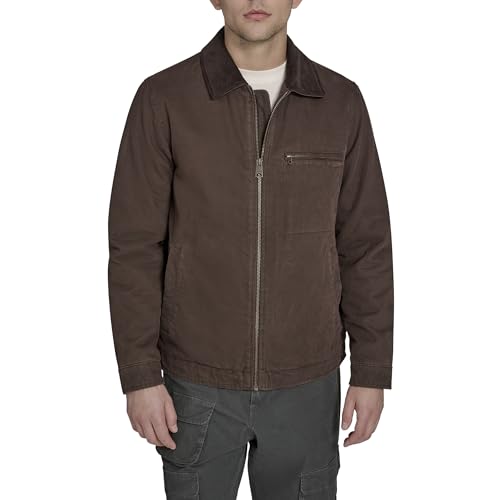
- Durable cotton construction with classic utility styling
- Laydown corduroy collar adds contrast and vintage appeal
A true 1960s Levi’s jacket is not a starter vintage purchase. It’s a collector-priced piece with specific markers and specific risks. Here’s how to navigate it if you’re set on the era.
The vintage Levi jacket 1960 category sits in the expensive end of vintage denim outerwear. The 1960s saw the transition from Type II to Type III trucker, the big E red tab still in production, and construction details that collectors care deeply about. This piece is for buyers who specifically want a 1960s piece and want to understand what they’re paying for. Builds on Vintage Levi’s Denim Jacket and Vintage Levi’s Jacket; the Brand Guides pillar covers the broader vintage picture.
The Type II to Type III transition
Levi’s introduced the Type III trucker jacket in 1962, meaning the early 1960s produced both Type II (discontinued by ~1963) and Type III (1962 onward). The two styles are distinct:
Type II has two chest pockets with buttoned flaps, a cinch back strap, and a boxier cut. Produced 1953–1962/63.
Type III has two chest pockets with pointed flap design, V-stitch across the chest, side tabs instead of cinch back, and a slightly more tailored cut. Produced 1962–present.
If a 1960s Levi’s jacket listing doesn’t specify Type II or Type III, it should be easy to tell from photos. The pointed pocket flaps and V-stitch on Type III are distinctive.
What to look for in an authentic 1960s piece
Big E red tab: the “LEVI’S” on the red back-pocket-style tab (on the left chest of the jacket) should be in all caps. Lowercase “e” on a 1960s jacket is a strong sign of a misdated piece.
Care tag: 1960s jackets don’t have interior care tags (those started in 1971). The absence of a care tag supports 1960s dating.
Two-horse patch: should be leather, showing age-appropriate cracking and darkening. 1960s patches haven’t been replaced by the treated composite material yet.
Donut buttons: the round buttons should be copper-colored metal, stamped with “LEVIS” or “L.S.M.F.” Loose or mismatched buttons are a sign of replacements.
Selvedge seams: 1960s Type III jackets often have selvedge (self-finished) seams on the side panels. You can see the red line on the interior. Selvedge is a strong authenticity marker.
Stitching: single-needle construction is typical for 1960s. Double-needle construction started later on some seams.
The sizing challenge
1960s Levi’s jackets were cut for a smaller, more slender male frame than modern bodies. A “size 42” from 1962 measures roughly a modern size 38–40. Shoulders were narrower; torsos were shorter.
The practical consequence: the tagged size on a 1960s Type III is not a reliable guide to how it will fit. A jacket tagged at your usual chest size can feel a size smaller than a modern equivalent, with close shoulders, snug armholes and a shorter body. Buyers with broader shoulders or a longer torso often find that no early-60s size works for them, while buyers with slimmer frames have an easier time. Ask the seller for flat measurements (pit-to-pit, shoulder seam to shoulder seam, back length and sleeve length) and compare them with a jacket you already own that fits well.
If you want a 1960s Levi’s jacket to actually wear (not collect), try to find one in a size 1–2 larger than your modern Levi’s jacket size. And be prepared for the possibility that no 1960s size will drape correctly on a modern broader-shouldered frame.
Price tiers
No reliable published price guide exists for 1960s Levi’s jackets, and prices swing widely with condition, size and whether it’s a Big E Type III or an earlier Type II. Expect collector pricing, typically several hundred dollars or more for a clean, authenticated example, and check recent eBay sold listings for the same type and size before you pay. An unusually cheap “1960s” jacket is more likely misdated (a 1970s piece listed as 1960s) or a reproduction, so verify carefully.
Where to source
Specialty vintage retailers: the safest option at this price point. Sellers have reputations to protect and typically authenticate before listing. 30–50% markup over auction prices, but you’re paying for certainty.
eBay auctions: can produce great deals for patient buyers who know the markers. Set saved searches and watch for underpriced listings. Auction format works in your favor because many bidders bail when prices climb.
Poshmark: occasionally lists authentic 1960s pieces, but the platform isn’t where experienced collectors typically sell. If a “1960s Levi’s trucker” on Poshmark is priced well below recent sold comps, it’s probably not 1960s. Vintage 1960S Levis Trucker Jacket on Poshmark for the occasional find.
Estate sales: lottery territory. Finding a 1960s Type III at an estate sale is rare, but when it happens the price can be a fraction of retail. Worth checking estatesales.net for sales in older neighborhoods.
Amazon: not a reliable source for authenticated 1960s pieces. Levis Vintage Clothing Type Iii on Amazon pulls mostly LVC reissues, which can be a good substitute but are not original 1960s.
The reproduction option
Levi’s Vintage Clothing (LVC) makes faithful reproductions of 1960s Type III jackets at premium new-jacket prices. These use period-accurate denim, donut buttons, selvedge seams, and big E tabs. They are not vintage — they’re new production modeled on 1960s specs. If you want the look without the sourcing risk, LVC is the straightforward path.
Collectors distinguish between vintage (original period production) and LVC (reproduction). Both have value; they’re different categories.
Downsides specific to 1960s pieces
Condition issues are common. Any jacket that’s survived 60+ years has accumulated wear. Collar fraying, interior lining stains, donut button replacements, and minor repairs are typical. A “mint condition” 1960s jacket is either deadstock (rare, expensive) or misrepresented.
Sizing mismatches are common too. Most 1960s jackets won’t fit modern buyers in the body and shoulders the way a modern equivalent would. The ones that do fit are rare and command premium prices.
Counterfeits exist at this price point. Reproduction big E tags, aged-looking patches, and faked waistband stamps have been seen on eBay. At collector prices, buy from reputable sellers.
The verdict
A vintage Levi jacket 1960 is a collector piece. Expect collector pricing for an authenticated wearable example (check sold listings for your size), expect sizing challenges for larger modern frames, and consider LVC reproductions if sourcing feels too risky. If you just want the aesthetic of a 1960s trucker without the authentication burden, a 1970s Type III is cheaper, easier to size, and visually nearly identical. See Vintage Levi Jacket 1970 for the 70s alternative and Vintage Levi Jacket 1980 for decade comparisons.
Shop the look on Amazon
Everything you need to build a secondhand-style wardrobe, delivered. We may earn a commission on purchases.
FAQ
How do I tell if a Levi’s jacket is really from the 1960s?
Big E red tab, no interior care tag, leather two-horse patch with age-appropriate cracking, donut buttons, and often selvedge side seams. Multiple markers should agree.
Are 1960s Levi’s jackets worth the price?
For collectors, yes. For wearers, a 1970s or 1980s Type III offers nearly identical aesthetic at 30–50% of the price. The premium on 1960s is primarily collector-driven.
What size should I buy in a 1960s Levi’s jacket?
Size up 1–2 from your modern Levi’s jacket size. The cut was designed for a slighter frame. Measure shoulders and chest before buying.
Is Levi’s Vintage Clothing the same as 1960s vintage?
No. LVC is a modern reproduction line that faithfully copies 1960s specs. It’s new production, not vintage.