Every sweater is built from a handful of basic stitches, and learning to read them tells you how a knit will stretch, curl, wear and wash before you take it to the till.
This guide covers the main types of knits you will find on sweaters, cardigans and knit fabrics: the flat stitches like jersey and garter, the stretchy rib, textured cables, and the named traditions such as Aran, gansey and Fair Isle. For each, you get a short definition, how to spot it, and how it is usually worn. If you want to start from the garment rather than the stitch, our Types of Sweaters hub walks through crew necks, turtlenecks, cardigans and more.
One thing to know up front: a knit is made from loops of yarn, while a woven fabric is made from threads crossing at right angles. That loop structure is why knits stretch, and why they behave so differently in the wash.
Types of sweater knits at a glance
| Knit | Key feature | Typically worn with / seen on |
|---|---|---|
| Jersey (stockinette) | Smooth V-columns on the face; edges curl | T-shirts, fine-gauge sweaters |
| Reverse stockinette | Bumpy purl side worn outward | Background for cables |
| Garter stitch | Ridged, same on both sides, lies flat | Scarves, borders, baby knits |
| Rib knit (1×1, 2×2) | Vertical stripes; stretches and springs back | Cuffs, hems, necklines, fitted tops |
| Cable knit | Crossed, rope-like columns | Chunky sweaters, cardigans |
| Aran | Panels of cables and texture | Cream fisherman-style jumpers |
| Gansey | Close, tight knit; seamless body | Workwear-style sweaters |
| Fair Isle | Small multicolour bands of pattern | Yoke and all-over patterned sweaters |
Basic knit stitches
Jersey knit (stockinette)
According to Wikipedia, “In the flat, stocking stitch is produced by knitting and purling alternate rows. In the round, stocking stitch is produced by knitting every stitch.” It has “a strong tendency to curl,” and “jersey” is listed as another name for it. The Online Etymology Dictionary dates “jersey” as a knitted cloth to the 1580s, named after Jersey in the Channel Islands. How to spot it: neat columns of little Vs on the front and horizontal bumps on the back. Look at a T-shirt hem that has rolled up: that is the curl. How it is worn: the fine-gauge version is the fabric of most tees and lightweight sweaters. The Met notes that Chanel used jersey, a fabric previously used mainly for men’s underwear. Our What Is Jersey Fabric? The Knit Behind T-Shirts explainer goes deeper.
Reverse stockinette
The same fabric worn the other way round: the purl stitches are on the right side and the knit stitches on the wrong side, per Wikipedia. How to spot it: a pebbly, horizontal-ridged surface, often as the background that makes cables stand out.
Garter stitch
In flat knitting, garter stitch is “produced by knitting every stitch,” according to Wikipedia. It has “little tendency to curl, due to the symmetry of its faces,” and both faces look the same. How to spot it: raised horizontal ridges on both sides of the fabric, which stays flat at the edges. It is common on scarves, blankets and button bands.
Rib knit
In ribbing, “vertical stripes of stockinette stitch alternate with vertical stripes of reverse stockinette stitch,” and it is “often used for cuffs, sweater hems and, more generally, any edge that should be form-fitting,” per Wikipedia, which adds that 1×1 rib stretches more than 2×2. How to spot it: vertical lines that pull together when relaxed and open up when stretched. Count the columns: one knit, one purl is 1×1; two and two is 2×2. All-over rib knits are common on fitted sweaters and turtlenecks, and our Types of Cuffs guide shows where rib finishes a sleeve.
Textured and traditional knits
Cable knit
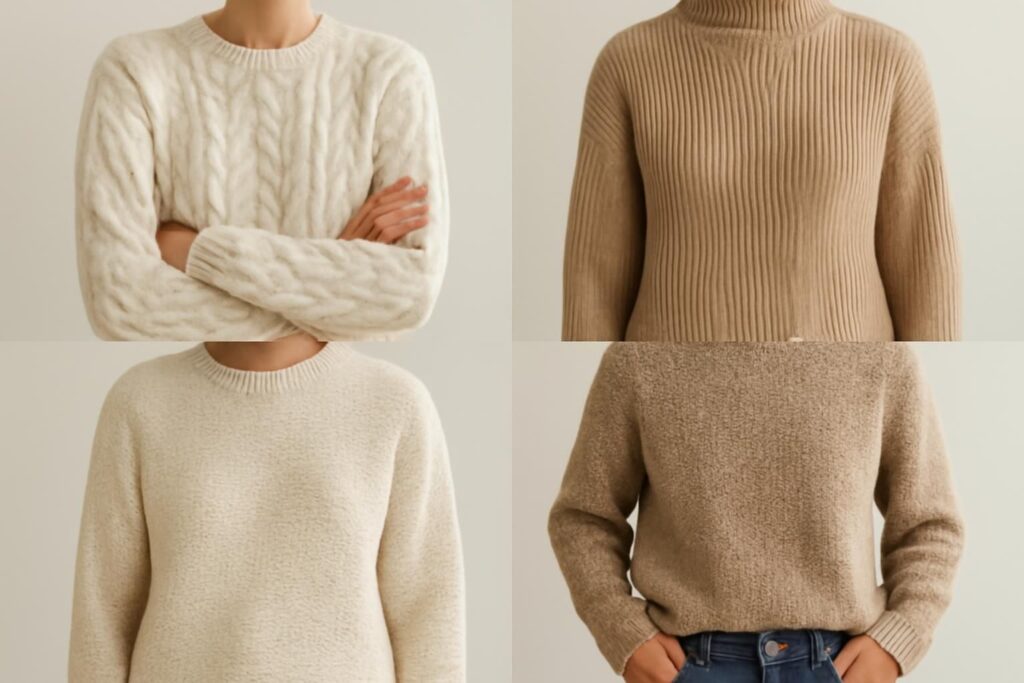
In cable knitting, “textures of crossing layers are achieved by permuting stitches,” and a cable needle holds stitches temporarily while others are knitted, according to Wikipedia. How to spot it: columns that appear to twist over each other like rope, usually raised against a reverse-stockinette background. How it is worn: cable sweaters and cardigans are a cold-weather staple, often chunky and cream or oatmeal. Our Types of Cardigans guide covers cable cardigans by name.
Aran
The Aran jumper is named for the Aran Islands off the west coast of Ireland. According to Wikipedia’s summary, Aran knitting developed only in the 1890s and early 1900s and was popularised in the 1950s–60s, partly by the Clancy Brothers. You may hear that each stitch carries a clan meaning or ancient Celtic symbolism; that story has been debunked, and Wikipedia traces it to Heinz Edgar Kiewe, citing the knitting historians Richard Rutt and Alice Starmore. How to spot it: vertical panels of different cables and textures across the front, traditionally in undyed cream wool.
Gansey
The V&A’s Staithes gansey, a fisherman’s jersey, was worked in the round without side seams, in “vertical panels with alternate cable and double moss stitch.” The museum notes it was close-fitting for warmth and tightly knitted to repel water. How to spot it: a dense, firm knit, often navy, with texture concentrated on the chest and no side seams.
Fair Isle
The V&A says the Prince of Wales popularised the Fair Isle sweater by wearing one as golf attire in 1921. How to spot it: bands of small repeating motifs in several colours. On the inside you will see short strands of the unused colours carried across the back, called floats in common knitting terms. Snagging those floats is the main wear point to check.
How to thrift knitwear
These are common checks, not guarantees:
- Read the fibre label first, since wool, cotton and acrylic each behave differently.
- Stretch the rib at the cuffs and hem and watch whether it springs back.
- Check the underarms and sides for pilling.
- Look for holes along cable crossings and at the elbows.
- Turn Fair Isle pieces inside out and check for snagged floats.
- Hold the sweater up to light to spot moth damage.
Wool needs particular care. Wool-care guides explain that wool fibres are covered in tiny overlapping scales that open and interlock with heat, moisture and agitation, which is why wool felts and shrinks, and that felting is permanent. Follow the care label and our How to Wash a Wool Sweater Without Shrinking It guide. Washing inside out on a gentle, cold cycle and avoiding high-heat drying is commonly recommended to reduce pilling, and our How to Remove Pilling From Clothes (and Stop It Coming Back) guide covers fixes; a Fabric Shaver Sweater on Amazon is the usual tool. Store knits folded rather than hung so the shoulders keep their shape, as shown in How to Fold a Sweater So It Keeps Its Shape.
Top-selling match on Amazon

- Safety System: The Ziitty sweater shaver features a safety lock function — it stops instantly when…
- Best Choice For Gift: This depiller is cordless, lightweight and portable — perfect for traveling or home…
- Packing List: 1 x Lint Remover, 3 x Replacement Blades (one is already installed), 1 x Type-C…
If you want to try making these stitches yourself, a Cable Needle Set on Amazon and some Wool Yarn Worsted on Amazon are enough to practise rib and cables.
Top-selling match on Amazon

- Snag-Free Smooth Aluminum: Experience effortless knitting! Crafted from premium polished aluminum, these cable…
- Ergonomic Grip For Hand Comfort: Designed with the knitter's comfort in mind, the ergonomic bent shape fits naturally…
Shop the look on Amazon
Everything you need to build a secondhand-style wardrobe, delivered. We may earn a commission on purchases.
FAQ
What is the difference between jersey and rib knit?
Jersey (stockinette) shows smooth V-columns on one side and curls at the edges. Rib alternates columns of knit and purl, so it springs back and is often used for snug edges such as cuffs and hems.
Do Aran sweater stitches have clan meanings?
No. That idea has been debunked; Wikipedia traces it to Heinz Edgar Kiewe and dates Aran knitting to the 1890s and early 1900s.
Why does garter stitch lie flat?
Because both faces are the same. Wikipedia notes it has little tendency to curl “due to the symmetry of its faces.”
What is cable knit?
A texture made by crossing groups of stitches over each other, usually with a cable needle, so the columns look like twisted rope. For decoration added on top of a knit, see our Types of Embroidery guide.
Which type of knit sweater is warmest?
Dense, textured wool knits are usually the warmest, such as chunky cable and Aran sweaters or a tightly knitted gansey. Cables and textured panels add thickness that traps warm air, and the gansey’s close fit and tight knit were designed for warmth and to repel water. Fair Isle sweaters gain extra warmth from the strands of yarn carried across the inside. Fine-gauge jersey knits and cotton or acrylic yarns are lighter options.