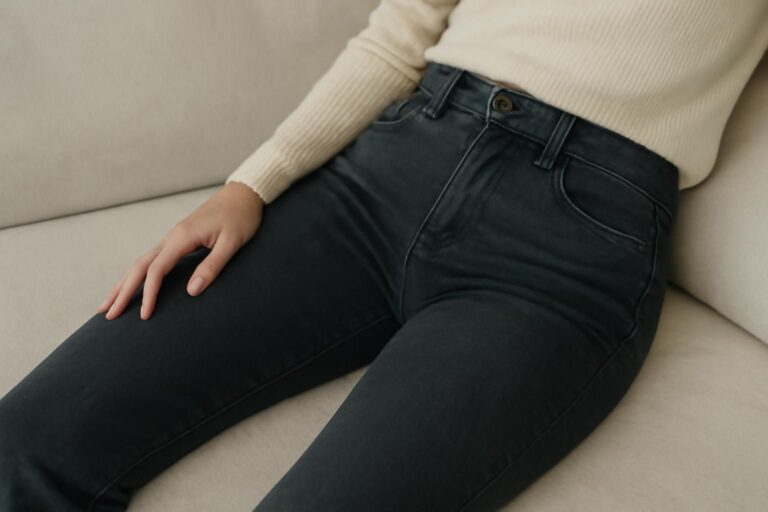
On a hanger they look like the same jean. On the leg they behave nothing alike, and one of them will feel wrong all day if you buy the other by mistake.
The slim vs skinny jeans confusion comes down to one thing brands rarely spell out: how tightly the leg grips. A skinny jean is drafted to sit against the leg like a second skin from hip to ankle. A slim jean narrows the same way but keeps a margin of ease, following the leg without clinging to it. That gap in intent is small on paper and huge in wear, which is why we treat it as a core entry in our Men’s Denim guide. Get slim vs skinny jeans right and the jean either disappears into your day or fights you at every knee bend, and the difference is entirely in the drafting. Below is how to tell them apart before you spend the money.
What slim jeans actually are
A slim jean tapers from the hip down to a narrow-ish ankle but stops short of gripping. The seat and thigh have a trimmed, tailored line with a little room, the knee is close without pinching, and the leg opening is narrow but not cuff-tight. The through-line of a slim fit is ease: it follows the shape of the leg rather than compressing it, which is why a well-cut slim reads as sharp and modern without looking sprayed on. Think of it as a tailored straight leg with the taper turned up, not a skinny with the volume turned down.
Because slim keeps that margin, it works across a much wider range of legs and occasions than skinny does. It sits comfortably under a boot, holds a clean line under a longer coat, and does not require stretch to be wearable, though most modern slims include a touch of it for recovery. Levi’s 511 is the canonical men’s slim and the pair most shoppers benchmark against, which is why we gave it a full Levi’s 511 Slim Fit. The broader category, including where slim sits next to straight and taper, is laid out in the Men’s Slim Fit Jeans.
The important thing about a slim is what it does not do. It does not grip the calf, it does not need to be peeled off, and it does not depend on a high stretch percentage to move with you. A rigid or low-stretch slim is a completely normal, comfortable jean. That is the cleanest structural line between it and a skinny.
What skinny jeans actually are
A skinny jean is fitted skin-tight the entire length of the leg, hip to a very narrow ankle, and it relies on stretch to make that possible. The seat and thigh are compressed against the leg, the knee grips, and the leg opening is small enough that the fabric has to give in order for your foot to get through. A true skinny is a second-skin fit by design: the whole point is that there is no air between the denim and the leg. That is only achievable with meaningful elastane content, which is why almost every real skinny is a high-stretch fabric.
Skinny is the more polarizing cut and the more trend-sensitive one. It dominated menswear and womenswear alike for the better part of a decade, then ceded ground to looser fits, and it has held on hardest in the contexts where a snug ankle is the entire look. Whether it is worth buying now is a live question we track in Are Skinny Jeans Still in Style? A Direct Answer for 2026, and the fit has meaningful variants worth knowing, from the Low Rise Skinny Jeans to versions cut for a fuller hip-to-waist ratio. What unites all of them is grip: a skinny that does not cling is not really a skinny, it is a slim wearing the wrong label.
The one-line difference between slim vs skinny jeans
Here is the sentence to keep: skinny is skin-tight to the ankle, slim keeps ease and is not skin-tight. Both taper, both narrow toward the bottom, but only the skinny grips the leg the whole way down. The slim leaves room.
Everything else people cite as a difference, leg-opening numbers, stretch percentage, how the jean looks in a flat photo, is really just a downstream symptom of that one variable. A jean built to grip needs stretch, needs a smaller opening, and looks tighter in every column of the spec sheet. A jean built to skim can skip the stretch, run a slightly wider opening, and still look tailored. When you are stuck deciding between two pairs, ignore the marketing name and ask the single question that matters: is this drafted to touch the leg all the way down, or to follow it with a little air. That answer is the whole slim vs skinny jeans distinction.
How slim vs skinny jeans compare
| Fit | Rise | Thigh / seat | Knee | Leg opening / hem | Best for | Vibe |
|---|---|---|---|---|---|---|
| Slim | Low to high, all common | Trim with a little ease, no compression | Close, does not pinch | Narrow but not cuff-tight | An everyday tailored leg that works under boots and coats | Sharp, versatile, modern-classic |
| Skinny | Low to high, all common | Skin-tight, compressed against the leg | Grips | Very narrow, needs stretch to pass the foot | A second-skin line and a snug ankle as the look | Bold, tight, statement |
Read the table down the middle and the pattern is clear: every skinny column is one notch tighter than the slim column above it, and all of it traces to the grip-versus-ease decision. The two fits are not points on totally different maps, they are neighbours, which is exactly why they get mixed up. Slim is the roomier neighbour and skinny the tighter one.
Note again that rise does not separate them. You can buy a low, mid, or high-rise version of either fit, and the rise you choose is a coverage and proportion decision that sits on top of the slim-versus-skinny one. Treat them as two independent dials. The wash does not separate them either. A dark slim and a dark skinny can look almost identical in a straight-on photo and feel like different garments the moment you put them on.
The tell: how the fabric behaves
The fastest way to settle slim vs skinny without a fitting room is to watch how the denim behaves against the calf. Pinch the fabric at the mid-calf of a jean you are wearing or holding to the leg. On a slim you can lift a small tent of fabric away from the skin, there is slack to grab. On a skinny there is nothing to pinch, the denim is already flush against the leg and stretched to stay there. That pinch test is more reliable than any label.
In photos, look at the knee and the calf rather than the thigh. A slim shows a faint gap or a soft fold behind the knee and a leg line that skims. A skinny shows the denim molded to the kneecap and calf with visible tension, often with the horizontal stress marks that stretch fabric picks up when it is worn snug. If the jean looks like it was drawn onto the model, it is a skinny. If it looks like a narrow trouser leg, it is a slim.
Rise, and why it barely separates the two
Rise is where the waistband sits, and it is worth understanding because shoppers keep trying to use it to tell slim from skinny. It will not help. Low-rise runs about 7 to 8 inches of front rise and sits on the hips below the navel. Mid-rise runs about 9 to 10 inches and sits just below the navel. High-rise runs roughly 10 to 12 inches and up and sits at or above the natural waist, giving more coverage when you sit and tending to stay put through the day.
Both slim and skinny come in the full rise range, so rise tells you nothing about grip. What rise does change is proportion: a higher rise lengthens the visible leg line above the taper, which can make either fit read leaner and longer. Choose rise for comfort and coverage, choose slim or skinny for grip, and do not let one decision contaminate the other.
The role of stretch
Stretch is where the two fits genuinely diverge on the spec sheet, and it is a useful proxy when you cannot try a pair on. A true skinny almost always carries a meaningful elastane percentage because compression is impossible in rigid denim, you simply could not get the jean on. A slim can go either way: plenty of slims include a small amount of stretch for recovery and comfort, but a rigid or near-rigid slim is a completely normal, wearable jean because it is not asking the fabric to compress anything.
So if you are looking at two pairs and one is rigid or low-stretch, it is far more likely to be a slim regardless of what the tag says, because a rigid skinny is close to a contradiction. High stretch does not guarantee a skinny, some slims run stretchy for comfort, but very low stretch strongly rules a skinny out. Use stretch as supporting evidence, not the verdict.
Which fit is for which goal
Choose slim when you want a tailored leg you stop thinking about. It carries most occasions, dresses up and down without complaint, works under a boot and a longer coat, and does not depend on stretch to feel good. For most people asking the slim vs skinny question for the first time, slim is the answer, it delivers the sharp, modern line they actually want without the commitment of a gripping fit. The taper-forward version, closer to a straight top block with a slim finish, is worth a look in the Levi’s 501 Slim Taper if you want a touch more room through the seat.
Choose skinny when the snug, second-skin line is the point. If you want the ankle tight, the leg fully fitted, and a silhouette that reads deliberately lean, the skinny does something a slim will not. The tradeoffs are real: it depends on stretch, it can feel restrictive through a long day of sitting, and it is the more trend-exposed of the two. Those are acceptable costs when the tight line is what you are after and needless friction when it is not.
As with any fit decision, we would steer clear of framing this around what either cut does for a body. Both are engineering choices. Slim manages the balance between a tailored line and everyday ease; skinny manages the balance between compression and mobility. Pick the one whose job matches the look and the comfort you want, not a promise about your shape.
Slim and skinny across menswear models
Naming the reference pairs helps because the labels drift between brands. In men’s denim the 511 is the standard slim benchmark, trim through the leg with real ease, and it is the pair most people mean when they say a jean fits slim. A skinny in the same lineup, often labeled with a lower number or an explicit “skinny,” runs tighter through the knee and calf and leans on stretch to do it. If you are comparing model numbers within a single brand, our Levi’s 514 vs 501 shows how much a couple of digits can change the block, and the same logic applies when you step down from a slim to a skinny: the fit gets tighter at every point below the hip.
The practical takeaway is to shop the measurement and the fabric, not the marketing name. Two jeans both labeled “slim” from different brands can differ more than a slim and a skinny from the same brand. Find the leg opening, check the stretch content, and apply the pinch test the moment the pair arrives.
How to style each fit
Slim is the low-maintenance styler. It takes a boot, a sneaker, or a loafer without adjustment, breaks cleanly at the ankle, and holds a sharp line under a blazer or an overcoat because the leg is trim without being tight. A slight break or a clean full-length hem both work. It is the jean you can build a smart-casual outfit around without thinking about your shoes first.
Skinny asks for more intent. The tight ankle wants a lower-profile shoe, a boot or a clean sneaker, so the leg-to-shoe transition stays neat, and it pairs best with a top that has some structure or length to balance the very lean bottom half. Because the whole leg is fitted, bulky footwear or a heavy, dropped hem tends to break the line the skinny is built to create. Keep the ankle clean and let the fit be the statement.
Which to buy: the verdict
Buy the slim. For the large majority of people weighing slim vs skinny jeans, the slim delivers the tailored, modern line they are picturing, works across more occasions and shoes, and does not depend on stretch to feel wearable through a full day. It is the safer, more versatile, more comfortable pick, and it is the one you will keep reaching for. A mid-rise slim in a dark, low-contrast rinse is close to a default piece in a men’s rotation.
Buy the skinny only if the second-skin line is specifically what you want, and go in knowing what it demands: stretch, a snug ankle, and a bit more thought about comfort and shoes. It is not a worse jean, it is a more specialized one, and when the tight silhouette is the goal, nothing else substitutes for it. If you are ready to compare pairs, start with Mens Slim Fit Jeans on Amazon and run the pinch and stretch checks above against whatever arrives before you decide the label was telling the truth.
Top-selling match on Amazon

- SLIM FIT. This slim boot cut jean is designed with fashion-forward style. Built with a slim…
- RETRO STYLING. Designed with Retro style in mind, this boot cut jean provides a vintage look…
Shop the look on Amazon
Everything you need to build a secondhand-style wardrobe, delivered. We may earn a commission on purchases.
FAQ
Are slim and skinny jeans the same thing?
No. Both taper toward the ankle, but a skinny grips the leg skin-tight the whole way down and needs stretch to do it, while a slim narrows with a margin of ease and never clings. The quickest test is the pinch: on a slim you can lift a small tent of fabric off the calf, on a skinny there is nothing to grab because the denim is already flush against the leg.
Which is more flattering, slim or skinny jeans?
Neither is universally more flattering, they suit different goals. A slim is the better choice if you want a sharp, versatile everyday leg that works with most shoes and occasions and stays comfortable all day. A skinny is the better choice if a snug, second-skin line is specifically the look you are after. Match the cut to the silhouette and comfort you want rather than to a body type.
How can I tell slim from skinny before buying?
Check the leg opening, the stretch content, and the photo. A slim runs a narrow but not cuff-tight opening and can be low-stretch or even rigid. A skinny runs a very small opening and almost always carries meaningful stretch, because compression is impossible in rigid denim. In photos, a skinny looks molded to the knee and calf with visible tension, a slim looks like a trim trouser leg with a soft skim.
Do slim jeans stretch out like skinny jeans?
Both stretch-blend jeans relax a little through wear and recover after a wash, but a slim depends on stretch far less than a skinny does. Because a slim is drafted with ease built in, a rigid or low-stretch slim stays comfortable without giving out. A skinny leans on its elastane to stay wearable, so it is more likely to feel loose by the end of a long day and snap back after washing.
Are skinny jeans still in style or should I switch to slim?
Looser fits have taken a lot of the spotlight, and slim and straight cuts have absorbed most shoppers moving away from a gripping ankle. Skinny still holds where the tight line is the intended look, so it is not gone, just less of a default. If you want a jean that reads current and low-effort, a slim is the safer buy right now, while a skinny remains the right call when the second-skin fit is the point.