Half the shirts sold as flannel are actually plaid, and half the shirts sold as plaid are not flannel. Sorting that out is the whole job of this guide.
The phrase “plaid shirt” gets used to describe everything from a 4-ounce poplin worn under a blazer to a 10-ounce buffalo-check work shirt that could double as outerwear. They are not the same garment, they do not solve the same problem, and they are not priced anywhere near each other. Before any wallet opens, the pattern conversation needs separating from the fabric conversation. We tracked the category for Tumbleweed Thrift readers across roughly two dozen brands, and the cleanest mental model is the one in our broader Flannel Mens hub. This guide narrows the lens to the plaid shirt specifically, the one most shoppers Google when what they actually want is a checked button-up that holds up after a winter of real wear.
Plaid is a pattern, not a fabric
This is the single most useful distinction in the category, and most retailers blur it on purpose. Plaid is a pattern of crossed horizontal and vertical bands of color forming a check. Flannel is a fabric, brushed cotton or wool with a soft napped surface, originally a Welsh wool textile from the 17th century. A flannel shirt is usually plaid, but it does not have to be. A plaid shirt may or may not be flannel. Plenty of dress shirts in oxford weave, poplin, or twill carry plaid patterns and have nothing in common with the brushed-cotton workwear flannel most people picture. The shirt aisle at any department store mixes both kinds without flagging the difference, which is how shoppers end up disappointed at home.
The practical test is the hand. Run your fingers across the surface. If it feels fuzzy, slightly pilled, soft like a low-pile fleece, that is brushed flannel. If it feels smooth, crisp, almost paper-like, that is a poplin or oxford-weave plaid, the same construction as a standard dress shirt. Both can be plaid. Only one will keep you warm in October. We get into the brushed-cotton specifics in our Flannel Shirts anchor, but the short version is that fabric weight matters more than any other variable for warmth, and the pattern printed on top is largely cosmetic.
Tartan, check, gingham, and the plaid family tree
“Plaid” in American English is a catch-all that covers several pattern families. Tartan is the formal name for the Scottish clan-pattern plaid, with specific named designs (Black Watch, Royal Stewart, Hunting MacLeod) registered to families and regiments. Tartan can be printed on any fabric weight, and the tartan you see on a J.Crew oxford is the same pattern you might see on a Pendleton wool flannel. The fabric changes, the pattern stays.
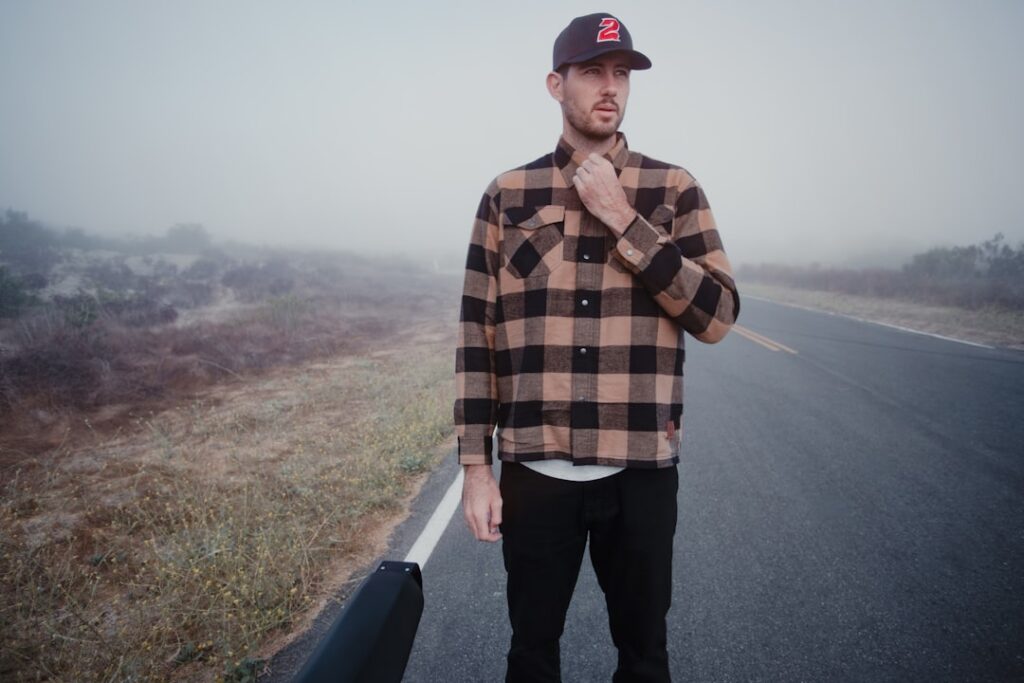
Buffalo plaid is the iconic American workwear pattern, large-scale two-color check, almost always red and black, sometimes black and white or red and white. The pattern dates to the 1850s when Woolrich began producing its Buffalo Check Wool Coat in Chatham Run, Pennsylvania, and the design has been continuously associated with North American outdoor and workwear ever since. L.L.Bean, Filson, and Pendleton all run buffalo-plaid SKUs in their flannel lines.
Gingham is the small-scale two-color check most people associate with summer dress shirts and tablecloths. Gingham technically meets the definition of a check pattern but is rarely called “plaid” in the menswear context, and is almost never woven in flannel weight. Windowpane is a sparser pattern with thin lines forming large open boxes, common on dress shirts and rare on flannels. Madras is a brightly colored Indian-cotton plaid associated with summer prep, lightweight, and never flannel. Tattersall is a fine-line check on a light ground, traditional on country shirts and shooting wear. Knowing these names is not vocabulary trivia, it is how you read a product description and understand what you are actually buying.
When a plaid shirt is a flannel and when it is not
The tipoff is in the fabric weight, the brushing, and usually the price. A plaid shirt that costs $25 from Old Navy or $30 from Uniqlo is most often a 3-to-5-ounce woven cotton, brushed lightly or not at all, sold for the look more than the warmth. A plaid shirt at $55 to $70 from L.L.Bean Scotch Plaid or Eddie Bauer Mountain Flannel is a true mid-weight 6-ounce brushed flannel, the everyday sweet spot. A plaid shirt at $90-plus from Filson, Pendleton, Patagonia, Dixxon, or Orvis sits in the 8-to-10-ounce heavyweight tier, where the fabric drapes structured rather than soft and the garment behaves closer to a light jacket. We get into the heavy end specifically at our Carhartt Flannel write-up and at Dixxon Flannel for the cult brand.
Then there is the dress-shirt plaid. A J.Crew Ludlow plaid in fine cotton, a Brooks Brothers tattersall, a Charles Tyrwhitt windowpane, a Bonobos casual button-up in a plaid weave. These are plaid shirts. They are not flannels. They get worn under sportcoats, with chinos, in offices that allow a soft collar. Confusing them with workwear flannel is how you end up sweating through dinner because someone told you a plaid shirt would be warm.
Buffalo plaid, the pattern that became a category
Buffalo plaid earns its own section because it is the closest thing to a default in this category. Woolrich’s Buffalo Check Wool Coat from the 1850s is the origin point, and the pattern has been continuously produced ever since. The story most often told is that Woolrich designer Jerry Roberts named the pattern after his herd of buffalo, though that detail comes from brand marketing rather than independent record. What is documented is the unbroken production line and the cultural footprint, from logging-camp uniforms in the late 19th century to mid-century outdoor wear to current ironic-rural and lumberjack-aesthetic revivals.
Today the pattern is sold by virtually every flannel brand. L.L.Bean’s Buffalo Plaid Flannel runs around $55-65 in mid-weight cotton. Pendleton’s Buffalo Check Lodge Shirt is a heavier wool flannel near $129. Filson’s Mackinaw Cruiser jacket carries the pattern at the $400-plus heavy-wool tier. Old Navy and Wrangler and Dickies all run cotton-flannel buffalo-plaid SKUs in the $25-45 range. The pattern is identical, the garment around it is not. If you want our color-by-color breakdown across the broader red-flannel category, the Red Flannel Shirt piece walks through it.
The brand spectrum, briefly
A plaid shirt buying decision lives or dies on the brand and weight match. Here is the spectrum we keep coming back to.
L.L.Bean Scotch Plaid Flannel. The default mid-weight reference. Continuously produced since 1922, currently around $60-70, 6-ounce brushed cotton, classic relaxed Maine fit, runs slightly large. Buffalo Plaid Flannel sits at the same tier. The Chamois Cloth Shirt at around $75 is a heavier brushed-cotton variant, flannel-adjacent rather than literal flannel. L.L.Bean’s lifetime quality position has been narrowed in recent years but the shirts still hold up to multiple seasons.
Pendleton Lodge plaids. Wool flannel rather than cotton, made in Oregon on vintage looms, around $129-149. The Lodge Shirt is the iconic medium-weight wool flannel and behaves differently from cotton, warmer, more structured, slower to soften. The Board Shirt at $119 is lighter, the Trail Shirt at $79 is the entry point. Wool flannel is a different garment from cotton flannel and we cover it in detail at Wool Flannel Shirt.
Carhartt plaid flannels. Workwear-mid heavy. The Hubbard Plaid Flannel Shirt at around $35-50 is the most accessible 6-ounce option, the Loose Fit Heavyweight Flannel at $55-70 is closer to 8 ounces, and the Heavyweight Flannel Shirt Jac at $90-100 sits at the 10-ounce border between shirt and jacket. Heavy Amazon distribution. The dedicated Carhartt Plaid Shirt write-up covers SKU-level differences.
J.Crew Heritage Plaid. Heritage Cotton Flannel and Slub Cotton Flannel, both around $89-98. Lighter than workwear weights, prep-tilt fit, frequent 30-40% off promo cycles. These are plaid flannels first and dress shirts second, but the cut is closer to a slim casual button-up than the boxy Carhartt fit.
Old Navy plaid pajamas and shirts. The $20-35 value tier. Built-in Flex Flannel shirts and the holiday-staple plaid pajama pants. The fabric is light, the pattern is the point, and the garment is sized for fashion rather than warmth. Not on Amazon (Gap Inc. retains DTC). We cover the pajama line at Mens Flannel Pajamas.
Wrangler western plaid. Wrangler Authentics Flannel at $25-35, Wrangler Riggs Workwear flannels at $40-55. The western-cut plaid shirt is a slightly different silhouette from the workwear cut, with a sharper yoke, a more tapered waist, and snap buttons rather than buttons on the Western Snap models. Heavy Walmart and Tractor Supply distribution. Useful when the plaid you want is the rodeo-style plaid rather than the lumberjack one.
Dixxon Flannel Co. The Phoenix-founded premium brand, around $90-110, 8.5-9 ounce cotton flannel, double-stitch construction, snap-button closures, elaborate pattern collabs (Snap-On, Harley-Davidson, Misfits, brewing brands). Drops sell out in hours, not on Amazon. Cult ownership in motorcycle and hot-rod culture. The full Dixxon write-up sits at Dixxon Flannel.
Plaid in dress shirts versus plaid in flannel
This is where most shoppers get tripped up. A plaid pattern in a poplin or oxford-weave dress shirt is a different garment with a different role. It tucks cleanly, it takes a tie if needed, the collar holds a point rather than slumping, and the fabric stays cool against the skin. Brooks Brothers, Charles Tyrwhitt, Mizzen+Main, and the prep-tier J.Crew Ludlow all sell plaid dress shirts in this register. Anchor links into the dress-shirt category live at Button Up Shirts for the broader collar discussion.
A plaid in flannel is a casual garment, full stop. The collar is softer, the cut is roomier, the cuffs are usually buttoned but not stiffly, and the fabric is opaque enough to hide an undershirt. It does not tuck cleanly into anything other than rugged pants, and it never takes a tie convincingly. Trying to dress a flannel up the way you would a dress shirt is the most common styling miss in the category. If you need a plaid for a job that involves a blazer, buy a dress-shirt plaid in oxford or poplin. If you need a plaid for a job that involves outdoors, buy a flannel plaid. The crossover middle, where a brushed lightweight plaid meant to bridge the two, mostly fails at both.
Fit, sizing, and the relaxed-cut question
Most workwear flannel plaid shirts run boxy. Carhartt Loose Fit and L.L.Bean Traditional Fit are both cut for layering over base layers, with extra room through the chest and a longer body. If you are slim and want a flannel plaid that does not balloon around the torso, look for Slim Fit or Tailored Fit labeling, or step into Patagonia’s Fjord or J.Crew’s Slim Heritage. Patagonia tags run slightly slim and most reviewers report sizing up if between sizes.
Tall sizes are a real category in flannel because the garment lives or dies on whether the body covers the waist when raising arms. L.L.Bean, Carhartt, and Eddie Bauer all carry tall-cut flannel plaids and we cover the fit logic at Mens Tall Flannel Shirts. Sleeve length is the most common complaint we see in user reviews on standard cuts above six-foot-three. The mens’-casual-shirt category at Mens Casual Shirts runs into the same issue.
Plaid scale, color, and what to actually buy
Pattern scale matters more on plaid than on most patterns because the lines literally redraw the body. Large-scale buffalo plaid (the four-inch check) reads bold and visually shortens, which works on tall builds and flattens shorter ones. Mid-scale plaid (one-to-two-inch repeats) is the safest default, the L.L.Bean Scotch Plaid sits in this range. Small-scale plaid (half-inch or finer) reads almost as a solid from a distance and works on slighter frames or dressier contexts. Tartan repeats run varied, anywhere from two to six inches depending on the pattern.
Color combinations follow weight loosely. Saturated red-and-black buffalo plaid is the workwear default, classic logging-camp aesthetic. Forest greens and navy plaids shift the shirt slightly more outdoor-prep. Earth-tone plaids in browns, rusts, and ochres read more modern and pair more easily with brown leather and tan chinos, which is why we have a separate Brown Flannel piece. Neutrals (gray, charcoal, faded olive) are the most versatile under jackets and behave the closest to a solid in outfit math.
Walking the dog in 40-degree weather, a 6-ounce L.L.Bean Scotch Plaid or a Carhartt Hubbard Plaid covers it. Splitting wood or working outdoors below freezing, an 8-to-10-ounce heavy from Filson, Carhartt Loose Fit Heavyweight, or a Pendleton Lodge wool plaid. A casual office that allows a soft collar, a J.Crew Heritage plaid or a Patagonia Fjord lightweight, both wear closer to a smart casual shirt than the workwear set. A weekend dive bar, anything from Dixxon if you can find one, otherwise a Pendleton Board Shirt or an Orvis Big Bear plaid.
For the grab-and-go everyday-rotation pick, the Carhartt Hubbard Plaid sitting around $35-50 is the unflashy answer. It is the shirt we recommend most often when readers ask for a single plaid shirt that will not embarrass them in any context short of a black-tie event. Carhartt Hubbard Plaid Flannel Shirt Mens on Amazon is the Amazon route. For the slightly heavier upgrade pick, the Carhartt Loose Fit Heavyweight Flannel at $55-70 is the next tier and worth the bump if your climate runs cold. Carhartt Loose Fit Heavyweight Flannel Shirt Mens on Amazon.
Pairing a plaid shirt with the rest of the closet
The default pairing is plaid shirt plus mid-wash or dark-wash jeans, which is so worn-in as a combination that it borders on uniform. Our Men’s Flannel Lined Jeans piece covers the matching denim side. The pairing earns its longevity for a reason: the rough-textured plaid breaks visually against the smooth denim, and the colors of buffalo plaid (red, black, green, navy) sit easily next to indigo. Brown jeans plus an earth-tone plaid is the underused alternative, and pulls the outfit slightly out of the lumberjack register.
A plaid shirt also wears well as the open-over layer above a plain tee. Solid white, gray, or olive crewneck under a buffalo-plaid flannel plus jeans is the workwear-uniform standard. Closed-button plaid plus chinos plus a quilted vest reads more outdoor-prep. Closed-button plaid under a corduroy or canvas chore coat reads more rural-modern. We cover the layered-over-flannel question at Flannel Jacket for the shirt-jacket version specifically. Goodthreads Heavyweight Flannel Plaid Shirt Mens on Amazon is a budget-tier alternative if Carhartt sizing does not match.
Where the plaid shirt category gets oversold
Two honest negatives. First, lightweight plaid shirts under $30 (most fast-fashion plaid, plenty of mall-tier brands) tend to pill at the seams within a season and bleed color in the wash. The pattern is the entire selling point and the fabric does not back it up. If a plaid shirt costs less than a movie ticket, that is the reason. Second, even premium flannel plaid (Filson, Pendleton, Dixxon) does not behave like outerwear regardless of weight. A 10-ounce flannel is still a shirt, it is not waterproof, it is not windproof, and a 30-degree windy day will cut through it. Buying a heavy flannel and expecting jacket performance is the second most common mistake we see in user reviews.
The third quiet failure mode is mistaking polyester-blend plaid (frequent at Old Navy, Target, mass-tier value chains) for cotton flannel. A 65-percent polyester plaid shirt feels close to flannel in the store and behaves nothing like it after a season, holding sweat, fading at the elbows, and developing a glossy worn-look that betrays the synthetic content. Read the fabric tag.
The verdict
A plaid shirt is the most over-shopped, under-understood garment in mens casual, and the single best move a shopper can make is separating the pattern conversation from the fabric conversation before opening any tab. Plaid is a pattern, flannel is a fabric, and the two only sometimes overlap. If the goal is warmth and rough-wear durability, buy a real flannel in a 6-ounce or heavier brushed cotton from L.L.Bean, Carhartt, Eddie Bauer, or Filson, and accept that the pattern is secondary to the weight. If the goal is a casual button-up with personality, buy whatever plaid pleases the eye in oxford or poplin, and stop pretending it is a flannel. Buffalo plaid in mid-weight cotton is still the genre default for a reason, and the L.L.Bean Scotch Plaid plus the Carhartt Hubbard Plaid plus a Pendleton Lodge if the budget allows is the three-shirt rotation that covers most readers for a decade. Avoid the under-$30 polyester-blend plaid shirts entirely. Buy fewer and heavier.
Shop the look on Amazon
Everything you need to build a secondhand-style wardrobe, delivered. We may earn a commission on purchases.
FAQ
Is every plaid shirt a flannel?
No. Plaid is the pattern, flannel is the fabric. Plenty of plaid shirts are woven in oxford, poplin, or twill and have no brushed-flannel surface. The hand test is the easiest way to tell, fuzzy and soft is flannel, smooth and crisp is not.
What is buffalo plaid actually?
Buffalo plaid is the large-scale two-color check, almost always red and black, that originated with Woolrich’s Buffalo Check Wool Coat in the 1850s. It became the default North American workwear pattern and is now sold by virtually every flannel brand at every price tier.
How is tartan different from plaid?
Tartan is a specific type of plaid associated with Scottish clan patterns, registered to families and regiments. American English uses “plaid” as a catch-all that includes tartan, buffalo plaid, windowpane, and other check patterns. All tartans are plaids, not all plaids are tartan.
Can a plaid shirt be worn as a dress shirt?
A poplin or oxford-weave plaid dress shirt absolutely works in business-casual or smart-casual settings. A flannel plaid shirt does not. The collar is too soft, the fabric is too casual, and the cut is too roomy to tuck cleanly under a blazer.
Which plaid shirt holds up the longest?
The Filson Vintage Flannel Work Shirt at the $165-185 tier is built like outerwear and shoppers consistently report multi-decade wear. For mid-tier durability the L.L.Bean Scotch Plaid and Carhartt Loose Fit Heavyweight both clear five-plus years of regular rotation in user reviews. Anything under $30 will not.
How do you identify what type of plaid a shirt has?
The type of plaid on a shirt comes down to the scale of the check, the number of colors and the spacing of the lines. Buffalo plaid is a large two-color check, usually red and black. Gingham is a small, even two-color check. Tartan layers several colors in crossing bands of different widths. Windowpane uses thin lines forming large open boxes, tattersall uses fine lines on a light ground, and madras is a bright, lightweight cotton plaid.
How can you tell if a plaid shirt is woven or printed?
Checking the inside of the shirt is the quickest way to tell a woven plaid from a printed one. In a yarn-dyed woven plaid the colored yarns run through the fabric, so the pattern looks the same on both sides. A printed plaid sits only on the surface and looks faded or blank inside. Woven plaids also keep crisp lines at seams and pockets, while printed patterns tend to fade faster in the wash.